意味 スカラーの表記法
仮にX {\displaystyle X} は体 上のベクトル空間であるK {\displaystyle \mathbb {K} } R {\displaystyle \mathbb {R} } 複素数 C 、 {\displaystyle \mathbb {C} ,} − ∞ ≤ r ≤ ∞ 、 {\displaystyle -\infty \leq r\leq \infty ,} B r = { 1 ∈ K : | 1 | < r } そして B ≤ r = { 1 ∈ K : | 1 | ≤ r } {\displaystyle B_{r}=\{a\in \mathbb {K} :|a|<r\}\quad {\text{ および }}\quad B_{\leq r}=\{a\in \mathbb {K} :|a|\leq r\}} は、それぞれ半径 r の開球 (閉球 ) を表す。r {\displaystyle r} K {\displaystyle \mathbb {K} } 0. {\displaystyle 0.} K ⊆ K {\displaystyle K\subseteq \mathbb {K} } A {\displaystyle A} K A = { k 1 : k ∈ K 、 1 ∈ A } 、 {\displaystyle KA=\{ka:k\in K,a\in A\},} K ⊆ K {\displaystyle K\subseteq \mathbb {K} } x {\displaystyle x} K x = { k x : k ∈ K } 。 {\displaystyle Kx=\{kx:k\in K\}。}
予備 バランスの取れたコアとバランスの取れた船体
サブセットS {\displaystyle S} X {\displaystyle X} バランスが取れている 1 s ∈ S {\displaystyle as\in S} s ∈ S {\displaystyle s\in S} 1 {\displaystyle a} | 1 | ≤ 1 ; {\displaystyle |a|\leq 1;} B ≤ 1 S ⊆ S 、 {\displaystyle B_{\leq 1}S\subseteq S,} B ≤ 1 S = S 。 {\displaystyle B_{\leq 1}S=S.}
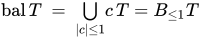
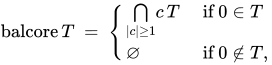
集合が与えられたT 、 {\displaystyle T,} セット T 、 {\displaystyle T,} ボール T 、 {\displaystyle \operatorname {bal} T,} 船体 T {\displaystyle T} T 、 {\displaystyle T,} バルコア T 、 {\displaystyle \operatorname {balcore} T,} 取れたコア T 。 {\displaystyle T.} ボール T = ⋃ | c | ≤ 1 c T = B ≤ 1 T {\displaystyle \operatorname {bal} T~=~{\textstyle \bigcup \limits _{|c|\leq 1}}c\,T=B_{\leq 1}T} バルコア T = { ⋂ | c | ≥ 1 c T もし 0 ∈ T ∅ もし 0 ∉ T 、 {\displaystyle \operatorname {balcore} T~=~{\begin{cases}{\textstyle \bigcap \limits _{|c|\geq 1}}c\,T&{\text{ if }}0\in T\\\varnothing &{\text{ if }}0\not \in T,\\\end{cases}}} T {\displaystyle T} T = ボール T {\displaystyle T=\operatorname {bal} T} T = バルコア T {\displaystyle T=\operatorname {balcore} T} T = ボール T = バルコア T 。 {\displaystyle T=\operatorname {bal} T=\operatorname {balcore} T.}
もしc {\displaystyle c} ボール ( c T ) = c ボール T = | c | ボール T {\displaystyle \operatorname {bal} (c\,T)=c\,\operatorname {bal} T=|c|\,\operatorname {bal} T} c ≠ 0 {\displaystyle c\neq 0} 0 ∈ T {\displaystyle 0\in T} バルコア ( c T ) = c バルコア T = | c | バルコア T 。 {\displaystyle \operatorname {balcore} (c\,T)=c\,\operatorname {balcore} T=|c|\,\operatorname {balcore} T.}
あるセットが別のセットを吸収する もしS {\displaystyle S} A {\displaystyle A} X 、 {\displaystyle X,} A {\displaystyle A} 吸収する S {\displaystyle S}
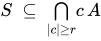
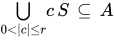
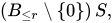
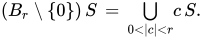
定義 :現実が存在するr > 0 {\displaystyle r>0} S ⊆ c A {\displaystyle S\,\subseteq \,c\,A} c {\displaystyle c} | c | ≥ r 。 {\displaystyle |c|\geq r.} S ⊆ ⋂ | c | ≥ r c A {\displaystyle S\;\subseteq \;{\textstyle \bigcap \limits _{|c|\geq r}}c\,A} r > 0. {\displaystyle r>0.} スカラー場がR {\displaystyle \mathbb {R} } A {\displaystyle A} S {\displaystyle S} A {\displaystyle A} t A {\displaystyle tA} t → ∞ {\displaystyle t\to \infty } 最終的には (すべての正の値に対して)t > 0 {\displaystyle t>0} t A {\displaystyle tA} S ; {\displaystyle S;} t A {\displaystyle tA} S {\displaystyle S} t < 0 {\displaystyle t<0} この定義は、基礎となるスカラー場の正準ノルム(つまり、絶対値)に依存します。 | ⋅ | {\displaystyle |\cdot |} ユークリッド位相と結びついています。結果として、 吸収集合 の定義(下記参照)もこの位相と結びついています。 現実が存在するr > 0 {\displaystyle r>0} c S ⊆ A {\displaystyle c\,S\,\subseteq \,A} [ 注1 ] c ≠ 0 {\displaystyle c\neq 0} | c | ≤ r 。 {\displaystyle |c|\leq r.} ⋃ 0 < | c | ≤ r c S ⊆ A {\displaystyle {\textstyle \bigcup \limits _{0<|c|\leq r}}c\,S\,\subseteq \,A} r > 0. {\displaystyle r>0.} この結合は等しいので( B ≤ r ∖ { 0 } ) S 、 {\displaystyle \left(B_{\leq r}\setminus \{0\}\right)S,} B ≤ r ∖ { 0 } = { c ∈ K : 0 < | c | ≤ r } {\displaystyle B_{\leq r}\setminus \{0\}=\{c\in \mathbb {K} :0<|c|\leq r\}} ( B ≤ r ∖ { 0 } ) S ⊆ A {\displaystyle \left(B_{\leq r}\setminus \{0\}\right)S\,\subseteq \,A} r > 0. {\displaystyle r>0.} 非厳密な不等式≤ {\displaystyle \,\leq \,} < 、 {\displaystyle \,<\,,} 現実が存在するr > 0 {\displaystyle r>0} c S ⊆ A {\displaystyle c\,S\,\subseteq \,A} [ 注1 ] c ≠ 0 {\displaystyle c\neq 0} | c | < r 。 {\displaystyle |c|<r.} ( B r ∖ { 0 } ) S ⊆ A {\displaystyle \left(B_{r}\setminus \{0\}\right)S\subseteq \,A} r > 0. {\displaystyle r>0.} ここB r ∖ { 0 } = { c ∈ K : 0 < | c | < r } {\displaystyle B_{r}\setminus \{0\}=\{c\in \mathbb {K} :0<|c|<r\}} ( B r ∖ { 0 } ) S = ⋃ 0 < | c | < r c S 。 {\displaystyle \left(B_{r}\setminus \{0\}\right)S\,=\,{\textstyle \bigcup \limits _{0<|c|<r}}c\,S.} もしA {\displaystyle A} がバランスの取れたセット である場合、このリストは以下のように拡張できます。
ゼロでないスカラーが存在するc ≠ 0 {\displaystyle c\neq 0} S ⊆ c A 。 {\displaystyle S\;\subseteq \,c\,A.} もし0 ∈ A {\displaystyle 0\in A} c ≠ 0 {\displaystyle c\neq 0} ゼロでないスカラーが存在する[ 注1 ] c ≠ 0 {\displaystyle c\neq 0} c S ⊆ A 。 {\displaystyle c\,S\,\subseteq \,A.} もし0 ∈ A {\displaystyle 0\in A} A {\displaystyle A} 吸収集合 である、または位相における原点の近傍である)場合、このリストは以下のように拡張できます。
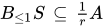
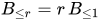
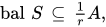
存在するr > 0 {\displaystyle r>0} c S ⊆ A {\displaystyle c\,S\;\subseteq \,A} c {\displaystyle c} | c | < r 。 {\displaystyle |c|<r.} B r S ⊆ A 。 {\displaystyle B_{r}\;S\,\subseteq \,A.} 存在するr > 0 {\displaystyle r>0} c S ⊆ A {\displaystyle c\,S\;\subseteq \,A} c {\displaystyle c} | c | ≤ r 。 {\displaystyle |c|\leq r.} B ≤ r S ⊆ A 。 {\displaystyle B_{\leq r}S\,\subseteq \,A.} 包含B ≤ r S ⊆ A {\displaystyle B_{\leq r}S\,\subseteq \,A} B ≤ 1 S ⊆ 1 r A {\displaystyle B_{\leq 1}S\,\subseteq \,{\tfrac {1}{r}}A} B ≤ r = r B ≤ 1 {\displaystyle B_{\leq r}=r\,B_{\leq 1}} B ≤ 1 S = ボール S 、 {\displaystyle B_{\leq 1}S\,=\,\operatorname {bal} \,S,} ボール S ⊆ 1 r A 、 {\displaystyle \operatorname {bal} \,S\,\subseteq \,{\tfrac {1}{r}}A,} 存在するr > 0 {\displaystyle r>0} ボール S ⊆ r A 。 {\displaystyle \operatorname {bal} \,S\,\subseteq \,r\,A.} 存在するr > 0 {\displaystyle r>0} ボール S ⊆ バルコア ( r A ) 。 {\displaystyle \operatorname {bal} \,S\,\subseteq \,\operatorname {balcore} (r\,A).} 存在するr > 0 {\displaystyle r>0} S ⊆ バルコア ( r A ) 。 {\displaystyle \;\;\;\;\;\;S\,\subseteq \,\operatorname {balcore} (r\,A).} 次の特徴付けは、上記の特徴付けと、すべてのスカラーに対してc 、 {\displaystyle c,} バランス の取れた船体A {\displaystyle A} ボール ( c A ) = c ボール A = | c | ボール A {\displaystyle \,\operatorname {bal} (c\,A)=c\,\operatorname {bal} A=|c|\,\operatorname {bal} A\,} 0 ∈ A {\displaystyle 0\in A} バランスの取れたコア が満足バルコア ( c A ) = c バルコア A = | c | バルコア A 。 {\displaystyle \,\operatorname {balcore} (c\,A)=c\,\operatorname {balcore} A=|c|\,\operatorname {balcore} A.} 存在するr > 0 {\displaystyle r>0} S ⊆ r バルコア A 。 {\displaystyle \;\;\,S\,\subseteq \,r\,\operatorname {balcore} A.} A {\displaystyle A} それが、バランス のとれたコアの正のスカラー倍に含まれている場合A 。 {\displaystyle A.} 存在するr > 0 {\displaystyle r>0} r S ⊆ バルコア A 。 {\displaystyle r\,S\subseteq \,\;\;\;\;\operatorname {balcore} A.} ゼロでないスカラーが存在する[ 注1 ] c ≠ 0 {\displaystyle c\neq 0} c S ⊆ バルコア A 。 {\displaystyle c\,S\,\subseteq \,\operatorname {balcore} A.} 取れた核心は A {\displaystyle A} S 。 {\displaystyle S.} スカラーが存在するc {\displaystyle c} ボール S ⊆ c A 。 {\displaystyle \operatorname {bal} S\,\subseteq \,c\,A.} A {\displaystyle A} 船体 を含むようにスケールできますS 。 {\displaystyle S.} スカラーが存在するc {\displaystyle c} ボール S ⊆ バルコア ( c A ) 。 {\displaystyle \operatorname {bal} S\,\subseteq \,\operatorname {balcore} (c\,A).} スカラーが存在するc {\displaystyle c} S ⊆ バルコア ( c A ) 。 {\displaystyle \;\;\;\;\;\;S\,\subseteq \,\operatorname {balcore} (c\,A).} A {\displaystyle A} コア がS 。 {\displaystyle S.} スカラーが存在するc {\displaystyle c} S ⊆ c バルコア A 。 {\displaystyle \;\;\;\;\;\;S\,\subseteq \,c\,\operatorname {balcore} A.} スカラーが存在するc {\displaystyle c} ボール S ⊆ c バルコア ( A ) 。 {\displaystyle \operatorname {bal} S\,\subseteq \,c\,\operatorname {balcore} (A).} 取れた核心は A {\displaystyle A} 船体 を含むようにスケールできますS 。 {\displaystyle S.} バランスの取れたコアA {\displaystyle A} S {\displaystyle S} もし0 ∉ S {\displaystyle 0\not \in S} 0 ∈ A {\displaystyle 0\in A}
A ∪ { 0 } {\displaystyle A\cup \{0\}} S {\displaystyle S} 言い換えると、A {\displaystyle A} A ∪ { 0 } {\displaystyle A\cup \{0\}} 0 ∉ S {\displaystyle 0\not \in S} 0 ∈ A {\displaystyle 0\in A} 点を吸収する集合
セットはポイントを吸収する x {\displaystyle x} シングルトンセット を吸収する場合{ x } 。 {\displaystyle \{x\}.} A {\displaystyle A} 0 ∈ A 。 {\displaystyle 0\in A.} 吸収性があると言われています。X {\displaystyle X} もしそれがすべてのポイントを吸収するならばX 。 {\displaystyle X.}
ある集合が別の集合を吸収するというこの概念は、他の定義でも用いられています。位相ベクトル空間 の部分集合X {\displaystyle X} 有界である 吸収性であると呼ばれる。
最初の例
すべての集合は空集合を吸収するが、空集合は空でない集合を吸収しない。単一要素集合{ 0 } {\displaystyle \{\mathbf {0} \}}
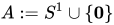
仮にX {\displaystyle X} R 2 {\displaystyle \mathbb {R} ^{2}} C 。 {\displaystyle \mathbb {C} .} A := S 1 ∪ { 0 } {\displaystyle A:=S^{1}\cup \{\mathbf {0} \}} は単位円 (原点を中心とする)です0 {\displaystyle \mathbf {0} } { 0 } {\displaystyle \{\mathbf {0} \}} A {\displaystyle A} 存在 しない。 X {\displaystyle X} S 1 。 {\displaystyle S^{1}.} 近傍 は 、X {\displaystyle X}
吸収セット サブセットA {\displaystyle A} X {\displaystyle X} K {\displaystyle \mathbb {K} } 吸収性 (または性 ) サブセット X {\displaystyle X} 吸収する X {\displaystyle X}
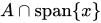
意味 :A {\displaystyle A} を吸収する X ; {\displaystyle X;} x ∈ X 、 {\displaystyle x\in X,} A {\displaystyle A} 吸収する { x } 。 {\displaystyle \{x\}.} 特に、A {\displaystyle A} 0 ∉ A 。 {\displaystyle 0\not \in A.} A {\displaystyle A} X 。 {\displaystyle X.} すべてのx ∈ X 、 {\displaystyle x\in X,} r > 0 {\displaystyle r>0} x ∈ c A {\displaystyle x\in cA} c ∈ K {\displaystyle c\in \mathbb {K} } | c | ≥ r 。 {\displaystyle |c|\geq r.} すべてのx ∈ X 、 {\displaystyle x\in X,} r > 0 {\displaystyle r>0} c x ∈ A {\displaystyle cx\in A} c ∈ K {\displaystyle c\in \mathbb {K} } | c | ≤ r 。 {\displaystyle |c|\leq r.} すべてのx ∈ X 、 {\displaystyle x\in X,} r > 0 {\displaystyle r>0} B r x ⊆ A 。 {\displaystyle B_{r}x\subseteq A.} ここB r = { c ∈ K : | c | < r } {\displaystyle B_{r}=\{c\in \mathbb {K} :|c|<r\}} r {\displaystyle r} B r x = { c x : c ∈ B r } = { c x : c ∈ K そして | c | < r } 。 {\displaystyle B_{r}x=\left\{cx:c\in B_{r}\right\}=\{cx:c\in \mathbb {K} {\text{ and }}|c|<r\}.} 閉じたボールは、開いたボールの代わりに使用できます。 なぜならB r x ⊆ K x = スパン { x } 、 {\displaystyle B_{r}x\subseteq \mathbb {K} x=\operatorname {span} \{x\},} B r x ⊆ A {\displaystyle B_{r}x\subseteq A} B r x ⊆ A ∩ K x 。 {\displaystyle B_{r}x\subseteq A\cap \mathbb {K} x.} すべてのx ∈ X 、 {\displaystyle x\in X,} r > 0 {\displaystyle r>0} B r x ⊆ A ∩ K x 、 {\displaystyle B_{r}x\subseteq A\cap \mathbb {K} x,} K x = スパン { x } 。 {\displaystyle \mathbb {K} x=\operatorname {span} \{x\}.} トポロジーへの接続 : もしK x {\displaystyle \mathbb {K} x} に通常のハウスドルフユークリッド位相 を与えると、集合はB r x {\displaystyle B_{r}x} 、 K x ; {\displaystyle \mathbb {K} x;} r > 0 {\displaystyle r>0} B r x ⊆ A ∩ K x {\displaystyle B_{r}x\subseteq A\cap \mathbb {K} x} A ∩ K x {\displaystyle A\cap \mathbb {K} x} K x 。 {\displaystyle \mathbb {K} x.} A {\displaystyle A} x ∈ X 、 {\displaystyle x\in X,} A ∩ スパン { x } {\displaystyle A\cap \operatorname {span} \{x\}} 0 {\displaystyle 0} スパン { x } = K x {\displaystyle \operatorname {span} \{x\}=\mathbb {K} x} スパン { x } {\displaystyle \operatorname {span} \{x\}} 1次元ベクトル空間上の唯一のTVS位相[ 注2 ] 自明位相 とハウスドルフユークリッド位相である。X {\displaystyle X} K x = スパン { x } {\displaystyle \mathbb {K} x=\operatorname {span} \{x\}} ゼロでない いくつかのx ∈ X {\displaystyle x\in X} K x {\displaystyle \mathbb {K} x} ハウスドルフベクトル位相 K → K x {\displaystyle \mathbb {K} \to \mathbb {K} x} c ↦ c x {\displaystyle c\mapsto cx} は必然的にTVS 同型写像 である(通常、K {\displaystyle \mathbb {K} } は、ユークリッド計量 によって誘導される標準的なユークリッド位相 を備えている。 A {\displaystyle A} Y {\displaystyle Y} X 、 {\displaystyle X,} A ∩ Y {\displaystyle A\cap Y} Y {\displaystyle Y} Y {\displaystyle Y} its unique Hausdorff vector topology (i.e. the Euclidean topology ). The reason why the Euclidean topology is distinguished in this characterization ultimately stems from the defining requirement on TVS topologies[ note 2] K × X → X {\displaystyle \mathbb {K} \times X\to X} K {\displaystyle \mathbb {K} } 0 {\displaystyle 0} topological vector space (TVS) is necessarily absorbing: If U {\displaystyle U} X {\displaystyle X} Y , {\displaystyle Y,} U ∩ Y {\displaystyle U\cap Y} Y {\displaystyle Y} Y {\displaystyle Y} subspace topology induced on it by X . {\displaystyle X.} [ note 2] Y {\displaystyle Y} the Hausdorff Euclidean topology and the trivial topology , which is a subset of the Euclidean topology. So regardless of which of these vector topologies is on Y , {\displaystyle Y,} U ∩ Y {\displaystyle U\cap Y} Y {\displaystyle Y} [ note 3] U {\displaystyle U} A {\displaystyle A} Y {\displaystyle Y} X , {\displaystyle X,} A ∩ Y {\displaystyle A\cap Y} Y {\displaystyle Y} This characterization shows that the property of being absorbing in X {\displaystyle X} only on how A {\displaystyle A} X . {\displaystyle X.} Z {\displaystyle Z} X {\displaystyle X} n > 1 {\displaystyle n>1} A ∩ Z {\displaystyle A\cap Z} Z {\displaystyle Z} A ∩ Z {\displaystyle A\cap Z} Z {\displaystyle Z} A ∩ Z {\displaystyle A\cap Z} closed in Z {\displaystyle Z} barrel Z {\displaystyle Z} Z , {\displaystyle Z,} barrelled space ). If K = R {\displaystyle \mathbb {K} =\mathbb {R} }
The algebraic interior of A {\displaystyle A} 0 ∈ i A {\displaystyle 0\in {}^{i}A} If A {\displaystyle A} balanced then to this list can be appended:
For every x ∈ X , {\displaystyle x\in X,} c ≠ 0 {\displaystyle c\neq 0} x ∈ c A {\displaystyle x\in cA} c x ∈ A {\displaystyle cx\in A} For every x ∈ X , {\displaystyle x\in X,} c {\displaystyle c} x ∈ c A . {\displaystyle x\in cA.} If A {\displaystyle A} convex or balanced then to this list can be appended:
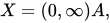
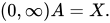
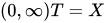
For every x ∈ X , {\displaystyle x\in X,} r > 0 {\displaystyle r>0} r x ∈ A . {\displaystyle rx\in A.} バランスの取れた A {\displaystyle A} X {\displaystyle X} c A = | c | A {\displaystyle cA=|c|A} c ≠ 0 {\displaystyle c\neq 0} r := | c | > 0 {\displaystyle r:=|c|>0} 凸 A {\displaystyle A} X {\displaystyle X} [ 証明1 ] 証明の要約 : 仮定により、任意 の非ゼロに対して0 ≠ y ∈ X 、 {\displaystyle 0\neq y\in X,} r > 0 {\displaystyle r>0} R > 0 {\displaystyle R>0} R y ∈ A {\displaystyle Ry\in A} r ( − y ) ∈ A {\displaystyle r(-y)\in A} A ∩ R y {\displaystyle A\cap \mathbb {R} y} ( − r 、 R ) y = 定義 { t y : − r < t < R 、 t ∈ R } 、 {\displaystyle (-r,R)y\,{\stackrel {\scriptscriptstyle {\text{def}}}{=}}\,\{ty:-r<t<R,t\in \mathbb {R} \},} A ∩ R y {\displaystyle A\cap \mathbb {R} y} 区間 と呼ばれます。R y {\displaystyle \mathbb {R} y} R {\displaystyle \mathbb {R} } R {\displaystyle \mathbb {R} } K y {\displaystyle \mathbb {K} y} その独自のハウスドルフベクトル位相構造 を示す必要がある。A ∩ K y {\displaystyle A\cap \mathbb {K} y} K y 。 {\displaystyle \mathbb {K} y.} K = R {\displaystyle \mathbb {K} =\mathbb {R} } K = C 。 {\displaystyle \mathbb {K} =\mathbb {C} .} S = 定義 ( A ∩ R y ) ∪ ( A ∩ R ( 私 y ) ) ⊆ A ∩ ( C y ) {\displaystyle S\,{\stackrel {\scriptscriptstyle {\text{def}}}{=}}\,(A\cap \mathbb {R} y)\,\cup \,(A\cap \mathbb {R} (iy))\,\subseteq \,A\cap (\mathbb {C} y)} 四角形 凸包はS 、 {\displaystyle S,} A ∩ C y 、 {\displaystyle A\cap \mathbb {C} y,} ◼ {\displaystyle \blacksquare } すべてのx ∈ X 、 {\displaystyle x\in X,} r > 0 {\displaystyle r>0} x ∈ r A 。 {\displaystyle x\in rA.} この条件は以下と同等です: すべてのx ∈ X {\displaystyle x\in X} ⋃ 0 < r < ∞ r A = { r 1 : 0 < r < ∞ 、 1 ∈ A } = ( 0 、 ∞ ) A 。 {\displaystyle {\textstyle \bigcup \limits _{0<r<\infty }}rA=\{ra:0<r<\infty ,a\in A\}=(0,\infty )A.} X = ( 0 、 ∞ ) A 、 {\displaystyle X=(0,\infty )A,} ( 0 、 ∞ ) A = X 。 {\displaystyle (0,\infty )A=X.} 任意の部分集合に対して、T {\displaystyle T} X 、 {\displaystyle X,} ( 0 、 ∞ ) T = X {\displaystyle (0,\infty )T=X} T ∩ ( 0 、 ∞ ) x ≠ ∅ {\displaystyle T\cap (0,\infty )x\neq \varnothing } x ∈ X 、 {\displaystyle x\in X,} ( 0 、 ∞ ) x = 定義 { r x : 0 < r < ∞ } 。 {\displaystyle (0,\infty )x\,{\stackrel {\scriptscriptstyle {\text{def}}}{=}}\,\{rx:0<r<\infty \}.} すべてのx ∈ X 、 {\displaystyle x\in X,} A ∩ ( 0 、 ∞ ) x ≠ ∅ 。 {\displaystyle A\cap (0,\infty )x\neq \varnothing .} もし0 ∈ A {\displaystyle 0\in A} A {\displaystyle A} x ∈ X 、 {\displaystyle x\in X,} x ∈ X 。 {\displaystyle x\in X.}
例と十分条件
セットが魅力的であるためには 任意のノルムベクトル空間 (または半ノルムベクトル空間 )の単位球 は吸収性を持つ。より一般的には、X {\displaystyle X} が位相ベクトル空間 (TVS) である場合、原点の任意の近傍はX {\displaystyle X} X 。 {\displaystyle X.} X 。 {\displaystyle X.}
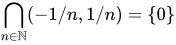
吸収集合のすべてのスーパーセットは吸収集合です。したがって、(1 つ以上の)吸収集合の任意の族の和集合は吸収集合です。有限個の吸収部分集合の共通部分は、再び吸収部分集合になります。ただし、開球は( − r n 、 − r n ) {\displaystyle (-r_{n},-r_{n})} r n = 1 、 1 / 2 、 1 / 3 、 … {\displaystyle r_{n}=1,1/2,1/3,\ldots } X := R {\displaystyle X:=\mathbb {R} } ⋂ n ∈ N ( − 1 / n 、 1 / n ) = { 0 } {\displaystyle \bigcap _{n\in \mathbb {N} }(-1/n,1/n)=\{0\}}
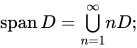
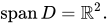
もしD ≠ ∅ {\displaystyle D\neq \varnothing } 円盤 (凸でバランスの取れた部分集合)である場合スパン D = ⋃ n = 1 ∞ n D ; {\displaystyle \operatorname {span} D={\textstyle \bigcup \limits _{n=1}^{\infty }}nD;} D ≠ ∅ {\displaystyle D\neq \varnothing } スパン D 。 {\displaystyle \operatorname {span} D.} D {\displaystyle D} X 、 {\displaystyle X,} D {\displaystyle D} X {\displaystyle X} スパン D = X 。 {\displaystyle \operatorname {span} D=X.} D ≠ ∅ {\displaystyle D\neq \varnothing } D {\displaystyle D} x {\displaystyle x} y {\displaystyle y} X = R 2 {\displaystyle X=\mathbb {R} ^{2}} スパン D = R 2 。 {\displaystyle \operatorname {span} D=\mathbb {R} ^{2}.}
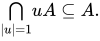
全射線形作用素による吸収集合の像は再び吸収集合となる。線形作用素による吸収部分集合(終域)の逆像は再び吸収集合となる(終域において)。A {\displaystyle A} 吸収すると、対称セット についても同じことが言える⋂ | u | = 1 u A ⊆ A 。 {\displaystyle {\textstyle \bigcap \limits _{|u|=1}}uA\subseteq A.}
補助的な基準空間
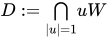
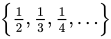
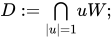
もしW {\displaystyle W} 凸型 で吸収型X {\displaystyle X} 対称セット D := ⋂ | u | = 1 u W {\displaystyle D:={\textstyle \bigcap \limits _{|u|=1}}uW} バランスが取れている( 絶対凸集合 ディスク X 。 {\displaystyle X.} ミンコフスキー関数が p D : X → R {\displaystyle p_{D}:X\to \mathbb {R} } D {\displaystyle D} セミノーマル になるX 、 {\displaystyle X,} ( X 、 p D ) {\displaystyle \left(X,p_{D}\right)} 正準擬似計量 位相を持つ半ノルム空間 へ。スカラー倍の集合r D {\displaystyle rD} r {\displaystyle r} { 1 2 、 1 3 、 1 4 、 … } {\displaystyle \left\{{\tfrac {1}{2}},{\tfrac {1}{3}},{\tfrac {1}{4}},\ldots \right\}} 0 {\displaystyle 0} 局所凸 トポロジーの原点における吸収ディスクの 近傍基底 を形成します。X {\displaystyle X} は位相ベクトル空間 であり、この凸吸収部分集合がW {\displaystyle W} 有界部分集合 でもある。X 、 {\displaystyle X,} D := ⋂ | u | = 1 u W ; {\displaystyle D:={\textstyle \bigcap \limits _{|u|=1}}uW;} D {\displaystyle D} p D {\displaystyle p_{D}} 標準 となり、( X 、 p D ) {\displaystyle \left(X,p_{D}\right)} 補助ノルム空間 と呼ばれるものを形成する。 このノルム空間がバナッハ空間 である場合、D {\displaystyle D} これはバナッハ円盤




























































































































![{\displaystyle [(-d,d)x]\cup [(-d,d)ix],}](https://wikimedia.org/api/rest_v1/media/math/render/svg/a44106d6782899bbe836f6e6d07bffa9fe625b17)





