位相的内部の一般化
数学の一分野である関数解析 において 、 ベクトル空間 の部分集合の 代数的内部 または 放射状核は、 内部 の概念を洗練させたものである 。
意味 がベクトル空間の部分集合である と仮定する。 に対する の 代数 的内部
( または 放射状核 )は、 が 放射状集合 である におけるすべての点の集合である 。点は の 内部点 [2] と呼ばれ 、 任意の に対して となる実数が存在するとき、 において 放射状 で ある と 言われる
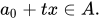
。この最後の条件は と書くこともできる。 ここで、集合
は から始まり で 終わる
線分(または閉区間)であり、
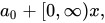
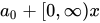
この線分は の部分集合であり、 その部分集合は から の方向 (つまり、 に平行/ の並進)に 発する 光線 である。したがって幾何学的には、部分集合の内部点 と は、あらゆる可能な方向(ベクトル)において から始まりその方向に向かう(非退化)線分 (つまり、光線 の部分集合)を含むという性質を持つ点である。 ( に関して) の代数的内部は、そのようなすべての点の集合である。つまり、それは に関してそれが 集合の 放射状 点である、与えられた集合に含まれる点の部分集合である。 [3]
あ
{\displaystyle A}
バツ 。
{\displaystyle X.}
あ
{\displaystyle A}
バツ
{\displaystyle X}
あ
{\displaystyle A}
1つの
0
∈ あ
{\displaystyle a_{0}\in A}
あ
{\displaystyle A}
あ
{\displaystyle A}
1つの
0
{\displaystyle a_{0}}
x ∈ バツ
{\displaystyle x\in X}
t
x
> 0
{\displaystyle t_{x}>0}
t ∈ [ 0 、
t
x
] 、
{\displaystyle t\in [0,t_{x}],}
1つの
0
+ t x ∈ あ 。
{\displaystyle a_{0}+tx\in A.}
1つの
0
+ [ 0 、
t
x
] x ⊆ あ
{\displaystyle a_{0}+[0,t_{x}]x\subseteq A}
1つの
0
+ [ 0 、
t
x
] x
:=
{
1つの
0
+ t x : t ∈ [ 0 、
t
x
]
}
{\displaystyle a_{0}+[0,t_{x}]x~:=~\left\{a_{0}+tx:t\in [0,t_{x}]\right\}}
1つの
0
{\displaystyle a_{0}}
1つの
0
+
t
x
x ;
{\displaystyle a_{0}+t_{x}x;}
1つの
0
+ [ 0 、 ∞ ) x 、
{\displaystyle a_{0}+[0,\infty )x,}
1つの
0
{\displaystyle a_{0}}
x
{\displaystyle x}
[ 0 、 ∞ ) x
{\displaystyle [0,\infty )x}
あ
{\displaystyle A}
1つの
0
∈ あ
{\displaystyle a_{0}\in A}
x ≠ 0 、
{\displaystyle x\neq 0,}
あ
{\displaystyle A}
1つの
0
{\displaystyle a_{0}}
1つの
0
+ [ 0 、 ∞ ) x
{\displaystyle a_{0}+[0,\infty )x}
あ
{\displaystyle A}
バツ
{\displaystyle X}
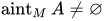
が の線型部分空間である 場合 、この定義は に対する の 代数的内部 に一般化できます 。
では 常に成り立ち、 の場合、 は の アフィン包 です (これは に等しい )。
ま
{\displaystyle M}
バツ
{\displaystyle X}
あ ⊆ バツ
{\displaystyle A\subseteq X}
あ
{\displaystyle A}
ま
{\displaystyle M}
ない
ま
あ :=
{
1つの ∈ バツ :
全ての
メートル ∈ ま 、
いくつか存在する
t
メートル
> 0
そのような
1つの +
[
0 、
t
メートル
]
⋅ メートル ⊆ あ
}
。
{\displaystyle \operatorname {aint} _{M}A:=\left\{a\in X:{\text{ すべての }}m\in M に対して、{\text{ }}t_{m}>0{\text{ が存在し、 }}a+\left[0,t_{m}\right]\cdot m\subseteq A\right\} となります。}
ない
ま
あ ⊆ あ
{\displaystyle \operatorname {aint} _{M}A\subseteq A}
ない
ま
あ ≠ ∅
{\displaystyle \operatorname {aint} _{M}A\neq \varnothing }
ま ⊆ 賛成 ( あ − あ ) 、
{\displaystyle M\subseteq \operatorname {aff} (AA),}
賛成 ( あ − あ )
{\displaystyle \operatorname {aff} (AA)}
あ − あ
{\displaystyle AA}
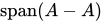
スパン ( あ − あ )
{\displaystyle \operatorname {span} (AA)}
代数的閉包
ポイント は
x ∈ バツ
{\displaystyle x\in X}
部分集合から 線形アクセス可能 であるとは、線分 に含まれる ものが存在すること を意味する の に関する
的 閉包 され 、 内のすべての点は から線形アクセス可能である
あ ⊆ バツ
{\displaystyle A\subseteq X}
1つの ∈ あ
{\displaystyle a\in A}
[ 1つの 、 x ) := 1つの + [ 0 、 1 ) x
{\displaystyle [a,x):=a+[0,1)x}
あ 。
{\displaystyle A.}
あ
{\displaystyle A}
バツ
{\displaystyle X}
ACL
バツ
あ 、
{\displaystyle \operatorname {acl} _{X}A,}
あ
{\displaystyle A}
バツ
{\displaystyle X}
あ 。
{\displaystyle A.}
代数的内部(コア) 集合 が
ま := バツ 、
{\displaystyle M:=X,}
ない
バツ
あ
{\displaystyle \operatorname {aint} _{X}A}
代数的内部 または の 核
あ
{\displaystyle A}
であり、または で表されます
。形式的には、が ベクトル空間である場合、の代数的内部は [ 6]
あ
私
{\displaystyle A^{i}}
コア あ 。
{\displaystyle \operatorname {core} A.}
バツ
{\displaystyle X}
あ ⊆ バツ
{\displaystyle A\subseteq X}
ない
バツ
あ := コア ( あ ) :=
{
1つの ∈ あ :
全ての
x ∈ バツ 、
いくつか存在する
t
x
> 0 、
全ての
t ∈
[
0 、
t
x
]
、 1つの + t x ∈ あ
}
。
{\displaystyle \operatorname {aint} _{X}A:=\operatorname {core} (A):=\left\{a\in A:{\text{ すべての }}x\in X に対して、{\text{ }}t_{x}>0,{\text{ が存在し、すべての }}t\in \left[0,t_{x}\right],a+tx\in A\right\} に対して成り立ちます。}
が空でない場合、これらの追加の部分集合は、凸関数解析における多くの定理( ウルシェスクの定理 など )の記述にも役立ちます。
あ
{\displaystyle A}
私 c
あ :=
{
私
あ
もし
賛成 あ
は閉集合であり、
∅
さもないと
{\displaystyle {}^{ic}A:={\begin{cases}{}^{i}A&{\text{ if }}\operatorname {aff} A{\text{ is a closed set,}}\\varnothing &{\text{ else}}\end{cases}}}
私 b
あ :=
{
私
あ
もし
スパン ( あ − 1つの )
は、
バツ
誰にとっても
1つの ∈ あ
、
∅
さもないと
{\displaystyle {}^{ib}A:={\begin{cases}{}^{i}A&{\text{ if }}\operatorname {span} (A-a){\text{ is a barrelled linear subspace of }}X{\text{ for any/all }}a\in A{\text{,}}\\\varnothing &{\text{ otherwise}}\end{cases}}}
が フレシェ空間 、 が凸、 が 閉じている 場合 、となりますが、一般に が空で ない 間に となることが可能です 。
X
{\displaystyle X}
A
{\displaystyle A}
aff
A
{\displaystyle \operatorname {aff} A}
X
{\displaystyle X}
i
c
A
=
i
b
A
{\displaystyle {}^{ic}A={}^{ib}A}
i
c
A
=
∅
{\displaystyle {}^{ic}A=\varnothing }
i
b
A
{\displaystyle {}^{ib}A}
例 もし 、 しかし 、そして
A
=
{
x
∈
R
2
:
x
2
≥
x
1
2
or
x
2
≤
0
}
⊆
R
2
{\displaystyle A=\{x\in \mathbb {R} ^{2}:x_{2}\geq x_{1}^{2}{\text{ or }}x_{2}\leq 0\}\subseteq \mathbb {R} ^{2}}
0
∈
core
(
A
)
,
{\displaystyle 0\in \operatorname {core} (A),}
0
∉
int
(
A
)
{\displaystyle 0\not \in \operatorname {int} (A)}
0
∉
core
(
core
(
A
)
)
.
{\displaystyle 0\not \in \operatorname {core} (\operatorname {core} (A)).}
コアの特性 仮定する
A
,
B
⊆
X
.
{\displaystyle A,B\subseteq X.}
一般に、が 凸集合 である 場合は 、次のようになります。
core
A
≠
core
(
core
A
)
.
{\displaystyle \operatorname {core} A\neq \operatorname {core} (\operatorname {core} A).}
A
{\displaystyle A}
core
A
=
core
(
core
A
)
,
{\displaystyle \operatorname {core} A=\operatorname {core} (\operatorname {core} A),}
そして その時 みんなのために
x
0
∈
core
A
,
y
∈
A
,
0
<
λ
≤
1
{\displaystyle x_{0}\in \operatorname {core} A,y\in A,0<\lambda \leq 1}
λ
x
0
+
(
1
−
λ
)
y
∈
core
A
.
{\displaystyle \lambda x_{0}+(1-\lambda )y\in \operatorname {core} A.}
A
{\displaystyle A}
が 実ベクトル空間の 吸収部分集合となるのは、 [3]
0
∈
core
(
A
)
.
{\displaystyle 0\in \operatorname {core} (A).}
A
+
core
B
⊆
core
(
A
+
B
)
{\displaystyle A+\operatorname {core} B\subseteq \operatorname {core} (A+B)}
A
+
core
B
=
core
(
A
+
B
)
{\displaystyle A+\operatorname {core} B=\operatorname {core} (A+B)}
もし
B
=
core
B
.
{\displaystyle B=\operatorname {core} B.}
凸集合の核と代数的閉包は両方とも凸である。 が凸である
場合 、 線分は に含まれる。
C
{\displaystyle C}
c
∈
core
C
,
{\displaystyle c\in \operatorname {core} C,}
b
∈
acl
X
C
{\displaystyle b\in \operatorname {acl} _{X}C}
[
c
,
b
)
:=
c
+
[
0
,
1
)
b
{\displaystyle [c,b):=c+[0,1)b}
core
C
.
{\displaystyle \operatorname {core} C.}
位相的内部との関係 を位相ベクトル空間 とし 、 内部演算子を表すと、次のように なります 。
X
{\displaystyle X}
int
{\displaystyle \operatorname {int} }
A
⊆
X
{\displaystyle A\subseteq X}
int
A
⊆
core
A
{\displaystyle \operatorname {int} A\subseteq \operatorname {core} A}
が凸で 有限次元である 場合、
A
{\displaystyle A}
X
{\displaystyle X}
int
A
=
core
A
.
{\displaystyle \operatorname {int} A=\operatorname {core} A.}
が凸で内部が空でない 場合、 [8]
A
{\displaystyle A}
int
A
=
core
A
.
{\displaystyle \operatorname {int} A=\operatorname {core} A.}
が閉凸集合であり、が 完備距離空間 である 場合 、 [9]
A
{\displaystyle A}
X
{\displaystyle X}
int
A
=
core
A
.
{\displaystyle \operatorname {int} A=\operatorname {core} A.}
相対代数内部 のとき 、集合は で表され、 の相対代数的内部 と呼ばれます。 この名前は、 のときかつその場合に限り、 であり、 である という事実に由来しています ( ただし のときかつその場合に限ります )。
M
=
aff
(
A
−
A
)
{\displaystyle M=\operatorname {aff} (A-A)}
aint
M
A
{\displaystyle \operatorname {aint} _{M}A}
i
A
:=
aint
aff
(
A
−
A
)
A
{\displaystyle {}^{i}A:=\operatorname {aint} _{\operatorname {aff} (A-A)}A}
A
.
{\displaystyle A.}
a
∈
A
i
{\displaystyle a\in A^{i}}
aff
A
=
X
{\displaystyle \operatorname {aff} A=X}
a
∈
i
A
{\displaystyle a\in {}^{i}A}
aff
A
=
X
{\displaystyle \operatorname {aff} A=X}
aff
(
A
−
A
)
=
X
{\displaystyle \operatorname {aff} (A-A)=X}
相対的な内部 が位相ベクトル空間のサブセットである 場合 、 の 相対内部は セットです。
つまり、 は の 最小のアフィン線型部分空間を 含むA の位相内部です 。次のセットも便利です。
A
{\displaystyle A}
X
{\displaystyle X}
A
{\displaystyle A}
rint
A
:=
int
aff
A
A
.
{\displaystyle \operatorname {rint} A:=\operatorname {int} _{\operatorname {aff} A}A.}
aff
A
,
{\displaystyle \operatorname {aff} A,}
X
{\displaystyle X}
A
.
{\displaystyle A.}
ri
A
:=
{
rint
A
if
aff
A
is a closed subspace of
X
,
∅
otherwise
{\displaystyle \operatorname {ri} A:={\begin{cases}\operatorname {rint} A&{\text{ if }}\operatorname {aff} A{\text{ is a closed subspace of }}X{\text{,}}\\\varnothing &{\text{ otherwise}}\end{cases}}}
準相対内部 が位相ベクトル空間の部分集合である 場合 、 の 準相対内部 は集合
A
{\displaystyle A}
X
{\displaystyle X}
A
{\displaystyle A}
qri
A
:=
{
a
∈
A
:
cone
¯
(
A
−
a
)
is a linear subspace of
X
}
.
{\displaystyle \operatorname {qri} A:=\left\{a\in A:{\overline {\operatorname {cone} }}(A-a){\text{ is a linear subspace of }}X\right\}.}
ハウスドルフ 有限次元位相ベクトル空間 において、
qri
A
=
i
A
=
i
c
A
=
i
b
A
.
{\displaystyle \operatorname {qri} A={}^{i}A={}^{ic}A={}^{ib}A.}
参照
参考文献
^ John Cook (1988年5月21日). 「線形位相空間における凸集合の分離」 (PDF) . 2012年 11月14日 閲覧 。 ^ ab ヤシュケ、ステファン;クヒラー、ウーヴェ (2000)。 「一貫したリスク尺度、評価限界、および ( μ , ρ {\displaystyle \mu ,\rho } )-ポートフォリオの最適化」 (PDF) 。 ^ Nikolaĭ Kapitonovich Nikolʹskiĭ (1992). 関数解析 I: 線型関数解析 . Springer. ISBN 978-3-540-50584-6 。 ^カントロヴィッツ 、 シュムエル(2003年)。 現代分析入門 。 オックスフォード大学出版局 。p.134。ISBN 9780198526568 。 ^ ボナンズ、J. フレデリック、シャピロ、アレクサンダー (2000)、「最適化問題の摂動分析」、Springer オペレーションズ リサーチ シリーズ、Springer、注釈 2.73、p. 56、 ISBN 9780387987057 。
文献 Aliprantis, Charalambos D. ; Border, Kim C. (2006). 無限次元解析: ヒッチハイクガイド (第 3 版). ベルリン: Springer Science & Business Media. ISBN 978-3-540-29587-7 . OCLC 262692874. ナリシ、ローレンス; ベッケンシュタイン、エドワード (2011)。 位相ベクトル空間 。純粋数学と応用数学 (第 2 版)。ボカラトン、フロリダ州: CRC プレス 。ISBN 978-1584888666 . OCLC 144216834. Schaefer, Helmut H. ; Wolff, Manfred P. (1999). Topological Vector Spaces . GTM . Vol. 8 (第 2 版). ニューヨーク、NY: Springer New York Imprint Springer. ISBN 978-1-4612-7155-0 . OCLC 840278135. シェクター、エリック (1996)。 分析とその基礎ハンドブック 。サンディエゴ、カリフォルニア州:アカデミックプレス 。ISBN 978-0-12-622760-4 . OCLC 175294365. Zălinescu, Constantin (2002 年 7 月 30 日)。 一般ベクトル空間における凸解析 。 リバーエッジ、ニュージャージー、ロンドン: World Scientific Publishing。ISBN 978-981-4488-15-0 . MR 1921556. OCLC 285163112 – インターネットアーカイブ 経由。



![{\displaystyle t\in [0,t_{x}],}](https://wikimedia.org/api/rest_v1/media/math/render/svg/16747de8b50f297e31f0faf306bcf29f99e1c6de)
![{\displaystyle a_{0}+[0,t_{x}]x\subseteq A}](https://wikimedia.org/api/rest_v1/media/math/render/svg/7d323d0ede0d16ed6bc6a2f9ed7d85d98f74ceec)
![{\displaystyle a_{0}+[0,t_{x}]x~:=~\left\{a_{0}+tx:t\in [0,t_{x}]\right\}}](https://wikimedia.org/api/rest_v1/media/math/render/svg/358073de6ecb8ba88644038fc85a7285175a7939)





![{\displaystyle \operatorname {aint} _{M}A:=\left\{a\in X:{\text{ すべての }}m\in M に対して、{\text{ }}t_{m}>0{\text{ が存在し、 }}a+\left[0,t_{m}\right]\cdot m\subseteq A\right\} となります。}](https://wikimedia.org/api/rest_v1/media/math/render/svg/be7d7d28ade91c5aa4bd325442fb718c38360cc6)








![{\displaystyle \operatorname {aint} _{X}A:=\operatorname {core} (A):=\left\{a\in A:{\text{ すべての }}x\in X に対して、{\text{ }}t_{x}>0,{\text{ が存在し、すべての }}t\in \left[0,t_{x}\right],a+tx\in A\right\} に対して成り立ちます。}](https://wikimedia.org/api/rest_v1/media/math/render/svg/1f0b62d222e43648babc5681d1080467daae7f1d)

































