
Loading article…

音楽において、「スウィング」という用語には主に2つの用法があります。口語的には、リズムの推進力や「感覚」を表すのに用いられ、特に音楽が足踏みや頭を揺らすといった本能的な反応を引き起こす場合に使われます(脈動を参照)。この感覚は「グルーヴ」とも呼ばれます。
スウィングフィール、スウィングノート、スウィングリズムといった用語は、より具体的には、1拍の2つのパートのパルス分割における最初と2番目の連続する音符を交互に長くしたり短くしたりするテクニック(ジャズ[ 1 ] [2]に最もよく関連付けられているが、他のジャンルでも使用されている)を指すためにも使用される。
ファンクやロックの文脈でまとまりのあるリズミカルな「フィーリング」を表現するのに使われる「グルーヴ」という言葉と同様に、「スウィング」という概念も定義するのが難しい場合があります。実際、辞書によってはこれらの用語を同義語として使用しています。「グルーヴィー…は、本当にスウィングする音楽を意味します。」 [ 3 ]『ジャズ・イン・アメリカ』の用語集では、スウィングを「個々の演奏者またはアンサンブルが、聴く人に本能的な反応(足をトントンと叩いたり、頭をうなずかせたりする)を引き起こすほどリズミカルに協調した演奏をすること。言葉による定義では表現しきれない、抗いがたい引力のような浮遊感」と定義しています。[ 2 ]
ジャズパフォーマーのクーティー・ウィリアムズにその定義を尋ねたところ、彼は「定義する?それならアインシュタインの理論に取り組む方がましだ!」と冗談を言った。 [ 4 ]
Benny Goodman, the 1930s-era bandleader nicknamed the "King of Swing", called swing "free speech in music", whose most important element is "the liberty a soloist has to stand and play a chorus in the way he feels it". His contemporary Tommy Dorsey gave a more ambiguous definition when he proposed that "Swing is sweet and hot at the same time and broad enough in its creative conception to meet every challenge tomorrow may present."[4]Boogie-woogie pianist Maurice Rocco argues that the definition of swing "is just a matter of personal opinion".[4] When asked for a definition of swing, Fats Waller replied, "Lady, if you gotta ask, you'll never know."[5]
Bill Treadwell stated:
What is Swing? Perhaps the best answer, after all, was supplied by the hep-cat who rolled her eyes, stared into the far-off and sighed, "You can feel it, but you just can't explain it. Do you dig me?"
—Treadwell (1946), p.10[6]
Stanley Dance, in The World of Swing, devoted the two first chapters of his work to discussions of the concept of swing with a collection of the musicians who played it. They described a kinetic quality to the music. It was compared to flying; "take off" was a signal to start a solo. The rhythmic pulse continued between the beats, expressed in dynamics, articulation, and inflection. Swing was as much in the music anticipating the beat, like the swing of a jumprope anticipating the jump, as in the beat itself.[5] Swing has been defined in terms of formal rhythmic devices, but according to the Jimmie Lunceford tune, "T'aint whatcha do, it's the way thatcha do it" (say it so it swings). Physicists investigating swing have noted that it coincides with a perceptible difference between the timing of a soloist and the rest of the performers.[1]

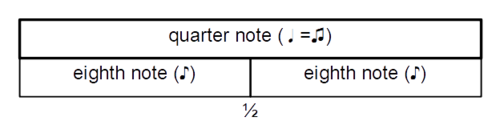
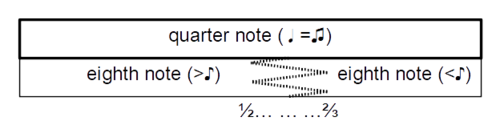
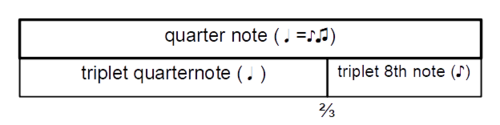
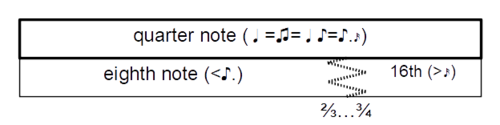
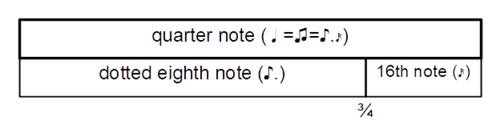
スウィングのリズムでは、拍子が不均等に分割され、特定の細分(通常は8分音符または16分音符の細分)が長い時間と短い時間を交互に繰り返す。バロック時代や古典派時代の音楽の中には、スウィングに類似したnotes inégalesを使用して演奏されるものがある。シャッフルのリズムでは、ペアの最初の音符の長さが2番目の音符の長さの2倍(またはそれ以上)になることがある。スウィングのリズムでは、最初の音符の長さと2番目の音符の長さの比率は、次の範囲に及ぶ。各ペアの最初の音符は、2番目の音符の2倍の長さであると理解されることが多く、3連符のような感覚を暗示しているが、実際には比率はそれほど明確ではなく、多くの場合、はるかに微妙である。[ 8 ]伝統的なジャズでは、スウィングは通常8分音符に適用される。ファンクやジャズロックなどの他のジャンルでは、スウィングは16分音符に適用されることが多い。[ 9 ] [ 10 ]



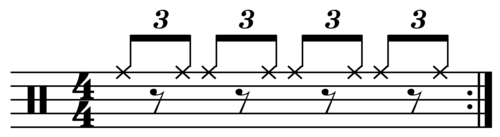
ジャズ音楽、特にビッグバンド時代以降のジャズでは、 4 /4拍子の小節の2拍目と4拍目が1拍目と3拍目よりも強調され、これらの拍は導入部と主拍の対句(ダ・ダム、ダ・ダム…)となります。「ダ」は「ダム」を予期するか、あるいは導入します。「ダ」の導入部は聞こえる場合も聞こえない場合もあります。フレーズや強弱をつけるために、時折アクセントが付けられることもあります。
スウィングのリズムセクションを構成する楽器は、音楽の発展とともに様々な方法でスウィング感を表現してきた。スウィング音楽の初期には、ベースはしばしば導入音(主音の二連符)を伴って演奏され、しばしば打楽器的な響きを伴っていた。その後、導入音は省略されたが、ベース奏者の身体的なリズムに組み込まれ、ビートを「しっかりとした」状態に保つようになった。導入音は聞こえなかったが、奏者の動きによって表現されたのである。
同様に、リズムギターは、演奏者が導入のビートをかき鳴らすように演奏されたが、ほとんど聞こえないほど、あるいは全く聞こえないほど小さな音だった。
ピアノは、スウィング感を出すために様々な手法で演奏された。付点8分音符と16分音符の連符のリズムで演奏されるコードパターンは、ブギウギ演奏の特徴であり(ブギウギのホーンセクション演奏でも使われることがある)、ジェームス・P・ジョンソン、ファッツ・ウォーラー、アール・ハインズらが用いた「スウィングベース」と呼ばれる左手の奏法では、1拍目と3拍目にベース音を置き、続いて中音域のコードで2拍目と4拍目を強調した。ベースと同様に、導入音は音として聞こえず、左腕の動きで表現された。
スウィングピアノでは、2拍子のベースフレーズにおいて、1拍目と3拍目を、強調される2拍目と4拍目を先取りする役割に置いた。[ 13 ]
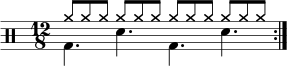
スウィング・タイムの曲は、テンポが遅く、1小節に12拍という珍しい拍子記号( 4/4拍子ではなく12/8拍子、つまり4連符を含む複合拍子)で書かれている場合があります。12/ 8拍子は、ハーモニー豊かなドゥーワップと組み合わせたり、1955年のスタンダード曲「アンチェインド・メロディ」のようなバラードで使用したりすることができます。「アンチェインド・メロディ」は、スウィング・タイムのリズムを持つ曲の中でも、歴史上最も有名な曲の1つです。
スウィング音楽が発展するにつれて、アンサンブルにおけるピアノの役割はアクセントやフィルを強調するように変化しました。これらはしばしばメインビートの導入部で演奏され、リズムにパンチを加えました。 カウント・ベイシーのスタイルは簡素で、ホーンセクションやソリストの伴奏として演奏されました。[ 14 ]
スウィング時代は、ベースドラムとスネアドラムが主要なリズムキーパーとして始まり、スネアは通常、導入部として、または2拍目と4拍目を強調するために使われました。その後すぐに、ハイハットシンバルがドラムセットのスウィングに新たな次元を加えることができることが分かりました。ハイハットシンバルは、「ti-tshhh-SH」という2拍子のパターンで演奏され、「ti」は1拍目と3拍目の「tshhh」への導入部、そして「SH」は強調された2拍目と4拍目を表します。
With that high-hat figure, the drummer expressed three elements of swing: the lead-in with the "ti," the continuity of the rhythmic pulse between the beats with the "tshhh," and the emphasis on the second and fourth beats with the "SH". Early examples of that high-hat figure were recorded by the drummer Chick Webb. Jo Jones carried the high-hat style a step further, with a more continuous-sounding "t'shahhh-uhh" two beat figure while reserving the bass and snare drums for accents. The changed role of the drum kit away from the heavier style of the earlier drumming placed more emphasis on the role of the bass in holding the rhythm.[14]
Horn sections and soloists added inflection and dynamics to the rhythmic toolbox, "swinging" notes and phrases. One of the characteristic horn section sounds of swing jazz was a section chord played with a strong attack, a slight fade, and a quick accent at the end, expressing the rhythmic pulse between beats. That device was used interchangeably or in combination with a slight downward slur between the beginning and the end of the note.
Similarly, section arrangements sometimes used a series of triplets, either accented on the first and third notes or with every other note accented to make a 3/2 pattern. Straight eighth notes were commonly used in solos, with dynamics and articulation used to express phrasing and swing. Phrasing dynamics built swing across two or four measures or, in the innovative style of tenor saxophonist Lester Young, across odd sequences of measures, sometimes starting or stopping without regard to place in the measure.[14]
The rhythmic devices of the swing era became subtler with bebop. Bud Powell and other piano players influenced by him mostly did away with left-hand rhythmic figures, replacing them with chords. The ride cymbal played in a "ting-ti-ting" pattern took the role of the high-hat, the snare drum was mainly used for lead-in accents, and the bass drum was mainly used for occasional "bombs." But the importance of the lead-in as a rhythmic device was still respected. Drummer Max Roach emphasized the importance of the lead-in, audible or not, in "protecting the beat."[15] Bebop soloists rose to the challenge of keeping a swinging feel in highly sophisticated music often played at a breakneck pace. The groundbreakers of bebop had come of age as musicians with swing and, while breaking the barriers of the swing era, still reflected their swing heritage.[14]
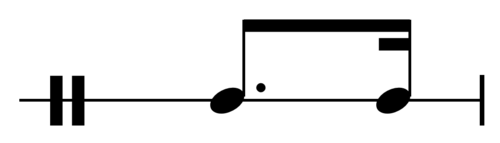
より微妙な範囲では、隣接する8分音符(またはスイングのレベルに応じて16分音符)のペアを、わずかに非対称な類似値のペアとして扱います。スペクトルのもう一方の端にある「付点8分音符-16分音符」のリズムは、短い音符の3倍の長さの長い音符で構成されます。20世紀半ばのダンスバンドのリズムセクションでよく見られるこのような「付点リズム」は、より正確には「シャッフル」と表現されます。 [ 16 ]これらはバロックダンスや他の多くのスタイルの重要な特徴でもあります。
ジャズでは、スイング比は通常1:1から3:1の間であり、かなり変化する可能性があります。ジャズのスイング比は、テンポが遅いほど広く、テンポが速いほど狭くなる傾向があります。[ 17 ]ジャズの楽譜では、スイングはしばしば想定されていますが、明示的に示されることもあります。たとえば、スウィング時代のジャズスタンダードである「サテン・ドール」は4/4拍子で記譜されており、一部のバージョンでは「ミディアムスイング」という指示が含まれています。
スウィングは、スウィングジャズ、ラグタイム、ブルース、ブギウギ、ジャズ、ウェスタンスウィング[ 18 ] 、ニュージャックスウィング[ 19 ] 、ビッグバンドジャズ、シティポップ、ファンク、ヒップホップ、R&B、ロックンロール、ロカビリー、スウィングリバイバル、ソウルミュージックでよく使われます。ジャズの多くの楽曲は、スウィングリズムで演奏されることを前提としています。常に伝統的な(三連符)リズムを使用し、「ハードスウィング」に似たスタイルには、フォックストロット、クイックステップ、その他のボールルームダンス、ストライドピアノ、1920年代のノベルティピアノ(ラグタイムスタイルの後継)などがあります。中東では、イラク、クルド、アゼルバイジャン、イラン、アッシリアのダンス音楽の一部で、シャッフルに非常によく似たリズムが使われています。[ 20 ]