A pet rat clearly showing the grid-like arrangement of the macrovibrissae on the face, and the microvibrissae under the nostrils. The supraorbital vibrissae above the right eye are also visible.
The mystacial whiskers can be roughly identified as macrovibrissae (long whiskers for feeling the space around the head) and microvibrissae (small, down-pointing whiskers for identifying objects).[13] Not only are these two types hard to distinguish on an animal's face (see for example the image of a rat here), there are similarly weak distinctions in how they are used, though the distinction is nonetheless referred to ubiquitously in scientific literature and is considered useful in analysis.
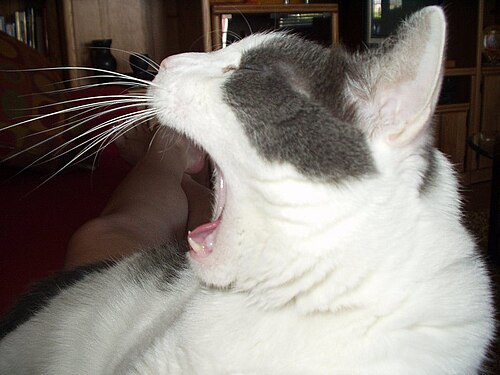
Many land mammals, including domestic cats, also have vibrissae on the underside of the leg just above the paws (called carpal vibrissae).[14] Whilst these five major groups are often reported in studies of land mammals, several other groups have been reported more occasionally; for instance nasal, angular, and submental whiskers.[15]
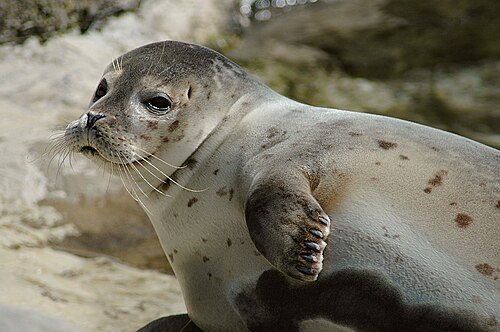
All the hairs of the manatee may be vibrissae.Macrovibrissae and supraorbital vibrissae of the common harbor seal (Phoca vitulina)
Marine mammals can have substantially different arrangements of their vibrissae. For instance, whales and dolphins have lost their snout whiskers and gained vibrissae around their blowholes,[16] whereas every single one of the body hairs of the Florida manatee may be a vibrissa (see image).[17] Other marine mammals, like seals and sea-lions, have head vibrissae just like those on land mammals (see image), although these groups function quite differently.
Vibrissal follicles have evolved other functions in dolphins, such as electroreception.
Some birds possess specialized hair-like feathers called rictal bristles around the base of the beak which are sometimes referred to as whiskers.
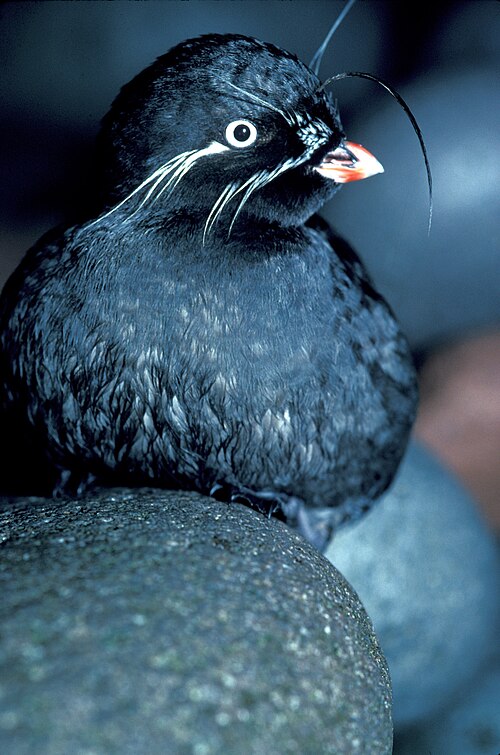
The whiskered auklet (Aethia pygmaea) has striking, stiff white feathers protruding from above and below the eyes of the otherwise slate-grey bird, and a dark plume which swoops forward from the top of its head. Whiskered auklets sent through a maze of tunnels with their feathers taped back bumped their heads more than twice as often as they did when their feathers were free, indicating they use their feathers in a similar way to cats.[60]
Some fish have slender, pendulous tactile organs near the mouth. These are often referred to as "whiskers", although they are more correctly termed barbels. Fish that have barbels include the catfish, carp, goatfish, hagfish, sturgeon, zebrafish and some species of shark.
The Pimelodidae are a family of catfishes (order Siluriformes) commonly known as the long-whiskered catfishes.
In pterosaurs
Anurognathid pterosaurs had a rugose (wrinkled) jaw texture that has been interpreted as the attachment sites for vibrissae,[61] though actual vibrissae have not been recorded.[62] More recently, a specific type of feathers has been found around anurognathid mouths.[63]
1 2 Rice, Frank L.; Mance, Ajuan; Munger, Bryce L. (1986 年 10 月 8 日). "口ひげパッドの感覚神経支配の比較光顕微鏡分析。I. ヒゲ毛包洞複合体の神経支配". The Journal of Comparative Neurology . 252 (2): 154– 174. doi : 10.1002/cne.902520203 . PMID 3782505 . S2CID 8228091 .
1 2 3 Ebara, Satomi; Kumamoto, Kenzo; Matsuura, Tadao; Mazurkiewicz, Joseph E.; Rice, Frank L. (2002年7月22日). "ラットとネコの口ひげ毛包洞複合体の神経支配の類似点と相違点:共焦点顕微鏡による研究". The Journal of Comparative Neurology . 449 (2): 103– 119. doi : 10.1002/cne.10277 . PMID 12115682 . S2CID 6428629 .
↑ Halata, Z.; Baumann, KI; Grim, M. (2008-01-01). "6.02 – メルケル細胞" . Masland, Richard H.; Albright, Thomas D.; Albright, Thomas D.; Masland, Richard H. (編). The Senses: A Comprehensive Reference . New York: Academic Press. pp. 33– 38. doi : 10.1016/b978-012370880-9.00341-8 . ISBN978-0-12-370880-92020年12月9日に取得。
↑Stuttgen, M. C.; Rüter, J.; Schwarz, C. (July 26, 2006). "Two Psychophysical Channels of Whisker Deflection in Rats Align with Two Neuronal Classes of Primary Afferents". The Journal of Neuroscience. 26 (30): 7933–7941. doi:10.1523/JNEUROSCI.1864-06.2006. PMC6674210. PMID16870738.
↑Starostin, E. L.; etal. (15 January 2020). "The Euler spiral of rat whiskers". Science Advances. 6 (3) eaax5145. Bibcode:2020SciA....6.5145S. doi:10.1126/sciadv.aax5145. PMC6962041. PMID31998835.
↑Marshall, CD; Amin, H.; Kovacs, K. M.; Lydersen, C. (January 2006). "Microstructure and innervation of the mystacial vibrissal follicle sinus complex in bearded seals, Erignathus barbatus (Pinnipedia: Phocidae)". The Anatomical Record Part A: Discoveries in Molecular, Cellular, and Evolutionary Biology. 288 (1): 13–25. doi:10.1002/ar.a.20273. PMID16342212.
↑Spotorno, Angel E.; Zuleta, Carlos A.; Valladares, J. Pablo; Deane, Amy L.; Jiménez, Jaime E. (15 December 2004). "Chinchilla Laniger". Mammalian Species. 758: 1–9. doi:10.1644/758.
12Dörfl, J (1982). "The musculature of the mystacial vibrissae of the white mouse". Journal of Anatomy. 135 (Pt 1): 147–154. PMC1168137. PMID7130049.
↑Hill, D. N.; Bermejo, R.; Zeigler, H. P.; Kleinfeld, D. (2008). "Biomechanics of the Vibrissa Motor Plant in Rat: Rhythmic Whisking Consists of Triphasic Neuromuscular Activity". The Journal of Neuroscience. 28 (13): 3438–3455. doi:10.1523/JNEUROSCI.5008-07.2008. PMC6670594. PMID18367610.
↑RoyalSociety (Oct 2, 2011). "CIA-Rat". Youtube. Archived from the original on Jul 3, 2013. Retrieved 2013-06-24.
↑Jin, T.-E.; Witzemann, V.; Brecht, M. (March 31, 2004). "Fiber Types of the Intrinsic Whisker Muscle and Whisking Behavior". The Journal of Neuroscience. 24 (13): 3386–3393. doi:10.1523/JNEUROSCI.5151-03.2004. PMC6730039. PMID15056718.
↑Mugnaini, Matias; Mehrotra, Dhruv; Davoine, Federico; Sharma, Varun; Mendes, Ana Rita; Gerhardt, Ben; Concha-Miranda, Miguel; Brecht, Michael; Clemens, Ann M. (2023). "Supra-orbital whiskers act as wind-sensing antennae in rats". PLOS Biology. 21 (7) e3002168. doi:10.1371/journal.pbio.3002168. ISSN1545-7885. PMC10325054. PMID37410722.
12McSporran, Keith. "Just the cat's whiskers". Archived from the original on 2012-02-12.
↑Wolfe, Jason; Mende, Carolin; Brecht, Michael (2011). "Social facial touch in rats". Behavioral Neuroscience. 125 (6): 900–910. doi:10.1037/a0026165. ISSN1939-0084. PMID22122151.
12Dehnhardt, G. (2001). "Hydrodynamic trail-following in harbor seals (Phoca vitulina)". Science. 293 (5527): 102–104. doi:10.1126/science.1060514. PMID11441183. S2CID9156299.
↑Ahissar, E.; Knutsen, P. M. (2011). "Vibrissal location decoding". Scholarpedia. 6 (10): 6639. Bibcode:2011SchpJ...6.6639A. doi:10.4249/scholarpedia.6639.
↑Diamond, M.; von Heimendahl, P; Knutsen, P.; Kleinfeld, D.; Ahissar, A. (2008). "「ヒゲ感覚運動系における「場所」と「内容」」。Nature Reviews Neuroscience . 9 (8): 601–612 . doi : 10.1038/nrn2411 . PMID 18641667. S2CID 6450408 .
↑ Brecht, Michael (2004年9月)「ひげが揺れる理由とは?」Journal of Neurophysiology . 92 (3): 1265–1266 . doi : 10.1152/jn.00404.2004 . PMID 15331639 .
↑ Krupa, David J.; Matell, Matthew S.; Brisben, Amy J.; Oliveira, Laura M.; Nicolelis, Miguel AL (2001). "Behavioral Properties of the trigeminal somatosensory system in rats performing whisker-dependent tactile discriminations" . The Journal of Neuroscience . 21 (15): 5752– 5763. doi : 10.1523/JNEUROSCI.21-15-05752.2001 . PMC 6762640 . PMID 11466447 .
1 2 Miersch, L.; Hanke, W.; Wieskotten, S.; Hanke, FD; Oeffner, J.; Leder, A.; Brede, M.; Witte, M.; Dehnhardt, G. (2011). "鰭脚類のヒゲによる流れの感知" . Philosophical Transactions of the Royal Society B: Biological Sciences . 366 (1581): 3077– 84. doi : 10.1098/rstb.2011.0155 . PMC 3172597 . PMID 21969689 .
↑Schulte-Pelkum, N.; Wieskotten, S.; Hanke, W.; Dehnhardt, G. & Mauck, B. (2007). "Tracking of biogenic hydrodynamic trails in harbour seals (Phoca vitulina)". Journal of Experimental Biology. 210 (5): 781–787. doi:10.1242/jeb.02708. PMID17297138.
↑Grant R, Wieskotten S, Wengst N, Prescott T, Dehnhardt G (2013). "Vibrissal touch sensing in the harbor seal (Phoca vitulina): how do seals judge size?". Journal of Comparative Physiology A. 199 (6): 521–531. doi:10.1007/s00359-013-0797-7. PMID23397461. S2CID14018274.
↑Hyvärinen H (1989). "Diving in darkness: whiskers as sense organs of the ringed seal (Phoca hispida saimensis)". Journal of Zoology. 218 (4): 663–678. doi:10.1111/j.1469-7998.1989.tb05008.x.
12Murphy, T. C.; Eberhardt, W. C.; Calhoun, B. H.; Mann, K. A.; Mann, D. A. (2013). "Effect of Angle on Flow-Induced Vibrations of Pinniped Vibrissae". PLOS ONE. 8 (7) e69872. Bibcode:2013PLoSO...869872M. doi:10.1371/journal.pone.0069872. PMC3724740. PMID23922834.
↑Ginter CC, Fish FE (2010). "Morphological analysis of the bumpy profile of phocid vibrissae". Marine Mammal Science. 26: 733–743. doi:10.1111/j.1748-7692.2009.00365.x.
↑Mynett, Natasha; Mossman, Hannah L.; Huettner, Tim; Grant, Robyn A. (2022). "Diversity of vibrissal follicle anatomy in cetaceans"(PDF). The Anatomical Record. 305 (3): 609–621. doi:10.1002/ar.24714. PMID34288543. S2CID236158643.
↑Deschenes, Martin; Urbain, Nadia (2009). "Vibrissal afferents from trigeminus to cortices". Scholarpedia. 4 (5): 7454. Bibcode:2009SchpJ...4.7454D. doi:10.4249/scholarpedia.7454.
↑Kleinfeld, Rune w. Berg (1999). "Anatomical loops and their electrical dynamics in relation to whisking by rat". Somatosensory & Motor Research. 16 (2): 69–88. CiteSeerX10.1.1.469.3914. doi:10.1080/08990229970528. PMID10449057.
12Mitchinson, B.; Grant, R. A.; Arkley, K.; Rankov, V.; Perkon, I.; Prescott, T. J. (12 November 2011). "Active vibrissal sensing in rodents and marsupials". Phil. Trans. R. Soc. B. 366 (1581): 3037–3048. doi:10.1098/rstb.2011.0156. PMC3172598. PMID21969685.
↑Tamatsu, Yuichi; Tsukahara, Kazue; Hotta, Mitsuyuki; Shimada, Kazuyuki (August 2007). "Vestiges of vibrissal capsular muscles exist in the human upper lip". Clin Anat. 20 (6): 628–31. doi:10.1002/ca.20497. PMID17458869. S2CID21055062.
↑Costandi, Mo (2006-10-05). "Sculpted Face". Neurophilosophy.wordpress.com. Retrieved 2013-06-24.
↑Fend, Miriam; Bovet, Simon; Hafner, Verena Vanessa (2004). The Artificial Mouse - A Robot with Whiskers and Vision. 35th International Symposium on Robotics. CiteSeerX10.1.1.58.6535.
↑Archived at Ghostarchive and the Wayback Machine: "Bristol Robotics Lab - Scratchbot". YouTube. 2009-07-01. Retrieved 2013-06-24.
↑Archived at Ghostarchive and the Wayback Machine: "SCRATCHbot - A Rat like Robot". YouTube. 2011-09-15. Retrieved 2013-06-24.
↑Archived at Ghostarchive and the Wayback Machine: "Whiskerbot". YouTube. 2011-09-03. Retrieved 2013-06-24.
↑Archived at Ghostarchive and the Wayback Machine: "A robot inspired by the Etruscan shrew called Shrewbot". YouTube. 2012-01-19. Retrieved 2013-06-24.
↑Brown, S. (2008). "Bird uses 'whiskers' like a cat". Nature. doi:10.1038/news.2008.674. Retrieved September 28, 2013.