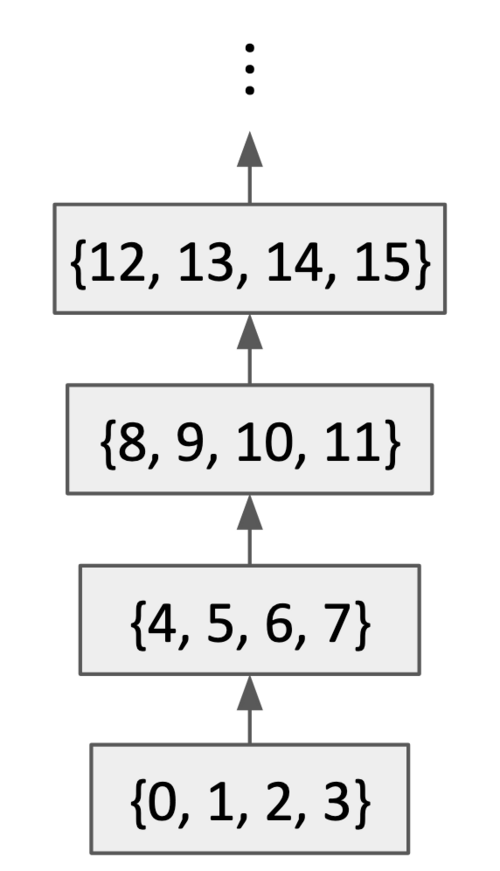
Preorders are closely related to equivalence relations and (non-strict) partial orders. Both of these are special cases of a preorder: an antisymmetric preorder is a partial order, and a symmetric preorder is an equivalence relation. Moreover, a preorder on a set can equivalently be defined as an equivalence relation on , together with a partial order on the set of equivalence class, cf. picture. Like partial orders and equivalence relations, preorders (on a nonempty set) are never asymmetric.
A preorder can be visualized as a directed graph, with elements of the set corresponding to vertices, and the order relation between pairs of elements corresponding to the directed edges between vertices. The converse is not true: most directed graphs are neither reflexive nor transitive. A preorder that is antisymmetric no longer has cycles; it is a partial order, and corresponds to a directed acyclic graph. A preorder that is symmetric is an equivalence relation; it can be thought of as having lost the direction markers on the edges of the graph. In general, a preorder's corresponding directed graph may have many disconnected components.
A preorder is often denoted or .
Definition
A binary relation on a set is called a preorder or quasiorder if it is reflexive and transitive; that is, if it satisfies:
A set that is equipped with a preorder is called a preordered set (or proset).[1]
Preorders as partial orders on partitions
Given a preorder on one may define an equivalence relation on by The resulting relation is reflexive since the preorder is reflexive; transitive by applying the transitivity of twice; and symmetric by definition.
Using this relation, it is possible to construct a partial order on the quotient set of the equivalence, by defining if That this is well-defined, meaning that it does not depend on the particular choice of representatives and , follows from the definition of .
Conversely, from any partial order on a partition of a set it is possible to construct a preorder on itself. There is a one-to-one correspondence between preorders and pairs (partition, partial order).
Example: Let be the set of all (valid or invalid) sentences in some subfield of mathematics, like geometry. Define if is a logical consequence of . Then is a preorder on : every sentence 自身から証明できる(反射性)場合、証明できる、 そしてから、 それからまた、以下のことから証明することもできます。(推移性)。対応する同値関係は通常、次のように表されます。、そして次のように定義されるそして; この場合そして論理的に同値である。文の同値類これはすべての文の集合です論理的に同等の正式には:予約注文セットは有向集合である:2つの文が与えられた場合それらの論理的結合、発音は「両方」そして「、はそれらの一般的な上限です。は、そして半順序集合したがって、これも有向集合である。関連する例については、リンデンバウム・タルスキー代数を参照のこと。
任意の有向グラフ(サイクルを含む場合もある)における到達可能性関係は、前順序を生み出す。前順序は、有向グラフにxからyへのパスが存在する場合に限り成立する。逆に、すべての前順序は有向グラフの到達可能性関係である(例えば、すべてのペア( x , y )に対してxからyへのエッジを持つグラフ)。しかし、多くの異なるグラフが互いに同じ到達可能性順序を持つ可能性があります。同様に、有向非巡回グラフ(サイクルを持たない有向グラフ)の到達可能性は、部分順序集合(追加の反対称性を満たす順序)を生み出します。
すべての有限位相空間は、定義によってその点に前順序を生み出す。x がyのすべての近傍に属する場合に限り、 x は y のすべての近傍に属する。このようにして、すべての有限前順序は位相空間の特殊化前順序として構成できる。つまり、有限位相と有限前順序の間には一対一の対応関係がある。しかし、無限位相空間とその特殊化前順序の関係は一対一ではない。






![{\displaystyle [x]\leq [y]}](https://wikimedia.org/api/rest_v1/media/math/render/svg/a78f45c685464633e52a4ca73a1bbc7e7f0ca480)


![{\displaystyle [p]=\{q\mid p\Leftrightarrow q\}}](https://wikimedia.org/api/rest_v1/media/math/render/svg/01d86ca1595dd2c9654c220a8cf2f20dc0b25a22)






















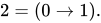


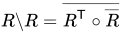




![{\displaystyle [a,b]}](https://wikimedia.org/api/rest_v1/media/math/render/svg/9c4b788fc5c637e26ee98b45f89a5c08c85f7935)


![{\displaystyle (a,b]}](https://wikimedia.org/api/rest_v1/media/math/render/svg/6a6969e731af335df071e247ee7fb331cd1a57ae)
