
Loading article…
歌舞伎症候群(以前は歌舞伎化粧症候群(KMS)または新川黒木症候群として知られていた)は、遺伝的原因によるまれな先天性疾患である。[ 1 ] [ 2 ]身体の複数の部分に影響を及ぼし、症状や重症度は様々であるが、最も一般的なのは特徴的な顔貌である。[ 3 ]
歌舞伎症候群(KS)は、およそ32,000人に1人の割合で発生します。[ 4 ] 1981年に、新川典夫氏と黒木義和氏を中心とする2つの日本の研究グループによって初めて特定され、記述されました。[ 5 ]歌舞伎症候群という名前は、罹患者の顔が日本の伝統的な演劇形式である歌舞伎で使用される舞台化粧に似ていることに由来します。[ 4 ]
歌舞伎症候群には2つのタイプがある。タイプ1はKMT2D遺伝子の病原性変異によって引き起こされ、タイプ2はKDM6A遺伝子の病原性変異によって引き起こされる。

歌舞伎症候群の具体的な症状は様々で、患者によって大きな違いがあります。[ 3 ]歌舞伎症候群のほとんどの人は、弓形の眉、長いまつげ、外側に反った下まぶたを持つ長いまぶた、突き出た耳、平らな鼻先、下向きに傾斜した口など、特徴的な顔の特徴を持っています。[ 3 ] [ 4 ]
KDM6AとKMT2Dの変異を持つ患者に共通する表現型の特徴としては、突出した耳、異常な歯列、先天性心疾患、摂食障害、停留精巣、関節過可動性、発達遅延、筋緊張低下、行動障害などが挙げられる。
その他の一般的な症状としては、骨格異常、低身長、心臓の欠陥、摂食困難および発育不全、視覚および聴覚障害、筋緊張低下(筋緊張低下)、小頭症、頻繁な感染症などがある。[ 3 ]
Mild to moderate intellectual disability and mild to severe developmental delay are often associated with Kabuki syndrome.[3][4][6] Infants and young children often experience difficulties relating to hypotonia, feeding issues/failure to thrive, infections, surgical repair of heart and palate defects and developmental delays.
Young children with Kabuki syndrome benefit from early intervention services. School age children tend to have fewer medical issues requiring hospitalization, though frequent infections, hearing loss and feeding issues occur. In addition, intellectual impairment, difficulty with visuospatial tasks and maintaining attention usually require an individualized education plan (IEP) if the child attends public school. Older children and adults report difficulties with anxiety. Endocrine abnormalities and immune system abnormalities such as idiopathic thrombocytopenia (ITP) and common variable immune deficiency (CVID) are medical issues that tend to present in older children, adolescents and adults.[7]
Type 1 Kabuki syndrome is caused by germline heterozygous loss of function variants in KMT2D (formerly known as the MLL2), located on human chromosome 12.[2] It is estimated that between 55 and 80% of cases of Kabuki syndrome are of Type 1.[8][9][10][11] Type 1 Kabuki syndrome demonstrates an autosomal dominant pattern of inheritance.
Type 2 Kabuki syndrome is caused by germline hemizygous (in males) or heterozygous (in females) chromosome deletions[12] or loss of function point variants[13] involving KDM6A (formerly known as UTX), located on the X chromosome. Approximately 5% of cases of Kabuki syndrome are of Type 2. Type 2 Kabuki syndrome demonstrates an X-linked dominant pattern of inheritance.[14]
Most cases of Kabuki syndrome occur de novo. That is, the mutation did not come from the parents and the gene was mutated early in embryological development. However, several cases of inherited mutations causing Type 1 or Type 2 Kabuki syndrome are now known.[10][14]
Some cases of Kabuki syndrome have no identifiable causative mutation.[4] These may be caused by types of mutations that are difficult to detect via current routine investigations. Another possibility is that these patients have other disorders that share some features with Kabuki syndrome.
The KMT2D and KDM6A genes belong to a family of genes called chromatin-modifyingenzymes. Specifically, these genes code for a histone methyltransferase (KMT2D) and a histone demethylase (KDM6A), and play a part in the regulation of gene expression.[15] Under normal circumstances, these enzymes transfer methyl groups on and off histones to regulate genes via epigenetic pathways. When the genes that encode these enzymes are mutated, epigenetic activation of certain developmental genes is impaired and developmental abnormalities occur, leading to the characteristics of Kabuki syndrome patients.[15] The specific developmental genes that are affected by the impaired epigenetic mechanisms in Kabuki syndrome are not yet fully known.[15]
There are hundreds of different mutations that have been identified in Kabuki syndrome patients. Most of these mutations are in the KMT2D gene and involve a change in amino acid sequence that creates a shortened and nonfunctional chromatin-modifying enzyme.[11]
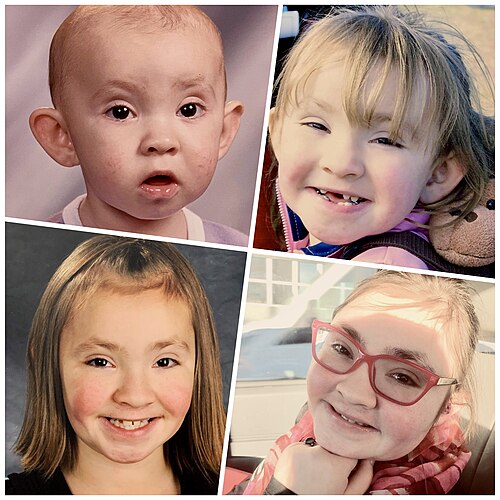
Kabuki syndrome is diagnosed with genetic testing (targeted, whole exome or whole genome sequencing).[3] When genetic testing is not available, Kabuki syndrome is diagnosed clinically (through identifying symptoms, physical exams, and lab results), most commonly by a geneticist.
A consensus on clinical diagnostic criteria for KS was defined in December 2018 by an international group of experts.[10] The authors propose that a definitive diagnosis can be made in an individual of any age with a history of infantile hypotonia, developmental delay and/or intellectual disability, and one or both of the following major criteria:
Further criteria for a probable and possible diagnosis, including a table of suggestive clinical features, were included in the publication.[10]
The original description of Kabuki syndrome by Niikawa et al.[16] defined five cardinal manifestations, although some of these “cardinal manifestations” may or may not be present in a patient with Kabuki syndrome.
Diagnosis can be difficult given the large spectrum of disease. The fact that some patients do not carry one of the two known mutations or can carry multiple mutations complicates the diagnosis further. In 2017, researchers published work that showed people with Kabuki syndrome have a unique pattern of DNA methylation.[20] This unique methylation pattern may lead to new ways to diagnose Kabuki syndrome in those who do not show mutations in KMT2D or KDM6A, but still present with a Kabuki syndrome phenotype.
Due to its rarity, Kabuki syndrome is not screened for in routine prenatal testing including blood tests, chorionic villus sampling (CVS), or amniocentesis. Although not routine for the general population, if Kabuki syndrome is a specific concern (i.e. expectant mother who has been diagnosed with Kabuki syndrome or sibling with KS), it is possible to test for one of the specific mutations.[4] This prenatal testing does require a CVS or amniocentesis. However Kabuki syndrome is usually not inherited and therefore most cases do not have a positive family history.[3][4] Kabuki syndrome can have positive screening tests, such as cystic hygroma seen on nuchal translucency ultrasound screening, although these findings are non-specific and have a wide differential diagnosis.[21][22]
Management is supportive, aimed at improving quality of life.[23] Newly diagnosed patients with Kabuki syndrome will often undergo tests that are aimed at detecting common abnormalities associated with the syndrome. They include an echocardiogram (ultrasound of the heart) for detection of structural heart defects, kidney ultrasound for detection of structural renal abnormalities, immunoglobulin levels, pneumococcal titers and a hearing screening test. Further evaluation and testing by specialists may be indicated in addition to cardiology, nephrology, allergy/immunology, audiology-mentioned above. This may include orthopedics (such as hip dysplasia), pulmonary (sleep study to rule out obstructive sleep apnea due to hypotonia), ophthalmology evaluation (vision screen), ENT evaluation (hearing evaluation), Neurology evaluation (i.e. if seizures present), Hematology evaluation (if bleeding disorder), GI evaluation (if gi abnormalities), or others as needed.
There are currently no Kabuki syndrome specific treatments and there is no cure. Treatment plans are customized to address the symptoms the individual is experiencing.[15] For example, someone experiencing seizures will be treated with the standard anti-epilepsy therapies.[15] Additionally, patients with Kabuki syndrome are routinely evaluated and monitored to address problems that may develop, such as vision or hearing problems, or cognitive difficulties.[15] If congenital heart disease is present, prophylactic antibiotics may be recommended before any procedures such as dental work that might cause infection.[15]
Life expectancy is not shortened in most cases of Kabuki syndrome. Some patients have coexisting conditions which may shorten life expectancy, such as hypoplastic left heart syndrome or kidney dysfunction. It is important that patients with cardiac, renal, or immunologic issues are identified and well-managed.[3]
Kabuki syndrome occurs about once in every 32,000 births.[4][16] The disease appears to affect all population groups equally, with no differences based on sex, race, or environment.[24] In 2023, a project called Kabuki Count was launched by a global collection of patient advocacy groups (led by the Kabuki Syndrome Foundation) as a global census to document how many people have Kabuki syndrome worldwide.
Research on Kabuki syndrome is limited due to its low incidence.[4] Despite this, several groups around the world are studying Kabuki syndrome.
In the United States, these include Dr. Hans Bjornson at Johns Hopkins University, The Roya Kabuki Program at Boston Children's Hospital, Dr. Mark Hannibal at the University of Michigan, Dr. Margaret Adam at Seattle Children's Hospital, Dr. Jacqui Harris at Kennedy Krieger Institute, as well as groups at University of Colorado, University of Utah, University of South Florida and others.[25][26]
In the UK, Prof Siddharth Banka's group at the University of Manchester and Manchester University Hospitals has a research program for Kabuki syndrome. In Canada, Dr. Rosanna Weksberg at SickKids and University of Toronto. Several European groups based in Italy, France, Germany and the Netherlands are also actively working on improving understanding of the condition and to identifying potential treatments.
In 2018, the Kabuki Syndrome Foundation was established to accelerate research efforts to treat or cure Kabuki syndrome. They launched the Kabuki Syndrome Outcome measures and Biomarkers Consortium (KSOC) in 2023 which is a collaborative clinical research study of Kabuki syndrome biomarkers.
In 1969, Norio Niikawa MD, a geneticist in Japan, was treating a child patient presenting with unique facial characteristics and various health problems. Never having seen this constellation of symptoms before, Dr Niikawa wondered if he was faced with an undiagnosed condition, a disorder with a genetic basis. Over the next several years, this physician treated several other patients with the same symptoms in his outpatient genetics clinic, furthering support for a disorder never before diagnosed.[27]
In 1979, Dr Niikawa presented his findings and hypothesis at the first Japan Dysmorphology Conference. A fellow physician at this conference, Yoshikazu Kuroki, recognized the symptoms, and realized that he had also seen several paediatric patients with this presentation; he presented two of his own cases at the second annual conference the following year. In 1981, the two doctors separately submitted articles on this new diagnosis to the Journal of Pediatrics.[5][27][28]
Dr Niikawa coined the term 'Kabuki syndrome' (also known as Kabuki make-up syndrome or Niikawa–Kuroki syndrome) as a reference to traditional Japanese theatre which he respected greatly. Many of the children presenting with this diagnosis had unusual, elongated lower eyelids, and this feature was reminiscent of the theatrical make-up worn by actors in Kabuki theatre.[18][29]
As reported by Dr. Niikawa "The name, 'Kabuki make-up', of the syndrome was given by myself, because the facial appearance of patients, especially eversion of their lower eyelids, is reminiscent of the makeup of actors in Kabuki, the traditional form of Japanese theater. Kabuki was founded early in the 17th century in Japan and over the next 300 years developed into a sophisticated form of theater. Kabuki actors usually apply traditional makeup to strengthen their eyes, especially in a hero play, and they are very proud of their performing art."[30]
The individual kanji, from left to right, mean sing (歌), dance (舞), and skill (伎). Kabuki is therefore sometimes translated as "the art of singing and dancing".
The genes for Kabuki syndrome were discovered in 2010 and 2012 for Type 1 and Type 2 Kabuki syndrome respectively.[31]