
Loading article…

石灰質土壌に生息する生物(文字通り「石灰質土壌に生息する生物」)は、最も一般的には維管束植物ですが、蘚苔類、地衣類、その他の分類群も含まれ、カルシウムを豊富に含み、しばしばアルカリ性の基質上で優先的に生育します。石灰質土壌にのみ生育するため、石灰質土壌に生息する生物は、土壌の化学組成が生物の生息場所をどのように決定するかを生態学者に明確かつ現実的な例として示しています。白亜、石灰岩、その他の石灰質岩石上での分布は、細胞質内のCa2 +を調節し、通常は不溶性の鉄とリンを獲得し、高い土壌pHに耐えることを可能にする一連の生理学的適応を反映しています。対照的に、石灰質土壌を避ける生物(「石灰質土壌を嫌う生物」)は、酸性でアルミニウムを豊富に含む土壌で優勢です。現代の研究では、石灰質土壌を好む性質は、ハインツ・エレンベルクの土壌反応値や石灰嫌性指数などの指標と関連付けられており、生薬学的研究では、多くの石灰質土壌を好む植物に様々な生物活性化合物が含まれていることが明らかになっている。[ 1 ]
calcicole という用語は、1895 年にアイルランドの博物学者 Nathaniel Colgan がダブリン県の石灰質土壌に生育するピラミッドラン (Anacamptis pyramidalis) に適用した際に、英語の植物学用語集に加わりました。 [ 1 ] [ 2 ]大陸の著者はそれ以前にcalciphileや calciphyte などの同義語を使用していましたが、イギリスとアイルランドの野外植物学者はほぼすぐに Colgan の表現を採用しました。文献には acidofuge、lime lover などの代替ラベルも見られますが、calcicole が依然として主流であり、その理由の一つは、化学的性質や生理的性質よりも生息地を強調しているためです。[ 1 ]
During the twentieth century, ecologists refined the concept by contrasting calcicoles with calcifuges and by recognising "strict" versus "non‑strict" calcicoles, depending on whether a species is confined to calcareous soils or merely favours them. Subsequent classifications divided the group further into obligate and facultative calcicoles on the basis of leaf Ca2+:Mg2+ ratios, or into "extreme" and "moderate" calcicoles according to whether they require pH above 7 or tolerate pH 5–7.[3][1]
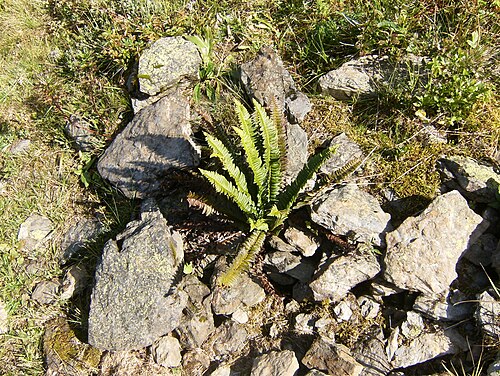
Calcicoles are conspicuous components of chalk grasslands, karst shrublands and Mediterranean garrigue, but they also occur on serpentine outcrops, metalliferous spoil and anthropogenic rubble where calcium carbonate buffers soil acidity. Families with many limestone specialists include Asteraceae, Caryophyllaceae, Poaceae and saxicolous (rock-dwelling) ferns such as Asplenium and Polystichum. Mosses (such as Tortula, Grimmia) and lichens (e.g. Cladonia rangiformis) likewise display calcicole–calcifuge pairs that partition the microhabitat.[1] A 2024 global survey of "limestone ferns" estimates that calcicole species make up 8–13% of regional fern floras (rising to more than 50% in some genera such as Asplenium and Adiantum), underlining the breadth of edaphic specialisation within the group.[4]
個々の種の地理的分布域は狭い場合もあれば(グレヴィレア・テレマニアナは西オーストラリアの単一の石灰岩の尾根に固有種である) 、イネ科植物のセスレリア・カエルレアのように大陸規模で分布し、アイルランドからバルカン半島まで広がっている場合もある。景観規模では、泥灰岩やドロマイトの斑状露出が土壌の島を作り出し、遺伝的分化を形作っている。ラナンキュラス・アルペストリスやその他の高山石灰質植物の集団研究では、現代の遺伝子流動にもかかわらず、歴史的に隔離されていたことが示されている。[ 1 ]
石灰質小胞は、Ca 2+に対する根膜の親和性が低いこと、可溶性 Ca c+を液胞に隔離すること、シュウ酸カルシウムまたはリン酸カルシウムとして沈殿すること(トリコーム先端細胞や表皮膀胱に結晶として見られることが多い)の組み合わせによってカルシウム毒性を回避します。このような区画化は、乾燥しやすい石灰岩地帯における浸透圧調節機構としても機能します。 [ 1 ]

高pHはFe 3+とPO 3− 4の溶解度を低下させるが、石灰質菌は鉄をキレートしリンを可動化するフィトシデロフォアとカルボン酸(クエン酸とシュウ酸)を放出することで微量栄養素の供給を維持する。 [ 5 ]外生菌根菌とエリカ菌根菌との共生は吸収をさらに促進する。菌糸は過剰なCa 2+を外部に沈殿させながら、FeとPを宿主に輸送する。IRONMAN(IMA)ペプチドファミリーは、根圏pHに関連して根レベルのFe吸収遺伝子を調整することでこれらの応答を微調整する。[ 1 ]
Nitrogen nutrition also diverges between strategies. Calcicoles grow best on nitrate-derived nitrogen, whereas calcifuges tolerate ammonium-derived nitrogen; this difference, together with aluminium sensitivity in calcicoles, reinforces the edaphic split between the two guilds. Collectively, these traits illustrate how a single element—calcium—can dictate a complex ecological syndrome.[1]
Quantitative indices permit rapid assignment of species to the calcicole–calcifuge spectrum. Etherington's Index of calcifugy expresses the proportion of a species' occurrences on soils with pH below 5.5 relative to all records; values near 0 identify strict calcicoles. Ellenberg's soil‑reaction (R) scale places most European calcicoles at R = 7–9, whereas Elias Landolt's Swiss system designates RL = 5 (above pH 6.5) as a "strict calcicole" score. These ordinal approaches, though region‑specific, have proved transferable after recalibration and now underpin vegetation monitoring across Europe and the Caucasus.[1]
Many calcicoles synthesise secondary metabolites of medicinal interest. Beet (Beta vulgaris) roots yield betalains with anti-inflammatory and nephroprotective effects, while Leontodon hispidus produces hypocretenolides active in topical inflammation models. Polyphenol‑rich extracts of Anthyllis vulneraria, Veronica spicata and wheat (Triticum aestivum) show antioxidant capacity, and saponins from Medicago sativa inhibit Candida albicans. Antibacterial synergy between Artemisia rupestrisflavonoids and fluoroquinolones demonstrates the pharmaceutical potential of limestone floras, hitherto overlooked in ethnobotanical surveys.[1]