
Loading article…

バトモルフィは、一般的にエイとして知られる軟骨魚類の区分です。この分類群は、バトイデア上目とみなされることもありますが、世界の魚類の第5版では、バトモルフィ区分として分類されています。[ 2 ] [ 3 ]バトモルフィは、サメの区分であるセラキイとともに、板鰓亜綱を構成しています。エイは、軟骨魚類のグループの中で最も種数が多く、26科に600種以上がいます。エイは、扁平な体、頭部に融合した大きな胸鰭、腹面に配置された鰓裂によって区別されます。
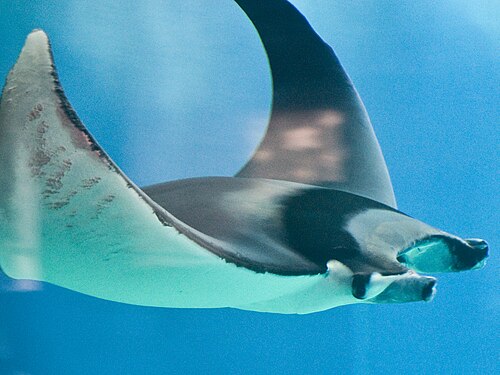
サメと同様に、バトモルフ類は軟骨魚類(軟骨魚綱)であり、丈夫で弾力性のある軟骨でできた骨のない骨格を持っています。ほとんどのバトモルフ類は背腹方向に扁平で、外套膜のような体型をしていますが、サカタザメ類やノコギリエイ類はそれほど扁平ではなく、ほとんどのサメは紡錘形の体型をしています。多くのバトモルフ類は胸鰭を翼と呼ばれる幅広で平たい付属肢に発達させています。尻鰭はありません。目と噴水孔は頭のてっぺんにあります。底生のバトモルフ類は、ほとんどの魚のように口からではなく、噴水孔から水を取り込み、鰓を通して外に排出することで呼吸します。鰓孔または鰓裂は胸鰭の下側にありますが、サメの鰓孔は頭の側面にあります。ほとんどのバトモルファ類は腹側に5つの鰓裂を持つが、ヘキサトリゴニ科は6つ持つ。[ 4 ]
Batomorphs have a ventrally located mouth and can considerably protrude their upper jaw (palatoquadrate cartilage) away from the cranium to capture prey.[5] The jaws have euhyostylic type suspension, which relies completely on the hyomandibular cartilages for support.[6] Most batomorphs have developed heavy, rounded teeth for crushing the shells of bottom-dwelling species such as snails, clams, oysters, crustaceans, and some fish, depending on the species. Manta rays feed on plankton using dense gill rakers to capture them.
Most species live on the sea floor, in a variety of geographical regions – mainly in coastal waters, although some live in deep waters to at least 3,000 metres (9,800 ft). Most batomorphs have a cosmopolitan distribution, preferring tropical and subtropical marine environments, although there are temperate and cold-water species. Only a few species, like manta rays, live in the open sea, and only a few live in freshwater, while some batomorphs can live in brackish bays and estuaries.
軟骨魚類の特徴として、エイ類は体内受精を行う。体内受精は精子を節約し、卵が捕食者に食べられるのを防ぎ、生殖に関わるすべてのエネルギーが保持され、環境に失われないことを保証するため、エイ類にとって有利である。[ 7 ]すべてのエイと一部のエイは卵生(卵を産む)であるが、他のエイは卵胎生であり、胎盤の関与なしに子宮内で発育する幼生を産む。[ 8 ]
卵生のエイの卵は、革のような卵鞘に産み付けられる。この卵鞘は一般的に「人魚の財布」と呼ばれ、エイが多く生息する地域では、空の卵鞘が海岸に打ち上げられることが多い。
漁獲によって誘発される早産や流産(総称して漁獲誘発分娩と呼ばれる)は、サメやエイが漁獲される際に頻繁に発生する。[ 8 ]漁獲誘発分娩は、胎生のサメやエイの少なくとも12%(現在までに88種)で発生していることが示されているにもかかわらず、漁業管理において考慮されることはほとんどない。[ 8 ]
エイ類は、軟骨魚類の古代系統に属します。今日の軟骨魚類の歯状鱗(皮膚にある歯のような鱗)に似た化石歯状鱗は、少なくともオルドビス紀まで遡り、軟骨魚類の最も古い明確な化石は中期デボン紀に遡ります。この多様な科の中のクレードである新軟骨魚類は三畳紀までに出現し、最もよく理解されている新軟骨魚類の化石はジュラ紀に遡ります。最も古い確認されているエイは、ドイツのプリンスバッキアン期のAntiquaobatisです。[ 9 ]このクレードは現在、サメ、ノコギリエイ、エイ、ガンギエイによって代表されています。[ 10 ]
Molecular evidence refutes the hypothesis that skates and rays are derived sharks.[11] The monophyly of the skates, the stingrays, and the electric rays has long been generally accepted. Along with Rhinopristiformes, these comprise the four traditionally accepted major batomorph lineages, as in Nelson's 2006 Fishes of the World. However, the exact phylogeny of the major batomorph lineages, internally and with respect to one another, has been subject to diverse treatments. The following cladogram is based on a comprehensive morphological assessment of batomorph phylogeny published in 2004:[12]
However, a 2011 study significantly reevaluated the phylogeny of batomorphs, using nuclear and mitochondrial DNA from 37 taxa, representing almost all recognized families and all of the traditional four major lineages. This is a far more numerous and diverse set of sample taxa than in any previous study, producing findings reflected in the cladogram below.[1]
This study strongly confirmed the traditionally accepted internal monophyly of skates, stingrays, and electric rays. It also recovered panrays as sister to the stingrays, as older morphological analyses had suggested. However, it found the Rhinopristiformes, including the sawfishes and various "guitarfishes", to be paraphyletic, comprising two distinct clades. Referred to as "Guitarfishes 1" and "Guitarfishes 2", the former contains only the Trygonorrhinidae, while the latter contains the remainder of Rhinopristiformes (the families Glaucostegidae, Pristidae, Rhinidae, and Rhinobatidae). In addition, while traditional phylogenies often find electric rays to be the basalmost batomorphs, followed by the Rhinopristiformes, this analysis finds a polytomy between skates, electric rays, and thornbacks at the base of Batomorphi, with weak support for skates being the actual most basal lineage, followed by a clade uniting the electric rays and thornbacks.
The MesozoicSclerorhynchoidea were long considered to be basal or incertae sedis; they show features of the Rajiformes but have snouts resembling those of sawfishes. Though considered to be the sister group to sawfishes for a time,[13] they are now considered true skates (Rajiformes).[14]
The following cladograms are derived from phylogenetic analyses taken from a 2022 study of batomorph morphology by Villalobos-Segura and colleagues;[14]

エシュマイヤーの魚類カタログでは、エイ類を次のように分類しています。[ 18 ]
According to a 2021 study in Nature, the number of oceanic sharks and rays has declined globally by 71% over the preceding 50 years, jeopardising "the health of entire ocean ecosystems as well as food security for some of the world's poorest countries". Overfishing has increased the global extinction risk of these species to the point where three-quarters are now threatened with extinction.[19][20][21] This is notably the case in the Mediterranean Sea - most impacted by unregulated fishing - where a recent international survey of the Mediterranean Science Commission concluded that only 38 species of rays and skates still subsisted.[22]