
Loading article…

アーセロールミッタル・オービット(オービット・タワーまたは元の名称であるオービットとも呼ばれる)は、ロンドンのストラトフォードにあるクイーン・エリザベス・オリンピック・パークにある高さ114.5メートル(376フィート)の彫刻と展望台である。これは英国最大の公共芸術作品であり[ 3 ]、ロンドンが2012年夏季オリンピックおよびパラリンピック競技大会を開催した際の永続的な遺産として、ストラトフォード地区のオリンピック後の再生を支援することを目的としている。ロンドン・スタジアム(旧オリンピック・スタジアム)とアクアティクス・センターの間に位置し、2つの展望台からオリンピック・パーク全体を見渡すことができる。
オービットは、ターナー賞受賞アーティストのアニッシュ・カプーアと、エンジニアリング会社アラップ・グループのセシル・バルモンドによって設計されました。2010年3月31日に発表され、2011年12月までに完成する予定でした。このプロジェクトは、 2008年にロンドン市長のボリス・ジョンソンとオリンピック担当大臣のテッサ・ジョウェルが、オリンピック・パークには「何か特別なもの」が必要だと判断したことから始まりました。デザイナーたちは、少なくとも高さ100メートル(330フィート)の「オリンピック・タワー」のアイデアを求められ、 9人の諮問委員会が検討した提案の中からオービットが満場一致で選ばれました。カプーアとバルモンドは、オービットは彫刻と構造工学を組み合わせる建築分野における革新的な進歩であり、来場者が組み込まれた螺旋状の通路を通して関わり、体験できる作品の中に安定性と不安定性の両方を兼ね備えていると信じていました。その大胆なデザインは賞賛と批判の両方を受けており、特に公共芸術プロジェクトとしての永続的な用途や価値が疑わしい自己満足プロジェクトとして批判されています。
このプロジェクトの費用は1910 万ポンドと見込まれており、そのうち1600万ポンドは 当時イギリスで最も裕福な人物であった鉄鋼王ラクシュミ・ミッタル氏(アルセロールミッタル鉄鋼会社会長)が拠出し、残りの310万ポンドはロンドン開発庁 が拠出した。「アルセロールミッタル・オービット」という名称は、主要スポンサーであるミッタル氏の会社名と、カプール氏とバルモンド氏の設計案の当初の仮称である「オービット」を組み合わせたものである。
アーセロールミッタル・オービットは、 2012年のオリンピックとパラリンピック競技大会の後、オービットが設置されているサウスプラザが公共の屋外スペースとして長期的に利用するための再建工事が行われたため、一時的に閉鎖されました。2014年4月5日に一般公開が再開されました。この構造物には、カーステン・ヘラーが設計した、世界で最も高く、最も長い178メートル(584フィート)の トンネルスライダーが組み込まれています。このアイデアは、ロンドン・レガシー開発公社がタワーへの訪問者を増やす方法として最初に構想したものです。スライダーには、ねじれた赤いタワーの「異なる視点」を与える透明なセクションがあり、2016年6月に完成しました。これは、2014年に導入されたタワーを懸垂下降するオプションに続くものです。
ロンドン市長ボリス・ジョンソンによると、2008年10月頃、ジョンソンとテッサ・ジョウェルは、 2012年オリンピックのオリンピックパークとなるロンドンのストラトフォードの敷地には「東ロンドンのスカイラインを際立たせ」、「ロンドン市民や観光客の好奇心と驚きを掻き立てる」ための「何か特別なもの」が必要だと判断した。[ 4 ]
2009年に開催されたデザインコンペでは、「オリンピックタワー」のデザインが募集され、約50件の応募があった。[ 5 ]ジョンソンは、このプロジェクトの初期構想はオービットよりも控えめなもので、「21世紀版トラヤヌス記念柱のようなもの」だったが、より大胆なアイデアが寄せられたため、この構想は撤回されたと述べている。[ 4 ]
The media reported unconfirmed details of the project in October 2009, describing the interest of the steel magnate Lakshmi Mittal, one of Britain's richest men, in funding a project that would cost around £15 million. Boris Johnson was believed to want something like the Eiffel Tower or the Statue of Liberty.[6][7] At that time there were understood to be five artists being considered, including Antony Gormley.[6] Early designs reportedly included 'Transmission' by Paul Fryer, a 400-foot (120 m) high structure "resembling a cross between a pylon and a native American totem pole", according to The Times.[6] A spokesman for Johnson would only confirm that he was "keen to see stunning, ambitious, world-class art in the Olympic Park", and that work on commissioning the project was at an early stage.[6][7]
Mittal's involvement came about after a chance meeting with Johnson in a cloakroom in Davos in January 2009,[8] as they were on their way to separate dinner engagements. In a conversation that reportedly lasted 45 seconds Johnson pitched the idea to Mittal, who immediately agreed to supply the steel.[4] Mittal later said of his involvement, "I never expected that this was going to be such a huge project. I thought it was just the supply of some steel, a thousand tonnes or so, and that would be it. But then we started working with artists and I realised that the object was not just to supply steel but to complete the whole project. It took us almost 15 months of negotiation and discussion."[9] Johnson has said that, "In reality, ArcelorMittal has given much more than the steel."[4]
Kapoor's and Balmond's Orbit was announced as the winner on 31 March 2010.[10] According to The Guardian, Orbit was chosen from a short list of three, beating a design by Antony Gormley and one by the architectural firm Caruso St John.[11] According to The Times, Gormley's design was a 390-foot (120 m) steel colossus titled Olympian Man, a trademark piece of a statue of himself, rejected mainly on the grounds of its projected cost, estimated at £40 million.[12]
Johnson and Jowell agreed to issue a commission for Orbit in partnership with Mittal after it was chosen by a nine-person advisory panel brought together by them to advise on a long list of proposals.[4][10] According to Mittal, the panel made a unanimous decision to pick Orbit, as it both represented the Olympic Games and was achievable within the ambitious time frame.[5] Kapoor described it as "the commission of a lifetime".[10]
Johnson pre-empted possible criticism during the official launch by stating: "Of course some people will say we are nuts – in the depths of a recession – to be building Britain’s biggest ever piece of public art. But both Tessa Jowell and I are certain that this is the right thing for the Stratford site, in Games time and beyond."[4]
The completed structure was officially unveiled to the press and public on 11 May 2012.[13]
An image of the structure was included in the 2015 design of the British passport.[14][15]
The structure was re-purposed with the world's longest slide in 2016, as a way to attract more visitors.[16]
According to Kapoor, the design brief from the Mayor's office was for a "tower of at least 100 metres (330 ft)", while Balmond said that he was told the Mayor was "looking for an icon to match the Eiffel Tower".[17]
Kapoor said that one of the influences on his design was the Tower of Babel, the sense of "building the impossible" that "has something mythic about it", and that the form "straddles Eiffel and Tatlin".[17] Balmond, working on the metaphor of an orbit, envisaged an electron cloud moving, to create a structure that appears unstable, propping itself up, "never centred, never quite vertical".[17] Both believe that Orbit represents a new way of thinking, "a radical new piece of structure and architecture and art" that uses non-linearity – the use of "instabilities as stabilities."[17] The spaces inside the structure, in between the twisting steel, are "cathedral like", according to Balmond, while according to Kapoor, the intention is that visitors will engage with the piece as they wind "up and up and in on oneself" on the spiral walkway.[17]
The Independent described Orbit as "a continuously looping lattice ... made up of eight strands winding into each other and combined by rings like a jagged knot". The Guardian describes it as a "giant lattice tripod sporting a counterweight collar around its neck designed to offset the weight of its head, a two-storey dining and viewing gallery". According to the BBC, the design incorporates the five Olympic rings.[18][19][20]
Upon its launch Johnson said "It would have boggled the minds of the Romans. It would have boggled Gustave Eiffel."[18] Nicholas Serota, a member of the design panel, said that Orbit was a tower with an interesting twist, with "the energy you might traditionally associate with this type of structure but in a surprisingly female form".[21]
According to Mittal, Orbit was already the working title, as it describes continuous action, a creative representation of the "extraordinary physical and emotional effort" that Olympians undertake in their continuous drive to do better. It was decided to keep this as the final name and prepend ArcelorMittal (as the project supporter).[5]
ジョンソンはデザインの公表に際し、それが正式名称以外の名称で知られるようになるかもしれないと認め、「ストラトフォードの巨像」や「ハッブル・バブル」などを提案した。これは、巨大なシーシャパイプに似ているという彼の考えに基づくものであった。また、人々が「巨大なト音記号」、「はねごり台」、「特大の突然変異トロンボーン」に似ていると認識していることを踏まえたものであった。[ 11 ]
オービットは「アニッシュ・カプーアとセシル・バルモンドによって設計された」と説明されている。[ 22 ]カプーアはターナー賞を受賞した彫刻家であり、バルモンドは世界を代表するデザイナーの一人である。カプーアによれば、二人は「建築と彫刻が出会う場所」と「形態と幾何学が構造を生み出す方法」に興味を持っているという。[ 23 ]カプーアとバルモンドは、2002年にテート・モダンのタービン・ホールにあるカプーアのインスタレーション「マルシュアス」で初めて共同作業を開始して以来、二人の興味は曖昧になり、互いの分野にまで及んでいると述べている。[ 23 ]オービットの他に、2010年にはカプーアとバルモンドはイングランド北部の公共アートプロジェクト「ティーズ・バレー・ジャイアンツ」にも取り組んでいた。[ 23 ]
この彫刻は、グローバルエンジニアリング会社Arupによって設計され、全体的な形状、構造設計、およびオリンピック競技大会で広く使用された照明を含む建物の設備が開発されました。[ 24 ] ArupのサブコンサルタントとしてUshida Findlay ArchitectsのKathryn Findlayが建築に携わり、階段の設計など、彫刻を機能的な建物にしました。[ 2 ] [ 25 ]

オービットの有機的なデザインは、並外れた量の構造エンジニアリング作業を必要とした。これはアラップによって行われ、プロジェクトの予算の3分の2を占めたと報告されている(これは、建築プロジェクトで構造エンジニアリングに通常割り当てられる割合の2倍である)。[ 26 ]
構造的な観点から見ると、Orbit は2 つの部分から構成されています。[ 26 ]
幹の基部の直径は37 メートル (121フィート)で、上に向かうにつれて5 メートル (16フィート)まで狭まり、展望デッキのすぐ下で再び9.6 メートル (31フィート)まで広がります。 [ 26 ]幹はチューブによって支えられ、安定しており、構造全体が三脚のような構造的特徴を持っています。[ 26 ]チューブと幹を囲む八角形の鋼製リングが4 メートル (13フィート)間隔で配置され、16 個の斜めに取り付けられた鋼製コネクタによってペアごとに交差して接続されており、構造の完全性がさらに高められています。[ 26 ]
構造の特別な部分は、幹の底から垂れ下がる円錐形のキャノピーです。当初はグラスファイバー複合構造として計画されていましたが、コスト上の理由からこの部分にも鋼鉄を使用せざるを得ませんでした。Centraalstaal社は鋼鉄製の円錐の設計に関する特別コンサルタントとして依頼を受け、個別に成形された 117 枚の鋼板で構成され、総表面積が 586 平方メートルの円錐の設計を考案しました。円錐全体の重量は 84トンです。[ 26 ]
当初の矛盾した報道では、この塔は高さ120メートル(390フィート)になると示唆されていた。[ 11 ] [ 27 ] [ 28 ] [ 29 ]しかし、最終的には114.5メートル(376フィート)となり、英国で最も高い彫刻となった。[ 30 ] [ 31 ]ノッティンガムにある高さ60メートル(200フィート)のアスパイアを上回った。
プロジェクトを発表した際、グレーター・ロンドン・オーソリティはオービットの高さを自由の女神像と比較し、 22メートル(72フィート)高くなると述べた[ 10 ]。自由の女神像は、 46メートル(151フィート)の像と台座を含めて高さ93メートル(305フィート)である。メディアは、オービットを高さ324メートル(1,063フィート)のエッフェル塔に対するロンドンの回答として位置づけようとする明らかな意図を捉えた。ガーディアン紙は、オービットが「かなり低い」と報じ[ 11 ] [ 18 ] [ 32 ] 、さらに「小さなブラックプール・タワーよりも20メートル(66フィート)低い」とも指摘した[ 32 ] 。
メディアではその高さがロンドンの他のランドマークと比較された。ウェストミンスター宮殿の中心にあるビッグベン時計塔よりも「わずかに高い」または「20メートル近く高い」と表現された。[ 11 ] [ 18 ]また、トラファルガー広場にあるネルソン提督を称える記念碑であるネルソン記念柱の「2倍の高さ」または「2倍以上の高さ」とも表現された。[ 18 ]他の報道では、エジプトのギザの大ピラミッド(ファラオ・クフの古代の墓)に「わずかに及ばない」または「ほぼ同じ高さ」であると表現された。[ 11 ] [ 33 ]ビッグベンは高さ96.3メートル(316フィート)、ネルソン記念柱は像と柱を含めて高さ51.5メートル(169フィート)である。ギザのピラミッドは、建設当初はエジプトのキュビット280 、つまり146.478メートル(480.57フィート)の高さだったと考えられているが、浸食によって高さが約10メートル低くなっている。

オービットはオリンピックパークの南部に位置し、ロンドンスタジアムとアクアティクスセンターの間にある。[ 10 ] 2010年3月に優勝デザインが確定した後、[ 5 ] [ 18 ] 2010年11月に建設が開始され、2011年11月に最高高さに達した。[ 34 ]
彫刻の主な材料は鋼鉄である。バルモンドによれば、鋼鉄はコイル構造で表現されている最小の厚さと最大の強度を実現できる唯一の材料であったため、実行可能な代替材料はなかった。[ 17 ]約2000トンの鋼鉄から作られ、可能な限りアルセロールミッタル社の工場で生産されたものが使用され、正確な調達先は必要な鋼鉄のグレードとプロジェクトの技術的要件によって決定された。[ 5 ]このうち60%はルクセンブルクのエッシュ・ベルヴァル製鉄所で生産されたリサイクル鋼鉄であった。[ 35 ]
2011年3月14日、メインの鉄塔の建設がすでに始まっていた頃、テレビ番組「ザ・ワン・ショー」は、現場でのプロジェクトの状況を伝える映像を放送し、鉄骨組立工2名、クレーンオペレーター1名、現場監督1名からなる4人チームを紹介した。
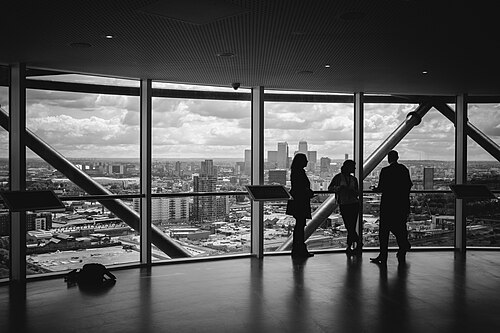
展望タワーであるオービットには、2つのレベルに2つの屋内展望台があり、各レベルの収容人数は150人です。[ 18 ] [ 31 ]グレーター・ロンドン・オーソリティによると、展望台からは「オリンピック・パークの250エーカー(1.0 km 2 ; 0.39平方マイル)全体とロンドンのスカイラインの比類のない眺め」が楽しめます。 [ 10 ]インディペンデント紙によると、訪問者はエレベーターで最上階まで行き、455段の階段を下りるべきです。そうすることで、アニッシュ・カプーアが彫刻を配置した景色を堪能できるはずです。[ 31 ]
1時間あたり700人の来場者に対応できるように設計されています。[ 18 ]オリンピック開催中は、入場料は大人15ポンド、子供7ポンドでした。[ 31 ]タワーにはダイニングエリアはありませんが、2014年4月にオープンしたサウスパークハブビルにはカフェ、ショップ、その他の施設があります。
The ambition is that the sculpture, as well as being a focal point for the Olympic Park during the Games, will form part of the wider Stratford regeneration plans, which aim to turn the Olympic site into a permanent tourist destination after the Games.[4]Tessa Jowell said Orbit will be "like honey to bees for the millions of tourists that visit London each year".[10] Boris Johnson predicted it would become "the perfect iconic cultural legacy".[10] According to Lord Coe, chairman of the London 2012 Olympic organisers, it would play a central part in the Game's role of leaving a lasting legacy and transformed landscape in east London.[10]
During the opening ceremony of the 2012 Summer Paralympics, Joe Townsend (a Royal Marine and double amputee) delivered the Paralympic flame into Olympic Stadium via a zipline that was attached to the top of Orbit.[36]

In 2016, a permanent slide designed by German artist Carsten Höller was added to the sculpture. The slide is reported to be the world's tallest and longest tunnel slide at 178 metres.[37] Though it was originally reported that admission to the slide would cost around £5,[38] the general adult price for entry to the slide and viewing platforms is £30.00 (£25.00 if bought in advance), as of March 2023.[39]
At the time of its public launch, the total cost of Orbit was announced as £19.1 million.[10] ArcelorMittal was to fund up to £16 million, with the remaining £3.1 million being provided by the London Development Agency.[10] This consists of a £10 million cash donation, and £6 million in underwriting of capital costs, which could be potentially recovered from profits generated after the Games.[10] According to Johnson, the cost of the project would be recouped after the games through the private hire of a dining area at the top, predicting it would become a "corporate money-making venture".[18]
ミッタル氏は、ロンドンがオリンピック招致に成功したという発表をめぐる興奮を思い出し、すぐにオービットに興味を持ったと語った。彼は、ロンドンに永続的な遺産を残し、「鉄のユニークな特性」を披露し、ストラトフォードの再開発に貢献する機会だと考えた。 [ 5 ]ミッタル氏は、このプロジェクトへの参加について、「私はロンドンに住んでいます。1997年からここに住んでいますが、素晴らしい街だと思います。このプロジェクトは、ロンドン、オリンピック、そしてオリンピックの遺産に永続的な役割を果たす、本当に壮大なものを建設する素晴らしい機会です。」と語った。[ 5 ]
諮問委員会のメンバーであり、テート・ギャラリーのディレクターであるニコラス・セロタ氏は、オービットは「スポーツとアートがどのように融合するかという問いに対する完璧な答え」であると述べ、ミッタル氏が「素晴らしい委託」を支援したことを「本当に印象的な後援」として称賛した。[ 21 ]
2015年10月、ロンドン議会の労働党議員であるレン・デュバルは、タワーが年間52万ポンドの損失を出していると述べた。LLDCは、年間訪問者目標を35万人から15万人に修正したと述べた。[ 40 ]
オービットに対する全体的な反応は賛否両論だったが、ほとんどは否定的だった。永続的な観光名所としての可能性に関して、ガーディアン紙のマーク・ブラウンは、人気はあったものの赤字だったテムズトンネル、ウィンストン・チャーチルの命令で解体されたスカイロン、そして成功を収めたロンドン・アイなど、ロンドンの他の象徴的な大型観光名所の明暗が分かれる運命を振り返った。[ 11 ]オリンピックタワーの計画が最初に報じられたとき、メディアは、ロンドンの「貴重な」スカイラインを守るために高層ビルを取り締まるというジョンソンのマニフェストの公約を指摘した。[ 6 ] [ 7 ]タイムズ紙は、このアイデアをジョンソンの虚栄心を満たすプロジェクトだと批判し、「彼の虚勢に見合った」デザインで「彼の功績を確固たるものにする」ために建てられたものだとし、ローマに建てられた「ウェディングケーキ」と呼ばれるヴィットリオ・エマヌエーレ2世記念碑や、トルクメニスタンのサパルムラト・ニヤゾフ大統領が建てた回転する黄金の像である中立のアーチなど、他の同様の虚栄心を満たすプロジェクトと比較されるだろうと推測し、ジョンソンをオジマンディアスになぞらえた。[ 6 ]美術評論家のブライアン・シーウェルは、「我が国には全く価値のない公共芸術が溢れている。我々はファシスト的巨大主義の新たな時代に突入している。これらはエゴの記念碑であり、ボリスほど記念碑的なエゴを持つ人物はいないだろう」と述べた。[ 6 ] [ 7 ]
タイムズ紙は、これを「公共芸術のゴジラ」と評したと報じた。[ 12 ] 2012年10月、アルセロールミッタル・オービットは、過去1年間に完成した英国最悪の建物に贈られるカーバンクル・カップのビルディング・デザイン誌の最終候補にノミネートされ、最終的にカティーサークの改修が受賞した。[ 41 ] [ 42 ]
Jay Merrick of The Independent said that "[Orbit's] sculptural power lies in its ability to suggest an unfinished form in the process of becoming something else", describing how its artistic riskiness elevated it above the banal artworks of the public art movement that have been built elsewhere in Britain's towns and cities. Merrick was of the opinion that it would be either loved or hated, being a design which is "beautifully fractious, and not quite knowable".[28]Jonathan Glancey of The Guardian described Orbit as "Olympian in ambition" and a "fusion between striking art and daring engineering", and said that, the Aquatics Centre apart, it represented the architecturally striking Joker in the pack, given that the rest of the landscaping and architecture for the Games "promises little to get excited about". He believed it would become a "genuine eyecatcher" for the Olympics television coverage, with its extraordinary form being a "strange and enticing marriage of sorts" between the Eiffel Tower and the un-built early Soviet era Tatlin's Tower, with the biblical Tower of Babel as "best man".[19]
Richard Morrison of The Times described Orbit as "like an enormous wire-mesh fence that has got hopelessly snagged round the bell of a giant french horn", adding that it "seems like an awful lot of trouble just to look at East London", in comparison to a music hall comedian's refrain at the $16 million cost of the Brooklyn Bridge.[33] Morrison not only compared Johnson to Ozymandias, but also to the 20th century dictators Adolf Hitler, Joseph Stalin and Nicolae Ceaușescu, in their acts of "phallic politics" in building grandiose monuments.[33] Criticising the lack of public involvement, he described how it would be an "undesired intrusion by the few into the consciousness of the many".[33] He feared that it could become one of the many "thousands of naff eyesores" of recent public art in Britain, citing the embracing couple at St Pancras station (The Meeting Place), the Dockland's Traffic Light tree, and the proposed Rotherhithe Tunnel 'match-stick man' tribute to Isambard Kingdom Brunel, as London-based examples.[33] Fellow Times writer Tom Dyckhoff, while calling it "a gift to the tabloids" and a "giant Mr. Messy", questioned whether the Olympic site needed another pointless icon, postulating whether it would stand the test of time like the London Eye and become a true icon to match the Eiffel Tower, or a hopeless white elephant. Suggesting the project had echoes of Tatlin's Monument to the Third International, and especially Constant Nieuwenhuys' utopian city New Babylon, he asked whether Orbit was just as revolutionary or possessed the same ideological purpose, or whether it was merely "a giant advert for one of the world’s biggest multinationals, sweetened with a bit of fun".[27]
ガーディアン紙のローワン・ムーアは、それが単なる愚行以上のものになるのか、あるいは自由の女神像のように雄弁なものになるのか疑問を呈した。[ 43 ]彼は、このプロジェクトが、社会が貧困地域を救済するための手段として大規模な象徴的プロジェクトを使用するのをやめる時期を示すものになるかもしれないと推測した。彼は、エンジェル・オブ・ザ・ノースやビルバオのグッゲンハイム美術館の成功と同様に、オリンピック後にストラトフォードに人々の注目を集めることができるのか疑問を呈した。[ 43 ]彼はまた、この作品が、少なくともゲーツヘッドに「気分を高揚させ、誇りを感じさせた」と彼が信じていたエンジェルのように人々の心に響くことができるのか、あるいは単に「誰も取り壊す勇気のない、愛されずに朽ち果てた多くの残骸」の1つになるだけなのか疑問を呈した。彼は、階段とエレベーターが追加されたことで、オービットはカプールの以前の成功作よりも簡潔さを欠くようになったと推測し、最終的には「何か大きなものを作るという考えを超えて、大きなアイデアが何なのか理解しにくい」と述べた。[ 43 ]
ガーディアン紙の同僚記者ジョン・グラハム=カミングは、エッフェル塔のような象徴との比較を否定した。エッフェル塔自体も永続的な記念碑として意図されたものではなく、有用性によって芸術として一般に受け入れられるようになったに過ぎない。彼はまた、ロードスの巨像は数十年以内に崩壊し、バベルの塔は「それを建設した人々を称賛するために建設された」と指摘した。彼は、ジョンソンが20年後に取り壊すべきかどうかを再考すべきだと示唆した。企業としての役割に疑問を呈することで、それは芸術作品というよりも虚栄心を満たすプロジェクトのように見えてくると彼は考えた。[ 32 ]ガーディアン紙が発表したオンライン投票では、読者の38.6%がそれを「壮大なデザイン」と見なした一方、61.4%が「ゴミ」と見なした。[ 44 ]
タイムズ紙が、アルセロールミタルのスポンサーシップとオービットの命名は、企業ブランディングが公共生活に不適切に侵入しているという懸念を示したことに対し、ジョンソン氏は、オリンピックの規則では、大会期間中は企業ブランディングを一切使用できないと述べた。 [ 8 ]ガーディアン紙の環境ブログのフェリシティ・カルスは、アルセロールミタルの炭素排出量に関する実績が、オービットが「世界初の持続可能なオリンピック」と銘打たれた2012年オリンピックにふさわしい記念碑となるのに十分かどうか疑問を呈した。[ 45 ]
In 2024, The New York Times' architecture critic Michael Kimmelman called Orbit "possibly the worst public sculpture of the 21st century."[46]
The advisory panel consisted of:[10]
In announcing the winning design, Johnson thanked the Greater London Authority, the Olympic Delivery Authority and the London Organising Committee of the Olympic Games and Paralympic Games, as well as David McAlpine and Philip Dilley of Arup, and Sir Robin Wales and Jules Pipe for their involvement and support in the project.[4]