
Loading article…
代数幾何学の分野では、代数多様体Vの特異点とは、その点において多様体上の接空間が正則に定義されない可能性があるという幾何学的な意味で「特別」(つまり特異)な点Pのことである。実数上で定義された多様体の場合、この概念は局所的な非平坦性の概念を一般化したものである。特異点を持たない代数多様体の点は正則であると言われる。特異点を持たない代数多様体は非特異または滑らかであると言われる。この概念は、現代のスキーム理論の言語では滑らかなスキームに一般化されている。
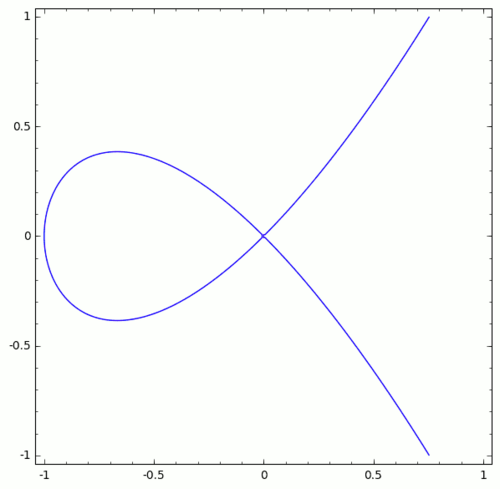
Fが滑らかな関数である場合、 Fのテイラー級数の次数がその点で少なくとも2 であるとき、F はある点で特異であると言われます。
その理由は、微分積分学では、このような曲線の点( x 0 , y 0 )における接線は次の式で定義されるからである。
左辺はテイラー展開の1次項である。したがって、この項がゼロの場合、タンジェントは標準的な方法では定義できない。これは、タンジェントが存在しないか、特別な定義が必要となるためである。
一般的に超曲面の場合
the singular points are those at which all the partial derivatives simultaneously vanish. A general algebraic varietyV being defined as the common zeros of several polynomials, the condition on a point P of V to be a singular point is that the Jacobian matrix of the first-order partial derivatives of the polynomials has a rank at P that is lower than the rank at other points of the variety.
Points of V that are not singular are called non-singular or regular. It is always true that almost all points are non-singular, in the sense that the non-singular points form a set that is both open and dense in the variety (for the Zariski topology, as well as for the usual topology, in the case of varieties defined over the complex numbers).[1]
In case of a real variety (that is the set of the points with real coordinates of a variety defined by polynomials with real coefficients), the variety is a manifold near every regular point. But a real variety may be a manifold and have singular points. For example the equation y3 + 2x2y − x4 = 0 defines a real analytic manifold but has a singular point at the origin.[2] This may be explained by saying that the curve has two complex conjugatebranches that cut the real branch at the origin.
As the notion of singular points is a purely local property, the above definition can be extended to cover the wider class of smooth mappings (functions from M to Rn where all derivatives exist). Analysis of these singular points can be reduced to the algebraic variety case by considering the jets of the mapping. The kth jet is the Taylor series of the mapping truncated at degree k and deleting the constant term.
In classical algebraic geometry, certain special singular points were also called nodes. A node is a singular point where the Hessian matrix is non-singular; this implies that the singular point has multiplicity two and the tangent cone is not singular outside its vertex.


