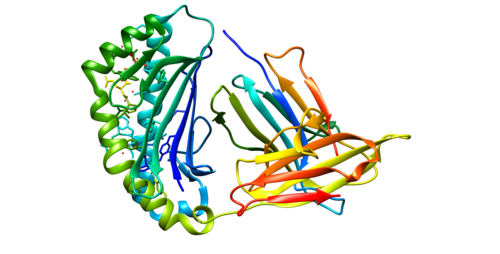
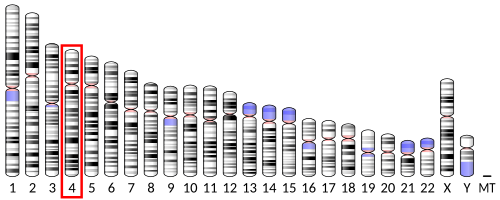
The function of AFP in adult humans is unknown. AFP is the most abundant plasma protein found in the human fetus. In the fetus, AFP is produced by both the liver and the yolk sac. It is believed to function as a carrier protein (similar to albumin) that transports materials such as fatty acids to cells.[14] Maternal plasma levels rise until the 32nd week of pregnancy, when they begin to decline.[15] They decrease rapidly after birth. Normal adult levels in the newborn are usually reached by the age of 8 to 12 months. While the function in humans is unknown, in rodents it binds estradiol to prevent the transport of this hormone across the placenta to the fetus. The main function of this is to prevent the virilization of female fetuses. As human AFP does not bind estrogen, its function in humans is less clear.[16] In human liver cancer, AFP is found to bind glypican-3 (GPC3), another oncofetal antigen.[17]
The rodent AFP system can be overridden with massive injections of estrogen, which overwhelm the AFP system and will masculinize the fetus. The masculinizing effect of estrogens may seem counter-intuitive since estrogens are critical for the proper development of female secondary characteristics during puberty. However, this is not the case prenatally. Gonadal hormones from the testes, such as testosterone and anti-Müllerian hormone, are required to cause development of a phenotypic male. Without these hormones, the fetus will develop into a phenotypic female even if genetically XY. The conversion of testosterone into estradiol by aromatase in many tissues may be an important step in masculinization of that tissue.[18][19] Masculinization of the brain is thought to occur both by conversion of testosterone into estradiol by aromatase, but also by de novo synthesis of estrogens within the brain.[20][21] Thus, AFP may protect the fetus from maternal estradiol that would otherwise have a masculinizing effect on the fetus, but its exact role is still controversial.
Serum levels
Maternal
Fetal AFP levels can be monitored in the urine of pregnant women. Since AFP is quickly cleared from the mother's serum via her kidneys, maternal urine AFP correlates with fetal serum levels, although the maternal urine level is much lower than the fetal serum level. AFP levels rise until about week 32. Maternal serum alpha-fetoprotein (MSAFP) screening is performed at 16 to 18 weeks of gestation.[22] If MSAFP levels indicate an anomaly, amniocentesis may be offered to the patient.
Infants
The normal range of AFP for adults and children is variously reported as under 50, under 10, or under 5ng/mL.[23][24] At birth, normal infants have AFP levels four or more orders of magnitude above this normal range, that decreases to a normal range over the first year of life.[25][26][27][28][29][30]
During this time, the normal range of AFP levels spans approximately two orders of magnitude.[27] Correct evaluation of abnormal AFP levels in infants must take into account these normal patterns.[27]
Very high AFP levels may be subject to hooking (see tumor marker), which results in the level being reported significantly lower than the actual concentration.[31] This is important for analysis of a series of AFP tumor marker tests, e.g. in the context of post-treatment early surveillance of cancer survivors, where the rate of decrease of AFP has diagnostic value.
Clinical significance
Measurement of AFP is generally used in two clinical contexts. First, it is measured in pregnant women through the analysis of maternal blood or amniotic fluid as a screening test for certain developmental abnormalities, such as aneuploidy. Second, serum AFP level is elevated in people with certain tumors, and so it is used as a biomarker to follow these diseases. Some of these diseases are listed below:
Developmental birth defects associated with elevated AFP
A peptide derived from AFP that is referred to as AFPep is claimed to possess anti-cancer properties.[38]
In the treatment of testicular cancer it is paramount to differentiate seminomatous and nonseminomatous tumors. This is typically done pathologically after removal of the testicle and confirmed by tumor markers. However, if the pathology is pure seminoma but the AFP is elevated, the tumor is treated as a nonseminomatous tumor because it contains yolk sac (nonseminomatous) components.[39]
123GRCh38: Ensembl release 89: ENSG00000081051–Ensembl, May 2017
123GRCm38: Ensembl release 89: ENSMUSG00000054932–Ensembl, May 2017
↑"Human PubMed Reference:". National Center for Biotechnology Information, U.S. National Library of Medicine.
↑"Mouse PubMed Reference:". National Center for Biotechnology Information, U.S. National Library of Medicine.
↑Lawrence E. "AFP". Henderson's Dictionary of Biological Terms (10thed.). p.1. ISBN0-470-21446-5.
↑Tomasi TB (1977). "Structure and function of alpha-fetoprotein". Annual Review of Medicine. 28: 453–465. doi:10.1146/annurev.me.28.020177.002321. PMID67821.
↑Mizejewski GJ (May 2001). "Alpha-fetoprotein structure and function: relevance to isoforms, epitopes, and conformational variants". Experimental Biology and Medicine. 226 (5). Maywood, N.J.: 377–408. doi:10.1177/153537020122600503. PMID11393167. S2CID23763069.
↑Harper ME, Dugaiczyk A (July 1983). "Linkage of the evolutionarily-related serum albumin and alpha-fetoprotein genes within q11-22 of human chromosome 4". American Journal of Human Genetics. 35 (4): 565–572. PMC1685723. PMID6192711.
↑Perry SE, Hockenberry MJ, Lowdermilk DL, Wilson D (2014). "8: Nursing Care of the Family During Pregnancy". Maternal Child Nursing Care (Fifthed.). St. Louis, Missouri: Elsevier. ISBN978-0-323-09610-2. OCLC858005418.
↑Pucci P, Siciliano R, Malorni A, Marino G, Tecce MF, Ceccarini C, etal. (May 1991). "Human alpha-fetoprotein primary structure: a mass spectrometric study". Biochemistry. 30 (20): 5061–5066. doi:10.1021/bi00234a032. PMID1709810.
↑ Carter CS (2002). "Neuroendocrinology of sexual behavior in the female" . In JB B (ed.). Behavioral Endocrinology . Cambridge, Massachusetts: MIT Press. pp. 88–89 . ISBN978-0-262-52321-9。
↑Harding CF (Jun 2004). "Hormonal modulation of singing: hormonal modulation of the songbird brain and singing behavior". Annals of the New York Academy of Sciences. 1016 (1): 524–539. Bibcode:2004NYASA1016..524H. doi:10.1196/annals.1298.030. PMID15313793. S2CID12457330.
↑Perry SE (2018). "Chapter 10: Assessment of High Risk Pregnancy". In Perry SE (ed.). Maternal child nursing care: maternity pediatric (Sixthed.). St. Louis, Missouri: Elsevier. ISBN978-0-323-54938-7. OCLC999441854.
↑Ball D, Rose E, Alpert E (March 1992). "Alpha-fetoprotein levels in normal adults". The American Journal of the Medical Sciences. 303 (3): 157–159. doi:10.1097/00000441-199203000-00004. PMID1375809.
↑Sizaret P, Martel N, Tuyns A, Reynaud S (February 1977). "Mean alpha-fetoprotein values of 1,333 males over 15 years by age groups". Digestion. 15 (2): 97–103. doi:10.1159/000197990. PMID65304.
↑Blohm ME, Vesterling-Hörner D, Calaminus G, Göbel U (1998). "Alpha 1-fetoprotein (AFP) reference values in infants up to 2 years of age". Pediatric Hematology and Oncology. 15 (2): 135–142. doi:10.3109/08880019809167228. PMID9592840.
↑Ohama K, Nagase H, Ogino K, Tsuchida K, Tanaka M, Kubo M, etal. (October 1997). "Alpha-fetoprotein (AFP) levels in normal children". European Journal of Pediatric Surgery. 7 (5): 267–269. doi:10.1055/s-2008-1071168. PMID9402482. S2CID260137699.
Nahon JL (May 1987). "The regulation of albumin and alpha-fetoprotein gene expression in mammals". Biochimie. 69 (5): 445–459. doi:10.1016/0300-9084(87)90082-4. PMID2445387.
Tilghman SM (1989). "The structure and regulation of the alpha-fetoprotein and albumin genes". Oxford Surveys on Eukaryotic Genes. 2: 160–206. PMID2474300.
Mizejewski GJ (Dec 2002). "Biological role of alpha-fetoprotein in cancer: prospects for anticancer therapy". Expert Review of Anticancer Therapy. 2 (6): 709–735. doi:10.1586/14737140.2.6.709. PMID12503217. S2CID8321005.
Yachnin S, Hsu R, Heinrikson RL, Miller JB (Aug 1977). "Studies on human alpha-fetoprotein. Isolation and characterization of monomeric and polymeric forms and amino-terminal sequence analysis". Biochimica et Biophysica Acta. 493 (2): 418–428. doi:10.1016/0005-2795(77)90198-2. PMID70228.
Aoyagi Y, Ikenaka T, Ichida F (Oct 1977). "Comparative chemical structures of human alpha-fetoproteins from fetal serum and from ascites fluid of a patient with hepatoma". Cancer Research. 37 (10): 3663–3667. PMID71198.
Aoyagi Y, Ikenaka T, Ichida F (Oct 1978). "Copper(II)-binding ability of human alpha-fetoprotein". Cancer Research. 38 (10): 3483–3486. PMID80265.
Aoyagi Y, Ikenaka T, Ichida F (Sep 1979). "alpha-Fetoprotein as a carrier protein in plasma and its bilirubin-binding ability". Cancer Research. 39 (9): 3571–3574. PMID89900.
Torres JM, Anel A, Uriel J (Mar 1992). "Alpha-fetoprotein-mediated uptake of fatty acids by human T lymphocytes". Journal of Cellular Physiology. 150 (3): 456–462. doi:10.1002/jcp.1041500305. PMID1371512. S2CID32015210.
Gibbs PE、Zielinski R、Boyd C、Dugaiczyk A (1987年3月)「ヒトα-フェトプロテイン遺伝子の完全配列によって明らかになった構造、多型、および新規反復DNA要素」Biochemistry . 26 (5): 1332– 1343. doi : 10.1021/bi00379a020 . PMID 2436661 .
Sakai M, Morinaga T, Urano Y (1985年4月). "ヒトα-フェトプロテイン遺伝子。配列構成と5'側隣接領域" . The Journal of Biological Chemistry . 260 (8): 5055–5060 . doi : 10.1016/S0021-9258(18)89178-5 . PMID 2580830 .
Ruoslahti E、Pihko H、Vaheri A、Seppala M、Virolainen M、Konttinen A (1975)「アルファフェトプロテイン:正常状態および肝障害下におけるヒトおよび近交系マウスの構造と発現」Johns Hopkins Medical Journal. Supplement . 3 : 249–255 . PMID 4138095 .
Urano Y, Sakai M, Watanabe K, Tamaoki T (Dec 1984). "Tandem arrangement of the albumin and alpha-fetoprotein genes in the human genome". Gene. 32 (3): 255–261. doi:10.1016/0378-1119(84)90001-5. PMID6085063.
Beattie WG, Dugaiczyk A (Dec 1982). "Structure and evolution of human alpha-fetoprotein deduced from partial sequence of cloned cDNA". Gene. 20 (3): 415–422. doi:10.1016/0378-1119(82)90210-4. PMID6187626.
Morinaga T, Sakai M, Wegmann TG, Tamaoki T (Aug 1983). "Primary structures of human alpha-fetoprotein and its mRNA". Proceedings of the National Academy of Sciences of the United States of America. 80 (15): 4604–4608. Bibcode:1983PNAS...80.4604M. doi:10.1073/pnas.80.15.4604. PMC384092. PMID6192439.