
Loading article…
人間の集団を肌の色で分類することは、歴史的に人種分類に用いられてきた。
カテゴリーの数は長い間主観的なものと認識されており、民族集団は歴史を通じてさまざまな時点でカテゴリーに分類されてきた。フランソワ・ベルニエ(1684)は肌の色を人種的特徴として用いることの妥当性に疑問を呈し、ヨハン・フリードリヒ・ブルーメンバッハ(1795)は「エチオピア人または黒人」、「コーカソイドまたは白人」、「モンゴル人または黄色」、「アメリカ人または赤」、「マレー人または褐色」の5色による分類と関連付けられ、チャールズ・ダーウィン(1871)はカテゴリー間の段階的な違いを強調した。[ 1 ]
現代の科学者の間では、人種の類型論的概念には科学的根拠がないという点で広く合意が得られている。[ 2 ] [ 3 ] [ 4 ] [ 5 ]
肌の色に基づいて人種グループを分類することは、古典古代では一般的でした。[ 6 ] 例えば、紀元前300年頃のギリシャの論文である『人相学』に見られます。
古代から17世紀ヨーロッパの初期人類学へと人種を表す「色彩用語」が伝わったのは、ラビ文学を通してであった。具体的には、『ピルケ・デ・ラビ・エリゼル』 (7世紀から12世紀頃の中世のラビ文献)には、ノアの3人の息子、すなわちセム、ハム、ヤペテに基づいて人類を3つのグループに分ける記述がある。
This division in Rabbi Eliezer and other rabbinical texts is received by Georgius Hornius (1666). In Hornius' scheme, the Japhetites (identified as Scythians, an Iranic ethnic group and Celts) are "white" (albos), the Aethiopians and Chamae are "black" (nigros), and the Indians and Semites are "brownish-yellow" (flavos), and almost all Jews being neither black nor white but "light brown" (buxus, the color of boxwood), following Mishnah Sanhedrin, they accordingly are classified as Semites.[7]
François Bernier in a short article published anonymously in 1684 moves away from the "Noahide" classification, proposes to consider large subgroups of mankind based not on geographical distribution but on physiological differences. Writing in French, Bernier uses the term race, or synonymously espece "kind, species", where Hornius had used tribus "tribe" or populus "people". Bernier explicitly rejects a categorization based on skin color, arguing that the dark skin of Indians is due to exposure to the Sun only, and that the yellowish colour of some Asians, while a genuine feature, is not sufficient to establish a separate category. Instead his first category comprises most of Europe, the Near East and North Africa, including populations in the Nile Valley and the Indian peninsula he describes as being of a near "black" skin tone due to the effect of the sun. His second category includes most of Sub-Saharan Africa, again not exclusively based on skin colour but on physiological features such as the shape of nose and lips. His third category includes Southeast Asia, China and Japan as well as part of Tatarstan (Central Asia and eastern Muscovy). Members of this category are described as white, the categorization being based on facial features rather than skin colour. His fourth category are the Lapps (Lappons), described as a savage race with faces reminiscent of bears (but for which the author admits to rely on hearsay). Finally, the natives of the Americas are considered as a fifth category, described as of "olive" (olivastre) skin tone. The author furthermore considers the possible addition of more categories, specifically the "blacks of the Cape of Good Hope", which seemed to him to be of significantly different build from most other populations below the Sahara.[8]
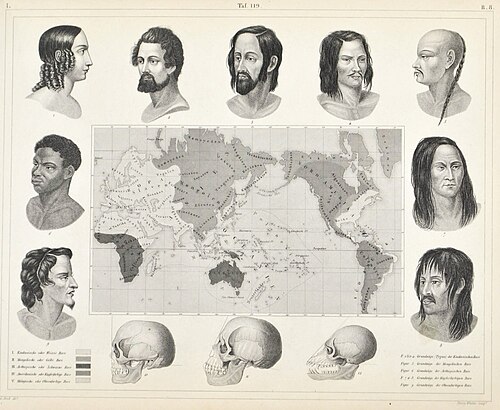
In the 1730s, Carl Linnaeus in his introduction of systematic taxonomy recognized four main human subspecies, termed Americanus (Americans), Europaeus (Europeans), Asiaticus (Asians) and Afer (Africans). The physical appearance of each type is briefly described, including colour adjectives referring to skin and hair colour: rufus "red" and pilis nigris "black hair" for Americans, albus "white" and pilis flavescentibus "yellowish hair" for Europeans, luridus "yellowish, sallow", pilis nigricantibus "swarthy hair" for Asians, and niger "black", pilis atris "coal-black hair" for Africans.[9]
The views of Johann Friedrich Blumenbach on the categorization of the major races of mankind developed over the course of the 1770s to 1820s. He introduced a four-fold division in 1775, extended to five in 1779, later borne out in his work on craniology (Decas craniorum, published during 1790–1828). He also used color as the name or main label of the races but as part of the description of their physiology. Blumenbach does not name his five groups in 1779 but gives their geographic distribution. The color adjectives used in 1779 are weiss "white" (Caucasian race), gelbbraun "yellow-brown" (Mongolian race), schwarz "black" (Aethiopian race), kupferrot "copper-red" (American race) and schwarzbraun "black-brown" (Malayan race).[10] Blumenbach belonged to a group known as the Göttingen school of history, which helped to popularize his ideas.
Blumenbach's division and choice of color-adjectives remained influential throughout the 19th and early 20th centuries, with variation depending on author. René Lesson in 1847 presented a division into six groups based on simple color adjectives: White (Caucasian), Dusky (South Asian), Orange (Austronesian), Yellow (East Asian), Red (Indigenous American), Black (African).[11] According to Barkhaus (2006)[12] it was the adoption of both the colour terminology and the French term race by Immanuel Kant in 1775 which proved influential. Kant published an essay Von den verschiedenen Racen der Menschen "On the diverse races of mankind" in 1775, based on the system proposed by Buffon, Histoire Naturelle, in which he recognized four groups, a "white" European race (Race der Weißen), a "black" Negroid race (Negerrace), a copper-red Kalmyk race (kalmuckishe Race) and an olive-yellow Indian race (Hinduische Race).[13]
Two historical anthropologists favored a binary racial classification system that divided people into a light skin and dark skin categories. 18th-century anthropologist Christoph Meiners, who first defined the Caucasian race, posited a "binary racial scheme" of two races with the Caucasian whose racial purity was exemplified by the "venerated... ancient Germans", although he considered some Europeans as impure "dirty whites"; and "Mongolians", who consisted of everyone else.[14] Meiners did not include the Jews as Caucasians and ascribed them a "permanently degenerate nature".[15] Hannah Franzieka identified 19th-century writers who believed in the "Caucasian hypothesis" and noted that "Jean-Julien Virey and Louis Antoine Desmoulins were well-known supports of the idea that Europeans came from Mount Caucasus."[16] In his political history of racial identity, Bruce Baum wrote, "Jean-Joseph Virey (1774–1847), a follower of Christoph Meiners, claimed that "the human races... may divided... into those who are fair and white and those who are dark or black."[17]

ロースロップ・ストッダードは『白人世界至上主義に対する有色人種の台頭』 (1920年)の中で、白人、黒人、黄色人種、褐色人種、アメリカ先住民(赤人種)の5つの人種を考察した。この明確に白人至上主義的な人種分類の説明では、「白人」のカテゴリーはブルーメンバッハの分類よりもはるかに限定的で、基本的にヨーロッパ人に限定されている一方、北アフリカ、西アジア、中央アジア、南アジアの非ヨーロッパ系コーカソイドのサブグループのために、別の「褐色」のカテゴリーが導入されている。[ 18 ]

第二次世界大戦後、生物学者や人類学者の間で、人種差別の政治的イデオロギーとの関連性から「人種」という用語の使用をやめる動きがますます強まった。そのため、 1950年代のユネスコの「人種問題」声明では、「人種」という概念の代わりに「民族集団」という用語を用いることが提案された。ヨーロッパ人種、モンゴロイド、ネグロイド、オーストラロイドといったカテゴリーは、法医学人類学などの分野では依然として使用されている。[ 19 ]
人種の区分は、多民族人口を抱える一部の国では公式の国勢調査の目的で依然として使用されており、米国では公式の区分が「黒人」、「白人」、「アジア人」、「ネイティブアメリカンおよびアラスカ先住民」、「ネイティブハワイアンおよびその他の太平洋諸島民」であり、英国では( 1991年以降)公式の区分が「白人」、「アジア人」、「黒人」となっている。[ 20 ]逆に、英語圏の国では、アジア人を指すのに「黄色」 、アメリカ大陸の先住民を指すのに「赤」を使用することは一般的ではない。これは、これらの用語が歴史的に否定的な意味合いを持つためである(例:黄禍論、レッドスキン)。[ 21 ] [ 22 ]しかし、一部のアジア人は「黄色」と自称することで、この言葉を取り戻そうと試みている。[ 23 ] [ 24 ]同様に、一部のネイティブアメリカンは「赤」という言葉を取り戻そうと試みている。[ 25 ]
色に基づく分類の多くは、米国の歴史のさまざまな時点で政治的に重要であったグループ(例えば、移民の波の一部)に関連しており、これらのカテゴリーには、中東や中央アジア出身の人々など、他のグループの人々に対する明確なラベルがありません。[ 26 ]しかし、英語圏の中東および南アジアの多くの人々は、肌の色がアイデンティティの中心であると考え、「ブラウン」と自認しています。[ 27 ] [ 28 ]多くのヒスパニック、特にメスティソは、 20世紀以来、ブロンズ人種(la raza de bronce )と自認しています。 [ 29 ]「オリーブ」という用語は、地中海ヨーロッパ人、西アジア人、ラテンアメリカ人、東南アジア人、北アフリカ人など、さまざまな人々を指すために使われることがあります。 [ 30 ]
マルティニーク生まれのフランス人フランツ・ファノンや、アフリカ系アメリカ人作家のラングストン・ヒューズ、マヤ・アンジェロウ、ラルフ・エリソンらは、「黒人」という言葉を取り巻く否定的な象徴が肯定的な象徴よりも多いと書いた。彼らは、白人と黒人に関連付けられた善悪の二元論が、無意識のうちに偏見に満ちた口語表現を形作っていると主張した。1970年代には、アメリカ合衆国で「黒人」という言葉が「ニグロ」に取って代わった。 [ 31 ]
社会によっては、肌の色の濃淡に敏感な人がいる。これは異人種間結婚や白皮症によるもので、権力や威信に影響を与えることがある。1930年代のハーレムのスラングでは、このような濃淡は「ハイ・ヤラー(黄色)、ヤラー、ハイ・ブラウン、ワセリン・ブラウン、シール・ブラウン、ロー・ブラウン、ダーク・ブラウン」というトーンスケールで表現されていた。[ 32 ]これらの用語は、ブルース音楽では、歌の歌詞や演奏者の名前で言及されることがあった。1920年代のジョージア州では、ウィリー・ペリーマンが兄のルーファスに続いてブルース・ピアニストになった。二人とも、肌の色が白く、赤みがかった髪で、視力の悪い白皮症の黒人だった。ルーファスはすでに「スペックルド・レッド」として有名だったが、ウィリーは「ピアノ・レッド」になった。[ 33 ]同じ州出身のピアニスト兼ギタリストのタンパ・レッドは、当時シカゴでキャリアを築いた。彼の名前は、彼の明るい肌の色、あるいは赤みがかった髪に由来するのかもしれない。
More recently such categorization has been noted in the Caribbean. It is reported that skin tones play an important role in defining how Barbadians view one another, and they use terms such as "brown skin, light skin, fair skin, high brown, red, and mulatto".[34] An assessment of racism in Trinidad notes people often being described by their skin tone, with the gradations being "HIGH RED – part White, part Black but 'clearer' than Brown-skin: HIGH BROWN – More white than Black, light skinned: DOUGLA – part Indian and part Black: LIGHT SKINNED, or CLEAR SKINNED Some Black, but more White: TRINI WHITE – Perhaps not all White, behaves like others but skin White".[35] In Jamaica, albinism has been stigmatized, but the albino dancehall singer Yellowman took his stage name in protest against such prejudice and has helped to end this stereotype.
Racial segregation in the United States was based on a binary classification, white vs. non-white, in which "white" was held to imply "purity" so that anyone with even the slightest amount of non-white ancestry was excluded from white privileges, and there could be no category of racially mixed people. In 1896 this doctrine was upheld in the Plessy v. Ferguson Supreme Court case. Traditionally the main distinction was between "white" and "black", but Japanese Americans could be accepted on both sides of the divide. As further racial groups were categorized, "white" became narrowly construed, and everyone else was categorised as a "person of color", suggesting that "white" people have no race, while racial subdivision of those "of color" was unimportant.[36]
At college campus protests during the 1960s, a "Flag of the Races" was in use, with five stripes comprising red, black, brown, yellow, and white tones.[37]
In the 2000 United States census, two of the five self-designated races are labeled by a color.[20] In the 2000 US Census, "White" refers to "person having origins in any of the original peoples of Europe, the Middle East, or North Africa."[20] In the 2000 US Census, "Black or African American" refers to a "person having origins in any of the Black racial groups of Africa."[20]
The other three self-designated races are not labeled by color.[20] This is due to historic negative associations of terms like "Yellow" (for East Asians) and "Red" (for Native Americans) with racism.[21][22] However, some Asian Americans and Native Americans have tried to reclaim these color terms by self-identifying as "Yellow" and "Red", respectively.[23][25]
Though not an official color or racial designation in the United States census, "Brown" has been used to describe certain peoples such as Arab Americans and Indian Americans.[27][28][38] Many Middle Eastern Americans have criticized the United States Census for denying them a racial designation, as they are classified as "White" by the United States census.[27] Furthermore, though Asian as a racial term in the United States groups together ethnically diverse Asian peoples such as the Chinese, Indians, Filipinos and Japanese, its common usage has been criticized for only referring to East Asians. This has led some South and Southeast Asian Americans to use the term "Brown Asian" to separate themselves from East Asian Americans.[28] Additionally, some Middle Eastern Americans will check “Asian” as their race, as technically, the region of the Middle East is located in Western Asia.
Ancestry, then, is a more subtle and complex description of an individual's genetic makeup than is race. This is in part a consequence of the continual mixing and migration of human populations throughout history. Because of this complex and interwoven history, many loci must be examined to derive even an approximate portrayal of individual ancestry.
[O]ngoing contacts, plus the fact that we were a small, genetically homogeneous species to begin with, has resulted in relatively close genetic relationships, despite our worldwide presence. The DNA differences between humans increase with geographical distance, but boundaries between populations are, as geneticists Kenneth Weiss and Jeffrey Long put it, "multilayered, porous, ephemeral, and difficult to identify." Pure, geographically separated ancestral populations are an abstraction: "There is no reason to think that there ever were isolated, homogeneous parental populations at any time in our human past."
しかし、私たちはインディアナポリスで殺害されたブラウンや南アジア人のために同様に立ち上がらなかった。