機能分析における構成
線形代数および関連する 数学 の分野
において、 バランス 集合 、 円 集合 、または ベクトル空間 ( 絶対値 関数 を持つ 体 上) の 円板 は、 すべての スカラー が
け
{\displaystyle \mathbb {K} }
|
⋅
|
{\displaystyle |\cdot |}
S
{\displaystyle S}
1つの S ⊆ S
{\displaystyle aS\subseteq S}
1つの
{\displaystyle a}
|
1つの
|
≤ 1.
{\displaystyle |a|\leq 1.}
集合の バランスのとれた殻 または バランス のとれた包絡線 は、集合に含まれる最小のバランスのとれた集合であり、 集合の バランスのとれた核
は 、集合に含まれる最大のバランスのとれた集合である。
S
{\displaystyle S}
S 。
{\displaystyle S.}
S
{\displaystyle S}
S 。
{\displaystyle S.}
バランス集合は関数解析 において遍在する 。なぜなら、あらゆる 位相ベクトル空間 (TVS)における原点のあらゆる 近傍 には原点のバランス集合が含まれ、原点のあらゆる凸近傍には原点のバランス集合の凸近傍が含まれるからである (TVS が 局所的に凸でなくても)。この近傍は 開集合 または 閉集合 として選択することもできる 。
意味 を実数 体または 複素数 体 上の ベクトル空間と します 。
バツ
{\displaystyle X}
け
{\displaystyle \mathbb {K} }
表記
が集合で、が スカラーである とき、 任意のに対して、 およびととを
それぞれ、 半径が の 開球 と閉球を表すもの と し
、 ここで 、および を中心とする スカラー場の 閉球を 表すものとする。
場のあらゆるバランスのとれた部分集合は、 何らかのに対して 、またはの 形をとる。
S
{\displaystyle S}
1つの
{\displaystyle a}
B ⊆
け
{\displaystyle B\subseteq \mathbb {K} }
1つの S = { 1つの s : s ∈ S }
{\displaystyle aS=\{as:s\in S\}}
B S = { b s : b ∈ B 、 s ∈ S }
{\displaystyle BS=\{bs:b\in B,s\in S\}}
0 ≤ r ≤ ∞ 、
{\displaystyle 0\leq r\leq \infty ,}
B
r
= { 1つの ∈
け
:
|
1つの
|
< r }
そして
B
≤ r
= { 1つの ∈
け
:
|
1つの
|
≤ r } 。
{\displaystyle B_{r}=\{a\in \mathbb {K} :|a|<r\}\qquad {\text{ かつ }}\qquad B_{\leq r}=\{a\in \mathbb {K} :|a|\leq r\}.}
r
{\displaystyle r}
け
{\displaystyle \mathbb {K} }
0
{\displaystyle 0}
B
0
= ∅ 、
B
≤ 0
= { 0 } 、
{\displaystyle B_{0}=\varnothing ,B_{\leq 0}=\{0\},}
B
∞
=
B
≤ ∞
=
け
。
{\displaystyle B_{\infty }=B_{\leq \infty }=\mathbb {K} .}
け
{\displaystyle \mathbb {K} }
B
≤ r
{\displaystyle B_{\leq r}}
B
r
{\displaystyle B_{r}}
0 ≤ r ≤ ∞ 。
{\displaystyle 0\leq r\leq \infty .}
バランスのとれたセット
の サブセット は
S
{\displaystyle S}
バツ
{\displaystyle X}
バランスのとれたセット 、または バランスがとれている とは、次の同等の条件のいずれかを満たす場合です。
定義 : すべて およびすべてのスカラー が満たす
1つの s ∈ S
{\displaystyle S}
s ∈ S
{\displaystyle s\in S}
1つの
{\displaystyle a}
|
1つの
|
≤ 1.
{\displaystyle |a|\leq 1.}
1つの S ⊆ S
{\displaystyle aS\subseteq S}
を満たす すべてのスカラーについて
1つの
{\displaystyle a}
|
1つの
|
≤ 1.
{\displaystyle |a|\leq 1.}
B
≤ 1
S ⊆ S
{\displaystyle B_{\leq 1}S\subseteq S}
(どこ )。
B
≤ 1
:= { 1つの ∈
け
:
|
1つの
|
≤ 1 }
{\displaystyle B_{\leq 1}:=\{a\in \mathbb {K} :|a|\leq 1\}}
S =
B
≤ 1
S 。
{\displaystyle S=B_{\leq 1}S.}
すべての
s ∈ S 、
{\displaystyle s\in S,}
S ∩
け
s =
B
≤ 1
( S ∩
け
s ) 。
{\displaystyle S\cap \mathbb {K} s=B_{\leq 1}(S\cap \mathbb {K} s).}
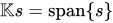
け
s = スパン { s }
{\displaystyle \mathbb {K} s=\operatorname {span} \{s\}}
は、 ( の場合 )または ( の場合 )次元ベクトル部分空間である。
0
{\displaystyle 0}
s = 0
{\displaystyle s=0}
1
{\displaystyle 1}
s ≠ 0
{\displaystyle s\neq 0}
バツ 。
{\displaystyle X.}
すると 、上記の等式は となり、 これは集合が均衡であるための前述の条件 とまったく同じです。したがって、 は、すべての に対して が均衡集合である場合に限り均衡となります (前述の定義条件のいずれかに従って)。
R := S ∩
け
s
{\displaystyle R:=S\cap \mathbb {K} s}
R =
B
≤ 1
R 、
{\displaystyle R=B_{\leq 1}R,}
S
{\displaystyle S}
s ∈ S 、
{\displaystyle s\in S,}
S ∩
け
s
{\displaystyle S\cap \mathbb {K} s}
のすべての 1 次元ベクトル部分空間 は、 (この定義条件以外の任意の定義条件に従って)バランスの取れた集合です。
はい
{\displaystyle Y}
スパン S 、
{\displaystyle \operatorname {span} S,}
S ∩ はい
{\displaystyle S\cap Y}
任意 のに対して 、 または
s ∈ S 、
{\displaystyle s\in S,}
0 ≤ r ≤ ∞
{\displaystyle 0\leq r\leq \infty }
S ∩
け
s =
B
r
s
{\displaystyle S\cap \mathbb {K} s=B_{r}s}
S ∩
け
s =
B
≤ r
s 。
{\displaystyle S\cap \mathbb {K} s=B_{\leq r}s.}
S
{\displaystyle S}
は、(これ以外の「バランスの取れた」の定義条件に従って)
バランスの取れたサブセットです。
スパン S
{\displaystyle \operatorname {span} S}
したがって、が の バランスのとれた部分集合である 場合、かつそれが を 含む体上の任意の(同値で、いくつかの)ベクトル空間のバランスのとれた部分集合である場合に限ります。したがって、 体の内容が 文脈から明らかであると仮定すると、 ベクトル空間について言及せずに「 はバランスがとれている」と書くことが正当化されます。 [注 1]
S
{\displaystyle S}
バツ
{\displaystyle X}
け
{\displaystyle \mathbb {K} }
S 。
{\displaystyle S.}
け
{\displaystyle \mathbb {K} }
S
{\displaystyle S}
が凸集合 である 場合 、このリストは以下を含むように拡張できます。
S
{\displaystyle S}
1つの S ⊆ S
{\displaystyle aS\subseteq S}
を満たす すべてのスカラーに対して
1つの
{\displaystyle a}
|
1つの
|
= 1.
{\displaystyle |a|=1.}
その場合 、このリストは次のように拡張される可能性があります:
け
=
R
{\displaystyle \mathbb {K} =\mathbb {R} }
S
{\displaystyle S}
対称的 (つまり )で あり、
− S = S
{\displaystyle -S=S}
[ 0 、 1 ) S ⊆ S 。
{\displaystyle [0,1)S\subseteq S.}
バランスのとれた船体
バル S
=
⋃
|
1つの
|
≤ 1
1つの S =
B
≤ 1
S
{\displaystyle \operatorname {bal} S~=~\bigcup _{|a|\leq 1}aS=B_{\leq 1}S}
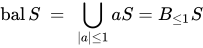
の で表される の サブセットのバランスの とれた包は、 次のいずれかの同等の方法で定義されます。
S
{\displaystyle S}
X
,
{\displaystyle X,}
bal
S
,
{\displaystyle \operatorname {bal} S,}
定義 :は、 を含む 最小の( に関して )バランスのとれた部分集合です。
bal
S
{\displaystyle \operatorname {bal} S}
⊆
{\displaystyle \,\subseteq \,}
X
{\displaystyle X}
S
.
{\displaystyle S.}
bal
S
{\displaystyle \operatorname {bal} S}
は、以下を含むすべてのバランスのとれた集合の 共通部分 である。
S
.
{\displaystyle S.}
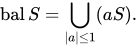
bal
S
=
⋃
|
a
|
≤
1
(
a
S
)
.
{\displaystyle \operatorname {bal} S=\bigcup _{|a|\leq 1}(aS).}
bal
S
=
B
≤
1
S
.
{\displaystyle \operatorname {bal} S=B_{\leq 1}S.}
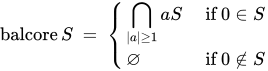
バランスのとれたコア
balcore
S
=
{
⋂
|
a
|
≥
1
a
S
if
0
∈
S
∅
if
0
∉
S
{\displaystyle \operatorname {balcore} S~=~{\begin{cases}\displaystyle \bigcap _{|a|\geq 1}aS&{\text{ if }}0\in S\\\varnothing &{\text{ if }}0\not \in S\\\end{cases}}}
の で表される の サブセットのバランスの とれたコアは 、次のいずれかの同等の方法で定義されます。
S
{\displaystyle S}
X
,
{\displaystyle X,}
balcore
S
,
{\displaystyle \operatorname {balcore} S,}
定義 : は、 の最大の( に関して )バランスの取れた部分集合です。
balcore
S
{\displaystyle \operatorname {balcore} S}
⊆
{\displaystyle \,\subseteq \,}
S
.
{\displaystyle S.}
balcore
S
{\displaystyle \operatorname {balcore} S}
は、すべてのバランスの取れた部分集合の和集合である。
S
.
{\displaystyle S.}
balcore
S
=
∅
{\displaystyle \operatorname {balcore} S=\varnothing }
もしも 、 もしも
0
∉
S
{\displaystyle 0\not \in S}
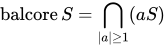
balcore
S
=
⋂
|
a
|
≥
1
(
a
S
)
{\displaystyle \operatorname {balcore} S=\bigcap _{|a|\geq 1}(aS)}
0
∈
S
.
{\displaystyle 0\in S.}
例 空集合は バランス の取れた集合です。任意の(実数または複素数) ベクトル空間 の任意のベクトル部分空間も同様です。特に、 は常にバランスの取れた集合です。
{
0
}
{\displaystyle \{0\}}
原点を含まない空でない集合はバランスが取れておらず、さらに、そのような集合のバランスの取れたコアは空集合と等しくなります。
ノルムベクトル空間と位相ベクトル空間
ノルムベクトル空間 内の原点を中心とする開いた 球 と閉じた球は 、バランスの取れた集合です。 が ベクトル空間上の 半ノルム (または ノルム )である場合 、任意の定数に対して 集合は バランスが取れています。
p
{\displaystyle p}
X
{\displaystyle X}
c
>
0
,
{\displaystyle c>0,}
{
x
∈
X
:
p
(
x
)
≤
c
}
{\displaystyle \{x\in X:p(x)\leq c\}}
が任意の部分集合である 場合、はバランスの とれ た集合である。特に、 が 位相ベクトル空間 における原点の任意の バランスのとれた 近傍である場合、
S
⊆
X
{\displaystyle S\subseteq X}
B
1
:=
{
a
∈
K
:
|
a
|
<
1
}
{\displaystyle B_{1}:=\{a\in \mathbb {K} :|a|<1\}}
B
1
S
{\displaystyle B_{1}S}
U
⊆
X
{\displaystyle U\subseteq X}
X
{\displaystyle X}
Int
X
U
⊆
B
1
U
=
⋃
0
<
|
a
|
<
1
a
U
⊆
U
.
{\displaystyle \operatorname {Int} _{X}U~\subseteq ~B_{1}U~=~\bigcup _{0<|a|<1}aU~\subseteq ~U.}
バランスセット と
R
{\displaystyle \mathbb {R} }
C
{\displaystyle \mathbb {C} }
を実数体 または 複素数 体 とし、 を上の 絶対値 を表し 、 を 上のベクトル空間を表すものとします 。したがって、たとえば、 が 複素数体である場合、 は 1 次元の複素ベクトル空間ですが、 である場合、 は 1 次元の実ベクトル空間です。
K
{\displaystyle \mathbb {K} }
R
{\displaystyle \mathbb {R} }
C
,
{\displaystyle \mathbb {C} ,}
|
⋅
|
{\displaystyle |\cdot |}
K
,
{\displaystyle \mathbb {K} ,}
X
:=
K
{\displaystyle X:=\mathbb {K} }
K
.
{\displaystyle \mathbb {K} .}
K
:=
C
{\displaystyle \mathbb {K} :=\mathbb {C} }
X
=
K
=
C
{\displaystyle X=\mathbb {K} =\mathbb {C} }
K
:=
R
{\displaystyle \mathbb {K} :=\mathbb {R} }
X
=
K
=
R
{\displaystyle X=\mathbb {K} =\mathbb {R} }
のバランスの取れた部分集合は 次のようになる:
X
=
K
{\displaystyle X=\mathbb {K} }
∅
{\displaystyle \varnothing }
X
{\displaystyle X}
{
0
}
{\displaystyle \{0\}}
{
x
∈
X
:
|
x
|
<
r
}
{\displaystyle \{x\in X:|x|<r\}}
本当の意味で
r
>
0
{\displaystyle r>0}
{
x
∈
X
:
|
x
|
≤
r
}
{\displaystyle \{x\in X:|x|\leq r\}}
本当の意味で
r
>
0.
{\displaystyle r>0.}
その結果、すべてのスカラー セットのバランスの取れたコアとバランスの取れたハルは、上記のセットのいずれかに等しくなります。
バランスの取れた集合は 、それ自身、空集合、およびゼロを中心とする開いた円盤と閉じた円盤です。対照的に、2 次元ユークリッド空間には、より多くのバランスの取れた集合が存在します。つまり、原点を中点とする任意の線分が適しています。その結果、 スカラー乗算 に関する限り、 とはまったく異なります 。
C
{\displaystyle \mathbb {C} }
C
{\displaystyle \mathbb {C} }
R
2
{\displaystyle \mathbb {R} ^{2}}
バランスセット
R
2
{\displaystyle \mathbb {R} ^{2}}
全体を通して、 (したがって は 上のベクトル空間 )とし、 は 原点を中心とする 内
の閉じた単位球とします。
X
=
R
2
{\displaystyle X=\mathbb {R} ^{2}}
X
{\displaystyle X}
R
{\displaystyle \mathbb {R} }
B
≤
1
{\displaystyle B_{\leq 1}}
X
{\displaystyle X}
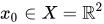
がゼロでない 場合、 集合は の原点の閉じた対称でバランスの とれ た近傍になります。より一般的には、 が の任意 の閉じた部分集合 で、 が の 原点の閉じた対称でバランスのとれた近傍になる場合、この例は 任意の整数に対して に一般化できます。
x
0
∈
X
=
R
2
{\displaystyle x_{0}\in X=\mathbb {R} ^{2}}
L
:=
R
x
0
,
{\displaystyle L:=\mathbb {R} x_{0},}
R
:=
B
≤
1
∪
L
{\displaystyle R:=B_{\leq 1}\cup L}
X
.
{\displaystyle X.}
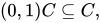
C
{\displaystyle C}
X
{\displaystyle X}
(
0
,
1
)
C
⊆
C
,
{\displaystyle (0,1)C\subseteq C,}
S
:=
B
≤
1
∪
C
∪
(
−
C
)
{\displaystyle S:=B_{\leq 1}\cup C\cup (-C)}
X
.
{\displaystyle X.}
R
n
{\displaystyle \mathbb {R} ^{n}}
n
≥
1.
{\displaystyle n\geq 1.}
を、点と 点の間の線分と、点 と点 の間の線分の和集合と します。 このとき、 はバランスが取れていますが凸ではありません。 も吸収的です( は ベクトル空間全体である
にもかかわらず)。
B
⊆
R
2
{\displaystyle B\subseteq \mathbb {R} ^{2}}
(
−
1
,
0
)
{\displaystyle (-1,0)}
(
1
,
0
)
{\displaystyle (1,0)}
(
0
,
−
1
)
{\displaystyle (0,-1)}
(
0
,
1
)
.
{\displaystyle (0,1).}
B
{\displaystyle B}
B
{\displaystyle B}
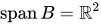
span
B
=
R
2
{\displaystyle \operatorname {span} B=\mathbb {R} ^{2}}
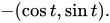
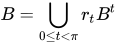
あらゆる に対して、は 任意の 正の実数、 は 点と の間 の (開線または閉線)線分とします。 この場合、集合は 平衡かつ吸収集合ですが、必ずしも凸集合であるとは限りません。
0
≤
t
≤
π
,
{\displaystyle 0\leq t\leq \pi ,}
r
t
{\displaystyle r_{t}}
B
t
{\displaystyle B^{t}}
X
:=
R
2
{\displaystyle X:=\mathbb {R} ^{2}}
(
cos
t
,
sin
t
)
{\displaystyle (\cos t,\sin t)}
−
(
cos
t
,
sin
t
)
.
{\displaystyle -(\cos t,\sin t).}
B
=
⋃
0
≤
t
<
π
r
t
B
t
{\displaystyle B=\bigcup _{0\leq t<\pi }r_{t}B^{t}}
閉集合の平衡包は必ずしも 閉じている必要はない。例えば、
x
y
=
1
{\displaystyle xy=1}
X
=
R
2
.
{\displaystyle X=\mathbb {R} ^{2}.}
次の例は、凸集合の平衡包が凸にならない場合があることを示しています (ただし、平衡集合の凸包は常に平衡です)。 たとえば、凸部分集合を とし、これは の軸の 上にある水平の閉じた線分です。 平衡包は、 非凸部分集合で、「 砂時計型」であり、2 つの閉じた塗りつぶされた 二等辺三角形 と の和集合に等しくなります。 ここで 、 と は、 頂点が原点と の端点を合わせたものである塗りつぶされた三角形です (言い換えると、は の 凸包 であり 、 は の凸包 です )。
S
:=
[
−
1
,
1
]
×
{
1
}
,
{\displaystyle S:=[-1,1]\times \{1\},}
x
−
{\displaystyle x-}
X
:=
R
2
.
{\displaystyle X:=\mathbb {R} ^{2}.}
bal
S
{\displaystyle \operatorname {bal} S}
T
1
{\displaystyle T_{1}}
T
2
,
{\displaystyle T_{2},}
T
2
=
−
T
1
{\displaystyle T_{2}=-T_{1}}
T
1
{\displaystyle T_{1}}
S
{\displaystyle S}
T
1
{\displaystyle T_{1}}
S
∪
{
(
0
,
0
)
}
{\displaystyle S\cup \{(0,0)\}}
T
2
{\displaystyle T_{2}}
(
−
S
)
∪
{
(
0
,
0
)
}
{\displaystyle (-S)\cup \{(0,0)\}}
十分な条件 セットがバランスの取れた状態になるのは、バランスの取れたハル またはバランスの取れたコアと 等しい場合のみです。バランスの取れたコアと 等しい場合は、次の 3 つのセットはすべて等しくなります。
T
{\displaystyle T}
bal
T
{\displaystyle \operatorname {bal} T}
balcore
T
,
{\displaystyle \operatorname {balcore} T,}
T
=
bal
T
=
balcore
T
.
{\displaystyle T=\operatorname {bal} T=\operatorname {balcore} T.}
バランスの 取れた集合の族の直積は、対応するベクトル空間の積空間(同じ体上)でバランスが取れ て い ます 。
K
{\displaystyle \mathbb {K} }
コンパクトな (それぞれ、 完全に有界な 、 有界な )集合のバランスのとれた包は 同じ性質を持つ。 均衡集合の凸包は凸かつ均衡です(つまり、 絶対的に凸 です)。ただし、凸集合の均衡包は凸ではない場合があります(反例が上記に示されています)。 バランスの取れた集合の任意の和 集合はバランスが取れており、バランスの取れた集合の任意の 積集合 についても同様です 。 バランスのとれた集合の スカラー倍数と(有限の) ミンコフスキー和は再びバランスがとれます。 線型写像 による平衡集合の像と逆像は 再び平衡になります。明示的には、 が 線型写像で、 と が 平衡集合である場合、 と は 平衡集合になります。
L
:
X
→
Y
{\displaystyle L:X\to Y}
B
⊆
X
{\displaystyle B\subseteq X}
C
⊆
Y
{\displaystyle C\subseteq Y}
L
(
B
)
{\displaystyle L(B)}
L
−
1
(
C
)
{\displaystyle L^{-1}(C)}
バランスの取れた近隣 任意の位相ベクトル空間 において 、平衡集合の閉包は平衡である。 平衡集合の原点 と 位相内部との和集合は平衡である。したがって、原点の平衡 近傍 の位相内部は 平衡である。 [証明 1] しかし、 は 原点を含む の平衡部分集合である が、その (空でない) 位相内部には原点が含まれず、したがって平衡集合ではない。 同様に、実ベクトル空間について、 が の凸包を表し 、 ( これらの 3 点を頂点とする塗りつぶされた 三角形 ) を表す場合、 は の( 砂時計 型の) 平衡部分集合であり 、その空でない位相内部には原点が含まれず、したがって平衡集合ではない (原点を加えて形成される集合は 平衡であるが、開集合でも原点の近傍でもない)。
{
0
}
{\displaystyle \{0\}}
{
(
z
,
w
)
∈
C
2
:
|
z
|
≤
|
w
|
}
{\displaystyle \left\{(z,w)\in \mathbb {C} ^{2}:|z|\leq |w|\right\}}
X
=
C
2
{\displaystyle X=\mathbb {C} ^{2}}
(
0
,
0
)
∈
X
{\displaystyle (0,0)\in X}
T
{\displaystyle T}
(
0
,
0
)
{\displaystyle (0,0)}
(
±
1
,
1
)
{\displaystyle (\pm 1,1)}
B
:=
T
∪
(
−
T
)
{\displaystyle B:=T\cup (-T)}
X
:=
R
2
{\displaystyle X:=\mathbb {R} ^{2}}
{
(
0
,
0
)
}
∪
Int
X
B
{\displaystyle \{(0,0)\}\cup \operatorname {Int} _{X}B}
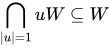
位相ベクトル空間 における原点のすべての近傍(それぞれ凸近傍) には、原点のバランスの取れた(それぞれ凸かつバランスの取れた)開近傍が含まれます。実際、次の構成により、このようなバランスの取れた集合が生成されます。 対称 集合 が与えられ、これが に対して成り立つときはいつでも、 は凸(それぞれ、閉じた、バランスの取れた、有界 な 、原点の近傍、 の 吸収部分 集合)になります。 が原点で 星型 である 場合、それはバランスの取れた集合になります。 [注 2] これは、たとえば が凸で を含む場合、真になります。 特に、 が原点の凸近傍である場合、 は原点の バランスの取れた 凸近傍になり 、そのためその 位相的な内部は原点のバランスの取れた 凸開 近傍 になります 。
X
{\displaystyle X}
W
⊆
X
,
{\displaystyle W\subseteq X,}
⋂
|
u
|
=
1
u
W
⊆
W
{\displaystyle \bigcap _{|u|=1}uW\subseteq W}
X
{\displaystyle X}
W
.
{\displaystyle W.}
W
{\displaystyle W}
W
{\displaystyle W}
0.
{\displaystyle 0.}
W
{\displaystyle W}
⋂
|
u
|
=
1
u
W
{\displaystyle \bigcap _{|u|=1}uW}
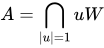
証拠 と を定義します ( ここで はスカラー 体の元を表します )。 をとると、 が 凸であれば も (凸集合の交差は凸であるため)、したがって の内部も であることがわかります。 で あれ ば
であり
、したがって が 原点において星型である場合 [注 2] 、任意の も( に対して ) であり、これは任意の に対して となることを意味し、
したがって が 釣り合っていることを証明します。 が凸であり、原点を含む場合、 は原点において星型であり、したがって は 釣り合っていることになります。
0
∈
W
⊆
X
{\displaystyle 0\in W\subseteq X}
A
=
⋂
|
u
|
=
1
u
W
{\displaystyle A=\bigcap _{|u|=1}uW}
u
{\displaystyle u}
K
{\displaystyle \mathbb {K} }
u
:=
1
{\displaystyle u:=1}
A
⊆
W
.
{\displaystyle A\subseteq W.}
W
{\displaystyle W}
A
{\displaystyle A}
A
{\displaystyle A}
|
s
|
=
1
{\displaystyle |s|=1}
s
A
=
⋂
|
u
|
=
1
s
u
W
⊆
⋂
|
u
|
=
1
u
W
=
A
{\displaystyle sA=\bigcap _{|u|=1}suW\subseteq \bigcap _{|u|=1}uW=A}
s
A
=
A
.
{\displaystyle sA=A.}
W
{\displaystyle W}
u
W
{\displaystyle uW}
|
u
|
=
1
{\displaystyle |u|=1}
0
≤
r
≤
1
,
{\displaystyle 0\leq r\leq 1,}
r
A
=
⋂
|
u
|
=
1
r
u
W
⊆
⋂
|
u
|
=
1
u
W
=
A
{\displaystyle rA=\bigcap _{|u|=1}ruW\subseteq \bigcap _{|u|=1}uW=A}
A
{\displaystyle A}
W
{\displaystyle W}
A
{\displaystyle A}
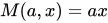
ここで、が における原点の近傍であると仮定します。 スカラー乗法 ( によって定義される )は 原点で連続で あり、 の積位相 における 原点の 基本的な開 近傍 ( および) が存在するため、 集合はバランスが取れて おり 、 と書けるため、これも開いています。
ここで、 は常に原点の開近傍です。
最後に、
は も原点の近傍である
ことを示しています。 が バランスが取れている場合、その内部に 原点が含まれているため、 もバランスが取れています。 が凸である場合、 は 凸かつバランスが取れているため、 についても同じことが言えます。
W
{\displaystyle W}
X
.
{\displaystyle X.}
M
:
K
×
X
→
X
{\displaystyle M:\mathbb {K} \times X\to X}
M
(
a
,
x
)
=
a
x
{\displaystyle M(a,x)=ax}
(
0
,
0
)
∈
K
×
X
{\displaystyle (0,0)\in \mathbb {K} \times X}
M
(
0
,
0
)
=
0
∈
W
,
{\displaystyle M(0,0)=0\in W,}
B
r
×
V
{\displaystyle B_{r}\times V}
r
>
0
{\displaystyle r>0}
B
r
:=
{
c
∈
K
:
|
c
|
<
r
}
{\displaystyle B_{r}:=\{c\in \mathbb {K} :|c|<r\}}
K
×
X
{\displaystyle \mathbb {K} \times X}
M
(
B
r
×
V
)
⊆
W
;
{\displaystyle M\left(B_{r}\times V\right)\subseteq W;}
M
(
B
r
×
V
)
=
B
r
V
{\displaystyle M\left(B_{r}\times V\right)=B_{r}V}
B
r
V
=
⋃
|
a
|
<
r
a
V
=
⋃
0
<
|
a
|
<
r
a
V
(since
0
⋅
V
=
{
0
}
⊆
a
V
)
{\displaystyle B_{r}V=\bigcup _{|a|<r}aV=\bigcup _{0<|a|<r}aV\qquad {\text{ (since }}0\cdot V=\{0\}\subseteq aV{\text{ )}}}
a
V
{\displaystyle aV}
a
≠
0.
{\displaystyle a\neq 0.}
A
=
⋂
|
u
|
=
1
u
W
⊇
⋂
|
u
|
=
1
u
B
r
V
=
⋂
|
u
|
=
1
B
r
V
=
B
r
V
{\displaystyle A=\bigcap _{|u|=1}uW\supseteq \bigcap _{|u|=1}uB_{r}V=\bigcap _{|u|=1}B_{r}V=B_{r}V}
A
{\displaystyle A}
A
{\displaystyle A}
Int
X
A
{\displaystyle \operatorname {Int} _{X}A}
Int
X
A
{\displaystyle \operatorname {Int} _{X}A}
W
{\displaystyle W}
A
{\displaystyle A}
Int
X
A
.
{\displaystyle \operatorname {Int} _{X}A.}
◼
{\displaystyle \blacksquare }
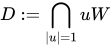
が の凸かつ 吸収部分 集合であると仮定すると 、 は の 凸平衡 吸収部分 集合となり、これ により の ミンコフスキー関数が 上の 半ノルム に なること が保証され 、それにより は 標準 擬似測度化可能位相を保持する 半ノルム空間 になります。 上の範囲(または を 極限点として 持つ他の任意の非ゼロのスカラー集合上) として のスカラー倍数の集合は、この 局所凸 位相の原点で吸収 ディスク の近傍基を形成します。 が位相 ベクトル空間 であり 、この凸吸収部分集合 が の 有界部分集合 でもある場合 、同じことが吸収ディスクにも当てはまります。 さらに が 非自明なベクトル部分空間を含まない場合、 は ノルム となり 、 補助ノルム空間 と呼ばれるものを形成します 。 このノルム空間が バナッハ空間 である場合、 は バナッハディスク と呼ばれます 。
W
{\displaystyle W}
X
.
{\displaystyle X.}
D
:=
⋂
|
u
|
=
1
u
W
{\displaystyle D:=\bigcap _{|u|=1}uW}
X
,
{\displaystyle X,}
p
D
:
X
→
R
{\displaystyle p_{D}:X\to \mathbb {R} }
D
{\displaystyle D}
X
,
{\displaystyle X,}
(
X
,
p
D
)
{\displaystyle \left(X,p_{D}\right)}
r
D
{\displaystyle rD}
r
{\displaystyle r}
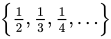
{
1
2
,
1
3
,
1
4
,
…
}
{\displaystyle \left\{{\tfrac {1}{2}},{\tfrac {1}{3}},{\tfrac {1}{4}},\ldots \right\}}
0
{\displaystyle 0}
X
{\displaystyle X}
W
{\displaystyle W}
X
,
{\displaystyle X,}
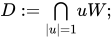
D
:=
⋂
|
u
|
=
1
u
W
;
{\displaystyle D:={\textstyle \bigcap \limits _{|u|=1}}uW;}
D
{\displaystyle D}
p
D
{\displaystyle p_{D}}
(
X
,
p
D
)
{\displaystyle \left(X,p_{D}\right)}
D
{\displaystyle D}
プロパティ バランス集合の特性
バランスのとれた集合が空でないのは、原点が含まれている場合のみです。定義により、集合が 絶対凸となる のは、 凸かつ バランスがとれている場合のみです。すべてのバランスのとれた集合は 星形 (0 において) で、 対称集合 です。が のバランスのとれた部分集合である場合 、次のようになります。
B
{\displaystyle B}
X
{\displaystyle X}
任意のスカラーに対して 、 かつ の 場合 、 かつ したがって および が任意のスカラーである場合、
c
{\displaystyle c}
d
,
{\displaystyle d,}
|
c
|
≤
|
d
|
{\displaystyle |c|\leq |d|}
c
B
⊆
d
B
{\displaystyle cB\subseteq dB}
c
B
=
|
c
|
B
.
{\displaystyle cB=|c|B.}
c
{\displaystyle c}
d
{\displaystyle d}
(
c
B
)
∩
(
d
B
)
=
min
{
|
c
|
,
|
d
|
}
B
.
{\displaystyle (cB)\cap (dB)=\min _{}\{|c|,|d|\}B.}
B
{\displaystyle B}
が吸収される のは、すべてのに対して、 次のもの が存在する 場合のみで ある
X
{\displaystyle X}
x
∈
X
,
{\displaystyle x\in X,}
r
>
0
{\displaystyle r>0}
x
∈
r
B
.
{\displaystyle x\in rB.}
集合の任意 の 1次元ベクトル部分空間は 凸かつ平衡である。が 空でなく、がの1次元ベクトル部分空間である場合、 は どちら かであり 、そう でなければ 吸収である。
Y
{\displaystyle Y}
X
,
{\displaystyle X,}
B
∩
Y
{\displaystyle B\cap Y}
B
{\displaystyle B}
Y
{\displaystyle Y}
span
B
{\displaystyle \operatorname {span} B}
B
∩
Y
{\displaystyle B\cap Y}
{
0
}
{\displaystyle \{0\}}
Y
.
{\displaystyle Y.}
任意の に対して、 が 複数の点を含む場合、この空間に ハウス ドルフユークリッド位相 が備わっているとき、それは 1 次元ベクトル空間内の の凸かつ均衡な近傍です 。また、集合 は 原点を含む 実ベクトル空間の凸均衡な部分集合です。
x
∈
X
,
{\displaystyle x\in X,}
B
∩
span
x
{\displaystyle B\cap \operatorname {span} x}
0
{\displaystyle 0}
span
x
{\displaystyle \operatorname {span} x}
B
∩
R
x
{\displaystyle B\cap \mathbb {R} x}
R
x
{\displaystyle \mathbb {R} x}
バランスのとれた船体とバランスのとれたコアの特性
任意のサブセットの 集合に対して
S
{\displaystyle {\mathcal {S}}}
X
,
{\displaystyle X,}
bal
(
⋃
S
∈
S
S
)
=
⋃
S
∈
S
bal
S
and
balcore
(
⋂
S
∈
S
S
)
=
⋂
S
∈
S
balcore
S
.
{\displaystyle \operatorname {bal} \left(\bigcup _{S\in {\mathcal {S}}}S\right)=\bigcup _{S\in {\mathcal {S}}}\operatorname {bal} S\quad {\text{ and }}\quad \operatorname {balcore} \left(\bigcap _{S\in {\mathcal {S}}}S\right)=\bigcap _{S\in {\mathcal {S}}}\operatorname {balcore} S.}
任意の位相ベクトル空間において、原点の任意の開近傍の平衡包は再び開包となる。が ハウス ドルフ位相ベクトル空間 であり 、 がのコンパクト部分集合である場合 、の平衡包は コンパクトである。
X
{\displaystyle X}
K
{\displaystyle K}
X
{\displaystyle X}
K
{\displaystyle K}
集合が閉じている場合(それぞれ、凸、 吸収 、原点の近傍)、そのバランスの取れたコアについても同じことが当てはまります。
任意の部分集合 と任意のスカラー
S
⊆
X
{\displaystyle S\subseteq X}
c
,
{\displaystyle c,}
bal
(
c
S
)
=
c
bal
S
=
|
c
|
bal
S
.
{\displaystyle \operatorname {bal} (c\,S)=c\operatorname {bal} S=|c|\operatorname {bal} S.}
任意のスカラーに対して この等式は 成立する の場合に限り成立する したがって の場合 または の 場合 に限り成立する
c
≠
0
,
{\displaystyle c\neq 0,}
balcore
(
c
S
)
=
c
balcore
S
=
|
c
|
balcore
S
.
{\displaystyle \operatorname {balcore} (c\,S)=c\operatorname {balcore} S=|c|\operatorname {balcore} S.}
c
=
0
{\displaystyle c=0}
S
⊆
{
0
}
.
{\displaystyle S\subseteq \{0\}.}
0
∈
S
{\displaystyle 0\in S}
S
=
∅
{\displaystyle S=\varnothing }
balcore
(
c
S
)
=
c
balcore
S
=
|
c
|
balcore
S
{\displaystyle \operatorname {balcore} (c\,S)=c\operatorname {balcore} S=|c|\operatorname {balcore} S}
c
.
{\displaystyle c.}
実数または複素数ベクトル空間上の 関数は、
p
:
X
→
[
0
,
∞
)
{\displaystyle p:X\to [0,\infty )}
バランスのとれた関数 とは、以下の同等の条件のいずれかを満たす関数である。
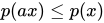
p
(
a
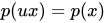
x
)
≤
p
(
x
)
{\displaystyle p(ax)\leq p(x)}
がスカラーで あり 、
a
{\displaystyle a}
|
a
|
≤
1
{\displaystyle |a|\leq 1}
x
∈
X
.
{\displaystyle x\in X.}
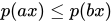
p
(
a
x
)
≤
p
(
b
x
)
{\displaystyle p(ax)\leq p(bx)}
と が スカラーであり 、
a
{\displaystyle a}
b
{\displaystyle b}
|
a
|
≤
|
b
|
{\displaystyle |a|\leq |b|}
x
∈
X
.
{\displaystyle x\in X.}
{
x
∈
X
:
p
(
x
)
≤
t
}
{\displaystyle \{x\in X:p(x)\leq t\}}
は、すべての非負実数に対してバランスのとれた集合である。
t
≥
0.
{\displaystyle t\geq 0.}
が釣り合いのとれた関数である場合、 すべてのスカラー とベクトルに対して が成り立ちます
。特に、すべての 単位長さの スカラー ( を満たす )とすべての に対して が成り立ちます。
を使用すると 、すべての釣り合いのとれた関数は 対称関数 であることが示されます。
p
{\displaystyle p}
p
(
a
x
)
=
p
(
|
a
|
x
)
{\displaystyle p(ax)=p(|a|x)}
a
{\displaystyle a}
x
∈
X
;
{\displaystyle x\in X;}
p
(
u
x
)
=
p
(
x
)
{\displaystyle p(ux)=p(x)}
u
{\displaystyle u}
|
u
|
=
1
{\displaystyle |u|=1}
x
∈
X
.
{\displaystyle x\in X.}
u
:=
−
1
{\displaystyle u:=-1}
実数値関数 が 半ノルムとなるのは、それがバランスのとれた 部分線形関数 である場合のみです 。
p
:
X
→
R
{\displaystyle p:X\to \mathbb {R} }
参照
参考文献
^ ある集合を含むすべてのベクトル空間が 同じ体上にあると仮定すると、その集合が「バランスが取れている」と記述するときに、 その集合を含むベクトル空間について言及する必要はありません。つまり、「 は の バランスの取れた部分集合 である」の代わりに「 はバランスが取れている 」と書くことができます。
S
{\displaystyle S}
S
.
{\displaystyle S.}
S
{\displaystyle S}
S
{\displaystyle S}
X
{\displaystyle X}
^ ab が原点で星型であるということは、 すべての場合において 、およびとなることを意味する 。
W
{\displaystyle W}
0
∈
W
{\displaystyle 0\in W}
r
w
∈
W
{\displaystyle rw\in W}
0
≤
r
≤
1
{\displaystyle 0\leq r\leq 1}
w
∈
W
.
{\displaystyle w\in W.}
証明
^ を バランスさせます 。その位相的内部が 空であればバランスが取れているので、そうでないと仮定して を スカラーとします。すると、 によって定義される 写像 は 同相写像 であり、これ は が開いている ためである ことを意味します。したがって、 残っているのは、 に対してこれが真であることを示すことだけです。 ただし、 は真ではない可能性がありますが、 が真である場合は は バランスが取れます。
B
⊆
X
{\displaystyle B\subseteq X}
Int
X
B
{\displaystyle \operatorname {Int} _{X}B}
|
s
|
≤
1
{\displaystyle |s|\leq 1}
s
≠
0
{\displaystyle s\neq 0}
X
→
X
{\displaystyle X\to X}
x
↦
s
x
{\displaystyle x\mapsto sx}
s
Int
X
B
=
Int
X
(
s
B
)
⊆
s
B
⊆
B
;
{\displaystyle s\operatorname {Int} _{X}B=\operatorname {Int} _{X}(sB)\subseteq sB\subseteq B;}
s
Int
X
B
{\displaystyle s\operatorname {Int} _{X}B}
s
Int
X
B
⊆
Int
X
B
{\displaystyle s\operatorname {Int} _{X}B\subseteq \operatorname {Int} _{X}B}
s
=
0.
{\displaystyle s=0.}
0
∈
Int
X
B
{\displaystyle 0\in \operatorname {Int} _{X}B}
Int
X
B
{\displaystyle \operatorname {Int} _{X}B}
◼
{\displaystyle \blacksquare }
出典 ブルバキ、ニコラス (1987) [1981]。 位相ベクトル空間: 第 1 章から第 5 章まで 。 数学的要素 。エグルストン、HG による翻訳。マダン、サウス・ベルリン、ニューヨーク: Springer-Verlag。 ISBN 3-540-13627-4 . OCLC 17499190. コンウェイ、ジョン (1990)。 関数解析コース 。 数学大学院テキスト。第 96 巻(第2版)。ニューヨーク: シュプリンガー・フェアラーク 。ISBN 978-0-387-97245-9 . OCLC 21195908. ダンフォード、ネルソン 、 シュワルツ、ジェイコブ T. (1988)。 線形演算子 。 純粋数学と応用数学。第 1 巻。ニューヨーク: ワイリー・インターサイエンス 。ISBN 978-0-471-60848-6 . OCLC 18412261. エドワーズ、ロバート E. (1995)。 関数解析: 理論と応用 。ニューヨーク: Dover Publications。ISBN 978-0-486-68143-6 . OCLC 30593138. ヤルコウ、ハンス (1981)。 局所的に凸状の空間 。シュトゥットガルト:BG・トイブナー。 ISBN 978-3-519-02224-4 . OCLC 8210342. ケーテ、ゴットフリート (1983) [1969]。 位相ベクトル空間 I . Grundlehren der mathematischen Wissenschaften。 Vol. 159. Garling、DJH ニューヨーク訳: Springer Science & Business Media。 ISBN 978-3-642-64988-2 . MR 0248498. OCLC 840293704. ケーテ、ゴットフリート (1979)。 位相ベクトル空間 II . Grundlehren der mathematischen Wissenschaften。 Vol. 237. ニューヨーク: Springer Science & Business Media。 ISBN 978-0-387-90400-9 . OCLC 180577972. ナリシ、ローレンス、ベッケンシュタイン、エドワード (2011)。 位相ベクトル空間 。純粋数学と応用数学 (第 2 版)。ボカラトン、フロリダ州: CRC プレス 。ISBN 978-1584888666 . OCLC 144216834. ロバートソン、アレックス P.; ロバートソン、ウェンディ J. (1980)。 位相 ベクトル空間 。ケンブリッジ数学論文集。第 53 巻。ケンブリッジ、イギリス: ケンブリッジ大学出版局 。ISBN 978-0-521-29882-7 . OCLC 589250. ルディン、ウォルター (1991)。関数解析。国際純粋・応用数学シリーズ。第 8 巻 (第 2 版)。ニューヨーク、NY: McGraw - Hill Science/Engineering/ Math。ISBN 978-0-07-054236-5 . OCLC 21163277. Schaefer, Helmut H. ; Wolff, Manfred P. (1999). Topological Vector Spaces . GTM . Vol. 8 (第 2 版). ニューヨーク、NY: Springer New York Imprint Springer. ISBN 978-1-4612-7155-0 . OCLC 840278135. シェクター、エリック(1996年10月24日)。分析とその基礎のハンドブック。アカデミックプレス 。ISBN 978-0-08-053299-8 。 スワーツ、チャールズ (1992)。 関数解析入門 。ニューヨーク: M. デッカー 。ISBN 978-0-8247-8643-4 . OCLC 24909067. トレヴ、フランソワ (2006) [1967]。 トポロジカル ベクトル空間、ディストリビューション、およびカーネル 。ニューヨーク州ミネオラ:ドーバー出版。 ISBN 978-0-486-45352-1 . OCLC 853623322. ウィランスキー、アルバート (2013)。 位相ベクトル空間における最新の手法 。ニューヨーク州ミネオラ: Dover Publications, Inc. ISBN 978-0-486-49353-4 . OCLC 849801114.


























































![{\displaystyle S:=[-1,1]\times \{1\},}](https://wikimedia.org/api/rest_v1/media/math/render/svg/cb10505772077602624c3a0b9f8cec7db7c70a61)