
Loading article…
ライトレールトランジットシステム(現地ではLRTという略称で知られている)は、シンガポールにある3つの旅客輸送システム群であり、重軌道の大量高速輸送システム(MRT)へのフィーダーサービスとして機能し、国の鉄道輸送サービスの核を形成している。
最初のLRT路線は1999年に開通し、その後、ブキッ・パンジャン、センカン、プンゴルの3つの新都市を結ぶ路線に拡張され、総延長は約30km (19マイル)に及んでいます。これらの路線を走る列車は、少なくとも1つの駅でMRTへの乗り換えが可能です。
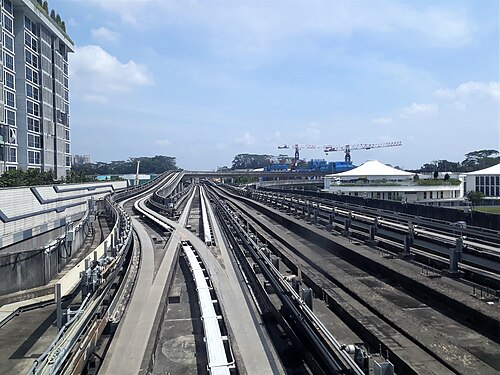
その名前とは裏腹に、このシステムは、部分的に立体交差した路面電車のような車両を用いた伝統的な意味でのライトレールではありません。 [ 2 ]代わりに、空港向けに開発された技術を基にした、ゴムタイヤの自動運転車両によるピープルムーバー技術を採用しています。LRTとチャンギ空港スカイトレインは技術的に非常に似ています。
MRTと同様に、LRTも陸上交通庁(LTA)が建設・所有しており、運営権は現在、 SMRTコーポレーションの子会社であるSMRT Trains Ltdと、ComfortDelGroの子会社であるSBS Transit Ltdに与えられている。シンガポールの2つのLRT路線が完成したため、現在、LRTネットワークをさらに拡張する計画はない。[ 3 ] [ 4 ]

1991年9月、都市再開発庁(URA)は、イシュンやタンピネスなどの新都市にサービスを提供できる新しいフィーダー鉄道の方式を提案した改訂版コンセプトプラン1991を発表した。このようなシステムは、既存のフィーダーバスよりも速い代替手段として、完全に自動化された高架式ライトレールシステムとなる予定だった。[ 5 ]
1994年、当時の通信大臣マハ・ボウ・タンは、シンガポールにおけるLRTの利用、特に新都市への内部フィーダーサービスとしての利用について調査するよう、マス・ラピッド・トランジット・コーポレーション(MRTC)に指示した。特に、ブキッ・パンジャンとセンカンの2つの都市について、LRTの実現可能性を調査することになっていた。MRTCはまた、サンテック・シティ、マリーナ・センター、シェントン・ウェイなどのいくつかの大規模開発により、この地域の交通サービスの需要が増加すると見込んで、英国のコンサルタント会社オスカー・ファーバーTPAに、ビーチ・ロード/ニコル・ハイウェイ回廊におけるLRTシステムの実現可能性調査を委託した。同年12月3日、マハは、ブキッ・パンジャンとブオナ・ビスタで2つのLRTシステムを試験的に導入するという政府の意向を発表した。トア・パヨなどのより成熟した都市にも新たなLRTシステムが提案されたが、さらなる決定は試験プログラムが実施された後に行われることになっていた。[ 5 ]結局、ブオナビスタ周辺のLRT計画は、鉄道路線の需要不足のため中止された。[ 5 ] [ 6 ]
1995年には、 HDB公営住宅の近くにLRTシステムを建設する実現可能性とLRTと他の公共交通機関との統合について調査するため、フランスのSKシステムとVéhicule Automatique Léger (VAL)システムへの視察旅行が行われ、また、シンガポール工科大学とシンガポール国立大学にそのようなシステムを導入する可能性について調査するため、ドイツのHバーン懸垂式モノレールシステムへの視察旅行が行われた。[ 5 ]
1996年、 1995年にMRTCを含む複数の運輸法定機関が合併して設立された陸上交通庁(LTA)は、シンガポールの世界クラスの交通システムに関する目標を概説した白書を発表した。その目標の一つは、LRTシステムをMRTネットワークへのフィーダーサービスとして活用すること、そして住民の利便性を最大化するためにLRT施設をHDB団地に統合することであった。[ 5 ]
政府は、LRTシステムをフィーダーサービスとして利用することに加えて、ベドック-タンピネス、アンモキオ-ビシャン-トアパヨ、ジュロン地区など、近隣の町同士を接続するためにLRTシステムを利用することの実現可能性についても調査した。[ 5 ]
A North Branch consisting of two to four LRT stations for the Punggol LRT line had been planned, which would have brought commuters from Punggol LRT station via Sam Kee and Teck Lee LRT station before branching out from the West Loop tracks onto this branch, terminating near Coney Island. The line code for the north branch would have been known as 'PN'. The branch was eventually never built and was only visible in the planning stages of Punggol LRT since 2000.[7] It was eventually replaced by more bus services and the Punggol Coast extension of the North East Line which includes Punggol Coast MRT station on the North East Line (NEL) to better serve commuters in the area. It is also the new terminus of the North East Line, replacing Punggol MRT/LRT station as the terminus.[8]
A light rail network was proposed in 2001 which would have served the western regions of Singapore such as Jurong. It was also envisioned to serve commuters travelling to Nanyang Technological University (NTU).[9] However, the LTA announced in 2008 that there were no plans for the line to be built.[10] The project was later revived with the release of the Land Transport Master Plan 2013, in the form of the Jurong Region MRT line. It is set to open in stages from 2028 to 2029.[11][12][13]
The Bukit Panjang LRT line opened on 6 November 1999, with all 14 stations opening at the same time. Ten Mile Junction LRT station was closed from 10 December 2010 till 30 December 2011 for retrofitting works due to the closure and redevelopment of Ten Mile Junction shopping mall (now known as Junction 10), making it the first MRT/LRT station to be completely closed in Singapore after opening. The station was closed permanently from 13 January 2019 due to low demand. The closure of the station also led to the cessation of Bukit Panjang LRT Service C, formerly running from this station and looping in Bukit Panjang town via Senja. The vacated station was converted to Ten Mile Junction Depot Extension. This was also the first ever MRT and LRT station in Singapore's history to be permanently closed and removed from operations. It is the first and only LRT line to be operated by SMRT Light Rail.
センカンLRT線は2つの主要な段階で開通し、まず2003年1月18日に東ループが開通し、2005年1月29日に西ループの大部分が開通しました。その後、西ループのファームウェイLRT駅が2007年11月15日に開通しました。2013年1月1日にはチェンリムLRT駅が旅客サービスを開始し、西ループは両方向で運行されるようになりました。[ 14 ]この路線で最後に開通したクパンLRT駅は、 2015年6月27日に旅客サービスを開始しました。[ 15 ]
プンゴルLRT線では、東ループはセンカンLRTの西ループと同じ日に運行を開始し、2つの駅が閉鎖されました。オアシスLRT駅は、駅周辺のHDBフラットに住民が増えた後、2007年6月15日に営業を開始しました。 [ 16 ]ダマイLRT駅は2011年6月20日に開業しました。[ 17 ]西ループは2014年6月29日午前11時15分に開業し、ニボン、スマン、スーテックが最初に開業した駅でした。[ 18 ]サムキー、プンゴルポイント、サムデラはそれぞれ2016年2月29日、2016年12月29日、2017年3月31日に開業しました。[ 19 ] [ 20 ]この路線で最後に開業する駅であるテックリーLRT駅は、 2024年8月15日に旅客サービスを開始しました。[ 21 ]
現在、既存の3路線を超えてLRTネットワークを拡張する計画はありません。比較的コスト効率が良く、調整しやすいバスと比較すると、LRTシステムは修正が難しく、長期的な影響が出る可能性があります。さらに、LTAは、LRTよりもフィーダーとしての役割を果たすサークル線やダウンタウン線などの中容量路線を追加してMRTネットワークを拡張することに重点を置いています。[ 22 ]
SMRTとLTAは、BPLRTシステムが耐用年数20年を迎えるにあたり、システム全体の全面的な改修計画を発表した。[ 23 ]運輸大臣のコー・ブーン・ワン氏も、システムの改修を円滑に進めるため、ブキット・パンジャンLRTを数年間閉鎖する計画を発表した。[ 24 ]
On 23 October 2017, SMRT announced that from 12 November 2017 till the end of the year, the BPLRT will begin operations later at 7am instead of 5.30am on all Sundays, to allow more time for track maintenance and renewal works, which will oversee the replacement of ageing rail mounting frames and rail expansion joints.[25]
On 23 March 2018, SMRT announced that the BPLRT will be closed on all Sundays from 15 April to 24 June 2018 to facilitate maintenance works, which will oversee the replacement of the power rail and track switch components.[26][27]
On 21 June 2018, SMRT announced that from 1 July to 28 October 2018, the BPLRT will begin operations later at 8am instead of 5.30am on all Sundays, to carry out intensified maintenance work.[28][29]
On 12 January 2019, Ten Mile Junction served its last passengers and closed on the next day, 13 January 2019. Service C, which served the station, was also withdrawn.
On 31 October 2012, LTA announced that by 2016, Sengkang and Punggol LRT systems will be upgraded to a two-car system for 16 of the 41 existing train cars, allowing double the number of passengers to board at any one time. Each train car can take up to 105 passengers. Hence, there is also the need to modify the signaling and communication system.[30]
On 22 December 2015, the two-car trains entered service on the Sengkang LRT line, boosting capacity to 204 per trip as compared to 105 in a single car configuration.[31]
As of 2017, two car trains have entered service on the Punggol LRT line.[19]
On 15 December 2017, the Land Transport Authority announced that there will be limited services on parts of the Sengkang-Punggol LRT (SPLRT) on most Sundays from 14 January 2018 to 25 February 2018, to facilitate renewal and improvement works from (except 18 February as it was a Chinese New Year holiday). Only one platform will open for service at 5.30am on Sundays. The other platform will open from 7am.[32][33][34] The arrangement continued until 29 April 2018.[35][36]
On 14 February 2018, the LTA announced that it has taken over SBS Transit's rail assets (the North East MRT line and Sengkang-Punggol LRT lines) worth $30.8 million and transit to the New Rail Financing Framework on 1 April 2018.[37] The LTA has also said that this will benefit commuters as there will be "more coordinated and timely expansion, and renewal of the rail system".[38]
From 27 May 2018 to 7 October 2018, limited services on Sundays will continue on the Sengkang-Punggol LRT (SPLRT). One platform will open at 5.30am and the other platform will open at 5.30pm.[39][40]
On 5 February 2021, the Land Transport Authority announced that it has purchased 17 two-car trains for the Sengkang and Punggol LRT systems. The new trains will be delivered progressively from 2024 to 2027. In addition to new trains, the Sengkang Depot will also be expanded to 11.1 ha from the existing 3.5 ha to ensure that is capacity and maintenance space for the new trains. The expansion of the depot will also see two new reception tracks being built to shorten the train launching time. To ensure there is enough electricity to support the larger fleet of trains, 3 new power stations will be built, increasing the total number of power stations supporting the system to 8 once completed.[41]
From 19 April to 18 October 2026, the Sengkang LRT West Loop will only operate in the direction via Renjong from Sengkang station. This is to facilitate viaduct connection works to the new extension of the Sengkang LRT Depot between Layar and Tongkang stations.[42][43]


LRTシステムは1990年代に建設されて以来、バリアフリー設備の計画は計画段階から既に盛り込まれています。43駅すべてにバリアフリー設備が備えられているため、高齢者や身体の不自由な方にとって不便はありません。バリアフリー設備には、エレベーター、スロープ、触覚誘導システム、幅広の改札口などが含まれます。これらのバリアフリー設備は、今後建設されるすべてのLRT駅にも設置される予定です。[ 44 ]
ブキット・パンジャンLRT線(BPLRT)はシンガポール初のライトレール路線です。全長7.6km 、13駅からなるこの路線は1999年に全線開通し、 SMRT Trains が運営する最初で唯一のLRT路線です。[ 45 ]
センカンLRT線(SKLRT)は、全長10.7kmの ライトレール路線で、2003年1月18日に一部開通しました。他の2路線とともにLRTシステムの一部となっています。東ループにはコンパスベールからラングンまでの5駅があり、すべて運行中です。一方、西ループにはチェンリムからレンジョンまでの8駅があります。2015年6月27日、クパン駅が開通し、センカンLRTで最後に開通した駅となりました。この地域でいくつかの新しい住宅開発が完了したため、12年ぶりに運行が可能になったと判断されました。[ 46 ]
プンゴルLRT線(PGLRT)は、シンガポールのLRTシステム内の他の2つの路線とともに、ライトレール路線です。全長10.3km、 15駅からなる第1期工事は、2005年1月29日に運行を開始しました(オアシス駅は2007年6月15日、ダマイ駅は2011年6月20日に開業)。ニボン駅、スマン駅、スー・テック駅は2014年6月29日に開業しましたが、プンゴルの開発が半分しか進んでいなかったため、残りの駅は開業しませんでした。その後、駅周辺地域の開発が進んだため、サム・キー駅が2016年2月29日に、プンゴル・ポイント駅が2016年12月29日に、サムデラ駅が2017年3月31日に開業しました。テック・リー駅はシンガポール工科大学キャンパスと連携して2024年8月15日に開業し、プンゴルLRTの最後の開業駅となった。[ 47 ]
LRT(ライトレールトランジット)の列車は、鉄製の車輪ではなくゴム製のタイヤを装着しており、専用のガイドウェイ上を走行します。このガイドウェイからは電力も供給されます。すべての車両は完全自動運転で無人運転であり、それぞれの車両基地から制御されています。


すべてのラインは完全自動運転が可能で、運転手や監視員なしで運転できます。
以下のリストは、システムの一覧です。
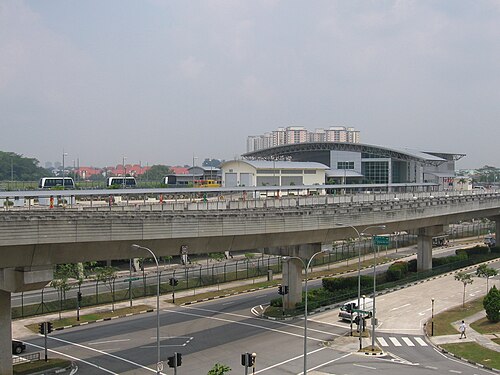
LRTシステムは2つの車両基地で構成されており、そこでは保守、点検、車両オーバーホールが行われ、車両が夜間保管されます。テンマイルジャンクション車両基地にはブキッパンジャンLRT用の車両が、センカン車両基地にはセンカン・プンゴルLRT(SPLRT)とマス・ラピッド・トランジット(MRT)の北東線(NEL)の両方の車両が保管されています。
2021年、LTAはセンカン車両基地のLRT区間の拡張計画を発表した。拡張された車両基地は、留置容量の増加、新しい保守工場、およびセンカン・プンゴルLRT(SPLRT)の容量を増やすための2つの新しい受入線路を提供する。さらに、既存の電力供給システムが強化され、既存の5つの牽引発電所に加えて3つの新しい牽引発電所が追加され、追加の列車をサポートする牽引力が向上する。拡張工事は2021年に開始され、2027年までに完了する予定である。[ 52 ] [ 53 ]
ライトレールトランジットはマスラピッドトランジットと同じチケットシステムを使用しており、非接触型のEZ-Linkスマートカードとツーリストパスを受け付けています。片道切符の廃止に伴い、すべてのGTMマシンはTUK-Aに、TUMマシンはTUKに置き換えられました。通勤者は、スクールスマートカード、ITE学生カード、ディプロマ学生カードの場合は最低2ドル、障害者の場合は5ドル、大人とパッションシルバーの場合は10ドルを現金でチャージできます。電子決済のチャージは、学生の場合は最低5ドル、大人の場合は最低10ドルで変更ありません。[ 54 ]
公共交通機関の乗車料金は、MasterCard、NETS、VISA、American Express、CEPAS 3.0 EZ-Link、CEPAS 3.0 Concession、NETS Prepaid、およびEZ-Link、Concession、NETSのプリペイドカード(一般的にNETS FlashPayとして知られるカードベースチケット(CBT)を使用)の初期CEPASバージョンで支払われていました。そのため、SimplyGoは旅行、カード、運賃に関するあらゆる問い合わせに対応しています。
ブキッ・パンジャンLRT線の全駅では、回転式改札機の代わりに格納式改札機が採用され、より速く簡単に利用できるようになった。この改札機の交換は2017年に完了した。
2018年までに、人が線路に転落するのを防ぐため、43のLRT駅すべてにガラスと鋼鉄製のプラットフォームバリアが設置されました。地上のMRT駅のものとは異なり、LRTの構造物にはスライドドアはなく、固定式の開口部があります。ダウンタウン線がブキッ・パンジャンまで開通すると通勤客が増加すると予想され、チョア・チュー・カン駅とブキッ・パンジャン駅にバリアが設置されました。これに続いて、2018年にはブキッ・パンジャン線とセンカン・プンゴル線の残りの駅にも設置されました。[ 55 ]
これらのバリアの設置は2017年にすべてのLRT駅で完了した。[ 56 ]