
Loading article…
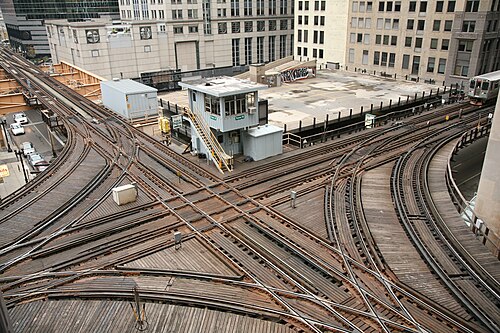
鉄道輸送の文脈における分岐点とは、2つ以上の鉄道路線が合流または分岐する場所のことである。2つの路線の線路間の物理的な接続(同じ軌間であると仮定した場合)は、分岐器(米国ではスイッチ)と信号によって提供される。[ 1 ]
それぞれ1本または2本の線路を持つ2つの路線が分岐点で交わる単純なケースでは、列車が一方の路線から他方の路線へ乗り換えるには、比較的単純な線路配置で十分である。列車が新しい路線に合流した後、どちらの方向にも走行できるようにするには、より複雑な分岐点が必要となる。例えば、三角形の線路配置を設けるなどである。[注1 ]
鉄道輸送業務において、鉄道の分岐点上またはその近くにある駅は分岐駅と呼ばれます。英国では、分岐点(および関連する駅)は支線の次の駅にちなんで名付けられるのが一般的です。例えば、ヨービル・ジャンクションはヨービルの南にある本線上にあり、支線の次の目的地はヨービル・ペン・ミルです。このような駅では、列車が編成されたり解体されたり(分離されたり)することが多く、同じ列車を分割して複数の目的地へ向かうことができます。貨物列車(米国では貨物列車)の場合、操車場(米国では分類ヤード)が同様の役割を果たします。
The capacity of the junctions limits the capacity of a railway network more than the capacity of individual railway lines. This applies more as the network density increases. Measures to improve junctions are often more useful than building new railway lines. The capacity of a railway junction can be increased with improved signaling measures, by building points suitable for higher speeds, or by turning level junctions into flying junctions, where tracks are grade-separated, and so one track passes over or under another.[2] With more complicated junctions such construction can rapidly become very expensive, especially if space is restricted by tunnels, bridges or inner-city tracks.
The installation of junctions into a rail system poses many challenges, including increased maintenance costs, and problems in on-time performance. Metro rail systems have a rail network design where the number of junctions is minimized. Passengers, and not trains, move from one train station to another.


 Media related to Rail junctions at Wikimedia Commons