All Bayesian inference can be cast in terms of free energy minimisation[35]. When free energy is minimised with respect to internal states, the Kullback–Leibler divergence between the variational and posterior density over hidden states is minimised. This corresponds to approximate Bayesian inference – when the form of the variational density is fixed – and exact Bayesian inference otherwise. Free energy minimisation therefore provides a generic description of Bayesian inference and filtering (e.g., Kalman filtering). It is also used in Bayesian model selection, where free energy can be usefully decomposed into complexity and accuracy:
Models with minimum free energy provide an accurate explanation of data, under complexity costs; cf. Occam's razor and more formal treatments of computational costs.[36] Here, complexity is the divergence between the variational density and prior beliefs about hidden states (i.e., the effective degrees of freedom used to explain the data).
Thermodynamics
Variational free energy is an information-theoretic functional and is distinct from thermodynamic (Helmholtz) free energy.[37] However, the complexity term of variational free energy shares the same fixed point as Helmholtz free energy (under the assumption the system is thermodynamically closed but not isolated). This is because if sensory perturbations are suspended (for a suitably long period of time), complexity is minimised (because accuracy can be neglected). At this point, the system is at equilibrium and internal states minimise Helmholtz free energy, by the principle of minimum energy.[38]
Information theory
Free energy minimisation is equivalent to maximising the mutual information between sensory states and internal states that parameterise the variational density (for a fixed entropy variational density). This relates free energy minimization to the principle of minimum redundancy.[39][15]
Neuroscience
Free energy minimisation provides a useful way to formulate normative (Bayes optimal) models of neuronal inference and learning under uncertainty[40] and therefore subscribes to the Bayesian brain hypothesis.[41] The neuronal processes described by free energy minimisation depend on the nature of hidden states: これらは、時間依存変数、時間不変パラメータ、およびランダム変動の精度(逆分散または温度)から構成される。変数、パラメータ、および精度を最小化することは、それぞれ推論、学習、および不確実性の符号化に対応する。
1 2 Friston, Karl (2022). 「非常に具体的: 「自由エネルギー原理の物理学はどれほど具体的か?」に対するコメント」「 . Physics of Life Reviews . 41 : 58–60 . Bibcode : 2022PhLRv..41...58F . doi : 10.1016/j.plrev.2022.05.002 . PMID 35588546. 2025年3月24日取得。
1 2 Aguilera, Miguel; Millidge, Beren; Tschantz, Alexander; Buckley, Christopher L. (2023). "From the free energy principle to a confederation of Bayesian mechanics" . Physics of Life Reviews . 44 : 270– 275. doi : 10.1016/j.plrev.2023.01.018 . PMID 36821891 . 2025-03-24に取得.
1 2 Ramstead, Maxwell; Sakthivadivel, Dalton; Heins, Conor; Koudahl, Magnus; Millidge, Beren; Da Costa, Lancelot; Klein, Brennan; Friston, Karl (2023). "On Bayesian mechanics: A physics of and by beliefs" . Interface Focus . 13 (3) 20220029. arXiv : 2205.11543 . doi : 10.1098 / rsfs.2022.0029 . PMC 10198254. PMID 37213925. S2CID 249017997 .
↑ Conant, Roger C.; Ross Ashby, W. (1970). "システムの優れた制御器はすべて、そのシステムのモデルでなければならない". International Journal of Systems Science . 1 (2): 89– 97. doi : 10.1080/00207727008920220 .
↑ Nicolis, G., & Prigogine, I. (1977). Self-organization in non-equilibrium systems. New York: John Wiley.
↑ Maturana, HR, & Varela, F. (1980). Autopoiesis: the organization of the living . In VF Maturana HR (Ed.), Autopoiesis and Cognition. Dordrecht, Netherlands: Reidel.
↑ Nikolić, Danko (2015). "Practopoiesis: Or how life fosters a mind". Journal of Theoretical Biology . 373 : 40–61 . arXiv : 1402.5332 . Bibcode : 2015JThBi.373...40N . doi : 10.1016/j.jtbi.2015.03.003 . PMID 25791287. S2CID 12680941 .
↑ Haken, H. (1983). シナジェティクス:入門。物理学、化学、生物学における非平衡相転移と自己組織化(第3版)。ベルリン:シュプリンガー・フェルラーク。
↑ Crauel, Hans; Flandoli, Franco (1994). "ランダム力学系のアトラクター" . Probability Theory and Related Fields . 100 (3): 365– 393. doi : 10.1007/BF01193705 . S2CID 122609512 .
↑ Ortega, Pedro A.; Braun, Daniel A. (2013). "情報処理コストを伴う意思決定の理論としての熱力学" . Proceedings of the Royal Society A: Mathematical, Physical and Engineering Sciences . 469 (2153). arXiv : 1204.6481 . Bibcode : 2013RSPSA.46920683O . doi : 10.1098/rspa.2012.0683 . S2CID 28080508 .
↑ Knill, David C.; Pouget, Alexandre (2004). "The Bayesian brain: The role of uncertainty in neural coding and computation" (PDF) . Trends in Neurosciences . 27 (12): 712– 719. doi : 10.1016/j.tins.2004.10.007 . PMID 15541511 . S2CID 9870936 . 2016-03-04 にオリジナル(PDF)からアーカイブ済み。2013-05-31 に取得。
↑ Friston, Karl; Stephan, Klaas; Li, Baojuan; Daunizeau, Jean (2010). "Generalised Filtering" . Mathematical Problems in Engineering . 2010 621670: 1– 34. doi : 10.1155/2010/621670 .
↑ Knill, David C.; Pouget, Alexandre (2004). "ベイズ脳:神経符号化と計算における不確実性の役割" (PDF) . Trends in Neurosciences . 27 (12): 712– 719. doi : 10.1016/j.tins.2004.10.007 . PMID 15541511 . S2CID 9870936 .
1 2 Mumford, D. (1992). "On the computational architecture of the neocortex" (PDF) . Biological Cybernetics . 66 (3): 241– 251. doi : 10.1007/BF00198477 . PMID 1540675 . S2CID 14303625 .
↑ Bastos, Andre M.; Usrey, W. Martin; Adams, Rick A.; Mangun, George R.; Fries, Pascal; Friston, Karl J. (2012). "Canonical Microcircuits for Predictive Coding" . Neuron . 76 (4): 695– 711. doi : 10.1016/j.neuron.2012.10.038 . PMC 3777738 . PMID 23177956 .
↑ Adams, Rick A.; Shipp, Stewart; Friston, Karl J. (2013). "Predictions not commands: Active inference in the motor system" . Brain Structure and Function . 218 (3): 611–643 . doi : 10.1007/s00429-012-0475-5 . PMC 3637647. PMID 23129312 .
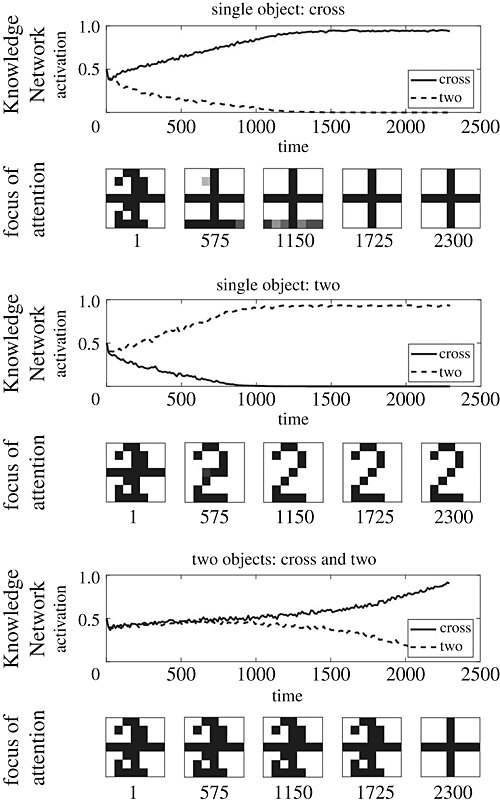
1 2 Friston, Karl J.; Feldman, Harriet (2010). "注意、不確実性、および自由エネルギー" . Frontiers in Human Neuroscience . 4 : 215. doi : 10.3389/fnhum.2010.00215 . PMC 3001758 . PMID 21160551 .
↑ Abadi, Alireza Khatoon; Yahya, Keyvan; Amini, Massoud; Friston, Karl; Heinke, Dietmar (2019). "シーン構築のベイズ定式化における興奮性フィードバックと抑制性フィードバック" . Journal of the Royal Society Interface . 16 (154). doi : 10.1098/rsif.2018.0344 . PMC 6544897 . PMID 31039693 .
↑ Frank, Michael J. (2005). "Dynamic Dopamine Modulation in the Basal Ganglia: A Neurocomputational Account of Cognitive Deficits in Medicated and Nonmedicated Parkinsonism" (PDF) . Journal of Cognitive Neuroscience . 17 (1): 51– 72. doi : 10.1162/0898929052880093 . PMID 15701239 . S2CID 7414727 .
↑ Friston, Karl; Mattout, Jérémie; Kilner, James (2011). "Action understanding and active inference" (PDF) . Biological Cybernetics . 104 ( 1– 2): 137– 160. doi : 10.1007/s00422-011-0424-z . PMC 3491875 . PMID 21327826 .
↑ Kilner, James M.; Friston, Karl J.; Frith, Chris D. (2007). "予測符号化: ミラーニューロンシステムの説明" (PDF) . Cognitive Processing . 8 (3): 159– 166. doi : 10.1007/s10339-007-0170-2 . PMC 2649419 . PMID 17429704 .
↑ Friston, Karl; Adams, Rick A.; Perrinet, Laurent; Breakspear, Michael (2012). "Perceptions as Hypotheses: Saccades as Experiments" . Frontiers in Psychology . 3 : 151. doi : 10.3389/fpsyg.2012.00151 . PMC 3361132. PMID 22654776 .
↑ Mirza, M. Berk; Adams, Rick A.; Mathys, Christoph; Friston, Karl J. (2018). "人間の視覚探索は知覚世界に関する不確実性を低減する" . PLOS ONE . 13 (1) e0190429. Bibcode : 2018PLoSO..1390429M . doi : 10.1371/journal.pone.0190429 . PMC 5755757 . PMID 29304087 .
↑ Perrinet, Laurent U.; Adams, Rick A.; Friston, Karl J. (2014). "能動的推論、眼球運動、および眼球運動遅延" . Biological Cybernetics . 108 (6): 777– 801. doi : 10.1007/s00422-014-0620-8 . PMC 4250571 . PMID 25128318 .
↑ Adams, Rick A.; Perrinet, Laurent U.; Friston, Karl (2012). "Smooth Pursuit and Visual Occlusion: Active Inference and Oculomotor Control in Schizophrenia" . PLOS ONE . 7 (10) e47502. Bibcode : 2012PLoSO...747502A . doi : 10.1371/journal.pone.0047502 . PMC 3482214. PMID 23110076 .
















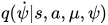

![{\displaystyle {\begin{aligned}{\underset {\mathrm {自由エネルギー} }{\underbrace {F(\mu ,a\,;s)} }}&={\underset {\text{期待エネルギー}}{\underbrace {\mathbb {E} _{q({\dot {\psi }})}[-\log p({\dot {\psi }},s,a,\mu \mid \psi )]} }}-{\underset {\mathrm {エントロピー} }{\underbrace {\mathbb {H} [q({\dot {\psi }}\mid s,a,\mu ,\psi )]} }}\\&={\underset {\mathrm {驚き} }{\underbrace {-\log p(s)} }}+{\underset {\mathrm {発散} }{\underbrace {\mathbb {KL} [q({\dot {\psi }}\mid s,a,\mu ,\psi )\parallel p_{\text{Bayes}}({\dot {\psi }}\mid s,a,\mu ,\psi )]} }}\\&\geq {\underset {\mathrm {surprise} }{\underbrace {-\log p(s)} }}\end{aligned}}}](https://wikimedia.org/api/rest_v1/media/math/render/svg/79cb2e8de6a300308d27a3f3d57f752de677151e)

![\displaystyle \lim _{T\to \infty }{\frac {1}{T}}{\underset {\text{自由作用}}{\underbrace {\int _{0}^{T}F(s(t),\mu (t))\,dt} }}\geq \lim _{T\to \infty }{\frac {1}{T}}\int _{0}^{T}{\underset {\text{驚き}}{\underbrace {-\log p(s(t)\mid m)} }}\,dt=H[p(s\mid m)]}](https://wikimedia.org/api/rest_v1/media/math/render/svg/45e9af1ac3447400ff76b1a3d8d09dbae0ea2542)
![自由エネルギー F(s, mu) = 複雑度 D_{KL}[q(\psi \mid \mu) \parallel p(\psi \mid m)] - 精度 E_q[log p(s \mid \psi , m)]](https://wikimedia.org/api/rest_v1/media/math/render/svg/1485673d77ce7c702ff0e37885de968ebae63e26)










