Loading article…
In physics, in particular in special relativity and general relativity, a four-velocity is a four-vector in four-dimensional spacetime[nb 1] that represents the relativistic counterpart of velocity, which is a three-dimensionalvector in space.
Physical events correspond to mathematical points in time and space, the set of all of them together forming a mathematical model of physical four-dimensional spacetime. The history of an object traces a curve in spacetime, called its world line. If the object has mass, so that its speed is necessarily less than the speed of light, the world line may be parametrized by the proper time of the object. The four-velocity is the rate of change of four-position with respect to the proper time along the curve. The velocity, in contrast, is the rate of change of the position in (three-dimensional) space of the object, as seen by an observer, with respect to the observer's time.
The value of the magnitude of an object's four-velocity, i.e. the quantity obtained by applying the metric tensorg to the four-velocity U, that is ‖U‖2 = U ⋅ U = gμνUνUμ, is always equal to ±c2, where c is the speed of light. Whether the plus or minus sign applies depends on the choice of metric signature. For an object at rest its four-velocity is parallel to the direction of the time coordinate with U0 = c. A four-velocity is thus the normalized future-directed timelike tangent vector to a world line, and is a contravariant vector. Though it is a vector, addition of two four-velocities does not yield a four-velocity: the space of four-velocities is not itself a vector space.[nb 2]
The path of an object in three-dimensional space (in an inertial frame) may be expressed in terms of three spatial coordinate functions xi(t) of time t, where i is an index which takes values 1, 2, 3.
3つの座標は3次元位置ベクトルを構成し、列ベクトルとして表される。
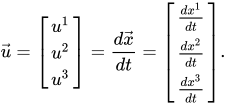
速度の成分(曲線に接する)世界線上の任意の点では
各コンポーネントは単純に記述されています
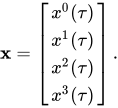
アインシュタインの相対性理論では、特定の基準系に対して運動する物体の経路は、4 つの座標関数x μ ( τ )によって定義されます。ここで、μは時空インデックスであり、時間的成分の場合は 0、空間的座標の場合は 1、2、3 の値をとります。ゼロ番目の成分は、時間座標にcを掛けたものとして定義されます。
各関数は、固有時間と呼ばれるパラメータτに依存します。列ベクトルとして、
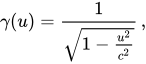
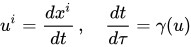
時間の遅れから、座標時間tと固有時間τの微分は次のように関係付けられる。 ここでローレンツ因子は、 これは、3次元速度ベクトルのユークリッドノルムu の関数である。:
4元速度は、時間的世界線の接線4元ベクトルである。4元速度世界線のどの地点でもは次のように定義されます。 どこは4ポジションで、適切な時期です。[ 1 ]
ここで定義される、物体の固有時間を用いた4元速度は、光速で移動する光子のような質量のない物体の世界線には存在せず、また、接線ベクトルが空間的であるタキオン世界線にも定義されない。
時間tと座標時間x 0の関係は次のように定義される。
これを固有時間τに関して微分すると、μ = 0の場合のUμ速度成分が得られます。
そして、他の 3 つの成分については、適切な時間に対して、μ = 1、2、3の場合のU μ速度成分が得られます。 ここでは連鎖律と関係性 を使用しています
したがって、4つの速度については、:
標準的な4ベクトル表記で表すと次のようになります。 どこは時間的要素であり、これは空間成分です。
特定の平坦な時空に関連付けられた同期された時計と定規の観点から、4元速度の3つの空間的成分は、移動する物体の固有速度を定義する。すなわち、対象物と共に移動する時計の単位固有時間あたりに、基準地図座標系内で移動する距離の速度。
他のほとんどの4ベクトルとは異なり、4速度は3つの独立した成分しか持たない。4 の代わりに。係数は三次元速度の関数である。
特定のローレンツスカラーに4元速度を掛けると、4つの独立した成分を持つ新しい物理的な4元ベクトルが得られる。
例えば:
実質的に、この因子はローレンツスカラー項と組み合わさって、4番目の独立成分を形成する。 そして
静止系における4元位置の微分を用いると、符号(−, +, +, +)を持つミンコフスキー計量によって4元速度の大きさが得られる。 つまり、あらゆる物体の4元速度の大きさは常に一定の定数である。
動いているフレームでは、同じ規範が成り立つ。 となることによって:
これはローレンツ因子の定義に帰着する。
![{\displaystyle {\vec {x}}(t)={\begin{bmatrix}x^{1}(t)\\[0.7ex]x^{2}(t)\\[0.7ex]x^{3}(t)\end{bmatrix}}\,.}](https://wikimedia.org/api/rest_v1/media/math/render/svg/61179c0e926675effb8b5e70e63d297ecf2cba92)