
Loading article…
Finstock is a village and civil parish about 2 miles (3 km) south of Charlbury in Oxfordshire, England.
The parish is bounded to the northeast by the River Evenlode, to the southeast partly by the course of Akeman StreetRoman road, and on other sides by field boundaries.[1] The 2011 census recorded the parish's population as 797.[2] For most of its history Finstock was a township of the ancient parish of Charlbury. Finstock became a separate civil parish in the late 19th century.[3]
The name means "Woodpecker place".[4]
A palaeolithic biface was found in the parish near Mount Skippett in 1983.[5] The artefact was found in isolation without any associated archaeological materials so it is difficult to date, but its manufacture shows a mixture of techniques from the Lower Palaeolithic (older than 200,000 years ago) and Middle Palaeolithic (200,000 to 45,000 years ago) periods.[6]Roman coins and Romano-Britishpotsherds have been found in the parish.
1086年のドゥームズデイ・ブックの調査当時、この地には何らかの集落が存在していたと考えられており、リンカーン司教が所有するバンベリー百人区の一部であった。1135年には、フィンストック村はフィンストークと呼ばれていた。この時期、この村はチャールベリー荘園および教区の一部であった。16世紀初頭、フィンストックを含むチャールベリー荘園とその土地は、 1555年にオックスフォード大学セント・ジョンズ・カレッジを創設したロンドンの仕立て屋、サー・トーマス・ホワイトが所有していた。その後、この荘園はカレッジの基金に組み込まれた。大学の土地は不在地主が所有していたため、 1592年から1776年まで、ディッチリー・パークのリー家[ 7 ]を含む多くの人々に貸し出されていた。その後、大学は1857年まで直接管理を再開し、その年に荘園の領主権はコーンベリー・パークの所有者である第2代ウィッチウッドのチャーチル卿フランシス・スペンサーに移った[ 8 ] 。
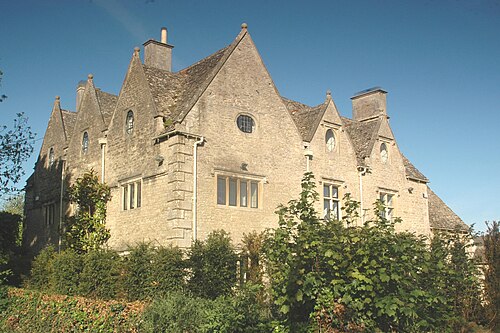
現在もコーンベリー・パークが所有しているが、荘園権の大部分は失効しており、フィンストック村の大部分は現在自由保有地となっている。 フィンストック荘園館は17世紀に建てられ、1660年の日付が刻まれた石碑がある。L字型の建物で、長い方の辺にそれぞれ3つの切妻があり、各切妻に屋根裏窓がある。切妻の屋根裏窓はすべて楕円形[ 9 ]で、1つは牛の目のような形をしている。屋根はストーンズフィールド産の粘板岩でできている。この家はグレードII*指定建造物である[ 10 ]。
ホーリー・トリニティ教会は、 1841年に建てられたゴシック・リバイバル様式の教会です。[ 9 ]装飾的な内陣は1905年に増築され、精巧な南側の窓は1929年に建築家モーリー・ホーダーによって作られました。 [ 9 ]
T. S. Eliot came to Finstock to be received into the Church of England. William Force Stead was a fellow American and came to England as an American consul but soon found that his real bents in life were literature and religion. He was ordained, became chaplain of Worcester College, Oxford and after meeting Eliot in 1923 (with whom he shared a love of cats) steadily drew him towards Anglicanism and agreed to baptise him.
Stead was then living in "a fine seventeenth-century gabled house at Finstock", Finstock Manor,[11] and invited Eliot to stay there to meet his godfathers, B. H. Streeter[12] and Vere Somerset, before his baptism at Finstock on 29 June 1927.[13] The novelist Barbara Pym lived at Finstock after her retirement and is buried in the churchyard of Holy Trinity.[14] The current (in 2021) Vicar, the Reverend Paul Mansell, arrived in February 2010; he was trained at Ripon College, Cuddesdon and ordained at Christ Church, Oxford.[15]
Finstock, together with its neighbours Charlbury, Fawler and Leafield, lay in a clearing of Wychwood Forest that used to stretch from Woodstock to Burford. Much of the forest land was cleared for growing arable crops and during the Middle Agesbarley was the main crop in Finstock. Other land was used for sheep grazing and many of the people of Finstock were involved in the wool industry — the carding being done by men and boys and the spinning by women. Glove making at the village hall site by the women and agricultural labouring on nearby land by the men and boys, used to be the principal occupations of the people of Finstock in the earlier part of the 20th century.
Finstock is now a separate civil and ecclesiastical parish,[16] its population mostly living along the sides of a large triangle formed by the main Witney-Charlbury road (west to north), School Road (east) and Finstock High Street (south). Much in-filling with new buildings has further completed the triangle and four new estates were built during the 20th century. The farming now is mainly arable, barley, wheat and oilseed rape, but there is still some mixed farming.
The building of the Oxford, Worcester and Wolverhampton Railway (OW&WR) along the Evenlode Valley began in 1845 and the line was opened in 1853. It passes through the northeastern edge of Finstock parish about 1⁄2 mile (800 m) from the village. Originally its nearest station was Charlbury, about 2 miles (3 km) from Finstock. The Great Western Railway took over the OW&WR in 1862 and opened Finstock railway station in 1934. Now many inhabitants of Finstock commute by car and bus to Witney, Chipping Norton & Oxford.
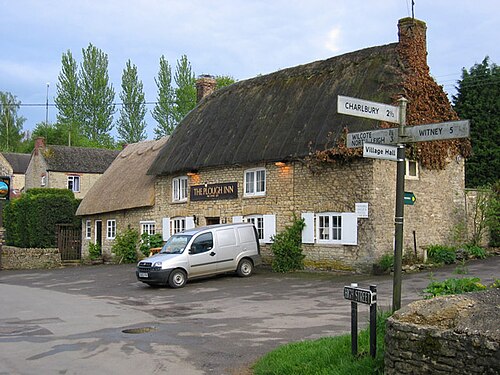
Finstock has one public house: The Plough Inn.[17] A second, The Crown, has been closed and converted into a house. Finstock has a combined village shop and sub-post office.
Finstock railway station is on the Cotswold Line. The station is between Finstock and the hamlet of Fawler. Pulhams Coaches operate a semi-regular bus service through Finstock, between Witney and Chipping Norton.
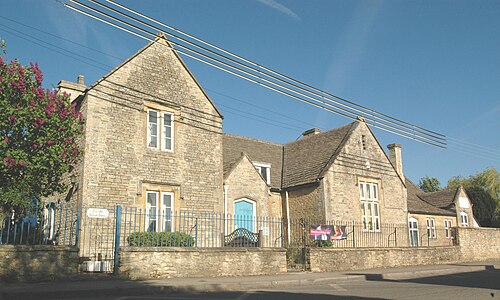
Finstock has a Church of England primary school[18] and a Village Hall that was opened by David Cameron, then MP and Prime Minister in May 2016.[19] It was built on the site of the old village hall that was originally built as a glove factory in 1929, and purchased as a village hall in 1939.[20] The village hall has many regular users including a baby and toddler group, Rainbows/Brownies/Guides, Yoga, Pilates, table tennis, short-mat bowls, darts, craft club, painting, Evenlode Folk Club, Finstock Local History Society, and others.[21]
Notable people associated with Finstock include:

