Loading article…
アレクサンデル8世(イタリア語: Alessandro VIII、1610年4月22日 - 1691年2月1日)は、ピエトロ・ヴィト・オットボーニとして生まれ、1689年10月6日から1691年2月に死去するまで、カトリック教会の首長であり、教皇領の統治者であった。彼は「アレクサンデル」という教皇名を名乗った最も新しい教皇である。
アレクサンデル8世は、前任者インノケンティウス11世の政策の多くを覆し、家族をさらに富ませるために縁故主義にふけったことで知られている。このような縁故主義は教皇の財源を枯渇させ、後に後継者インノケンティウス12世は教皇の財源を回復するために緊縮策を実施せざるを得なくなった。アレクサンデル8世の在位期間は短く、重要なことはほとんど行われなかったが、イエズス会が運営する学校で教えられていたいわゆる哲学的罪の教義を非難したことで知られている。[ 1 ]また、彼の在位中に、フランス国王ルイ14世はアヴィニョンを教皇領の領土として聖座に復帰させた。 [ 2 ]

ピエトロ・ヴィト・オットボーニは1610年にヴェネツィアの貴族の家に生まれ[ 1 ]、ヴェネツィア共和国の大宰相マルコ・オットボーニ(1554年 - 1646年)と妻(1594年)ヴィットリア・トルニエッリ(1635年11月6日没)の9人の子供の末っ子であり、マルカントニオ・オットボーニ(1576年7月30日没)と妻ディアノーラ・ベサル、バサルまたはバッサルー(1603年12月1日没)の父方の孫である。[ 2 ]彼の兄弟には、アゴスティーノ・オットボーニ(1608年7月31日 - 1673年8月2日没)がおり、最初にカンディダ・ベンチ(1647年12月31日没)と結婚し(ヴィットリア・オットボーニ(1637年生まれ)はルイージ・プリウリと結婚し子をもうけ、アントニオ・オットボーニはマリア・モレッティと結婚し枢機卿ピエトロ・オットボーニの両親)、2度目は1649年4月22日にヴェネツィアでパオリーナ・ベルナルドと結婚した(キアラ・オットボーニ(1651年7月27日生まれ)は1670年にフランチェスコ・ゼーノと結婚し子をもうけ、マルコ・オットボーニは初代フィアーノ公爵)彼の姉妹には、ジャンバッティスタ・ルビーニと結婚して子供をもうけたクリスティーナ・オットボーニと、彼の最初の妻として従兄弟のマルカントニオ・パダヴィーノと結婚したアンドリアーナ・オットボーニがいた。一家はゾンキオの戦い(1499年)の結果、ヴェネツィアの貴族に迎え入れられ、その後、外交官として財を成し、17世紀には貴族の資格を満たした。
オットボーニはパドヴァ大学で優れた学業成績を収め、1627年に教会法と民法の博士号を取得した。ウルバヌス8世[ 2 ]の教皇在位中にローマへ赴き、使徒座署名局の長官を務め、その後テルニ、リエーティ、チッタ・ディ・カステッロ、スポレートの各都市の知事を務めた。また、ローマ聖ロタの監査官も務めた。

Pope Innocent X appointed him to the cardinalate[3] and in 1652 at the request of the Venetian government and he was made the Cardinal-Priest of San Salvatore in Lauro. He was appointed as Bishop of Brescia in 1654 and later received episcopal consecration in the church of San Marco in Rome. He would spend a quiet decade in his diocese. He opted to be Cardinal-Priest of San Marco in 1660 and resigned as Bishop of Brescia in 1664. Ottoboni also opted to become Cardinal-Priest of Santa Maria in Trastevere in 1677 and later as Cardinal-Priest of Santa Prassede in 1680. He later became the Cardinal-Bishop of Sabina in 1681 and then to Frascati in 1683. His last swap was that of Porto e Santa Rufina in 1687.
Ottoboni was also the Vice-Dean of the College of Cardinals from 1687 to his pontifical election.

The ambassador of King Louis XIV (1643–1715) succeeded in procuring his election on 6 October 1689, as the successor to Pope Innocent XI (1676–89); nevertheless, after months of negotiation Alexander VIII finally condemned the declaration made in 1682 by the French clergy concerning the liberties of the Gallican church.[1]
He chose the pontifical name of "Alexander VIII" in gratitude to Cardinal Flavio Chigi, the nephew of Pope Alexander VII, who also had helped support his candidacy.[5] Ottoboni was crowned as pontiff on 16 October 1689 by the protodeacon Cardinal Francesco Maidalchini and took possession of the Basilica of Saint John Lateran on 28 October 1689.
Originally, the allies of Cardinal Flavio Chigi proposed a Venetian in the form of Gregorio Barbarigo rather than their true choice of Ottoboni, hence, a case of misdirection to test whether or not the electors would consider the appointment of a Venetian to the papal throne. Though Barbarigo seemed to garner an exceptional number of votes which highlighted that a Venetian pontiff was indeed a tantalizing opportunity, Barbarigo could not garner any additional votes beyond what he already had accrued. However, many in the camp that wanted continuity with the policies of Innocent XI had caught on to the deception, which only served to create indignation within the conclave. However, since Chigi and his faction had not directly voted for Barbarigo in order to maintain the deception, the Ottoboni candidacy could go ahead and could remain unmarred since Chigi and his faction lied that they were waiting for the arrival of the French cardinals and did not wish to commit to any particular candidate. Though the Venetians indicated their support for Ottoboni, the republic had also managed to secure the support of Madrid and Vienna through their ambassadors, while Cardinal Medici made certain that the Imperial and Spanish factions would also support Ottoboni's candidacy. The determination to elect Ottoboni came conclusively when Ottoboni himself indicated that he was strongly in favor of reconciliation with the French, something that greatly appeased Louis XIV who had been in a more conciliatory mood of late.[6]
Despite his age, Alexander VIII was said to be an able diplomat. During his brief pontificate, he managed to undo most of his predecessor's work. Money saved by Innocent XI was given to the Ottoboni family, and to a cardinal he said: "I have no time to lose; for me the day is almost done!"[7] He held a profound compassion and attentiveness for the poor, which was often squandered and abused by his relatives whom he enriched.[2]
Alexander VIII was almost an octogenarian when elected to the papacy, which lasted only sixteen months, during which time little of importance was done. Louis XIV, whose political situation was now critical, profited by the peaceful dispositions of the new pope, restored Avignon to him, and renounced the long-abused right of asylum for the French Embassy.[2]
On 29 November 1690, the pontiff established that no more than ten thousand ducats could be spent on the funeral of a pope. That same year, he also forbade that any furnishings of the conclave could not be stripped to be sold for profit.
1690年3月30日、教皇は教皇文書「アニマルム・サルーツ」の中で、東南アジアの改宗者の権利を確立し、確認した。
アレクサンデル8世は、前任者の経済政策を覆し、より恵まれない人々への財政支援を目的として、国民の税負担を軽減しようと試みた。しかし、教皇が大規模な慈善事業に注力し、オスマン帝国との大トルコ戦争に集中したため、この試みは裏目に出た。教皇は、前任者インノケンティウス11世が慎重に増やし、守ってきた教皇の資金を急速に枯渇させてしまったのである。
大規模な慈善事業と際限のない縁故主義により教皇の財源は枯渇し、[ 1 ]前任者の政策を覆した。さまざまな任命の中で、22歳の甥のピエトロは枢機卿と教会の副総長に任命され、[ 8 ] [ 1 ]甥のマルコ(兄アゴスティーノの息子)は海軍要塞の監察官とフィアーノ公爵に任命され、甥のアントニオ(アゴスティーノのもう一人の子供)は教会の総長に任命された。甥のジャンバッティスタ・ルビーニは枢機卿国務長官とヴィチェンツァ司教に任命された。貧しい教皇領の貧しい人々への同情から、彼は減税によって彼らを助けようとした。しかし、この同じ寛大な性質が、彼が蓄積したがっていた富を親族に与えることにもつながった。アレクサンダー8世は、彼らのために、そして教皇としての名誉を傷つける形で、インノケンティウス11世によって廃止された閑職を復活させた。[ 2 ]彼はスウェーデンのクリスティーナ女王の書籍や写本をバチカン図書館のために購入した。[ 3 ]アレクサンダー8世は、トルコとの戦争において故郷のヴェネツィアに寛大な補助金を与えて支援したほか、 [ 2 ]アルバニアでの戦役に7隻のガレー船と2,000人の歩兵を送った。
1690年、彼はイエズス会の学校で教えられていたいわゆる哲学的罪の教義を非難した。[ 1 ]また、彼は3回の枢機卿会議を開催し、14人の新しい枢機卿が昇格した。
ヴェネツィア出身のアレクサンダー8世は、ギリシャのペロポネソス半島とエーゲ海の支配権をめぐりオスマン帝国と戦ったヴェネツィア共和国の軍事作戦を全面的に支援し、ガレー船7隻を満載するほどの食料を寄付するとともに、アルバニアでの作戦のために歩兵部隊を派遣した。
1682年に批准されたガリカン提案の原則を非難し、教皇は前任者によって大きく緊張させられた聖座とフランスとの絶望的な関係を修復しようと試みた。それにもかかわらず、提案はアレクサンデル8世の死後、空位の司教区を管理する王権の教皇による承認と引き換えに、1693年に撤回された。[ 9 ]ルイ14世が自身の政治的立場が不安定であると感じた時、国王は教皇の平和的な姿勢から利益を得、ルイ14世はフランス大使館の長年濫用されてきた亡命権を放棄することを決定した。[ 2 ]
アレクサンドル8世は1690年6月11日にポーランド王妃の崇敬を承認し、これが列福式となった。同年10月16日、彼は聖パスカル・バイロン、聖ロレンツォ・ジュスティニアーニ、聖ヨハネ・オブ・サアグン、聖ヨハネ・オブ・ゴッド、聖ヨハネ・オブ・カピストラーノの4人の聖人を列聖した。
教皇は3回の枢機卿会議で14人の枢機卿を任命し、前任者の治世には見られなかった縁故主義の復活として、大甥のピエトロ・オットボーニのような人物を枢機卿に昇格させた。彼が任命した人物の中には、後の教皇クレメンス11世となるジャンフランチェスコ・アルバーニも含まれていた。
教皇は、前任者が断固として拒否したにもかかわらず、1690年にトゥーサン・ド・フォルバン=ジャンソンを枢機卿に任命した。インノケンティウス11世は、フォルバン=ジャンソンが1682年のガリカン提案を支持したことを理由に彼を枢機卿に任命することを拒否したが、アレクサンデル8世は、インノケンティウス11世と比較的仲が悪かったルイ14世との緊張関係を緩和しようとして、彼を枢機卿に任命することにした。フランス国王へのさらなる歩み寄りとして、アレクサンデル8世はさらに2人のフランス人枢機卿を任命したが、この動きは神聖ローマ皇帝レオポルト1世を大いに苛立たせ、皇帝はローマ教皇庁への大使を引き揚げた。さらに、教皇は皇帝の行動をそれほど気にしていなかった。なぜなら、皇帝はオスマン帝国に対する防衛よりもフランスとの敵対関係を優先していたからである。
1690年10月16日、アレクサンデル8世が列聖ミサを執り行った日、アレクサンデル8世は比較的元気がないように見え、病気になったようだった。軽い脳卒中を起こしたのではないかという憶測もあったが、医師たちは教皇に休養を取るよう勧めたものの、教皇が病気になった正確な原因は分からなかった。1691年1月20日、フォルバン・ジャンソン枢機卿はルイ14世に教皇が重病であることを伝え、1月22日には容態が劇的に悪化し、甥が叔父の回復の見込みについて悲観的になっていることを伝えた。1月27日には壊疽が始まったと報じられ、1月30日にはアレクサンデル8世は12人の枢機卿と会っていた。アレクサンデル8世は1691年2月1日午後4時に死去した。ナポリからローマに疫病が広がり、教皇も感染して死期を早めた。[ 10 ]
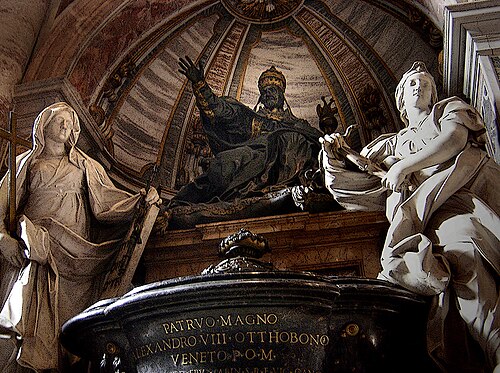
サン・ピエトロ大聖堂にある彼の壮大な墓は、彼の甥孫であるピエトロ・オットボーニ枢機卿の依頼で、アリーゴ・ディ・サン・マルティーノ伯爵が設計した。基部のレリーフと両脇の人物像(1704年)はアンジェロ・デ・ロッシが彫刻し、教皇のブロンズ像はジュゼッペ・ベルトージが鋳造した。[ 11 ]
アレクサンダー8世教皇は、以下の主要な聖別者であった:[ 12 ]