Augustine Zhao Rong, a Chinese diocesan priest. Having first been one of the soldiers who had escorted Monsignor Dufresse from Chengdu to Beijing, he was moved by his patience and had then asked to be numbered among the neophytes. Once baptized, he was sent to the seminary and then ordained a priest. Arrested, he was tortured and died in 1815.[9]
John of Triora, O.F.M., priest. Put in prison together with others in the summer of 1815, he was then condemned to death, and strangled on 7 February 1816.[10]
Joseph Yuan, a Chinese diocesan priest. Having heard Monsignor Dufresse speak of the Christian faith, he was overcome by its beauty and then became an exemplary neophyte. Later, he was ordained a priest and, as such, was dedicated to evangelisation in various districts. He was arrested in August 1816, condemned to be strangled, and was killed in this way on 24 June 1817.[8]
Francis Regis Clet of the Congregation of the Mission (Vincentians). After obtaining permission to go to the missions in China, he embarked for the Orient in 1791. Having reached there, for 30 years he spent a life of missionary sacrifice. Upheld by an untiring zeal, he evangelised three immense Chinese provinces: Jiangxi, Hubei, Hunan. Betrayed by a Christian, he was arrested and thrown into prison where he underwent atrocious tortures. Following sentence by the Jiaqing Emperor he was killed by strangling on 17 February 1820.[12]
Thaddeus Liu, a Chinese diocesan priest. He refused to apostatize, saying that he was a priest and wanted to be faithful to the religion that he had preached. Condemned to death, he was strangled on 30 November 1823.
Peter Liu, a Chinese lay catechist. He was arrested in 1814 and condemned to exile in Tartary, where he remained for almost twenty years. Returning to his homeland he was again arrested, and was strangled on 17 May 1834.
Joachim Ho, a Chinese lay catechist. He was baptised at the age of about twenty years. In the great persecution of 1814 he had been taken with many others of the faithful and subjected to cruel torture. Sent into exile in Tartary, he remained there for almost twenty years. Returning to his homeland he was arrested again and refused to apostatize. Following that, and the death sentence having been confirmed by the Emperor, he was strangled on 9 July 1839.
John Gabriel Perboyre, C.M., entered the Vincentians as a high school student. The death of his younger brother, also a Vincentian priest, moved his superiors to allow him to take his brother's place, arriving in China in 1835. Despite poor health, he served the poverty-stricken residents of Hubei. Arrested during a revival of anti-Christian persecution, upon imperial edict, he was strangled to death in 1840.[13]
Augustus Chapdelaine, M.E.P., a priest of the Diocese of Coutances. He entered the Seminary of the Paris Foreign Missions Society, and embarked for China in 1852. He arrived in Guangxi at the end of 1854. Arrested in 1856, he was tortured, condemned to death, and died in February 1856.[14]
Lawrence Bai Xiaoman, a Chinese layman, and an unassuming worker. He joined Blessed Chapdelaine in the refuge that was given to the missionary and was arrested with him and brought before the tribunal. Nothing could make him renounce his religious beliefs. He was beheaded on 25 February 1856.[15]
Agnes Cao Guiying, a widow, born into an old Christian family. Being dedicated to the instruction of young girls who had recently been converted by Blessed Chapdelaine, she was arrested and condemned to death in prison. She was executed on 1 March 1856.[16]
Martyrs of Maokou and Guizhou
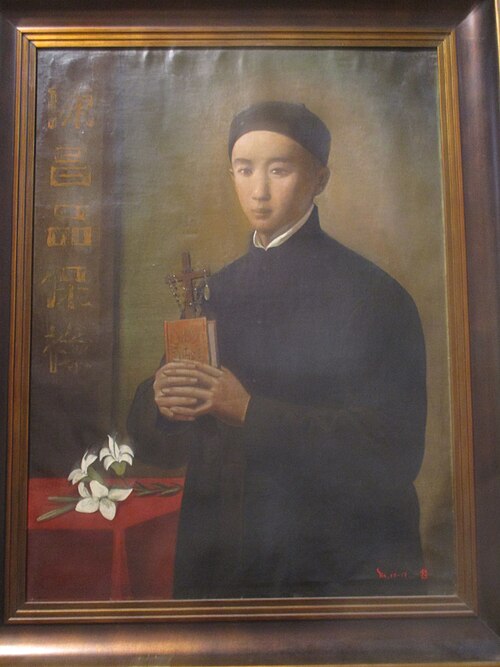
Saint Paul Chen
Three catechists, known as the Martyrs of Maokou (in the province of Guizhou) were killed on 28 January 1858, by order of the officials in Maokou:
All three had been called on to renounce the Christian religion and having refused to do so were condemned to be beheaded.
In Guizhou, two seminarians and two lay people, one of whom was a farmer, the other a widow who worked as a cook in the seminary, suffered martyrdom together on 29 July 1861. They are known as the Martyrs of Qingyanzhen (Guizhou):
Joseph Zhang Wenlan, seminarian
Paul Chen Changpin, seminarian
John Baptist Luo Tingyin, layman
Martha Wang Luo Mande, laywoman
In the following year, on 18 and 19 February 1862, another five people gave their life for Christ. They are known as the Martyrs of Guizhou.
Jean-Pierre Néel, a priest of the Paris Foreign Missions Society,
c) 直隷の殉教者たち。山東省で始まり、その後山西省と湖南省に広がった義和団の蜂起が、当時イエズス会が管轄していた仙県使徒座代理区であった直隷省南東部にも達したとき、殺害されたキリスト教徒は数千人に上った。その中には、4人のフランス人イエズス会宣教師と、少なくとも52人の中国人信徒(男性、女性、子供)が含まれており、最年長は79歳、最年少はわずか9歳であった。彼らは全員、1900年の6月と7月に殉教した。彼らの多くは、避難していた朱家河村の教会で殺害された。彼らは、以下に挙げる最初の2人の宣教師とともに、その教会で祈りを捧げていた。




 この記事は、現在パブリックドメインとなっている出版物からのテキストを組み込んでいます。Herbermann , Charles, ed. (1913). " Martyrs in China ". Catholic Encyclopedia . New York: Robert Appleton Company.