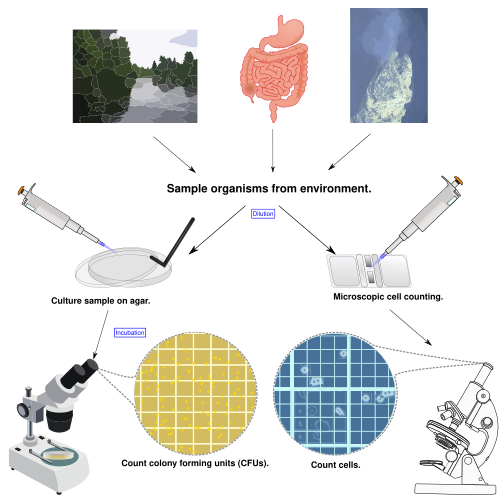
The great plate count anomaly. Counts of cells obtained via cultivation are orders of magnitude lower than those directly observed under the microscope. This is because microbiologists are able to cultivate only a minority of naturally occurring microbes using current laboratory techniques, depending on the environment.[1]
Microbial ecology (or environmental microbiology) is a discipline where the interaction of microorganisms and their environment are studied.[2] Microorganisms are known to have beneficial, neutral and harmful ecological relationships within their species and other species.[2] Many scientists have studied the relationship between nature and microorganisms: Martinus Beijerinck, Sergei Winogradsky, Louis Pasteur, Robert Koch, Lorenz Hiltner, Dionicia Gamboa and many more,[3][4][5][6] to understand the specific roles that these microorganisms have in biological and chemical pathways and the evolution of these microorganisms. Currently, there are several types of biotechnologies that have allowed scientists to analyze the biological and chemical properties of these microorganisms.[7]
In addition, certain antimicrobial substances in the environment can kill microorganisms, thus preventing them from interacting with their environment. These can be antibiotic, antifungal, or antiviral.[11]
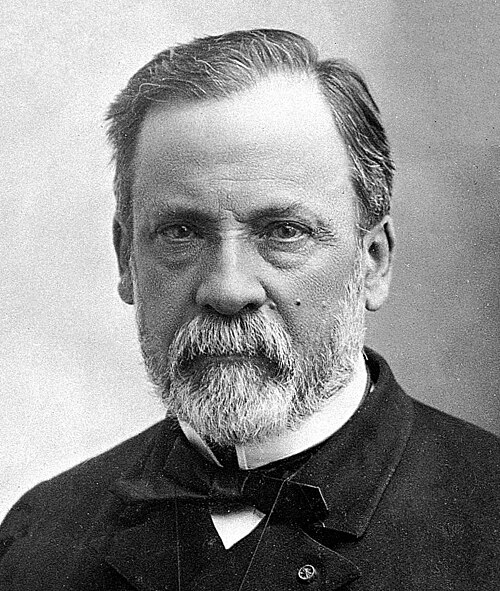
Louis Pasteur was a French chemist who derived key microbial principles that we use today: microbial fermentation, pasteurization, germ theory, and vaccines.[13] These principles have served as a foundation for scientists in viewing the relationship between microbes and their environment.[13] For example, Pasteur disproved the theory of spontaneous generation, the belief of life arising from nonliving materials.[14] Pasteur stated that life can only come from life and not nonliving materials.[15] This led to the idea that microorganisms were responsible for the microbial growth in any environment.[15]
Robert Koch was a physician-scientist who implemented the use of an oil-immersion lens and a condenser while using microscopes, to increase the imagery of viewing bacteria.[16] This led Koch to be the first publisher of bacteria photographs. As a result, Koch was able to study wound infections in animals at the microscopic level.[16] He distinguished between distinct bacteria species, which led him to believe that the best way to study a certain disease is to focus on a specific pathogen.[16] In 1879, Koch started to develop "pure" cultures to grow bacteria colonies.[16] These advancements led Koch to solve the Cholera pandemic in India during the year 1883.[16] Koch's laboratory techniques and materials led him to conclude that the use of unfiltered water that contained the bacteria thought to cause intestinal harm was causing the cholera pandemic.[16]
Lorenz Hiltner is known as one of the pioneers in "microbial ecology."[4] His research focused on how microbials in the rhizosphere provided nutrients to plants. Hiltner stated that the quality of plant products was a result of the plant's roots microflora.[4] One of Hiltner contributions to the study of plant nutrition and soil bacteriology was creating antimicrobial seeds covered with mercury chloride.[4] The sole purpose of creating the antimicrobial seeds were to protect the seeds from the harmful effects of pathogenic fungi. In addition, he recognized the known bacteria that were responsible for the nitrogen cycle: denitrification, nitrification, and nitrogen fixation.[4]
Important microbial roles in the environment
Microorganisms are the backbone of all ecosystems, even in areas where photosynthesis cannot take place. For example, chemosynthetic microorganisms are the primary producers in extreme environments, such as high temperature geothermal environments.[17] In these extreme conditions, the chemosynthetic microbes provide energy and carbon to other organisms. Chemosynthetic microorganisms gain energy by oxidizing inorganic compounds such as hydrogen, nitrite, ammonia, sulfur and iron (II). These organisms can be found in both aerobic and anaerobic environment.[18]
The nitrogen cycle, phosphorus cycle, sulphur cycle, and carbon cycle depend on microorganisms also. Each cycle involves microorganisms in certain processes.[19] For example, nitrogen gas makes up 78% of the Earth's atmosphere, but it is almost chemically inert; as a result, it is unavailable to most organisms. It has to be converted biologically to an available form by microorganism, through nitrogen fixation.[20] Through these biogeochemical cycles, microorganisms are able to make nutrients such as nitrogen, phosphorus and potassium available in the soil.[21] Microorganisms play a role in solubilizing phosphate, improving soil health, and plant growth.[22]
Mutualism is a close relationship between two different species in which each has a positive effect on the other. In mutualism, one partner provides service to the other partner and receives service from the other partner as well.[30] Mutualism in microbial ecology is a relationship between microbial species and other species (example humans) that allows for both sides to benefit.[31] Microorganisms form mutualistic relationships with other microorganism, plants or animals. One example of microbe-microbe interaction would be syntrophy, also known as cross-feeding,[32] of which Methanobacterium omelianskii is a classic example.[33][34] This consortium is formed by an ethanol fermenting organism and a methanogen. The ethanol-fermenting organism provides the archaeal partner with the H2, which this methanogen needs in order to grow and produce methane.[35][34] Syntrophy has been hypothesized to play a significant role in energy and nutrient-limited environments, such as deep subsurface, where it can help the microbial community with diverse functional properties to survive, grow and produce maximum amount of energy.[36][37]Anaerobic oxidation of methane (AOM) is carried out by mutualistic consortium of a sulfate-reducing bacterium and an anaerobic methane-oxidizing archaeon.[38][39] The reaction used by the bacterial partner for the production of H2 is endergonic (and so thermodynamically unfavored) however, when coupled to the reaction used by archaeal partner, the overall reaction becomes exergonic.[35] Thus the two organisms are in a mutualistic relationship which allows them to grow and thrive in an environment, deadly for either species alone. Lichen is an example of a symbiotic organism.[34]
Microorganisms also engage in mutualistic relationship with plants and a typical example of such relationship is arbuscular mycorrhizal (AM) relationship, a symbiotic relationship between plants and fungi.[9] This relationship begins when chemical signals are exchanged between the plant and the fungi leading to the metabolic stimulation of the fungus.[40][41] The fungus then attacks the epidermis of the plant's root and penetrates its highly branched hyphae into the cortical cells of the plant.[9] In this relationship, the fungi gives the plant phosphate and nitrogen obtained from the soil, while the plant provides the fungi with carbohydrate and lipids obtained from photosynthesis.[42] Also, microorganisms are involved in mutualistic relationship with mammals such as humans. As the host provides shelter and nutrient to the microorganisms, the microorganisms also provide benefits such as helping in the growth of the gastrointestinal tract of the host and protecting host from other detrimental microorganisms.[43]
Commensalism
Commensalism is very common in microbial world, literally meaning "eating from the same table".[44] It is a relationship between two species where one species benefits with no harm or benefit for the other species.[10] Metabolic products of one microbial population are used by another microbial population without either gain or harm for the first population. There are many "pairs "of microbial species that perform either oxidation or reduction reaction to the same chemical equation. For example, methanogens produce methane by reducing CO2 to CH4, while methanotrophs oxidise methane back to CO2.[45]
Amensalism
Amensalism (also commonly known as antagonism) is a type of symbiotic relationship where one species/organism is harmed while the other remains unaffected.[31] One example of such a relationship that takes place in microbial ecology is between the microbial species Lactobacillus casei and Pseudomonas taetrolens.[46] When co-existing in an environment, Pseudomonas taetrolens shows inhibited growth and decreased production of lactobionic acid (its main product) most likely due to the byproducts created by Lactobacillus casei during its production of lactic acid.[47]
1 2 Gray, ND; Head, IM (2008年1月1日)、「微生物生態学」、Jørgensen, Sven Erik; Fath, Brian D. (編)、生態学百科事典、オックスフォード:アカデミック・プレス、pp. 2357–2368、ISBN978-0-08-045405-42025年4月1日に取得
↑Kolter, Roberto (October 8, 2021). "The History of Microbiology—A Personal Interpretation". Annual Review of Microbiology. 75 (1): 1–17. doi:10.1146/annurev-micro-033020-020648. ISSN0066-4227. PMID33974804.
12345Hartmann, Anton; Rothballer, Michael; Schmid, Michael (November 1, 2008). "Lorenz Hiltner, a pioneer in rhizosphere microbial ecology and soil bacteriology research". Plant and Soil. 312 (1): 7–14. Bibcode:2008PlSoi.312....7H. doi:10.1007/s11104-007-9514-z. ISSN1573-5036.
↑Céline, Valadeau; Adriana, Pabon; Eric, Deharo; Joaquina, Albán–Castillo; Yannick, Estevez; Augusto, Lores Fransis; Rosario, Rojas; Dionicia, Gamboa; Michel, Sauvain; Denis, Castillo; Geneviève, Bourdy (June 25, 2009). "Medicinal plants from the Yanesha (Peru): Evaluation of the leishmanicidal and antimalarial activity of selected extracts". Journal of Ethnopharmacology. 123 (3): 413–422. doi:10.1016/j.jep.2009.03.041. hdl:20.500.12390/716. ISSN0378-8741.
↑Céline, Valadeau; Adriana, Pabon; Eric, Deharo; Joaquina, Albán–Castillo; Yannick, Estevez; Augusto, Lores Fransis; Rosario, Rojas; Dionicia, Gamboa; Michel, Sauvain; Denis, Castillo; Geneviève, Bourdy. "Medicinal plants from the Yanesha (Peru): Evaluation of the leishmanicidal and antimalarial activity of selected extracts". Journal of Ethnopharmacology. 123 (3): 413–422. doi:10.1016/j.jep.2009.03.041. hdl:20.500.12390/716– via Elsevier Science Direct.
↑Flavier, Albert B.; Balan, Venkatesh; Khan, Abdul Latif. "– Microbial Biotechnology: Fundamentals and Applications". Microbial Biotechnology: Fundamentals and Applications.
↑Glaeser, Jens; Overmann, Jörg (August 2004). "Biogeography, Evolution, and Diversity of Epibionts in Phototrophic Consortia". Applied and Environmental Microbiology. 70 (8): 4821–4830. Bibcode:2004ApEnM..70.4821G. doi:10.1128/aem.70.8.4821-4830.2004. ISSN0099-2240. PMC492462. PMID15294820.
12Mathis, Kaitlyn A.; Bronstein, Judith L. (November 2, 2020). "Our Current Understanding of Commensalism". Annual Review of Ecology, Evolution, and Systematics. 51 (1): 167–189. doi:10.1146/annurev-ecolsys-011720-040844. ISSN1543-592X.
12Strohl, William R. (April 9, 2014), "Antimicrobials", in Bull, Alan T. (ed.), Microbial Diversity and Bioprospecting, Washington, DC, USA: ASM Press, pp.336–355, doi:10.1128/9781555817770.ch31, ISBN978-1-68367-217-3, retrieved October 25, 2024
↑Madigan, Michael T. (2012). Brock biology of microorganisms (13thed.). San Francisco: Benjamin Cummings. ISBN978-0-321-64963-8.
12Mostowy, Serge (December 1, 2022). "Louis Pasteur continues to shape the future of microbiology". Disease Models & Mechanisms. 15 (12). doi:10.1242/dmm.050011. ISSN1754-8403. PMC10655809. PMID36504391.
↑"1.1C: Pasteur and Spontaneous Generation". Biology LibreTexts. May 6, 2017. Retrieved April 2, 2025.
12"1.6.2: Pasteur and Spontaneous Generation". Biology LibreTexts. July 22, 2022. Retrieved April 2, 2025.
1 2 3 4 5 6 Blevins, Steve M.; Bronze, Michael S. (2010年9月1日). 「ロベルト・コッホと細菌学の「黄金時代」」 . International Journal of Infectious Diseases . 14 (9): e744– e751. doi : 10.1016/j.ijid.2009.12.003 . ISSN 1201-9712 .
↑Basu, Sahana; Kumar, Gautam; Chhabra, Sagar; Prasad, Ram (January 1, 2021), "Chapter 13 - Role of soil microbes in biogeochemical cycle for enhancing soil fertility", in Verma, Jay Prakash; Macdonald, Catriona A.; Gupta, Vijai Kumar; Podile, Appa Rao (eds.), New and Future Developments in Microbial Biotechnology and Bioengineering, Elsevier, pp.149–157, doi:10.1016/b978-0-444-64325-4.00013-4, ISBN978-0-444-64325-4, retrieved November 4, 2024
↑Tian, Jiang; Ge, Fei; Zhang, Dayi; Deng, Songqiang; Liu, Xingwang (February 17, 2021). "Roles of Phosphate Solubilizing Microorganisms from Managing Soil Phosphorus Deficiency to Mediating Biogeochemical P Cycle". Biology. 10 (2): 158. doi:10.3390/biology10020158. ISSN2079-7737. PMC7922199. PMID33671192.
↑Zhao, Yue; Yao, Jun; Yuan, Zhimin; Wang, Tianqi; Zhang, Yiyue; Wang, Fei (October 8, 2016). "Bioremediation of Cd by strain GZ-22 isolated from mine soil based on biosorption and microbially induced carbonate precipitation". Environmental Science and Pollution Research. 24 (1): 372–380. doi:10.1007/s11356-016-7810-y. ISSN0944-1344. PMID27722882.
↑Saeed, Muhammad Usama; Hussain, Nazim; Sumrin, Aleena; Shahbaz, Areej; Noor, Saman; Bilal, Muhammad; Aleya, Lotfi; Iqbal, Hafiz M. N. (April 20, 2022). "Microbial bioremediation strategies with wastewater treatment potentialities – A review". Science of the Total Environment. 818 151754. doi:10.1016/j.scitotenv.2021.151754. ISSN0048-9697. PMID34800451.
↑Bilal, Muhammad; Ashraf, Syed Salman; Iqbal, Hafiz M. N. (2020), "Laccase-Mediated Bioremediation of Dye-Based Hazardous Pollutants", Environmental Chemistry for a Sustainable World, Cham: Springer International Publishing, pp.137–160, doi:10.1007/978-3-030-48985-4_6, ISBN978-3-030-48984-7
↑ Zhao, Youkang; Bai, Yang; Guo, Qiu; Li, Zhiling; Qi, Mengyuan; Ma, Xiaodan; Wang, Hao; Kong, Deyong; Wang, Aijie; Liang, Bin (2019年2月)「メタノール刺激による汚染都市河川堆積物のバイオレメディエーション:微生物群集の変化を伴う代謝プロセス」Science of the Total Environment . 653 : 649–657 . doi : 10.1016/j.scitotenv.2018.10.396 . ISSN 0048-9697 .
↑Bryant, M. P.; Wolin, E. A.; Wolin, M. J.; Wolfe, R. S. (1967). "Methanobacillus omelianskii, a symbiotic association of two species of bacteria". Archiv für Mikrobiologie. 59 (1–3): 20–31. Bibcode:1967ArMic..59...20B. doi:10.1007/bf00406313. ISSN0302-8933. PMID5602458. S2CID10348127.
123López-García, Purificación; Eme, Laura; Moreira, David (December 2017). "Symbiosis in eukaryotic evolution". Journal of Theoretical Biology. The origin of mitosing cells: 50th anniversary of a classic paper by Lynn Sagan (Margulis). 434 (Supplement C): 20–33. Bibcode:2017JThBi.434...20L. doi:10.1016/j.jtbi.2017.02.031. PMC5638015. PMID28254477.
12Kirchman, David L (2012). Processes in microbial ecology. Oxford: Oxford University Press. ISBN978-0-19-958693-6. OCLC777261246.
↑Lau, Maggie C. Y.; Kieft, Thomas L.; Kuloyo, Olukayode; Linage-Alvarez, Borja; van Heerden, Esta; Lindsay, Melody R.; Magnabosco, Cara; Wang, Wei; Wiggins, Jessica B.; Guo, Ling; Perlman, David H. (December 6, 2016). "An oligotrophic deep-subsurface community dependent on syntrophy is dominated by sulphur-driven autotrophic denitrifiers". Proceedings of the National Academy of Sciences. 113 (49): E7927–E7936. Bibcode:2016PNAS..113E7927L. doi:10.1073/pnas.1612244113. ISSN0027-8424. PMC5150411. PMID27872277.
↑Schink, Bernhard; Stams, Alfons J. M. (2013), "Syntrophism Among Prokaryotes", The Prokaryotes, Springer Berlin Heidelberg, pp.471–493, doi:10.1007/978-3-642-30123-0_59, ISBN978-3-642-30122-3
↑Boetius, Antje; Ravenschlag, Katrin; Schubert, Carsten J.; Rickert, Dirk; Widdel, Friedrich; Gieseke, Armin; Amann, Rudolf; Jørgensen, Bo Barker; Witte, Ursula; Pfannkuche, Olaf (October 2000). "A marine microbial consortium apparently mediating anaerobic oxidation of methane". Nature. 407 (6804): 623–626. Bibcode:2000Natur.407..623B. doi:10.1038/35036572. ISSN0028-0836. PMID11034209. S2CID205009562.
↑Raghoebarsing, Ashna A.; Pol, Arjan; van de Pas-Schoonen, Katinka T.; Smolders, Alfons J. P.; Ettwig, Katharina F.; Rijpstra, W. Irene C.; Schouten, Stefan; Damsté, Jaap S. Sinninghe; Op den Camp, Huub J. M.; Jetten, Mike S. M.; Strous, Marc (April 2006). "A microbial consortium couples anaerobic methane oxidation to denitrification"(PDF). Nature. 440 (7086): 918–921. Bibcode:2006Natur.440..918R. doi:10.1038/nature04617. hdl:1874/22552. ISSN0028-0836. PMID16612380. S2CID4413069.
↑Harrison, Maria J. (December 2012). "Cellular programs for arbuscular mycorrhizal symbiosis". Current Opinion in Plant Biology. 15 (6): 691–698. Bibcode:2012COPB...15..691H. doi:10.1016/j.pbi.2012.08.010. ISSN1369-5266. PMID23036821.
↑Shiu, Patrick; Xiao, Hua (May 28, 2021). "Faculty Opinions recommendation of Lipid exchanges drove the evolution of mutualism during plant terrestrialization". Science. doi:10.3410/f.740146041.793585932.
↑Leser, Thomas D.; Mølbak, Lars (September 2009). "Better living through microbial action: the benefits of the mammalian gastrointestinal microbiota on the host". Environmental Microbiology. 11 (9): 2194–2206. Bibcode:2009EnvMi..11.2194L. doi:10.1111/j.1462-2920.2009.01941.x. ISSN1462-2912. PMID19737302.
↑Bogitsh, Burton J.; Carter, Clint E.; Oeltmann, Thomas N. (2013), "Symbiosis and Parasitism", Human Parasitology, Elsevier, pp.1–13, doi:10.1016/b978-0-12-415915-0.00001-7, ISBN978-0-12-415915-0, S2CID88750087
↑Canfield, Donald E.; Erik Kristensen; Bo Thamdrup (2005), "Structure and Growth of Microbial Populations", Advances in Marine Biology, Elsevier, pp.23–64, doi:10.1016/s0065-2881(05)48002-5, ISBN978-0-12-026147-5
↑García, Cristina; Rendueles, Manuel; Díaz, Mario (September 2017). "Synbiotic Fermentation for the Co-Production of Lactic and Lactobionic Acids from Residual Dairy Whey". Biotechnology Progress. 33 (5): 1250–1256. doi:10.1002/btpr.2507. hdl:10651/46356. PMID28556559. S2CID23694837.
↑Krasner, Robert I. (2010). The microbial challenge: science, disease, and public health (2nded.). Sudbury, Mass.: Jones and Bartlett Publishers. ISBN978-0-7637-5689-5. OCLC317664342.
123Coque, Juan José R.; Álvarez-Pérez, José Manuel; Cobos, Rebeca; González-García, Sandra; Ibáñez, Ana M.; Diez Galán, Alba; Calvo-Peña, Carla (January 1, 2020), Gadd, Geoffrey Michael; Sariaslani, Sima (eds.), "Chapter Four - Advances in the control of phytopathogenic fungi that infect crops through their root system", Advances in Applied Microbiology, vol.111, Academic Press, pp.123–170, retrieved April 3, 2025
123Castillo, Julio Cesar; Reynolds, Stuart E.; Eleftherianos, Ioannis (December 1, 2011). "Insect immune responses to nematode parasites". Trends in Parasitology. 27 (12): 537–547. doi:10.1016/j.pt.2011.09.001. ISSN1471-4922.
↑Newman, David J.; Cragg, Gordon M. (February 7, 2016). "Natural Products as Sources of New Drugs from 1981 to 2014". Journal of Natural Products. 79 (3): 629–661. doi:10.1021/acs.jnatprod.5b01055. ISSN0163-3864. PMID26852623.
↑Jakubiec-Krzesniak, Katarzyna; Rajnisz-Mateusiak, Aleksandra; Guspiel, Adam; Ziemska, Joanna; Solecka, Jolanta (January 1, 2018). "Secondary Metabolites of Actinomycetes and their Antibacterial, Antifungal and Antiviral Properties". Polish Journal of Microbiology. 67 (3): 259–272. doi:10.21307/pjm-2018-048. ISSN2544-4646. PMC7256786. PMID30451442.
↑Chater, Keith F. (November 30, 2016). "Recent advances in understanding Streptomyces". F1000Research. 5: 2795. doi:10.12688/f1000research.9534.1. ISSN2046-1402. PMC5133688. PMID27990276.
↑Barka, Essaid Ait; Vatsa, Parul; Sanchez, Lisa; Gaveau-Vaillant, Nathalie; Jacquard, Cedric; Klenk, Hans-Peter; Clément, Christophe; Ouhdouch, Yder; van Wezel, Gilles P. (March 2016). "Taxonomy, Physiology, and Natural Products of Actinobacteria". Microbiology and Molecular Biology Reviews. 80 (1): 1–43. doi:10.1128/mmbr.00019-15. ISSN1092-2172. PMC4711186. PMID26609051.
↑Igarashi, Yasuhiro; Iida, Takako; Oku, Naoya; Watanabe, Hiroyuki; Furihata, Kazuo; Miyanouchi, Koji (April 25, 2012). "Nomimicin, a new spirotetronate-class polyketide from an actinomycete of the genus Actinomadura". The Journal of Antibiotics. 65 (7): 355–359. doi:10.1038/ja.2012.30. ISSN0021-8820. PMID22534651.
↑Qin, Zhiwei; Munnoch, John T.; Devine, Rebecca; Holmes, Neil A.; Seipke, Ryan F.; Wilkinson, Karl A.; Wilkinson, Barrie; Hutchings, Matthew I. (2017). "Formicamycins, antibacterial polyketides produced by Streptomyces formicae isolated from African Tetraponera plant-ants". Chemical Science. 8 (4): 3218–3227. doi:10.1039/c6sc04265a. ISSN2041-6520. PMC5414599. PMID28507698.
↑Lacret, Rodney; Oves-Costales, Daniel; Gómez, Cristina; Díaz, Caridad; De la Cruz, Mercedes; Pérez-Victoria, Ignacio; Vicente, Francisca; Genilloud, Olga; Reyes, Fernando (December 29, 2014). "New Ikarugamycin Derivatives with Antifungal and Antibacterial Properties from Streptomyces zhaozhouensis". Marine Drugs. 13 (1): 128–140. doi:10.3390/md13010128. ISSN1660-3397. PMC4306928. PMID25551780.
↑"The bacteria-fighting super element making a return to hospitals: Copper". Washington Post. Retrieved September 18, 2016.
12Evans, Andris; Kavanagh, Kevin A. (May 7, 2021). "Evaluation of metal-based antimicrobial compounds for the treatment of bacterial pathogens". Journal of Medical Microbiology. 70 (5): 001363. doi:10.1099/jmm.0.001363. ISSN0022-2615. PMC8289199. PMID33961541.
↑"Silver nanoparticles kill germs, raise health concerns". Archived from the original on February 22, 2014. Retrieved September 18, 2016.