Loading article…

ラグランジュの4平方定理(バシェ予想とも呼ばれる)は、すべての非負整数は4つの非負整数の平方の和として表すことができると述べている。[ 1 ]つまり、これらの平方は4次の加法基底を形成する。 4つの数字これらは整数です。例として、3、31、310は、次のように4つの平方数の和として表すことができます。
この定理は1770年にジョゼフ=ルイ・ラグランジュによって証明された。これはフェルマーの多角数定理の特殊な場合である。
『算術』に示された例から、ディオファントスがこの定理を知っていたことは明らかである。この本は1621年にバシェ(クロード・ガスパール・バシェ・ド・メジリアック)によってラテン語に翻訳され、彼は翻訳の注釈でこの定理を述べている。しかし、この定理が証明されたのは1770年、ラグランジュによるものであった。[ 2 ]
アドリアン=マリー・ルジャンドルは1797年から1798年にかけて、正の整数が3つの平方数の和として表せるのは、それが次の形式でない場合に限ることを証明することで、この定理を拡張した。整数kとmについて。その後、1834 年にカール・グスタフ・ヤコブ・ヤコビは、自身の四平方定理によって、整数を 4 つの平方数の和として表す数に関する簡単な公式を発見しました。
この公式は、4 つの円の曲率の二乗の和を含む、デカルトの 4 つの「接吻円」の定理にも関連しています。これはまた、最近ではラマヌジャン-ペーターソン予想に関連付けられたアポロニウスのギャスケットにも関連しています。[ 3 ]
ラグランジュの証明には、非常によく似た現代版がいくつか存在する[ 4 ] [ 5 ] [ 6 ] 。以下の証明は、 mが偶数または奇数の場合に個別の議論を必要としない、やや簡略化されたバージョンである。
It is sufficient to prove the theorem for every odd prime number p. This immediately follows from Euler's four-square identity (and from the fact that the theorem is true for the numbers 1 and 2).
The residues of a2 modulo p are distinct for every a between 0 and (p − 1)/2 (inclusive). To see this, take some a and define c as a2 mod p. a is a root of the polynomial x2 − c over the field Z/pZ. So is p − a (which is different from a). In a field K, any polynomial of degree n has at most n distinct roots (Lagrange's theorem (number theory)), so there are no other a with this property, in particular not among 0 to (p − 1)/2.
Similarly, for b taking integral values between 0 and (p − 1)/2 (inclusive), the −b2 − 1 are distinct. By the pigeonhole principle, there are a and b in this range, for which a2 and −b2 − 1 are congruent modulo p, that is for which
Now let m be the smallest positive integer such that mp is the sum of four squares, x12 + x22 + x32 + x42 (we have just shown that there is some m (namely n) with this property, so there is a least one m, and it is smaller than p). We show by contradiction that m equals 1: supposing it is not the case, we prove the existence of a positive integer r less than m, for which rp is also the sum of four squares (this is in the spirit of the infinite descent[7] method of Fermat).
For this purpose, we consider for each xi the yi which is in the same residue class modulo m and between (–m + 1)/2 and m/2 (possibly included). It follows that y12 + y22 + y32 + y42 = mr, for some strictly positive integer r less than m.
Finally, another appeal to Euler's four-square identity shows that mpmr = z12 + z22 + z32 + z42. But the fact that each xi is congruent to its corresponding yi implies that all of the zi are divisible by m. Indeed,
It follows that, for wi = zi/m, w12 + w22 + w32 + w42 = rp, and this is in contradiction with the minimality of m.
In the descent above, we must rule out both the case y1 = y2 = y3 = y4 = m/2 (which would give r = m and no descent), and also the case y1 = y2 = y3 = y4 = 0 (which would give r = 0 rather than strictly positive). For both of those cases, one can check that mp = x12 + x22 + x32 + x42 would be a multiple of m2, contradicting the fact that p is a prime greater than m.
Another way to prove the theorem relies on Hurwitz quaternions, which are the analog of integers for quaternions.[8]
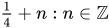
The Hurwitz quaternions consist of all quaternions with integer components and all quaternions with half-integer components. These two sets can be combined into a single formula where are integers. Thus, the quaternion components are either all integers or all half-integers, depending on whether is even or odd, respectively. The set of Hurwitz quaternions forms a ring; that is to say, the sum or product of any two Hurwitz quaternions is likewise a Hurwitz quaternion.
The (arithmetic, or field) norm of a rational quaternion is the nonnegative rational number where is the conjugate of . Note that the norm of a Hurwitz quaternion is always an integer. (If the coefficients are half-integers, then their squares are of the form , and the sum of four such numbers is an integer.)
Since quaternion multiplication is associative, and real numbers commute with other quaternions, the norm of a product of quaternions equals the product of the norms:
For any , . It follows easily that is a unit in the ring of Hurwitz quaternions if and only if .
The proof of the main theorem begins by reduction to the case of prime numbers. Euler's four-square identity implies that if Lagrange's four-square theorem holds for two numbers, it holds for the product of the two numbers. Since any natural number can be factored into powers of primes, it suffices to prove the theorem for prime numbers. It is true for . To show this for an odd prime integer p, represent it as a quaternion and assume for now (as we shall show later) that it is not a Hurwitz irreducible; that is, it can be factored into two non-unit Hurwitz quaternions
The norms of are integers such that and . This shows that both and are equal to p (since they are integers), and p is the sum of four squares
If it happens that the chosen has half-integer coefficients, it can be replaced by another Hurwitz quaternion. Choose in such a way that has even integer coefficients. Then
Since has even integer coefficients, will have integer coefficients and can be used instead of the original to give a representation of p as the sum of four squares.
As for showing that p is not a Hurwitz irreducible, Lagrange proved that any odd prime p divides at least one number of the form ここで、lとmは整数である。[ 8 ]これは次のように見ることができる。pは素数であるため、整数に対して成り立つのみしたがって、集合は正方形にはpを法とする異なる残基。同様に、を含む残基。合計でp個の残基しかないため、集合XとYは交差しなければならない。
数u は、フルヴィッツ四元数に因数分解できます。
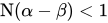
フルヴィッツ四元数のノルムは、ユークリッドの性質の一形態を満たす。任意の四元数に対して有理係数を用いると、フルヴィッツ四元数を選択できる。となることによってまず最初に選択することでとなることによってその後となることによってのためにすると、次のようになります。
したがって、任意のフルヴィッツ四元数に対してとフルヴィッツ四元数が存在するそのため
フルヴィッツ四元数の環Hは可換ではないため、実際のユークリッド整域ではなく、通常の意味での一意分解を持ちません。しかしながら、上記の性質は、すべての右イデアルが主イデアルであることを意味します。したがって、フルヴィッツ四元数 が存在します。そのため
特に、あるフルヴィッツ四元数に対して。 もし単位であった、pの倍数になるはずですが、これは不可能です。はフルヴィッツ四元数ではない同様に、もしユニットだったら、 したがって、p は割り切れるこれはまた、はフルヴィッツ四元数ではない。したがって、主張されているように、 pはフルヴィッツ既約ではない。
ラグランジュの四平方定理は、フェルマーの多角数定理とワーリングの問題の特殊な場合である。別の一般化として考えられるのは次の問題である。自然数が与えられたとき、解決できますか
すべての正の整数nに対して?そのケースラグランジュの四平方定理により、この問いには肯定的な答えが得られる。一般解はラマヌジャンによって与えられた。[ 9 ]彼は、一般性を失うことなく、と仮定すれば、すると、選択肢は正確に 54 通りあります。問題が整数で解けるようにすべてのnについて。(ラマヌジャンは 55 番目の可能性を挙げた)しかし、この場合、問題は解決できません。[ 10 ])
1986年、マイケル・O・ラビンとジェフリー・シャリット[ 11 ]は、単一の表現を計算するためのランダム化多項式時間アルゴリズムを提案した。与えられた整数nに対して、期待される実行時間さらに改良され、2018年にポール・ポラックとエンリケ・トレビーニョによって発表された。[ 12 ]
自然数n を4 つの整数の平方の和として表すことができる数の数はr 4 ( n ) で表されます。ヤコビの 4 平方定理によれば、nが奇数の場合はnの約数の和の 8 倍、 nが偶数の場合はnの奇数の約数の和の 24 倍になります (約数関数を参照)。
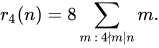
言い換えれば、4で割り切れないすべての約数の合計の8倍である。
これは次のように書くこともできます。 ここで、 nが 4 で割り切れない 場合は、第 2 項をゼロとする。特に、素数pに対しては、明示的な式r 4 ( p ) = 8( p + 1)が得られる。[ 13 ]
r 4 ( n )の値の中には、n が偶数の場合に r 4 ( n ) = r 4 (2 m n ) となるものがあり、無限に出現します。r 4 ( n ) / nの値は任意に大きくなる可能性があり、実際、r 4 ( n ) / nは 8 √ log nより無限に大きくなることがあります。[ 13 ]
正の整数の列のうち、非負の整数の4つの平方の和として(位数を除いて)ただ1つの表現しか持たないものは次のとおりである。
これらの整数は、1、3、5、7、11、15、23の7つの奇数と、次の形式のすべての数から構成されます。または。
4つの非ゼロ平方数の和として表せない正の整数の数列は次のとおりです。
これらの整数は、8 つの奇数 1、3、5、9、11、17、29、41 と、次の形式のすべての数から構成されます。または。
ラグランジュの四平方定理は様々な方法で改良することができる。例えば、孫志偉[ 14 ]は、4つの数の選択に関するいくつかの条件の下で、すべての自然数は4つの平方数の和として表すことができることを証明した。
各自然数を4つの平方数の和として表すために、平方整数の集合全体を使用する必要があるかどうか疑問に思う人もいるかもしれない。エドゥアルト・ヴィルシングは、平方数の集合Sが存在し、n以下のすべての正の整数は、Sの要素のうち最大4つの和として表すことができる 。[ 15 ]


![{\displaystyle {\begin{aligned}3&=1^{2}+1^{2}+1^{2}+0^{2}\\[3pt]31&=5^{2}+2^{2}+1^{2}+1^{2}\\[3pt]310&=17^{2}+4^{2}+2^{2}+1^{2}\\[3pt]&=16^{2}+7^{2}+2^{2}+1^{2}\\[3pt]&=15^{2}+9^{2}+2^{2}+0^{2}\\[3pt]&=12^{2}+11^{2}+6^{2}+3^{2}.\end{aligned}}}](https://wikimedia.org/api/rest_v1/media/math/render/svg/55818f31dee3cb222e1be20630fee8b6aa25f3b4)



























































![{\displaystyle r_{4}(n)={\begin{cases}8\sum \limits _{m\mid n}m&{\text{if }}n{\text{ is odd}}\\[12pt]24\sum \limits _{\begin{smallmatrix}m|n\\m{\text{ odd}}\end{smallmatrix}}m&{\text{if }}n{\text{ is even}}.\end{cases}}}](https://wikimedia.org/api/rest_v1/media/math/render/svg/b7bbc05690010165fd4605bfa83dba8eb42f46cb)