
Loading article…
ヨンス・ヤコブ・ベルセリウス(スウェーデン語: [ jœ̌ns ˈjɑ̂ːkɔb bæˈʂěːlɪɵs ] ; [ 1 ] 1779年8月20日 - 1848年8月7日)はスウェーデンの化学者。ベルセリウスは、ロバート・ボイル、ジョン・ドルトン、アントワーヌ・ラヴォアジエとともに、近代化学の創始者の一人と考えられている。[ 2 ]ベルセリウスは1808年にスウェーデン王立科学アカデミーの会員となり、1818年からは同アカデミーの主任役員を務めた。スウェーデンでは「スウェーデン化学の父」として知られている。生前はファーストネームを使わず、ヤコブ・ベルセリウスとして広く知られていた。[ 3 ]
ベルセリウスは医師としてキャリアをスタートさせたが、彼の永続的な貢献は電気化学、化学結合、化学量論の分野にあった。特に、原子量の決定と、化学化合物中の元素と化学反応の量的関係、そしてそれらが一定の比率で起こることに関する化学の一分野である化学量論の原理をより完全に理解することにつながる実験で知られている。この理解は「定比例の法則」として知られるようになった。[ 4 ]
ベルセリウスは厳格な経験主義者であり、新しい理論は当時の化学知識の総和と整合していなければならないと考えていた。彼は化学分析法の改良に取り組み、化学量論に関する研究を支える基礎データを得るために必要な手法を開発した。彼は異性体、同素体、触媒作用を研究し、これらの現象は彼の名にちなんで名付けられた。[ 5 ]ベルセリウスは無機化合物と有機化合物の違いを明確にした最初の一人であった。[ 6 ] [ 7 ]彼が研究した多くの鉱物や元素の中で、彼はセリウムとセレンを発見し、ケイ素とトリウムを最初に単離したことで知られている。鉱物学への関心から、ベルセリウスはこれらの元素や他の元素の新しい化合物を合成し、化学的に特徴づけた。
ベルセリウスは、電気化学セルを用いて特定の化学化合物を電気的に反対の成分のペアに分解できることを実証した。この研究から、彼は電気化学的二元論として知られるようになった理論を提唱し、化学化合物は静電相互作用によって結合した酸化物塩であると主張した。この理論は、いくつかの文脈では有用であったが、不十分であると見なされるようになった。[ 4 ]ベルセリウスの原子量に関する研究と電気化学的二元論の理論は、あらゆる化合物の組成を定性的にも定量的にも示す現代的な化学式表記法の開発につながった。彼のシステムでは、元素のラテン語名を1文字または2文字で省略し、上付き文字を用いて化合物中に存在する各元素の原子数を示した。後に、化学者は上付き文字ではなく下付き文字を使用するようになった。[ 4 ]
ベルセリウスはスウェーデンのエステルイェートランド地方のヴェーヴェルスンダ教区で生まれた。父のサミュエル・ベルセリウスは近隣のリンシェーピング市の教師で、母のエリザベス・ドロテア・ショーステーンは主婦だった。[ 8 ]両親はともに牧師の家系だった。ベルセリウスは幼い頃に両親を亡くした。父は1779年に亡くなり、その後母はアンダース・エクマルクという牧師と再婚し、エクマルクはベルセリウスに自然界の知識を含む基礎教育を与えた。1787年に母が亡くなると、リンシェーピングの親戚がベルセリウスの面倒を見た。そこで彼は現在カテドラルスコランとして知られる学校に通った。[ 9 ]十代の頃、彼は自宅近くの農場で家庭教師の仕事に就き、その間に花や昆虫の収集と分類に興味を持つようになった。[ 10 ]
ベルセリウスはその後、1796年から1801年までウプサラ大学の医学生として在籍した。タンタルの発見者であるアンダース・グスタフ・エーケベリは、この期間に彼に化学を教えた。彼は薬局で見習いとして働き、その間、ガラス吹きなどの実験室での実践的なことも学んだ。[ 10 ]学業の傍ら、彼はスウェーデンの化学者カール・ウィリアム・シェーレが行った実験を独力で再現し、シェーレの酸素の発見につながった。[ 9 ]彼はまた、メデヴィ鉱泉の医師と共同で研究を行った。この間、彼はこの水源の水の分析を行った。さらに、研究の一環として、1800年にベルセリウスは、一定の電流を供給できる最初の装置(つまり最初の電池)であるアレッサンドロ・ボルタの電気炉について学んだ。彼は銅と亜鉛のディスクを交互に並べた同様の電池を自作し、これが電気化学の分野における彼の最初の研究となった。[ 4 ] [ 10 ]
医学研究の論文研究として、彼はガルバニック電流がいくつかの病気に及ぼす影響を調べた。この一連の実験では、そのような影響の明確な証拠は得られなかった。[ 10 ]ベルセリウスは1802年に医師として卒業した。彼はストックホルム近郊で医師として働いていたが、化学者で鉱山主のヴィルヘルム・ヒジンガーが彼の分析化学者としての能力を認め、彼に実験室を提供した。[ 7 ]
1807年、ベルセリウスはカロリンスカ研究所の化学および薬学の教授に任命された。[ 4 ] 1808年から1836年の間、ベルセリウスは助手として働き、スウェーデン初の女性化学者であったアンナ・スンドストロムと共同研究を行った。 [ 11 ]
1808年、彼はスウェーデン王立科学アカデミーの会員に選出された。当時、スウェーデンのロマン主義の時代が科学への関心の低下を招いたため、アカデミーは数年間停滞していた。1818年、ベルセリウスはアカデミーの書記に選出され、1848年までその職を務めた。ベルセリウスの在任中、彼はアカデミーを活性化させ、第二の黄金時代(第一の黄金時代は天文学者ペール・ヴィルヘルム・ヴァルゲンティンが書記を務めた1749年から1783年の時代)に導いたとされている。[ 12 ] 1822年、彼はアメリカ芸術科学アカデミーの外国人名誉会員に選出された。 [ 13 ] 1827年、彼はオランダ王立研究所の通信員となり、1830年には準会員となった。 [ 14 ] In 1837, he was elected a member of the Swedish Academy , on chair number 5.
ベルセリウスは禁酒運動に積極的に参加した。ベングト・フランツ=スパッレ、アウグスト・フォン・ハルトマンスドルフ、アンダース・レツィウス、サミュエル・オーウェン、ジョージ・スコットらとともに、1837年にスウェーデン禁酒協会( Svenska nykterhetssällskapet)の創設者の一人であり、初代会長を務めた。[ 15 ]ベルセリウスは、カール・アフ・エーケンスタムの禁酒に関する著作の序文を執筆し、その著作は5万部印刷された。[ 16 ]

ベルセリウスは生涯を通じて様々な病気に苦しんだ。これには、繰り返す片頭痛や、後に痛風も含まれる。また、うつ病のエピソードもあった。[ 10 ]
1818年、ベルセリウスは神経衰弱を起こしたが、これは仕事のストレスが原因とされている。[ 9 ]医師からは旅行や休暇を取るように勧められた。しかし、この間、ベルセリウスはフランスへ渡り、クロード・ルイ・ベルトレの化学研究所で働いた。[ 10 ]
1835年、56歳で、スウェーデン内閣大臣の24歳の娘、エリザベス・ポピウスと結婚した。[ 10 ]
彼は63歳だった1843年4月18日に、マンチェスター文学哲学協会の名誉会員に選出された。
He died on 7 August 1848 at his home in Stockholm, where he had lived since 1806.[17] He is buried in the Solna Cemetery.[9]


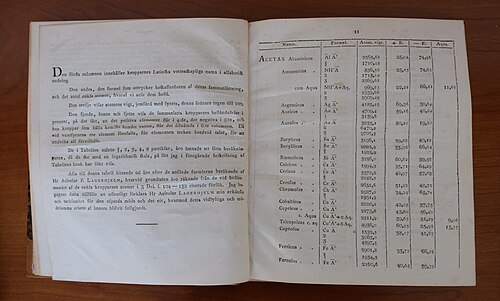
Soon after arriving in Stockholm, Berzelius wrote a chemistry textbook for his medical students, Lärbok i Kemien, which was his first significant scientific publication. He had conducted experimentation, in preparation for writing this textbook, on the compositions of inorganic compounds, which was his earliest work on definite proportions.[4] In 1813–4, he submitted a lengthy essay (published in five separate articles) on the proportions of elements in compounds. The essay commenced with a general description,[18][19] introduced his new symbolism, and examined all the known elements.[20][21] The essay ended with a table of the "specific weights" (relative atomic masses) of the elements, where oxygen was set to 100, and a selection of compounds written in his new formalism.[22][23][24] This work provided evidence in favour of the atomic theory proposed by John Dalton: that inorganic chemical compounds are composed of atoms of different elements combined in whole number amounts. In discovering that atomic weights are not integer multiples of the atomic weight of hydrogen, Berzelius also disproved Prout's hypothesis that elements are built up from atoms of hydrogen.[25]:682–683 Berzelius's last revised version of his atomic weight tables was first published in a German translation of his Textbook of Chemistry in 1826.[26]
実験を補助するために、彼は化学表記法を開発しました。この表記法では、特定の化学化合物を構成する元素に、酸素を表す O や鉄を表す Fe などの簡単な文字ラベルが付けられ、化学化合物中のそれらの割合が数字で示されます。ベルセリウスは、今日でも使用されている化学表記法を発明しました。主な違いは、今日使用されている下付き数字 (例: H 2 O または Fe 2 O 3 )の代わりに、ベルセリウスは上付き文字 (H 2 O または Fe 2 O 3 )を使用したことです。[ 27 ]
ベルセリウスは、化学元素セリウムとセレンの発見者として知られています。これらの発見はそれぞれ1803年と1817年に行われました。[ 28 ] [ 29 ]ベルセリウスはまた、1824年にシリコンとトリウム、チタンとジルコニウム を分離する方法も発見しました。[ 30 ] [ 31 ] [ 32 ] ベルセリウスの研究室で働いていた学生たちは、リチウム、ランタン、バナジウムも発見しました。[ 33 ]
ベルセリウスは、ゲイ=リュサックとテナールが行った実験を再現することで非晶質シリコンを発見した。ゲイ=リュサックとテナールは、四フッ化ケイ素を金属カリウムと反応させて非常に不純なシリコンを生成した。ベルセリウスはこの実験の変形として、フッ化ケイ酸カリウムをカリウムで加熱した。その結果、ケイ化カリウムが生成され、ベルセリウスはそれを水で撹拌して比較的純粋なシリコン粉末を得た。ベルセリウスはこの粉末をシリコンの新元素と認識し、それをシリシウムと名付けた[ 34 ]。この名前は、以前にデービーによって提案されていた[ 35 ]。
ベルセリウスは1824年に初めてジルコニウムを単離したが、純粋なジルコニウムは1925年にアントン・エドゥアルト・ファン・アルケルとヤン・ヘンドリック・デ・ボーアによって生産された。[ 36 ]

ベルセリウスは、「触媒作用」[ 37 ] 、「ポリマー」、「異性体」、「タンパク質」、「同素体」といった化学用語の創始者として知られていますが、彼の当初の定義は現代の用法とは大きく異なる場合もあります。[ 38 ]例えば、彼は1833年に「ポリマー」という用語を造語し、同一の実験式を持つが全体の分子量が異なる有機化合物を記述しました。分子量の大きい化合物は、分子量の小さい化合物の「ポリマー」と表現されました。[ 39 ]この頃は化学構造の概念がまだ確立されていなかったため、彼は各元素の原子数のみを考慮しました。このようにして、彼は例えばグルコース(C 6 H 12 O 6 )をホルムアルデヒド(CH 2 O)のポリマーとみなしましたが、現在ではグルコースはモノマーであるホルムアルデヒドのポリマーではないことが分かっています。[ 40 ]
ベルセリウスは、有機化合物(炭素を含むもの)と無機化合物を区別した最初の人物でした。特に、彼はコーヒー、紅茶、さまざまなタンパク質などの有機化合物の元素分析において、ゲラルドゥス・ヨハネス・ムルダーに助言を与えました。タンパク質という用語自体は、ムルダーがすべてのタンパク質が同じ実験式を持っているように見えることに気づき、それらが単一の種類の非常に大きな分子で構成されている可能性があるという誤った結論に達した後、1838年にベルセリウスによって造語されました。この用語はギリシャ語の「第一級の」に由来し、ベルセリウスはタンパク質が生物にとって非常に基本的なものであるため、この名前を提案しました。[ 41 ]
1808年、ベルセリウスは乳酸が牛乳だけでなく筋肉組織にも存在することを発見した。
ビリベルジンという用語は1840年にベルセリウスによって造語されたが、彼は「ビリルビン」(赤)よりも「ビリフルビン」(黄色/赤)を好んだ。[ 42 ]彼は同様にヘマトグロブリンという名前も造語した[ 43 ] 。これはヘモグロビンの語源である。

Berzelius stated in 1810 that living things work by some mysterious "vital force",[44] a hypothesis called vitalism. Vitalism had first been proposed by prior researchers, although Berzelius contended that compounds could be distinguished by whether they required any organisms in their synthesis (organic compounds) or whether they did not (inorganic compounds). However, in 1828, Friedrich Wöhler accidentally obtained urea, an organic compound, by heating ammonium cyanate. This showed that an organic compound such as urea could be prepared synthetically and not exclusively by living organisms. Berzelius corresponded with Wöhler on the urea synthesis findings. However, the notion of vitalism continued to persist, until further work on abiotic synthesis of organic compounds provided substantial evidence against vitalism.[45][46]

Berzelius was a prolific correspondent with leading scientists of his time, such as Gerardus Johannes Mulder, Claude Louis Berthollet, Humphry Davy, Friedrich Wöhler, Eilhard Mitscherlich and Christian Friedrich Schönbein.
In 1812, Berzelius traveled to London, England, including Greenwich to meet with prominent British scientists of the time. These included Humphry Davy, chemist William Wollaston, physician-scientistThomas Young, astronomer William Herschel, chemist Smithson Tennant, and inventor James Watt, among others. Berzelius also visited Davy's laboratory. After his visit to Davy's laboratory, Berzelius remarked, "A tidy laboratory is a sign of a lazy chemist."[38]
Humphry Davy in 1810 proposed that chlorine is an element. Berzelius rejected this claim because of his belief that all acids were based on oxygen. Since chlorine forms a strong acid (muriatic acid, modern HCl), chlorine must contain oxygen and thus cannot be an element. However, in 1812, Bernard Courtois proved that iodine is an element. Then in 1816 Joseph-Louis Gay-Lussac demonstrated that prussic acid (hydrogen cyanide) contains only hydrogen, carbon, and nitrogen, and no oxygen. These findings persuaded Berzelius that not all acids contain oxygen, and that Davy and Gay-Lussac were correct: chlorine and iodine are indeed elements.

In 1818 Berzelius was ennobled by King Carl XIV Johan. In 1835, he received the title of friherre.[47]
In 1820 he was elected a member of the American Philosophical Society.[48]
The Royal Society of London gave Berzelius the Copley Medal in 1836 with the citation "For his systematic application of the doctrine of definite proportions to the analysis of mineral bodies, as contained in his Nouveau Systeme de Mineralogie, and in other of his works."
In 1840, Berzelius was named Knight of the Order of Leopold.[49] In 1842, he received the honor Pour le Mérite for Sciences and Arts.[50]

The mineral berzelianite, a copper selenide, was discovered in 1850 and named after him by James Dwight Dana.[51][52]
In 1852, Stockholm, Sweden, built a public park and statue, both to honor Berzelius. Berzeliusskolan, a school situated next to his alma mater, Katedralskolan, is named for him. In 1890, a fairly prominent street in Gothenburg was named Berzeliigatan (Berzelii street) in his honour.
In 1898, the Swedish Academy of Sciences opened the Berzelius Museum in honor of Berzelius. The holdings of the museum included many items from his laboratory. The museum was opened on the occasion of fiftieth anniversary of Berzelius's death. Invitees at the ceremony marking the occasion included scientific dignitaries from eleven European nations and the United States, many of whom gave formal addresses in honor of Berzelius.[53] The Berzelius Museum was later moved to the observatory that is part of the Swedish Academy of Sciences.[7]
In 1939 his portrait appeared on a series of postage stamps commemorating the bicentenary of the founding of the Swedish Academy of Sciences.[54] In addition to Sweden, Grenada likewise honored him.[10]
The Berzelius Society at Yale University is named in his honor.
Berzeliustinden, a 1,211-metre (3,973 ft) mountain on Spitsbergen, is named in Berzelius's honor. Berzelius crater on the Moon was named after him.[55]
{{cite book}}: CS1 maint: location missing publisher (link)