
Loading article…
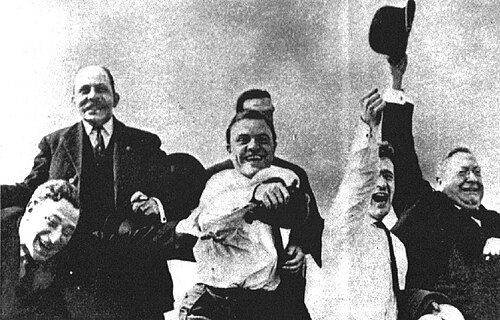
In modern usage, "enthusiasm" refers to intense enjoyment, interest, or approval expressed by a person. The term is allegedly related to playfulness, inventiveness, optimism, zest, verve, and high energy.[1] People can often characterise the modern version of enthusiasm as "infectious" or "contagious",[2] and sometimes even more metaphorically as a virus in its own right.[3]
The word once applied, in accordance with its etymology,[4] to persons possessed by a god, or to people who exhibited intense piety.

The word enthusiasm originates from the Greek ἐνθουσιασμός from ἐν (en, 'in') and θεός (theós, 'god'), meaning 'inspired or possessed by [a] god'. Applied by the Greeks to manifestations of divine possession, by Apollo (as in the case of the Pythia), or by Dionysus (as in the case of the Bacchantes and Maenads), the term enthusiasm was also used in a transferred or figurative sense. Socrates taught that the inspiration of poets is a form of enthusiasm.[6] The term was confined to a belief in religious inspiration, or to intense religious fervor or emotion.
From this, a Syrian sect of the fourth century was known as the Enthusiasts. They believed that "by perpetual prayer, ascetic practices, and contemplation, man could become inspired by the Holy Spirit, in spite of the ruling evil spirit, which the fall had given to him". From their belief in the efficacy of prayer, they were also known as Euchites.[7]
16世紀と17世紀に出現したいくつかのプロテスタントキリスト教宗派、特にリバイバル運動を行う宗派は熱狂的と呼ばれた。[ 7 ]
名誉革命直後の数年間、「熱狂」は、公の場で政治的または宗教的な主張を擁護すること、つまり狂信を指すイギリスの蔑称であった。1700年頃、このような「熱狂」は前世紀のイングランド内戦とその付随する残虐行為の原因と見なされており、したがって、熱狂に身を投じることで戦争を他人に思い出させることは絶対的な社会的罪であった。王立協会の規約では、協会の会合で宗教や政治について議論する者は「熱狂者」であるとして即座に追放されると規定されていた。[ 8 ]
18 世紀には、ジョン・ウェスレーやジョージ・ホワイトフィールドのような人気のあるメソジストは盲目的な熱狂だと非難されたが、彼らは狂信と「心の宗教」を区別することで反論した。新生(第一の恵みの働き)と完全な聖化(第二の恵みの働き)について熱心に説教し、体験するメソジストは、しばしば感情的な体験をする。[ 5 ] [ 7 ]
熱意は良いウイルスです。熱意がなければ広めることはできません。熱意で人を感染させることができます[...]。