As the universe's expansion is accelerating, all currently observable objects, outside the local supercluster, will eventually appear to freeze in time, while emitting progressively redder and fainter light. For instance, objects with the current redshiftz from 5 to 10 will only be observable up to an age of 4–6 billion years. In addition, light emitted by objects currently situated beyond a certain comoving distance (currently about 19 gigaparsecs (62Gly)) will never reach Earth.[13]
Overview
Observable Universe as a function of time and distance, in context of the expanding Universe
The universe's size is unknown, and it may be infinite in extent.[14] Some parts of the universe are too far away for the light emitted since the Big Bang to have had enough time to reach Earth or space-based instruments, and therefore lie outside the observable universe. In the future, light from distant galaxies will have had more time to travel, so one might expect that additional regions will become observable. Regions distant from observers (such as us) are expanding away faster than the speed of light, at rates estimated by Hubble's law.[note 1] The expansion rate appears to be accelerating, which dark energy was proposed to explain.
Assuming dark energy remains constant (an unchanging cosmological constant) so that the expansion rate of the universe continues to accelerate, there is a "future visibility limit" beyond which objects will never enter the observable universe at any time in the future because light emitted by objects outside that limit could never reach the Earth. Note that, because the Hubble parameter is decreasing with time, there can be cases where a galaxy that is receding from Earth only slightly faster than light emits a signal that eventually reaches Earth.[9][15] This future visibility limit is calculated at a comoving distance of 19 billion parsecs (62 billion light-years), assuming the universe will keep expanding forever, which implies the number of galaxies that can ever be theoretically observed in the infinite future is only larger than the number currently observable by a factor of 2.36 (ignoring redshift effects).[note 2]
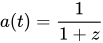
WMAP nine-year results combined with other measurements give the redshift of photon decoupling as z=1091.64±0.47,[38] which implies that the scale factor at the time of photon decoupling would be 1⁄1092.64. So if the matter that originally emitted the oldest CMBR photons has a present distance of 46 billion light-years, then the distance would have been only about 42 million light-years at the time of decoupling.
The light-travel distance to the edge of the observable universe is the age of the universe times the speed of light, 13.8 billion light years. This is the distance that a photon emitted shortly after the Big Bang, such as one from the cosmic microwave background, has traveled to reach observers on Earth. Because spacetime is curved, corresponding to the expansion of space, this distance does not correspond to the true distance at any moment in time.[39]
Matter and mass
Number of galaxies and stars
The observable universe contains as many as an estimated 2 trillion galaxies[40][41][42] and, overall, as many as an estimated 1024 stars[43][44]– more stars (and, potentially, Earth-like planets) than all the grains of beach sand on planet Earth.[45][46][47] Other estimates are in the hundreds of billions rather than trillions.[48][49][50] If the model of cosmic inflation is correct and the universe expanded by >60 e-folds, then the universe could contain over 10100 stars.[51]
Matter content—number of atoms
Assuming the mass of ordinary matter is about 1.45 × 10 53 kgと前述のように仮定し、すべての原子が水素原子であると仮定すると(質量で天の川銀河の全原子の約 74% を占める)、観測可能な宇宙の原子の総数は、通常の物質の質量を水素原子の質量で割ることによって推定されます。その結果は約 10 80個の水素原子となり、これはエディントン数としても知られています。[ 52 ]
通常の物質の塊
観測可能な宇宙の質量は、しばしば 10 53 kg と引用される。[ 53 ]この文脈では、質量とは通常の(バリオン)物質を指し、星間物質(ISM)と銀河間物質(IGM)を含む。ただし、暗黒物質と暗黒エネルギーは含まれない。宇宙の通常の物質の質量として引用されるこの値は、臨界密度に基づいて推定することができる。全体の体積は不明であり、無限である可能性があるため、計算は観測可能な宇宙のみを対象としている。
↑Special relativity prevents nearby objects in the same local region from moving faster than the speed of light with respect to each other, but there is no such constraint for distant objects when the space between them is expanding; see uses of the proper distance for a discussion.
↑The comoving distance of the future visibility limit is calculated on p. 8 of Gott et al.'s A Map of the Universe to be 4.50 times the Hubble radius, given as 4.220 billion parsecs (13.76 billion light-years), whereas the current comoving radius of the observable universe is calculated on p. 7 to be 3.38 times the Hubble radius. The number of galaxies in a sphere of a given comoving radius is proportional to the cube of the radius, so as shown on p. 8 the ratio between the number of galaxies observable in the future visibility limit to the number of galaxies observable today would be (4.50/3.38)3 = 2.36.
↑This does not mean "unbounded" in the mathematical sense; a finite universe would have an upper bound on the distance between two points. Rather, it means that there is no boundary past which there is nothing. See Geodesic manifold.
References
↑Itzhak Bars; John Terning (2009). Extra Dimensions in Space and Time. Springer. pp.27–. ISBN978-0-387-77637-8. Retrieved 2011-05-01.
↑"How big is the Universe? This is what astronomers think the size of the cosmos is, and how they worked it out". BBC Sky at Night Magazine. 2025-08-29. Retrieved 2026-05-01.
↑Abdollahi, S.; Ackermann, M.; Ajello, M.; etal. (30 November 2018). "A gamma-ray determination of the Universe's star formation history". Science. 362 (6418): 1031–1034. arXiv:1812.01031. Bibcode:2018Sci...362.1031F. doi:10.1126/science.aat8123. PMID30498122.
12Loeb, Abraham (2002). "Long-term future of extragalactic astronomy". Physical Review D. 65 (4) 047301. arXiv:astro-ph/0107568. Bibcode:2002PhRvD..65d7301L. doi:10.1103/PhysRevD.65.047301. S2CID1791226.
↑Liddle, Andrew (2015). An Introduction to Modern Cosmology. John Wiley. ISBN978-1-118-50214-3.
↑Is the universe expanding faster than the speed of light? (see the last two paragraphs).
↑Krauss, Lawrence M.; Scherrer, Robert J. (2007). "The Return of a Static Universe and the End of Cosmology". General Relativity and Gravitation. 39 (10): 1545–1550. arXiv:0704.0221. Bibcode:2007GReGr..39.1545K. doi:10.1007/s10714-007-0472-9. S2CID123442313.
↑Using Tiny Particles To Answer Giant Questions. Science Friday, 3 Apr 2009. According to the transcript, Brian Greene makes the comment "And actually, in the far future, everything we now see, except for our local galaxy and a region of galaxies will have disappeared. The entire universe will disappear before our very eyes, and it's one of my arguments for actually funding cosmology. We've got to do it while we have a chance."
↑ Meszaros, Attila; et al. (2009). "Impact on cosmology of the celestial anisotropy of the short gamma-ray bursts". Baltic Astronomy . 18 : 293– 296. arXiv : 1005.1558 . Bibcode : 2009BaltA..18..293M .
さらに読む
Labini, F. Sylos; Montuori, M.; Pietronero, L. (1998). "銀河クラスターのスケール不変性". Physics Reports . 293 (1): 61–226 . arXiv : astro-ph/9711073 . Bibcode : 1998PhR...293...61S . doi : 10.1016/S0370-1573(97)00044-6 .
Lineweaver, Charles H. (2005). 「インフレーションと宇宙マイクロ波背景放射」Colless, Matthew (編) 『新宇宙論』キャンベラ国際物理学サマースクール第16巻、World Scientific、pp. 31–65。arXiv : astro-ph/0305179 . doi : 10.1142/9789812702357_0002 . ISBN978-981-256-066-7。
Martinez, Vicent J.; Starck, Jean-Luc; Saar, Enn; Donoho, David L. ; Reynolds, Simon C.; de la Cruz, Pablo; Paredes, Silvestre (2005). "ウェーブレットノイズ除去による銀河分布の形態". The Astrophysical Journal . 634 (2): 744– 755. arXiv : astro-ph/0508326 . Bibcode : 2005ApJ...634..744M . doi : 10.1086/497125 .