
Loading article…
Terni (/ˈtɛərni/TAIR-nee; Italian:[ˈtɛrni]ⓘ; Latin: Interamna (Nahars)) is a city in the southern portion of the region of Umbria in centralItaly. It is near the border with Lazio. The city is the capital of the province of Terni, located in the plain of the River Nera. It is 104 kilometres (65 miles) northeast of Rome and 81 kilometres (50 mi) south of the regional capital, Perugia. With a population of 106,272, it is the 42nd-largest city in Italy.[2]
The Latin name means "between-two-rivers", in reference to its location on the confluence of the Nera river (Ancient UmbrianNahar, Latin: Nār, Nahar) and the Serra stream. When disambiguation was needed, it was referred to as Interamna Nahars.[3] Its inhabitants were known in Latin as Interamnātēs Na(ha)rtēs.[4]
Interamna was founded as an Ancient Roman town, although there were earlier settlements in the Terni area. During the 19th century, steel mills were introduced and led the city to have a role in the Second Industrial Revolution in Italy. Because of its industrial importance, the city was heavily bombed during World War II by the Allies. It remains an industrial hub and has been nicknamed "The Steel City".
Terni is also known as the "City of Lovers", as its patron saint, Saint Valentine, was born and became a bishop here, and his remains are preserved in the basilica-sanctuary.
この都市は紀元前7世紀頃、ウンブリア人のナハルテス族によって建設されました。この地域は(考古学的発掘調査によって証明されているように)青銅器時代にはすでに人が住んでいました。イグヴィエ碑文には、このナハルテス族は強くて数の多い民族であり、グッビオ(イグヴィウム)のウンブリア人にとって最も重要な敵であったと記されています。紀元前3世紀、テルニはローマ人に征服され、すぐにフラミニア街道沿いの重要な自治都市となり、 「二つの川の間」を意味するインテラムナという名で知られるようになりました。
紀元前271年、ローマの執政官マニウス・クリウス・デンタトゥスは、リエティ渓谷の湿地帯とヴェリーノ湖の水をマルモレの自然の崖に流し、滝を作るために運河(クリアーノ運河)の建設を命じた。これにより、下流のテルニ周辺の渓谷で洪水が発生した。長い間、これがリエティとテルニの両都市間の絶え間ない争いの原因となった。この問題は両都市間で非常に激しく争われたため、紀元前54年にローマ元老院がこの問題を取り上げざるを得なくなった。アウルス・ポンペイウスがテルニを、キケロがリエティを代表した。元老院はこの問題に対して何も対策を講じず、問題は数世紀にわたってそのまま残った。
755年のロンバルディア征服後、テルニはスポレート公国の地方都市へと格下げされ、その重要性を失った。1174年には、フリードリヒ・バルバロッサの将軍でありマインツ大司教であったクリスティアンによって略奪された。翌世紀、テルニは聖フランチェスコが説教を行うために頻繁に訪れた場所の一つとなった。
14世紀、テルニは独自の憲法を制定し、1353年からは城壁が拡張され、新たな運河が開通した。中世後期のイタリアの多くのコムーネと同様に、テルニもゲルフ派とギベリン派の支持者間の内乱、そして後にはノビリとバンデラーリ(テルニのブルジョワジー)間の内乱に悩まされた。その後、テルニは教皇領に加わった。1580年には、モンテレオーネ・ディ・スポレートで採掘された鉄鉱石を加工するための製鉄所、フェリエラが導入され、この都市の伝統的な工業都市としてのイメージが始まった。しかし、17世紀には疫病と飢饉によりテルニの人口はさらに減少した。
19世紀、テルニは産業革命とこの地域の豊富な水源を活かして発展を遂げた。製鉄所、鋳造所、武器工場、ジュート工場、羊毛工場など、新たな産業が次々と誕生した。1927年、テルニは県都となった。
重要な産業が存在したため、この都市は第二次世界大戦中、連合軍の爆撃の格好の標的となった。1943年8月11日、44機の米陸軍航空隊爆撃機による213トンの爆弾投下により、この都市は壊滅的な被害を受け、564人が死亡した。これは、テルニの建物の40%を破壊または損傷させ、1,018人の民間人を殺害した57回の空襲の最初のものであった。それにもかかわらず、戦後、工業環境は急速に回復した。[ 5 ] [ 6 ] [ 7 ] [ 8 ]
As of 2026, the population is 106,272, of which 48.1% are male, and 51.9% are female. Minors make up 12.9% of the population, and seniors make up 28.2%.[2]
As of 2025, immigrants make up 15.3% of the population. The 5 largest foreign countries of birth are Romania, Albania, Ukraine, India, and the Philippines.[12]
The city has three important industrial hubs: the first one is the Stainless Steel Area, called AST (part of the group ThyssenKrupp) and is a wide area located in the east part of Terni. West of the town, there is a second industrial hub, known as "Area Polymer", with four different chemical multinational industries. The third industrial hub is Italeaf, which controls TerniEnergia, a company listed on STAR segment of Borsa Italiana, that is active in the renewable energy sector, and promotes and develops technological start-ups in the cleantech sector.
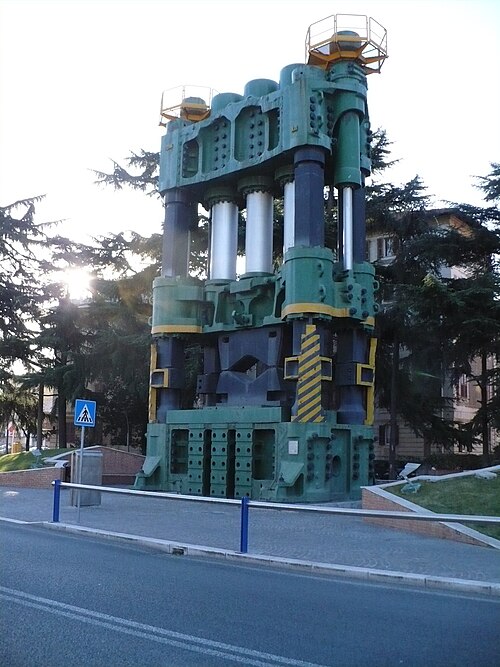
In the 1940s, heavy industry dominated. The Società Terni operated major steel works with eight open hearth and two electric furnaces and an annual capacity of 90,000 tons of special armament steels. The plant included presses, forges, rolling mills, and tube works. At the arsenal, the same concern produced machine guns, anti tank rifles, rifles, 75 mm and 149 mm field guns, naval guns up to 28 cm, and shells. The Royal Small Arms factory also produced small arms, and both concerns maintained shell filling plants.[13]
The Società Terni also operated a calcium carbide plant at Papigno with an estimated annual capacity of 180,000 tons, although shortages of coal and power reduced output below capacity. Cyanamide production occurred with an annual capacity of 22,000 tons nitrogen. Liqueurs, spirits, and mineral waters were also produced. Two large textile mills operated, including the SA Jutificio di Terni with 600 workers and Il Fabbricone with 500 workers. Timber processing was significant, with many sawmills.[13]
Terni is connected with the A1 motorway, the European route E45 and National Road Flaminia by the RATO, a motorway junction.
テルニ駅はアンコーナ-オルテ鉄道の一部であり、テルニ-スルモーナ鉄道(テルニとラクイラを結ぶ)とテルニ-サンセポルクロ鉄道(FCU )(ペルージャ方面)という2つの支線の分岐駅でもある。国内有数の貨物駅が近隣に位置している。市内および郊外の公共交通機関であるATCは、90路線のバスを運行している。市の北部(コッレルーナ地区)では、ペルージャからの路線をライトレールとして利用できるようにするための工事が進められている。
テルニには空港がなく、市に最も近い空港はペルージャ・サン・フランチェスコ・ダッシジ・ウンブリア国際空港で、イタリア国内、イギリス、ヨーロッパ各地への便が運航しています。この空港はテルニの北84km (52マイル)に位置しています。しかし、テルニの住民は通常、国内線と国際線のほとんどが運航しているローマ・フィウミチーノ空港を利用します。この空港はテルニの南西134km (83マイル)に位置しています。


テルナーナ・カルチョは、この街を代表するサッカークラブです。同クラブは、イタリアの1部リーグであるセリエAに2度(1972~1973年シーズンと1974~1975年シーズン)所属していました。現在、テルナーナはセリエC(2025~2026年シーズン)に所属しています。同クラブの本拠地は、収容人数22,000人のスタディオ・リベロ・リベラティです。このスタジアムは、テルニ生まれで1957年に500cc世界選手権を制覇し、テルニ近郊のヴァルネリーナ道路沿いでジレラ・サトゥルノのトレーニング中に事故死したイタリアのオートバイレーサー、リベロ・リベラティにちなんで名付けられました。
テルニは以下の都市と姉妹都市提携を結んでいます:[ 14 ]
 スペイン、カルタヘナ
 ハンガリー、ドゥナウーイヴァーロシュ
 フランス、サン=トゥアン=シュル=セーヌ