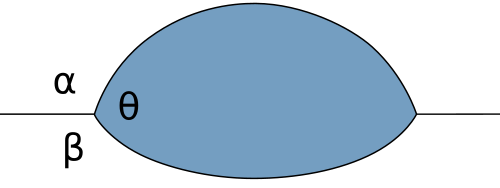
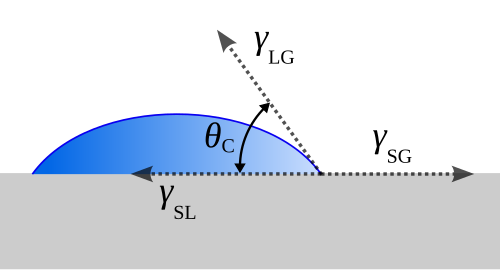
これら3つの表面エネルギーは三角形の辺を形成するため、三角形の不等式γ ij < γ jk + γ ikによって制約されます。つまり、いずれの表面張力も他の2つの表面張力の合計を超えることはできません。これらの不等式に従わない表面エネルギーを持つ3つの流体を接触させた場合、図3と一致する平衡状態は存在しません。
For many surface/adsorbate configurations, surface energy data and experimental observations are unavailable. As wetting interactions are of great importance in various applications, it is often desired to predict and compare the wetting behavior of various material surfaces with particular crystallographic orientations, with relation to water or other adsorbates. This can be done from an atomistic perspective with tools including molecular dynamics and density functional theory.[30][31] In the theoretical prediction of wetting by ab initio approaches such as DFT, ice is commonly substituted for water. This is because DFT calculations are generally conducted assuming conditions of zero thermal movement of atoms, essentially meaning the simulation is conducted at absolute zero. This simplification nevertheless yields results that are relevant for the adsorption of water under realistic conditions and the use of ice for the theoretical simulation of wetting is commonplace.[32]
Non-ideal rough solid surfaces
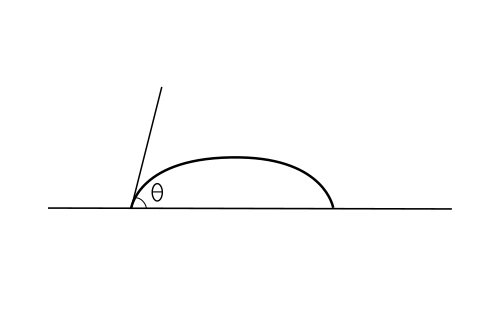
Figure 6: Schematic of advancing and receding contact angles
Unlike ideal surfaces, real surfaces do not have perfect smoothness, rigidity, or chemical homogeneity. Such deviations from ideality result in phenomenon called contact angle hysteresis, which is defined as the difference between the advancing (θa) and receding (θr) contact angles[33]
When the contact angle is between the advancing and receding cases, the contact line is considered to be pinned and hysteretic behaviour can be observed, namely contact angle hysteresis. When these values are exceeded, the displacement of the contact line, such as the one in Figure 3, will take place by either expansion or retraction of the droplet.[34] Figure 6 depicts the advancing and receding contact angles. The advancing contact angle is the maximum stable angle, whereas the receding contact angle is the minimum stable angle. Contact angle hysteresis occurs because many different thermodynamically stable contact angles are found on a nonideal solid. These varying thermodynamically stable contact angles are known as metastable states.[15]
Such motion of a phase boundary, involving advancing and receding contact angles, is known as dynamic wetting. The difference between dynamic and static wetting angles is proportional to the capillary number, 接触線が前進し、表面のより多くの部分を液体で覆うと、接触角は増加し、一般的に接触線の速度に関係します。[ 34 ] [ 35 ]接触線の速度が際限なく増加すると、接触角は増加し、180°に近づくと、気相が液体と固体の間の薄い層に巻き込まれます。これは、接触線が非常に高速で移動するため、完全な濡れが起こらないことから生じる運動学的非平衡効果です。
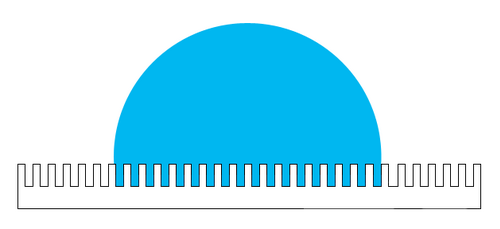
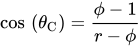
The Wenzel model is valid between θC and π/2. If the contact angle is less than ΘC, the penetration front spreads beyond the drop and a liquid film forms over the surface. Figure 11 depicts the transition from the Wenzel state to the surface film state. The film smooths the surface roughness and the Wenzel model no longer applies. In this state, the equilibrium condition and Young's relation yields:
By fine-tuning the surface roughness, it is possible to achieve a transition between both superhydrophobic and superhydrophilic regions. Generally, the rougher the surface, the more hydrophobic it is.
Spreading dynamics
If a drop is placed on a smooth, horizontal surface, it is generally not in the equilibrium state. Hence, it spreads until an equilibrium contact radius is reached (partial wetting). While taking into account capillary, gravitational, and viscous contributions, the drop radius as a function of time can be expressed as[48]
For the complete wetting situation, the drop radius at any time during the spreading process is given by
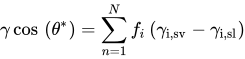
Many technological processes require control of liquid spreading over solid surfaces. When a drop is placed on a surface, it can completely wet, partially wet, or not wet the surface. By reducing the surface tension with surfactants, a nonwetting material can be made to become partially or completely wetting. The excess free energy (σ) of a drop on a solid surface is:[49]
↑Rafiee, J.; Mi, X.; Gullapalli, H.; Thomas, A. V.; Yavari, F.; Shi, Y.; Ajayan, P. M.; Koratkar, N. A. (2012). "Wetting transparency of graphene"(PDF). Nature Materials. 11 (3): 217–22. Bibcode:2012NatMa..11..217R. doi:10.1038/nmat3228. PMID22266468. Archived from the original(PDF) on 2017-11-15.
↑Mertens, Stijn F. L.; Hemmi, Adrian; Muff, Stefan; Gröning, Oliver; De Feyter, Steven; Osterwalder, Jürg; Greber, Thomas (2016). "Switching stiction and adhesion of a liquid on a solid"(PDF). Nature. 534 (7609): 676–679. Bibcode:2016Natur.534..676M. doi:10.1038/nature18275. PMID27357755. S2CID205249367. Archived from the original(PDF) on 2019-04-11.
12Sharfrin, E.; Zisman, William A. (1960). "Constitutive relations in the wetting of low energy surfaces and the theory of the retraction method of preparing monolayers". The Journal of Physical Chemistry. 64 (5): 519–524. doi:10.1021/j100834a002.
↑Mantanis, G. I.; Young, R. A. (1997). "Wetting of wood". Wood Science and Technology. 31 (5): 339–353. doi:10.1007/BF01159153. ISSN0043-7719.
12Eustathopoulos, N.; Nicholas, M.G.; Drevet B. (1999). Wettability at high temperatures. Oxford, UK: Pergamon. ISBN978-0-08-042146-9.
↑Loubet NA, Verde AR & Appignanesi GA, J. Chem. Phys. 160, 064502 (2025), https://doi.org/10.1063/5.0276390
↑Accordino SR et al., J. Phys.: Condens. Matter 37, 305101 (2025), https://doi.org/10.1088/1361-648X/adebd4
↑Schrader, M.E; Loeb, G.I. (1992). Modern Approaches to Wettability. Theory and Applications. New York: Plenum Press. ISBN978-0-306-43985-8.
↑ de Gennes, PG (1985). "濡れ: 静力学と動力学" (PDF) . Reviews of Modern Physics . 57 (3): 827– 863. Bibcode : 1985RvMP...57..827D . doi : 10.1103/RevModPhys.57.827 . 2016年9月10日にオリジナル(PDF)からアーカイブ済み。
↑ Chen, Kuang-Yen; Ivashenko, Oleksii; Carroll, Gregory T.; Robertus, Jort; Kistemaker, Jos CM; London, Gábor; Browne, Wesley R.; Rudolf, Petra; Feringa, Ben L. (2014). "三脚型光活性化分子モーターを用いた表面濡れ性の制御" . Journal of the American Chemical Society . 136 (8): 3219– 3224. doi : 10.1021/ja412110t . hdl : 11370/e9f60c58-81ab-4309-8978-e5eca18229fd . PMID 24490770 . S2CID 207106544 .
1 2 3ジョンソン、ルーロン E. (1993)、湿潤性編。バーグ、ジョン。 C. ニューヨーク州ニューヨーク: Marcel Dekker, Inc. ISBN0-8247-9046-4
↑ Rowlinson, JS; Widom, B. (1982). Molecular Theory of Capillarity . Oxford, UK: Clarendon Press. ISBN978-0-19-855642-8。
↑ Young, T. (1805). "流体の凝集力に関するエッセイ" (PDF) . Philosophical Transactions of the Royal Society of London . 95 : 65– 87. doi : 10.1098/rstl.1805.0005 . S2CID 116124581 .
↑ Tadmor, Rafael (2004). "線エネルギーと前進接触角、後退接触角、ヤング接触角の関係". Langmuir . 20 (18): 7659–64 . doi : 10.1021/la049410h . PMID 15323516 .
↑Makkonen, Lasse (2017). "A thermodynamic model of contact angle hysteresis". The Journal of Chemical Physics. 147 (6): 1–8. doi:10.1063/1.4996912. PMID064703.
↑Athanase M. Dupré, Paul Dupré (1869-01-01). Théorie mécanique de la chaleur (in French). Gauthier-Villars.
↑Clegg, Carl (2016). "Contact Angle Spreading Coefficient". www.ramehart.com. ramé-hart. Retrieved 6 January 2016.
12Gibbs, Josiah Willard Auteur du texte (1928). The collected works / of J. W. Gibbs,...
12Wciślik, Sylwia; Mukherjee, Sayantan (June 2022). "Evaluation of three methods of static contact angle measurements for TiO 2 nanofluid droplets during evaporation". Physics of Fluids. 34 (6): 062006. Bibcode:2022PhFl...34f2006W. doi:10.1063/5.0096644. ISSN1070-6631. S2CID249715372.
↑Marmur, Abraham (February 1997). "Line Tension and the Intrinsic Contact Angle in Solid–Liquid–Fluid Systems". Journal of Colloid and Interface Science. 186 (2): 462–466. Bibcode:1997JCIS..186..462M. doi:10.1006/jcis.1996.4666. PMID9056376.
↑Tadmor, Rafael (2004-08-01). "Line Energy and the Relation between Advancing, Receding, and Young Contact Angles". Langmuir. 20 (18): 7659–7664. doi:10.1021/la049410h. ISSN0743-7463. PMID15323516.
↑ Bormashenko, Edward (2009-08-05). "Young、Boruvka–Neumann、Wenzel、Cassie–Baxter 方程式を湿潤の変分問題の横断条件として用いる" . Colloids and Surfaces A: Physicochemical and Engineering Aspects . 345 (1): 163– 165. doi : 10.1016/j.colsurfa.2009.04.054 . ISSN 0927-7757 .
↑ Bormashenko, Edward (2020-01-17). "接触角を定義するための変分フレームワーク: 一般的な熱力学的アプローチ". Journal of Adhesion Science and Technology . 34 (2): 219– 230. doi : 10.1080/01694243.2019.1663030 . ISSN 0169-4243 . S2CID 203537637 .
↑Bormashenko, E. (2008). "Why does the Cassie–Baxter equation apply?". Colloids and Surfaces A. 324 (1–3): 47–50. doi:10.1016/j.colsurfa.2008.03.025.
↑Lin, F.; Zhang, Y; Xi, J; Zhu, Y; Wang, N; Xia, F; Jiang, L (2008). "Petal Effect: A Superhydrophobic State with High Adhesive Force". Langmuir. 24 (8): 4114–4119. doi:10.1021/la703821h. PMID18312016.
↑Muzammil, I.; Li, Y.P.; Li, X.Y.; Lei, M.K. (2018). "Duty cycle dependent chemical structure and wettability of RF pulsed plasma copolymers of acrylic acid and octafluorocyclobutane". Applied Surface Science. 436: 411–418. Bibcode:2018ApSS..436..411M. doi:10.1016/j.apsusc.2017.11.261.
12Ishino, C.; Okumura, K (2008). "Wetting transitions on textured hydrophilic surfaces"(PDF). European Physical Journal. 25 (4): 415–424. Bibcode:2008EPJE...25..415I. doi:10.1140/epje/i2007-10308-y. PMID18431542. S2CID35973585. Archived from the original(PDF) on 2019-04-11.
↑Quere, D.; Thiele, Uwe; Quéré, David (2008). "Wetting of Textured Surfaces"(PDF). Colloids and Surfaces A. 206 (1–3): 41–46. doi:10.1016/S0927-7757(02)00061-4. Archived from the original(PDF) on 2012-05-27. Retrieved 2011-12-17.
↑Härth, Michael; Schubert, Dirk W. (2012). "Simple Approach for Spreading Dynamics of Polymeric Fluids". Macromolecular Chemistry and Physics. 213 (6): 654–665. doi:10.1002/macp.201100631.
1 2 Lee, KS; Ivanova, N.; Starov, VM; Hilal, N.; Dutschk, V. (2008). "水性界面活性剤溶液による濡れと広がりの速度論". Advances in Colloid and Interface Science . 144 ( 1– 2): 54– 65. doi : 10.1016/j.cis.2008.08.005 . PMID 18834966 .
1 2 3 4 Pietschnig, R. (2016). "ペンダントフェロセンを有するポリマー" . Chemical Society Reviews . 45 (19): 5216– 5231. doi : 10.1039/C6CS00196C . PMID 27156979 .
↑ Connelly, NG; Geiger, WE (1996). "有機金属化学のための化学的酸化還元剤" (PDF) . Chemical Reviews . 96 (2): 877– 910. doi : 10.1021/cr940053x . PMID 11848774 . 2016年1月22日にオリジナル(PDF)からアーカイブ済み。









 ウィキメディア・コモンズにある、濡れに関するメディア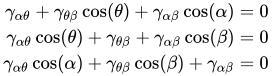



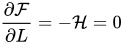
![{\displaystyle x\in I=[0,L]}](https://wikimedia.org/api/rest_v1/media/math/render/svg/d305c8663697c7ab89128c6c19f017d16b9addeb)

![{\displaystyle {\cal {F}}[y,L]=\int _{0}^{L}\left(\gamma _{LG}{\sqrt {1+y'^{2}}}+(\gamma _{\text{SL}}-\gamma _{\text{SG}})\right)dx}](https://wikimedia.org/api/rest_v1/media/math/render/svg/cafa53a96ca77cea619c007938a61bc58cd91db3)



















![{\displaystyle r(t)=r_{e}\left[1-\exp \left(-\left({\frac {2\gamma _{LG}}{r_{e}^{12}}}+{\frac {\rho g}{9r_{e}^{10}}}\right){\frac {24\lambda V^{4}\left(t+t_{0}\right)}{\pi ^{2}\eta }}\right)\right]^{\frac {1}{6}}.}](https://wikimedia.org/api/rest_v1/media/math/render/svg/2b7f6677efcbc2406fe5b0768f12d4ec45bea534)
![{\displaystyle r(t)=\left[\left(\gamma _{LG}{\frac {96\lambda V^{4}}{\pi ^{2}\eta }}\left(t+t_{0}\right)\right)^{\frac {1}{2}}+\left({\frac {\lambda (t+t_{0})}{\eta }}\right)^{\frac {2}{3}}{\frac {24\rho gV^{\frac {8}{3}}}{7\cdot 96^{\frac {1}{3}}\pi ^{\frac {4}{3}}\gamma _{LG}^{\frac {1}{3}}}}\right]^{\frac {1}{6}},}](https://wikimedia.org/api/rest_v1/media/math/render/svg/8bcb6aba24924cebc9d42eb226a22b70e595a519)

