
Loading article…
| |||

| |||
| Names | |||
|---|---|---|---|
| Preferred IUPAC name
Toluene[2] | |||
| Systematic IUPAC name
Methylbenzene | |||
| Other names
Methyl benzene[1]
Methylcyclohexa-1,3,5-triene Benzylane Phenylmethane Toluol Anisen | |||
| Identifiers | |||
| |||
3D model (JSmol)
|
| ||
| Abbreviations | PhMe MePh BnH Tol | ||
| ChEBI |
| ||
| ChEMBL |
| ||
| ChemSpider |
| ||
| DrugBank |
| ||
| ECHA InfoCard | 100.003.297 | ||
| |||
| KEGG |
| ||
PubChem CID
|
| ||
| RTECS number |
| ||
| UNII |
| ||
| UN number | 1294 | ||
CompTox Dashboard (EPA)
|
| ||
| |||
| |||
| Properties | |||
| C6H5CH3 | |||
| Molar mass | 92.141 g·mol−1 | ||
| Appearance | Colorless liquid[3] | ||
| Odor | sweet, pungent, benzene-like[4] | ||
| Density | 0.8623 g/mL (25 °C)[1] | ||
| Melting point | −95.0 °C (−139.0 °F; 178.2 K)[1] | ||
| Boiling point | 110.60 °C (231.08 °F; 383.75 K)[1] | ||
| 0.54 g/L (5 °C) 0.519 g/L (25 °C) 0.63 g/L (45 °C) 1.2 g/L (90 °C)[5] | |||
| log P | 2.73[6] | ||
| Vapor pressure | 2.8 kPa (20 °C)[4] | ||
| −66.1·10−6 cm3/mol[7] | |||
| Thermal conductivity | 0.1310 W/(m·K) (25 °C)[8] | ||
Refractive index (nD)
|
1.4941 (25 °C)[1] | ||
| Viscosity | 0.560 mPa·s (25 °C)[9] | ||
| Structure | |||
| 0.375 D[10] | |||
| Thermochemistry[11] | |||
Heat capacity (C)
|
157.3 J/(mol·K) | ||
Std enthalpy of
formation (ΔfH⦵298) |
12.4 kJ/mol | ||
Std enthalpy of
combustion (ΔcH⦵298) |
3.910 MJ/mol | ||
| Hazards | |||
| Occupational safety and health (OHS/OSH): | |||
Main hazards
|
highly flammable | ||
| GHS labelling: | |||
  
| |||
| Danger | |||
| H225, H304, H315, H336, H361d, H373 | |||
| P210, P240, P301+P310, P302+P352, P308+P313, P314, P403+P233 | |||
| NFPA 704 (fire diamond) | |||
| Flash point | 4 °C (39 °F; 277 K)[12] | ||
| 480[12] °C (896 °F; 753 K) | |||
| Explosive limits | 1.1–7.1%[12] | ||
Threshold limit value (TLV)
|
50 mL/m3, 190 mg/m3 | ||
| Lethal dose or concentration (LD, LC): | |||
LC50 (median concentration)
|
>26700 ppm (rat, 1 h) 400 ppm (mouse, 24 h)[13] | ||
LCLo (lowest published)
|
55,000 ppm (rabbit, 40 min)[13] | ||
| NIOSH (US health exposure limits): | |||
PEL (Permissible)
|
TWA 200 ppm C 300 ppm 500 ppm (10-minute maximum peak)[4] | ||
REL (Recommended)
|
TWA 100 ppm (375 mg/m3) ST 150 ppm (560 mg/m3)[4] | ||
IDLH (Immediate danger)
|
500 ppm[4] | ||
| Safety data sheet (SDS) | SIRI.org | ||
| Related compounds | |||
Related aromatic hydrocarbons
|
benzene xylene naphthalene | ||
Related compounds
|
methylcyclohexane methylcyclohexene | ||
| Supplementary data page | |||
| Toluene (data page) | |||
Except where otherwise noted, data are given for materials in their standard state (at 25 °C [77 °F], 100 kPa).
 verify (what is verify (what is  ?) ?)
Infobox references
| |||
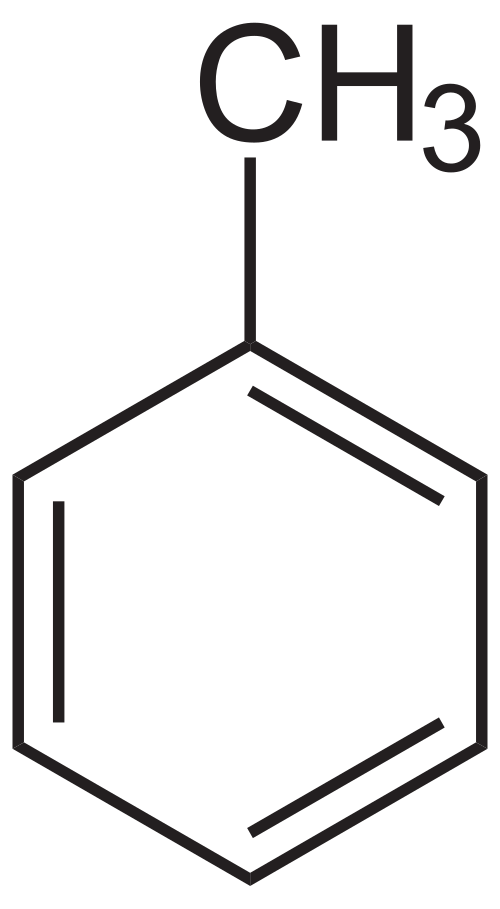


Toluene (/ˈtɒl.juiːn/), also known as toluol (/ˈtɒl.ju.ɒl, -ɔːl, -oʊl/), is a substituted aromatic hydrocarbon[15] with the chemical formula C6H5CH3, often abbreviated as PhCH3, where Ph stands for phenyl group. It is a colorless, water-insoluble liquid with the odor associated with paint thinners. It is a mono-substituted benzene derivative, consisting of a methyl group (CH3) attached to a phenyl group by a single bond. As such, its systematic IUPAC name is methylbenzene. Toluene is predominantly used as an industrial feedstock and a solvent.
As the solvent in some types of paint thinner, permanent markers, contact cement and certain types of glue, toluene is sometimes used as a recreational inhalant[16] and has the potential of causing severe neurological harm.[17][18]
History
The compound was first isolated in 1837 through a distillation of pine oil by Pierre Joseph Pelletier and Filip Neriusz Walter, who name