Loading article…
複素解析(数学の一分野)において、極とは複素変数の複素数値関数の特異点の一種です。これは、そのような関数の除去不可能な特異点の中で最も単純なタイプです(本質的特異点を参照)。厳密には、点z 0が関数fの極であるとは、z 0の近傍で1 / fが正則(つまり複素微分可能)である場合を指します。
関数fが開集合Uにおいて有理型であるとは、 Uの任意の点zに対して、 fと1/ fの少なくとも一方が正則となるようなzの近傍が存在することをいう。
関数fがUにおいて有理型である場合、 fの零点は1/ fの極であり、fの極は1/ fの零点である。これは零点と極の間に双対性をもたらし、有理型関数の研究において基本となる。例えば、関数が複素平面全体と無限遠点で有理型である場合、その極の重複度の合計は零点の重複度の合計に等しい。
複素変数zの関数は、開領域Uにおいて、Uのすべての点でzに関して微分可能である場合、正則である。言い換えれば、Uのすべての点でテイラー級数が存在し、その近傍で関数に収束する解析的である場合、正則である。関数は、 Uのすべての点において、 fと1/ fの少なくとも一方が正則となるような近傍が存在する場合、Uにおいて有理型である。
A zero of a meromorphic function f is a complex number z such that f(z) = 0. A pole of f is a zero of 1/f.
If f is a function that is meromorphic in a neighbourhood of a point of the complex plane, then there exists an integer n such that
is holomorphic and nonzero in a neighbourhood of (this is a consequence of the analytic property). If n > 0, then is a pole of order (or multiplicity) n of f. If n < 0, then is a zero of order of f. Simple zero and simple pole are terms used for zeroes and poles of order Degree is sometimes used synonymously to order.
This characterization of zeros and poles implies that zeros and poles are isolated, that is, every zero or pole has a neighbourhood that does not contain any other zero and pole.
Because of the order of zeros and poles being defined as a non-negative number n and the symmetry between them, it is often useful to consider a pole of order n as a zero of order −n and a zero of order n as a pole of order −n. In this case a point that is neither a pole nor a zero is viewed as a pole (or zero) of order 0.
A meromorphic function may have infinitely many zeros and poles. This is the case for the gamma function (see the image in the infobox), which is meromorphic in the whole complex plane, and has a simple pole at every non-positive integer. The Riemann zeta function is also meromorphic in the whole complex plane, with a single pole of order 1 at z = 1. Its zeros in the left halfplane are all the negative even integers, and the Riemann hypothesis is the conjecture that all other zeros are along Re(z) = 1/2.
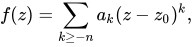
In a neighbourhood of a point a nonzero meromorphic function f is the sum of a Laurent series with at most finite principal part (the terms with negative index values):
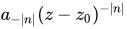
where n is an integer, and Again, if n > 0 (the sum starts with 主項はn項あり、 n位の極があり、n ≤ 0 の場合(和は主部はなく、次数がゼロとなる。。
関数が無限遠で有理型であるのは、無限遠の近傍(つまり、ある円盤の外側)で有理型であり、かつ、ある整数nが存在して、
は存在し、ゼロではない複素数である。
この場合、無限遠点はn > 0の場合はn位の極であり、n > 0の場合は n 位の零点である。n < 0 の場合。
例えば、n次多項式は無限遠にn次極を持つ。
無限遠点によって拡張された複素平面は、リーマン球面と呼ばれる。
関数fがリーマン球面全体で有理型である場合、有限個の零点と極を持ち、その極の位数の合計は零点の位数の合計に等しい。
すべての有理関数はリーマン球面全体において有理型であり、この場合、零点または極の位数の合計は、分子と分母の次数の最大値となる。

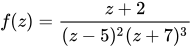
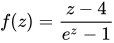
上記の例のうち、3番目を除くすべては有理関数です。このような関数の零点と極に関する一般的な説明については、「極零点図」§ 「連続時間システム」を参照してください。
零点と極の概念は、複素曲線上の関数、すなわち(複素数上の)次元1の複素解析多様体上の関数にも自然に拡張されます。このような曲線の最も単純な例は、複素平面とリーマン面です。この拡張は、解析的同型写像であるチャートを通して構造と性質を伝達することによって行われます。
より正確には、f を複素曲線Mから複素数への関数とする。この関数は、 Mの点zの近傍で正則(または有理型)であるのは、チャートが存在する場合である。そのため近傍で正則(または有理型)であるそして、zが n 位の極または零点であるのは、以下が成り立つ場合である。
曲線がコンパクトであり、関数fが曲線全体で有理型である場合、零点と極の数は有限であり、極の位数の合計は零点の位数の合計に等しくなります。これは、リーマン・ロッホの定理に関わる基本的な事実の 1 つです。