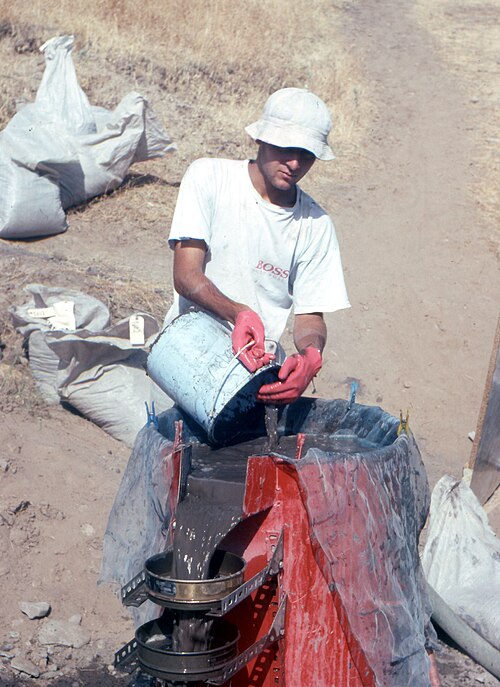
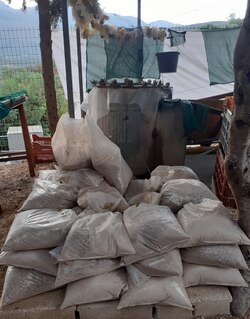
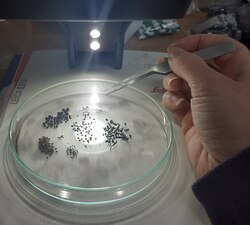
Flotation machine in use at Hallan Çemi, southeast Turkey, c. 1990. Note the two sieves catching charred seeds and charcoal, and the bags of archaeological sediment waiting for flotation.
Paleoethnobotany (also spelled palaeoethnobotany), or archaeobotany, is the study of past human-plant interactions through the recovery and analysis of ancient plant remains. Both terms are synonymous, though paleoethnobotany (from the Greek words palaios [παλαιός] meaning ancient, ethnos [έθνος] meaning race or ethnicity, and votano [βότανο] meaning plants) is generally used in North America and acknowledges the contribution that ethnographic studies have made towards our current understanding of ancient plant exploitation practices, while the term archaeobotany (from the Greek words archaios [αρχαίος] meaning ancient and votano) is preferred in Europe and emphasizes the discipline's role within archaeology.[1][2]
As a field of study, paleoethnobotany is a subfield of environmental archaeology. It involves the investigation of both ancient environments and human activities related to those environments, as well as an understanding of how the two co-evolved. Plant remains recovered from ancient sediments within the landscape or at archaeological sites serve as the primary evidence for various research avenues within paleoethnobotany, such as the origins of plant domestication, the development of agriculture, paleoenvironmental reconstructions, subsistence strategies, paleodiets, economic structures, and more.[3]
Paleoethnobotanical studies are divided into two categories: those concerning the Old World (Eurasia and Africa) and those that pertain to the New World (the Americas). While this division has an inherent geographical distinction to it, it also reflects the differences in the flora of the two separate areas. For example, maize only occurs in the New World, while olives only occur in the Old World. Within this broad division, paleoethnobotanists tend to further focus their studies on specific regions, such as the Near East or the Mediterranean, since regional differences in the types of recovered plant remains also exist.
Macrobotanical vs. microbotanical remains
Charred barley grains viewed through a low-powered microscope.
1 2 3 4 5 6 7 8 9 10 11 12 13 14 15 16 17 18 19 20 Pearsall , DM ( 2015 ) . Paleoethnobotany : a handbook of procedures ( Third ed.). Walnut Creek, California: Left Coast Press. ISBN978-1-61132-298-9OCLC 888401422
1 2 3 4 5 6 Marston, JM; d'Alpoim Guedes, J.; Warinner, C. (2014). "21世紀の古民族植物学の方法と理論". Marston, JM; d'Alpoim Guedes, J.; Warinner, C. (編).古民族植物学の方法と理論. ボルダー: コロラド大学出版局. pp. 1–15 . ISBN978-1-60732-316-7OCLC 903563629。
1 2 Christine Ann Hastorf; Virginia S. Popper 編 (1988). Current paleoethnobotany: analytical methods and cultural interpretations of archaeological plant remains . Chicago: University of Chicago Press. ISBN0-226-31892-3OCLC 18134655
↑ Heiss, Andreas G.; Bittmann, Felix; Kroll, Helmut; Pokorná, Adéla; Stika, Hans-Peter. "Website of the International Work Group for Palaeoethnobotany (IWGP)" . 2022-07-23に取得。
↑ Pearsall, DM (1989). Paleoethnobotany: A Handbook of Procedures (First ed.). San Diego: Academic Press.
↑ Van Zeist, W.; Casparie, WA; International Work Group for Palaeoethnobotany (1984). Plants and ancient man: studies in palaeoethnobotany: proceedings of the Sixth Symposium of the International Work Group for Palaeoethnobotany, Groningen, 30 May-3 June 1983. Rotterdam: AA Balkema. ISBN90-6191-528-7OCLC 11059732。
↑ Van Zeist, W.; Wasylikowa, K.; Behre, K.-E. (1991). Progress in old world palaeoethnobotany: a retrospective view on the occasion of 20 years of the International Work Group for Palaeoethnobotany . Rotterdam: AA Balkema. ISBN90-6191-881-2OCLC 22942783
↑ Lodwick, Lisa ; Stroud, Elizabeth (2019). "Paleoethnobotany and Stable Isotopes". In López Varela, Sandra L. (ed.). The Encyclopedia of Archaeological Sciences . Malden, MA: Wiley-Blackwell. pp. 1–4 . doi : 10.1002/9781119188230.saseas0436 . ISBN978-0-470-67461-1. S2CID 239512474 .
↑ Pownall, Angela (2014年8月1日) 「管理人がカーナーボン・レンジを開放」 The West Australian . 2022年7月19日閲覧。
↑ McDonald, Jo; Veth, Peter (2008). "Rock- art: Pigment dates provide new perspectives on the role of art in the Australian arid zone" . Australian Aboriginal Studies (2008/1): 4– 21 – via ResearchGate .
↑ Tolar, T.; Jacomet, S.; Velušček, A.; Čufar, K. (2009). "水浸しになった考古学的堆積物の回収技術:新石器時代の湖畔集落からのサンプルに対するさまざまな処理方法の比較". Vegetation History and Archaeobotany . 19 (1): 53–67 . doi : 10.1007/s00334-009-0221-y . ISSN 1617-6278 . S2CID 54768558 .
1 2 Fritz, G.; Nesbitt, M. (2014). "植物遺物の実験室分析と識別". Marston, JM; d'Alpoim Guedes, J.; Warriner, C. (編).古民族植物学における方法と理論. ボルダー: コロラド大学出版局. pp. 115–145 . ISBN978-1-60732-316-7OCLC 903563629。
1 2 Piperno, DR (2006). Phytoliths: a comprehensive guide for archaeologists and paleoecologists . Lanham, MD: AltaMira Press. ISBN0-7591-0384-4OCLC 60705579。
1 2 3 Marston, JM (2014). 「古民族植物学分析における比率と単純統計:データ探索と仮説検定」。Marston, JM、d'Alpoim Guedes, J.、Warriner, C. (編)『古民族植物学における方法と理論』所収。ボルダー:コロラド大学出版局。pp. 163–179。ISBN978-1-60732-316-7OCLC 903563629。
↑ Smith, A. (2014). 「考古植物学における多変量統計の利用」。Marston, JM; d'Alpoim Guedes, J.; Warriner, C. (編) 『古民族植物学における方法と理論』所収。ボルダー:コロラド大学出版局。pp. 181–204。ISBN978-1-60732-316-7OCLC 903563629。
↑ McKerracher, M; Hamerow, H; Bogaard, A; Bronk Ramsey, C; Charles, M; Forster, E; Hodgson, J; Holmes, M; Neil, S; Roushannafas, T; Thomas, R (2023). "アングロサクソン時代のイングランドの食糧供給:中世初期の農業研究のための生物考古学的データセット(データ論文)" . Internet Archaeology (61). doi : 10.11141/ia.61.5 .
↑フェヒナー、カイ。メニル、マリアンヌ (2002)。「Pain, fours et foyers des temps passés / 過去のパン、オーブン、囲炉裏」。文明。49 ( 1-2 )。ブリュッセル: ブリュッセル自由大学: 400. doi : 10.4000/civilisations.964。
↑ González Carretero, Lara; Wollstonecroft, Michèle; Fuller, Dorian Q. (2017). "考古学的穀物食の研究への方法論的アプローチ:Çatalhöyük East (トルコ) の事例研究" . Vegetation History and Archaeobotany . 26 (4): 415– 432. Bibcode : 2017VegHA..26..415G . doi : 10.1007/s00334-017-0602-6 . PMC 5486841 . PMID 28706348 .
↑ Heiss, Andreas G.; Antolín, Ferran; Bleicher, Niels; Harb, Christian; Jacomet, Stefanie; Kühn, Marlu; Marinova, Elena; Stika, Hans-Peter; Valamoti, Soultana Maria (2017). "State of the (t)art. Analytical approaches in the investigation of components and production traits of archaeological bread-like objects, applied to two finds from the Neolithic lakeshore settlement Parkhaus Opéra (Zürich, Switzerland)" . PLOS ONE . 12 (8) e0182401. Bibcode : 2017PLoSO..1282401H . doi : 10.1371/journal.pone.0182401 . PMC 5542691 . PMID 28771539 .
↑ Heiss, Andreas G.; Antolín, Ferran; Berihuete-Azorín, Marian; Biederer, Benedikt; Erlach, Rudolf; Gail, Niki; Griebl, Monika; Linke, Robert; Lochner, Michaela; Marinova, Elena; Oberndorfer, Daniel; Stika, Hans-Peter; Valamoti, Soultana Maria (2019). "The Hoard of the Rings. "Odd" annular bread-like objects as a case study for cereal-product diversity at the Late Bronze Age hillfort site of Stillfried (Lower Austria)" . PLOS ONE . 14 (6) e0216907. Bibcode : 2019PLoSO..1416907H . doi : 10.1371/ journal.pone.0216907 . PMC 6550392. PMID 31166950 .
↑ Bates, Jennifer; Willcox Black, Kelly; Morrison, Kathleen D. (2022). "南インド初期鉄器時代のキビパンと豆の生地:料理の指標としての焦げた食べ物の塊" . Journal of Archaeological Science . 137 105531. Bibcode : 2022JArSc.137j5531B . doi : 10.1016/j.jas.2021.105531 . S2CID 245031081 .
↑ Valamoti, SM (2018). "ワイン産地でビールを醸造?ギリシャ初期・中期青銅器時代のビール製造に関する最初の考古植物学的証拠". Vegetation History and Archaeobotany . 27 (4): 611–625 . Bibcode : 2018VegHA..27..611V . doi : 10.1007/s00334-017-0661-8 . ISSN 1617-6278 . S2CID 135345407 .
↑ Wang, J.; Liu, L.; Ball, T.; Yu, L.; Li, Y.; Xing, F. (2016). "中国で5000年前のビールレシピを解明" . Proceedings of the National Academy of Sciences . 113 (23): 6444– 6448. Bibcode : 2016PNAS..113.6444W . doi : 10.1073/pnas.1601465113 . ISSN 0027-8424 . PMC 4988576 . PMID 27217567 .
↑ Heiss, AG; Berihuete-Azorín, M.; Antolín, F.; Kubiak-Martens, L.; Marinova, E.; Arendt, EK; Biliaderis, CG; Kretschmer, H.; Lazaridou, A.; Stika, H.-P.; Zarnkow, M.; Baba, M.; Bleicher, N.; Ciałowicz, KM; Chłodnicki, M.; Matuschik, I.; Schlichtherle, H.; Valamoti, SM (2020-05-07). "Mashes to Mashes, Crust to Crust. Presenting a novel microstructural marker for malting in the archaeological record" . PLOS ONE . 15 (5) e0231696. Bibcode : 2020PLoSO..1531696H . doi : 10.1371/ journal.pone.0231696 . ISSN 1932-6203 . PMC 7205394. PMID 32379784 .
↑ Margaritis, E.; Jones, M. (2006). "Beyond cereals: crop processing and Vitis vinifera L. Ethnography, experiment and charred grape remains from Hellenistic Greece" . Journal of Archaeological Science . 33 (6): 784– 805. Bibcode : 2006JArSc..33..784M . doi : 10.1016/j.jas.2005.10.021 . ISSN 0305-4403 .
↑バラモティ、SM;ダルク、P. CK、クリサンタキ。マラミドウ、D.ツィルツォーニ、Z. (2015)。ダイラー、A.カーン・シェノル、A.アイドゥノール、アメリカ (編)。古代における東地中海におけるオリーブオイルとワインの生産: 国際シンポジウム議事録: 2011 年 11 月 17 ~ 19 日 ウルラ - トルコ = Antikçağ'da Doğu Akdeniz'de Zeytinyağı ve Şrap Üretimi : Uluslararası Sempozyum bildirileri: 17-19 Kasım 2011 ウルラ - イズミル。イズミル: Ege Üniversitesi Edebiyat Fakültesi Yayınları。127~ 139ページ。ISBN978-605-338-120-4OCLC 975246689
↑ Andreou, S.; Heron, C.; Jones, G.; Kiriatzi, V.; Psaraki, K.; Roumpou, M.; Valamoti, SM (2013). "Smelly Barbarians or Perfumed Natives". Voutsaki, F.; Valamoti, SM (eds.). Diet, economy and society in the ancient Greek world : towards a better integration of archaeology and science: proceedings of the International Conference held at the Netherlands Institute at Athens on 22-24 March 2010 . Leuven: Peeters. pp. 173– 185. ISBN978-90-429-2724-7OCLC 862107818
↑ Chauhan, MP; Singh, S.; Singh, AK (2009-12-01). "亜麻仁の収穫後利用". Journal of Human Ecology . 28 (3): 217– 219. doi : 10.1080/09709274.2009.11906243 . ISSN 0970-9274 . S2CID 111310895 .
↑ Bogaard, A.; Jones, G.; Charles, M. (2005). "作物処理が考古植物学的雑草証拠からの作物播種時期と耕作強度の再構築に与える影響". Vegetation History and Archaeobotany . 14 (4): 505–509 . Bibcode : 2005VegHA..14..505B . doi : 10.1007/s00334-005-0061-3 . ISSN 1617-6278 . S2CID 132300293 .
↑ Jones, G.; Bogaard, A.; Halstead, P.; Charles, M.; Smith, H. (1999). "雑草相に基づく作物栽培の強度の特定". The Annual of the British School at Athens . 94 : 167– 189. doi : 10.1017/S0068245400000563 . ISSN 0068-2454 . JSTOR 30103457 . S2CID 128393537 .
↑ Nitsch, EK; Jones, G.; Sarpaki, A.; Hald, MM; Bogaard, A. (2019). "クレタ島クノッソスにおける農業慣行と土地管理:新石器時代および青銅器時代の作物遺物のδ13Cおよびδ15N分析からの新たな知見". Garcia, D.; Orgeolet, R.; Pomadère, M.; Zurbach, J. (編)『都市の中の田園:原史時代の都市集落(エーゲ海および西地中海)の農業機能』所収。オックスフォード:Archaeopress。pp. 152–168。ISBN978-1-78969-133-7. OCLC 1123912620 .
↑ Papanthimou, A.; Valamoti, SM; Papadopoulou, E.; Tsagkaraki, E.; Voulgari, E. (2013). "青銅器時代初期の家計経済における食料貯蔵:アルコンティコ・ヤニストンからの新たな証拠". Voutsaki, S.; Valamoti, SM (編).古代ギリシア世界の食生活、経済、社会:考古学と科学のより良い統合に向けて:2010年3月22~24日にアテネのオランダ研究所で開催された国際会議の議事録. ルーヴェン:Peeters. pp. 103–111 . ISBN978-90-429-2724-7OCLC 862107818
↑ Margaritis, E. (2015). 「ヘレニズム時代のギリシャ農村における農業生産と家事活動」Harris, EM; Lewis, DM; Woolmer, M. (編) 『古代ギリシャ経済:市場、家計、都市国家』ケンブリッジ:ケンブリッジ大学出版局、pp. 187–203。ISBN978-1-139-56553-0OCLC 941031010
↑ Willcox, G.; Tengberg, M. (1995). "テル・アブラク遺跡における考古植物学的調査の予備報告:泥レンガ中の籾殻痕跡に特に注目" . Arabian Archaeology and Epigraphy . 6 (2): 129– 138. doi : 10.1111/aae.1995.6.2.129 . ISSN 1600-0471 .
↑ Braadbaart, F.; Marinova, E.; Sarpaki, A. (2016). "炭化したオリーブの種:燃料として使用されるオリーブ加工残渣を認識するための実験的および考古学的証拠" . Vegetation History and Archaeobotany . 25 (5): 415– 430. Bibcode : 2016VegHA..25..415B . doi : 10.1007/s00334-016-0562-2 . ISSN 1617-6278 . S2CID 131380871 .