
Loading article…
Magnesium hydroxide is an inorganic compound with the chemical formula Mg(OH)2. It occurs in nature as the mineral brucite. It is a white solid with low solubility in water (Ksp = 5.61×10⁻¹²).[5] Magnesium hydroxide is a common component of antacids, such as milk of magnesia.
Treating the solution of different soluble magnesium salts with alkaline water induces the precipitation of the solid hydroxide Mg(OH)2:
As Mg2+ is the second most abundant cation present in seawater after Na+, it can be economically extracted directly from seawater by alkalinisation as described above. On an industrial scale, Mg(OH)2 is produced by treating seawater with lime (Ca(OH)2). A volume of 600 m3 (160,000 US gal) of seawater gives about 1 tonne (2,200 lb) of Mg(OH)2. Ca(OH)2(Ksp = 5.02×10⁻⁶)[6] is far more soluble than Mg(OH)2(Ksp = 5.61×10⁻¹²) and dramatically increases the pH value of seawater from 8.2 to 12.5. The less soluble Mg(OH)2 precipitates because of the common ion effect due to the OH− added by the dissolution of Ca(OH)2:[7]
For seawater brines, precipitating agents other than Ca(OH)2 can be utilized, each with their own nuances:
It has been demonstrated that sodium hydroxide, NaOH, is the better precipitating agent compared to Ca(OH)2 and NH4OH due to higher recovery and purity rates, and the settling and filtration time can be improved at low temperatures and higher concentration of precipitates. Methods involving the use of precipitating agents are typically batch processes.[8]
It is also possible to obtain Mg(OH)2 from seawater using electrolysis chambers separated with a cation exchange membrane. This process is continuous, lower-cost, and produces oxygen gas, hydrogen gas, sulfuric acid (if Na2SO4 is used; NaCl can alternatively be used to yield HCl), and Mg(OH)2 of 98% or higher purity. It is crucial to deaerate the seawater to mitigate co-precipitation of calcium precipitates.[9]
Most Mg(OH)2 that is produced industrially, as well as the small amount that is mined, is converted to fused magnesia (MgO). Magnesia is valuable because it is both a poor electrical conductor and an excellent thermal conductor.[7]
Only a small amount of the magnesium from magnesium hydroxide is usually absorbed by the intestine (unless one is deficient in magnesium). However, magnesium is mainly excreted by the kidneys; so long-term, daily consumption of milk of magnesia by someone suffering from kidney failure could lead in theory to hypermagnesemia. Unabsorbed magnesium is excreted in feces; absorbed magnesium is rapidly excreted in urine.[10]

As an antacid, magnesium hydroxide is dosed at approximately 0.5–1.5 g in adults and works by simple neutralization, in which the hydroxideions from the Mg(OH)2 combine with acidic H+ions (or hydronium ions) produced in the form of hydrochloric acid by parietal cells in the stomach, to produce water.
As a laxative, magnesium hydroxide is dosed at 5–10 grams (0.18–0.35 oz), and works in a number of ways. First, Mg2+ is poorly absorbed from the intestinal tract, so it draws water from the surrounding tissue by osmosis. Not only does this increase in water content to soften the feces, it also increases the volume of feces in the intestine (intraluminal volume) which naturally stimulates intestinal motility. Furthermore, Mg2+ ions cause the release of cholecystokinin (CCK), which results in intraluminal accumulation of water and electrolytes, and increased intestinal motility. Some sources claim that the hydroxide ions themselves do not play a significant role in the laxative effects of milk of magnesia, as alkaline solutions (i.e., solutions of hydroxide ions) are not strongly laxative, and non-alkaline Mg2+ solutions, like MgSO4, are equally strong laxatives, mole for mole.[11]
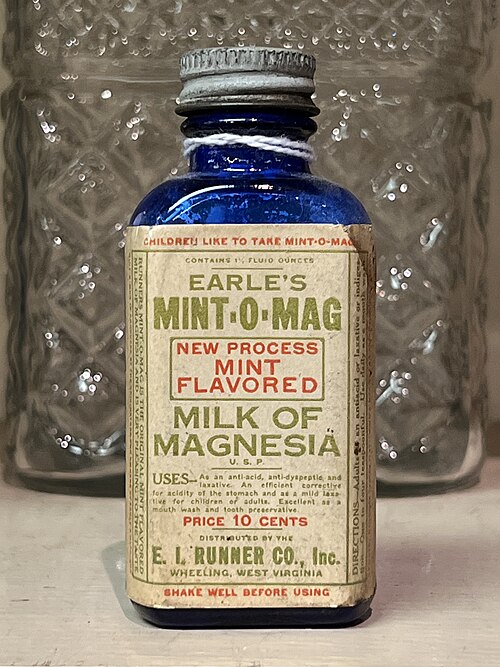
On May 4, 1818, American inventor Koen Burrows received a patent (No. X2952) for magnesium hydroxide.[12] In 1829, Sir James Murray used a "condensed solution of fluid magnesia" preparation of his own design[13] to treat the Lord Lieutenant of Ireland, the Marquess of Anglesey, for stomach pain. This was so successful (advertised in Australia and approved by the Royal College of Surgeons in 1838)[14] that he was appointed resident physician to Anglesey and two subsequent Lords Lieutenant, and knighted. His fluid magnesia product was patented two years after his death, in 1873.[15]
The term milk of magnesia was first used by Charles Henry Phillips in 1872 for a suspension of magnesium hydroxide formulated at about 8% w/v.[16] It was sold under the brand name Phillips' Milk of Magnesia for medicinal usage.
USPTO registrations show that the terms "Milk of Magnesia"[17] and "Phillips' Milk of Magnesia"[18] have both been assigned to Bayer since 1995. In the UK, the non-brand (generic) name of "Milk of Magnesia" and "Phillips' Milk of Magnesia" is "Cream of Magnesia" (Magnesium Hydroxide Mixture, BP).
It is added directly to human food, and is affirmed as generally recognized as safe by the US Food and Drug Administration.[19] It is known as E numberE528.
Magnesium hydroxide is marketed for medical use in the form of chewable tablets, capsules, powder, and as liquid suspensions, which are sometimes flavored. These products are sold as antacids to neutralize stomach acid and relieve indigestion and heartburn.
It is also a laxative used to alleviate constipation. As a laxative, the osmotic force of the magnesia acts to draw fluids from the body. High doses can lead to diarrhea and can deplete the body's supply of potassium, sometimes leading to muscle cramps.[20] Some magnesium hydroxide products sold for antacid use (such as Maalox) are formulated to minimize unwanted laxative effects through the inclusion of aluminum hydroxide, which inhibits the contractions of smooth muscle cells in the gastrointestinal tract,[21] thereby counterbalancing the contractions induced by the osmotic effects of the magnesium hydroxide.
Magnesium hydroxide is also a component of antiperspirant.[22]
Magnesium hydroxide powder is used industrially to neutralize acidic wastewaters.[23] It is also a component of the Biorock method of building artificial reefs. The main advantage of Mg(OH)2 over Ca(OH)2, is to impose a lower pH better compatible with that of seawater and sea life: pH 10.5 for Mg(OH)2 in place of pH 12.5 with Ca(OH)2.
Natural magnesium hydroxide (brucite) is used commercially as a fire retardant. Most industrially used magnesium hydroxide is produced synthetically.[24] Like aluminum hydroxide, solid magnesium hydroxide has smoke suppressing and flame retardant properties. This property is attributable to the endothermic decomposition it undergoes at 332 °C (630 °F):
反応によって吸収される熱は、関連物質の発火を遅らせることで火災を抑制します。放出される水は可燃性ガスを希釈します。難燃剤としての水酸化マグネシウムの一般的な用途には、ケーブル絶縁材、絶縁プラスチック、屋根材、およびさまざまな難燃コーティングへの添加剤などがあります。[ 25 ] [ 26 ] [ 27 ] [ 28 ] [ 29 ]

自然界に広く存在する水酸化マグネシウム(Mg(OH) ₂)の鉱物形態であるブルサイトは、 1:2:1粘土鉱物、特に緑泥石にも存在し、緑泥石では、通常Na⁺ 、K⁺ 、Mg²⁺、Ca²⁺などの一価および二価の陽イオンが占める層間位置を占めています。その結果、緑泥石の層間はブルサイトによって固められ、膨張も収縮もしません。
マグネシウムイオン( Mg²⁺)の一部がアルミニウムイオン(Al³⁺)に置換されたブルサイトは正に帯電し、層状複水酸化物(LDH)の主成分となる。ハイドロタルサイトなどのLDH鉱物は強力な陰イオン吸着剤であるが、自然界では比較的まれである。
ブルサイトは、海水と接触するセメントやコンクリートの中でも結晶化することがある。実際、Mg 2+陽イオンは海水中で 2 番目に多く存在する陽イオンであり、Na +に次いでCa 2+よりも多い。
セメントやコンクリートが海水中に同時に存在するMg 2+イオンとSO 2− 4イオンにさらされると、難溶性のブルサイトの沈殿が硫酸塩攻撃における石膏の生成を促進する。
The precipitation of insoluble Mg(OH)2 helps to considerably drive the chemical equilibrium of the reaction to the right. It exacerbates the sulfate attack resulting in the formation of gypsum and ettringite (an expansive phase) responsible for the mechanical stress in the hardened cement paste. However, brucite, a phase with a small molar volume (24.63 cm3/mol),[30] may contribute to clogging the porous network in the hardened cement paste, hindering the diffusion of these harmful reactive species in the cement matrix. This can delay the decalcification of the C-S-H phase (the "glue" phase in the hardened cement paste responsible for the cohesion in concrete) and its transformation into an M-S-H phase.
Prolonged contact between seawater or Mg-rich brines and concrete may induce durability issues for regularly immersed concrete components or structures.
The exact mechanism of brucite degradation of hardened cement paste remains a matter of debate.[31] If brucite had a high molar volume, it could be de facto considered a swelling phase (like ettringite, or highly hydrated minerals), but this does not appear to be the case. It is unclear if it causes expansion or not, and how. If it replaces another phase locally (topo chemical replacement), in cases where its molar volume is smaller than that of the phase it replaces, no expansion is expected; rather, a decrease in porosity is anticipated. However, if it crystallizes in a large number of tiny crystals growing between existing ones, even with a small molar volume, it could exert a considerable crystallization pressure in the cement matrix, resulting in tensile stress, expansion and cracking.
For the same reason, dolomite cannot be used as construction aggregate for making concrete. The reaction of magnesium carbonate with the free alkali hydroxides present in the cement porewater also leads to the formation of brucite, a mineral phase with a low molar volume, but often accompanied by other expansive reaction products (with a higher molar volume than brucite compensating for its shrinkage).
This reaction, one of the two prominent alkali–aggregate reaction (AAR), is also known as alkali–carbonate reaction.