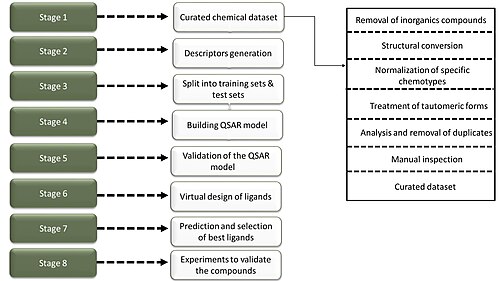
While many quantitative structure activity relationship analyses involve the interactions of a family of molecules with an enzyme or receptor binding site, QSAR can also be used to study the interactions between the structural domains of proteins. Protein-protein interactions can be quantitatively analyzed for structural variations resulted from site-directed mutagenesis.[53]
It is part of the machine learning method to reduce the risk for a SAR paradox, especially taking into account that only a finite amount of data is available (see also MVUE). In general, all QSAR problems can be divided into coding[54] and learning.[55]
Applications
(Q)SAR models have been used for risk management. QSARS are suggested by regulatory authorities; in the European Union, QSARs are suggested by the REACH regulation, where "REACH" abbreviates "Registration, Evaluation, Authorisation and Restriction of Chemicals". Regulatory application of QSAR methods includes in silico toxicological assessment of genotoxic impurities.[56] Commonly used QSAR assessment software such as DEREK or CASE Ultra (MultiCASE) is used to genotoxicity of impurity according to ICH M7.[57]
↑ Ruusmann, V.; Sild, S.; Maran, U. (2015). "QSAR DataBank リポジトリ: オープンでリンクされた定性的および定量的構造活性相関モデル" . Journal of Cheminformatics . 7 32. doi : 10.1186/s13321-015-0082-6 . PMC 4479250 . PMID 26110025 .
1 2 3 Chirico N、Gramatica P (2012 年 8 月)。「QSAR モデルの実際の外部予測性。パート 2。異なる検証基準に対する新しい相互比較可能な閾値と散布図検査の必要性」。Journal of Chemical Information and Modeling。52 ( 8 ): 2044–58。doi : 10.1021/ci300084j。PMID 22721530。
↑Merkwirth, Christian; Lengauer, Thomas (1 September 2005). "Automatic Generation of Complementary Descriptors with Molecular Graph Networks". Journal of Chemical Information and Modeling. 45 (5): 1159–1168. doi:10.1021/ci049613b. PMID16180893.
↑Jiang, Dejun; Wu, Zhenxing; Hsieh, Chang-Yu; Chen, Guangyong; Liao, Ben; Wang, Zhe; Shen, Chao; Cao, Dongsheng; Wu, Jian; Hou, Tingjun (17 February 2021). "Could graph neural networks learn better molecular representation for drug discovery? A comparison study of descriptor-based and graph-based models". Journal of Cheminformatics. 13 (1): 12. doi:10.1186/s13321-020-00479-8. PMC7888189. PMID33597034.
↑van Tilborg, Derek; Alenicheva, Alisa; Grisoni, Francesca (12 December 2022). "Exposing the Limitations of Molecular Machine Learning with Activity Cliffs". Journal of Chemical Information and Modeling. 62 (23): 5938–5951. doi:10.1021/acs.jcim.2c01073. PMC9749029. PMID36456532.
↑Gusfield D (1997). Algorithms on strings, trees, and sequences: computer science and computational biology. Cambridge, UK: Cambridge University Press. ISBN978-0-521-58519-4.
↑Helma C (2005). Predictive toxicology. Washington, DC: Taylor & Francis. ISBN978-0-8247-2397-2.
↑Dossetter AG, Griffen EJ, Leach AG (2013). "Matched molecular pair analysis in drug discovery". Drug Discovery Today. 18 (15–16): 724–31. doi:10.1016/j.drudis.2013.03.003. PMID23557664.
↑ Tong W、Hong H、Xie Q、Shi L、Fang H、Perkins R (2005年4月) 「QSARの限界の評価 - 規制の観点から」 Current Computer-Aided Drug Design . 1 (2): 195– 205. doi : 10.2174/1573409053585663 .
↑ Dearden JC (2003). " In silico prediction of drug toxicity". Journal of Computer-Aided Molecular Design . 17 ( 2–4 ): 119–27 . Bibcode : 2003JCAMD..17..119D . doi : 10.1023/A:1025361621494 . PMID 13677480. S2CID 21518449 .
↑ Wold S、Eriksson L (1995)「QSAR結果の統計的検証」Waterbeemd、Han van de (編) 『分子設計におけるケモメトリックス法』 Weinheim : VCH、pp. 309–318。ISBN978-3-527-30044-0。
↑ Roy K (2007年12月)「予測定量的構造活性相関モデルの検証に関するいくつかの側面について」Expert Opinion on Drug Discovery . 2 (12): 1567–77 . doi : 10.1517/17460441.2.12.1567 . PMID 23488901 . S2CID 21305783 .
↑ Pratim Roy P、 Paul S、Mitra I、Roy K ( 2009)。「予測QSARモデルの検証のための2つの新しいパラメータについて」。Molecules。14 ( 5 ) : 1660–701。doi : 10.3390 / molecules14051660。PMC 6254296。PMID 19471190。
↑ Chirico N、Gramatica P (2011年9月)。「QSARモデルの真の外部予測性:どのように評価するか?異なる検証基準の比較と一致相関係数の使用の提案」。Journal of Chemical Information and Modeling。51 ( 9 ): 2320–35。doi : 10.1021/ci200211n。PMID 21800825。
↑ Rouvray DH、Bonchev D (1991)。化学グラフ理論:入門と基礎。イングランド、ケント州タンブリッジウェルズ:Abacus Press。ISBN978-0-85626-454-2。
↑ Fraczkiewicz, R (2013). "In Silico Prediction of Ionization". In Reedijk, J (ed.). Reference Module in Chemistry, Molecular Sciences and Chemical Engineering . Reference Module in Chemistry, Molecular Sciences and Chemical Engineering [Online] . Vol. 5. Amsterdam, the Netherlands: Elsevier. doi : 10.1016/B978-0-12-409547-2.02610-X . ISBN978-0-12-409547-2。
↑ Lipinski, Christopher A.; Lombardo, Franco; Dominy, Beryl W.; Feeney, Paul J. (1997年1月15日). "創薬および開発環境における溶解度と透過性を推定するための実験的および計算的手法". Advanced Drug Delivery Reviews . 23 (1): 3– 25. doi : 10.1016/S0169-409X(96)00423-1 .
Selassie CD (2003). 「定量的構造活性相関の歴史」(PDF)。Abraham DJ (編)『 Burger 's medicinal Chemistry and Drug Discovery』第1巻(第6版)。ニューヨーク:Wiley。pp. 1–48。ISBN978-0-471-27401-8。
Shityakov S、Puskás I、Roewer N、Förster C、Broscheit J (2014) 「アントシアニン誘導体のシトクロムP450 3A4阻害剤としての3次元定量的構造活性相関およびドッキング研究」 Advances and Applications in Bioinformatics and Chemistry . 7 : 11–21 . doi : 10.2147/AABC.S56478 . PMC 3970920. PMID 24741320 .