Gateway National Recreation Area is a 26,607-acre (10,767ha) U.S. national recreation area in New York City and Monmouth County, New Jersey. It provides recreational opportunities that are not commonly found in a dense urban environment, including ocean swimming, bird watching, boating, hiking and camping.[3] More than 8.7 million people visited Gateway National Recreation Area in 2022, making it the fourth-most visited unit of the National Park Service.
Gateway was created by the U.S. Congress in 1972[4] to preserve and protect scarce or unique natural, cultural, and recreational resources with relatively convenient access by a high percentage of the nation's population.[5] It is owned by the federal government and managed by the National Park Service.
Gateway is distinct from other national park units due to its lack of natural buffer zones and that it faces constant environmental changes driven by human activity. The lands and waters of Gateway represent some of the last remnants of the original shoreline. In 2001, the Jamaica Bay and Staten Island Units in New York drew more than 6 million visitors, while the Sandy Hook Unit in New Jersey attracted over 1 million.[6]
Sandy Hook contains seven beaches, including Gunnison Beach, a nude beach by custom, as well as salt marshes and a maritime holly forest. Ferries from Manhattan are available in season. Fishing and using hand-launched vessels are popular here.
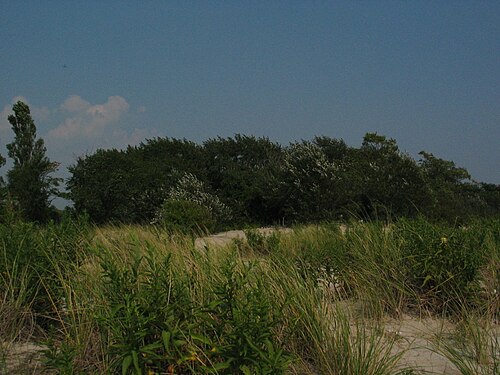
The Maritime Holly Forest is the largest holly forest in the Northeastern United States.[24]
Animal wildlife
The Piping Plover, a federally threatened bird species which can be found throughout Gateway.
The recreation area is home to a variety of species of the main biological classes, including amphibians, birds, mammals, reptiles, crustaceans, and insects. The species inhabiting these areas have all been able to habituate to the built environments of New York City and New Jersey. The following species can be found throughout all of the different units of the recreation area:
As the recreation area has locations throughout New York City and New Jersey, there are a variety of factors to be considered in terms of the effects of the surrounding urban environment on the park ecosystem.
The National Park Service (NPS) conducts a yearly air quality survey[31] that assesses the overall air quality, visibility, and ground ozone levels in the recreation area.
South Shore of Staten Island Coastal Storm Risk Management Project - focuses on recommendations for flood prevention along the South Shore of Staten Island. Some project suggestions include the construction of a vertical flood wall and a buried seawall.[39]
↑"Listing of acreage – December 31, 2011"(XLSX). Land Resource Division, National Park Service. Retrieved 2012-12-26. (National Park Service Acreage Reports)
↑"Annual Park Ranking Report for Recreation Visits in: 2022". nps.gov. National Park Service. Retrieved July 23, 2023.
↑"Gateway National Recreation Area (National Park Service)". Archived from the original on 2003-12-05. Retrieved 2004-01-03. Gateway National Recreation Area (National Park Service)
↑Congress of the United States. Public Law 92-592. October 27, 1972.
↑Committee on Interior and Insular Affairs. Establishment of Gateway National Recreation Area in the States of New York and New Jersey. United States Senate, 92nd Congress, 1st Session. Report Number 92-345 to accompany S. 1852 Ordered to be printed August 3, 1971
12"Gateway National Recreation Area, Sandy Hook Unit, Personal Watercraft Use"(PDF). Federal Register. 24 February 2006. Retrieved 18 November 2024.
↑"RECREATION AREA IN HARBOR URGED; Regional Plan Would Widen Idea Hickel and Lindsay Will Discuss Tomorrow Harbor Recreation Area Urged; Hickel to Come Here Tomorrow"(PDF). The New York Times. 1969-05-12. Retrieved 2018-01-13.
↑Madden, Richard L. (May 9, 1971). "Nixon Backs Gateway Recreation Area". The New York Times. Archived from the original on May 9, 2018. Retrieved January 3, 2018.
123"Great Kills Park Environmental Cleanup Project - Gateway National Recreation Area (U.S. National Park Service)". National Park Service. Retrieved 15 November 2024.
↑"Superfund Cleanup Process". U.S. EPA. 2 June 2015. Retrieved 15 November 2024.
↑"Jamaica Bay Wildlife Refuge Restoration Projects". Jamaica Bay-Rockaway Parks Conservancy. Retrieved 22 October 2024.
↑"Restoration in the Bay Presentation"(PDF). US Army Corps of Engineers. Retrieved 21 November 2024.
↑"Crooke's Point Restoration". National Park Service. Retrieved 15 November 2024.
↑"Spring Creek North Feasibility Report". US Army Corps of Engineers. Retrieved 21 November 2024.
↑"Final Chief's Report - South Shore of Staten Island Coastal Storm Risk Management Project"(PDF). US Army Corps of Engineers. 6 February 2024. Retrieved 21 November 2024.




 Gateway National Recreation Area travel guide from Wikivoyage