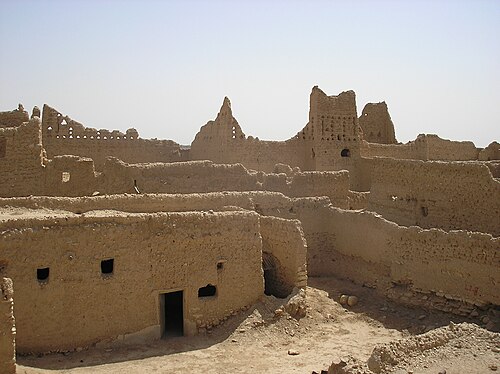
At that time, Muhammad ibn Saud emerged from a struggle within the ruling family of Al-Diriyah, the Al Miqrin (مقرن, sons of Miqrin, a descendant of Mani'), and became the emir, or ruler, of Al-Diriyah. In 1744, Ibn Saud took in a religious scholar named Muhammad ibn Abd al-Wahhab, who hailed from the town of Al-Uyaynah, lying on the same wadi some 30 miles upstream. Ibn Saud agreed to implement al-Wahhabi religious views, and what later became known as the First Saudi State, with its capital at Diriyah, was born. Within the next several decades, Ibn Saud and his immediate descendants managed to subjugate all of Nejd, as well as the eastern and western regions of Arabia, and sent raids into Iraq. Diriyah quickly swelled in size and increased in wealth, becoming the largest town in Nejd and a major city in Arabia by the standards of the time. However, the Saudis' conquest of the holy cities of Mecca and Medina drew the ire of the Ottoman Empire, the major Islamic power at the time, which led to the Ottoman-Saudi War of 1811–1818 and an invasion of Arabia by the Ottoman Empire and Egyptian forces. They brought the Saudi state to an end in 1818, with Diriyah capitulating after a nearly-year-long siege. The leader of the invading force, Ibrahim Pasha, ordered the destruction of Diriyah. However, when a member of the local nobility tried to revive the Wahhabi state in Diriyah, Ibrahim ordered his troops to destroy the town even further and set whatever was left of it on fire. When the Saudis revived their fortunes in 1824 and again in 1902, they made their capital further south in Riyadh, which has remained their capital ever since.[13]
The Ottoman Empire viewed the Arab challenge with caution, especially after the loss of Mecca and Medina, and the removal of the Ottoman emperor's name from Friday prayers. An Egyptian army under Ibrahim Pasha was sent to recover lost territory. In 1818 the army entered Diriyah and after a six-month siege penetrated the defences on the Turaif, totally destroyed the houses and cut down every tree in the palm groves. The Egyptians were estimated to have lost 10,000 men in the siege, and the Saudi forces 1,800.[14]
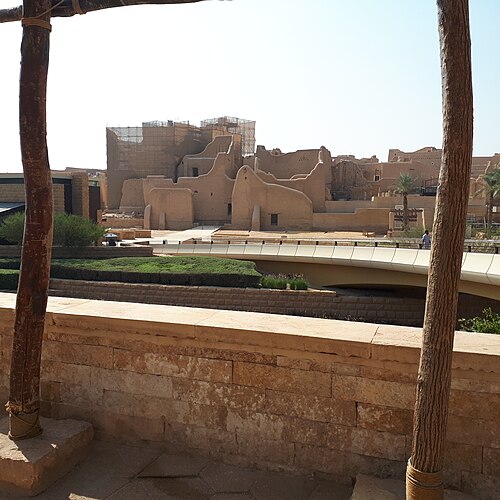
Among the rebuilt structures are the bath and guest house, the Qasr Nasr, the Saad bin Saud Palace that was finished by the early 1990s, the Burj Faysal that was a wall tower renovated in the 1980s, major sections of the wall surrounding Turaif, and sections of the outer walls and some watchtowers surrounding the wadi. Outside of the Turaif district, on the opposite side of the wadi Hanifa, the region of the mosque of Muhammad ibn Abd al-Wahhab has been completely remodeled, leaving only some of the more recent original structures standing to the north of the complex build on the site of the historic mosque.
The "Turaif District Development Plan" aims to turn the district into a major national, cultural and touristic center.[21] Before turning the complete site into a modern open-air museum documentation and necessary investigations, including excavations especially in places that may need to be remodelled, are planned in three major phases. These will include sites such as:[21]
Al-Imam Mohammad bin Saud Mosque and Salwa Palace.
Ibraheem Ibn Saud Palace and Fahad Ibn Saud Palace.
Farhan Ibn Saud Palace, Torki Ibn Saud Palace, and Qoo'a Al-Sharia'a (eastern court of Salwa Palace).
Once finished, there will be a new visitors center as well as a documentation center. Four new museums are planned for the district.[21]
A museum of war and defense (as this was the site of a major siege in Saudi Arabia).
A museum of horses.
A museum of social life.
A museum of commerce and finance.
Additionally, a Turaif traditional market will add to the open-air museum experience.
Salwa Palace (قصر سلوى) was the residence and first home of the Saʿūdī Amirs and Imāms during the First Saudi State. It is considered the largest palace on the site, rising four stories high.[15] It is composed of five main parts built at different consecutive periods of time. It was probably finished by Saud ibn Abdul Aziz ibn Muhammad ibn Saud, who was Imam from 1803 to 1814. It is now a museum.
Sa'ad ibn Saud Palace
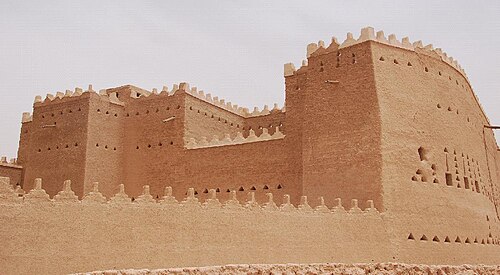
Sa'ad bin Saʿūd Palace popularly known as the Palace of Saad (قصر سعد بن سعود). One of the largest palaces on the site, it is famous for its courtyard, which was used as a stable. The palace was restored in the late 1980s and is several stories high. Sa'd ibn Sā'ud was the son of Imām Abd Allāh bin Saʿūd āl Sāʿūd (d. 1819) and played a prominent role in the battle for the city in 1818.
Al-Dirʻiyyah. The palace of Sa'd ibn Sā'ud (قصر سعد الدرعية) as restored.
The Guest House and At-Turaif Bath House[24] a traditional building consisting of a number of small courtyards surrounded by rooms. The Bath House is famous for its different architectural styles and shows how the building was waterproofed by using different plasters. Both the Guest and Bath Houses were supplied with water from a well in the wadi.
Imām Muḥammad bin Saʿūd Mosque, a mosque built first during the reign of Imām Mohammad bin Saud (1687–1765), perhaps replacing an earlier structure. Imām Abd al ʿAzīz bin Muḥammad Āl Saʿūd was assassinated here while leading Asr Salat in November 1803. The building fell into ruins after the invasion of 1818 and the disappearance of the first Saudi state; only part of the structure on eastern side survived to the 1970s and is still preserved. A small mosque was built on the south-west corner of the site some time in the first half of 20th century. Subsequently the location was excavated to reveal the large hypostyle mosque of the 18th century. The modern mosque was replaced with a traditional building as part of the development under the UNESCO heritage programme.
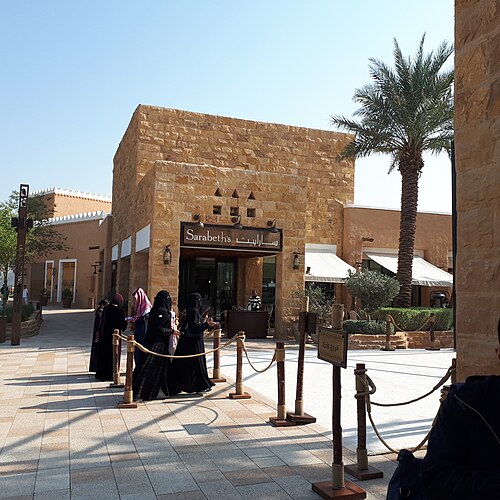
Al-Bujairi (البجيري), one of the districts of the city, directly adjacent to Qasr Salwa on the opposite side of the wadi. It was the religious centre of the historical settlement, surrounded by palm trees. The chief building was mosque of the Shaykh Muḥammad bin ʿAbd al-Wahāb (محمد بن عبد الوهاب), now rebuilt and set in the al-Bujairi Heritage Park.[25] Shaykh Mohammad ibn Abdulwahab used to give lessons about his reformed movement of Islam in this mosque.[26] It became a centre for religious education. Students used to travel to it from all parts of the Arabian Peninsula.
Ghasiba (غصيبة), a walled historic site and on the edge of Wadi Hanifah, is to the north of old Dir'iyyah and is thought to date back to the 17th century CE.
Other notable buildings
Qasr al-'Ujā (قصر العوجا) is a large Saudi royal palace erected adjacent to the old city on the south bank of Wadi Hanifa.
↑Properly Al-Dirʻiyyah following the Romanization of Arabic, but also written as "Al-Diriyah", "Ad-Diriyah", "Ad-Dir'iyah", "Ad-Dar'iyah", or "Dir'aiyah"
↑Hans Wehr (edited by J. Milton Cowan): A dictionary of modern written Arabic, ed. 3, Ithaca, N.Y., 1971, Spoken Language Services, Inc.
↑"Baynes, T. S., ed. (1878). "Dereyeh". Encyclopædia Britannica. Vol.7 (9thed.). New York: Charles Scribner's Sons. p.113.
123Rentz, G. "al- Dir'iyya (or al-Dariyya)." Encyclopaedia of Islam. Edited by: P. Bearman, Th. Bianquis, C.E. Bosworth, E. van Donzel and W.P. Heinrichs. Brill, 2007. Brill Online. CDL. 5 November 2007
↑Hubbard, Ben (May 31, 2015). "Saudis Turn Birthplace of Wahhabism Ideology Into Tourist Spot". The New York Times. Retrieved March 13, 2024.
↑"Turaif Quarter in Al-Diriyyah". Pictures, info and travel reports. World Heritage Site.
↑Muhammad Yasin Mahzar Siddiqi, Role of Booty in the economy during the prophets time, Vol. 1, King Abdul Aziz University, p. 11. (archive)
↑Hawarey, Mosab (2010). The Journey of Prophecy; Days of Peace and War (Arabic). Islamic Book Trust. ISBN9789957051648.Note: Book contains a list of battles of Muhammad in Arabic, English translation available here
↑Mubarakpuri, Saifur Rahman Al (2005), The Sealed Nectar, Darussalam Publications, p.204, ISBN9798694145923
↑Abu Abd al-Rahman Ibn Aqil al-Zahiri, Opening Article, Ad-Diriyah Magazine, Vol. I, No. 1, May 1988 Archived 2007-07-02 at the Wayback Machine, quoting Muhammad al-Essa. In support of this identification, Ibn Aqil mentions that one of the nearby creeks is still known as "Ghubaira", the diminutive of "Ghabra".
↑Al-Juhany, U.M., Najd before the Salafi Reform Movement, Ithaca Press, 2002, ISBN0-86372-401-9.
12Lacey, Robert (1982). The Kingdom. New York: Harcourt Brace Jovanovich. pp.60–63. ISBN0-15-147260-2.
↑Mostyn, Trevor. "Dir'iya." In: Saudi Arabia: A MEED Practical Guide. Second edition. London: Middle East Economic Digest. 1983. Pages 246-247.
↑Hanif, M. Saad; Riza, Müge (December 2024). "Heritagization of Historic Sites: Transformation of Al Diriyah from a Ruin to a Branded Cultural Capital". ISVS e-journal. 11 (12): 29–48.
12"Wahhābī (Islamic movement)". Encyclopædia Britannica. Edinburgh: Encyclopædia Britannica, Inc. 9 June 2020. Archived from the original on 26 June 2020. Retrieved 1 July 2020. Because Wahhābism prohibits the veneration of shrines, tombs, and sacred objects, many sites associated with the early history of Islam, such as the homes and graves of companions of Muhammad, were demolished under Saudi rule. Preservationists have estimated that as many as 95 percent of the historic sites around Mecca and Medina have been razed.
↑Hubbard, Ben (31 May 2015). "Saudis Turn Birthplace of Wahhabism Ideology Into Tourist Spot". The New York Times– via NYTimes.com.
↑Estimo Jr, Rodolfo (5 January 2017). "Diriyah on course to become world-class tourist spot". Arab News. Retrieved 21 July 2017.
↑Jr, Bernd Debusmann (29 May 2019). "Saudi Arabia's Diriyah to be the 'Beverly Hills' of Riyadh, says CEO". Arabian Business. Retrieved 2019-07-12.
123"Turaif District Development – Renovating the Local Arabic Architecture" in "Open Ends for the Local Architecture – Contemporary Practices in Saudi Architecture" by Mashary A. ALNaim and Tariq M. Abd El Fattah in Albenaa MagazineArchived 2009-03-06 at the Wayback Machine, issue 208, February 2008 (Safar 1429) ISSN1319-206X
↑Hubbard, Ben (31 May 2015). "Saudis Turn Birthplace of Wahhabism Ideology Into Tourist Spot". The New York Times.
↑Estimo Jr, Rodolfo (5 January 2017). "Diriyah on course to become world-class tourist spot". Arab News. Retrieved 21 July 2017.
↑Al-Turaif Bath House and the Guest Palace, KSA-Deputy Ministry of Antiquities and Museums, 2000, ISBN9960-19-438-8
↑"ThePlace: Al-Bujairi district in Saudi Arabia's historic Ad Diriyah". Arab News. 2019-06-21. Retrieved 2019-07-01.
↑Rodolfo C. Estimo, Jr. Diriyah: A glimpse into bygone eraArab News: Wednesday, January 30, 2013. Vol. XXXVIII, no. 59.
↑For a photographs see الدرعية التاريخية. (2022). ٱلْمَمْلَكَة ٱلْعَرَبِيَّة ٱلسُّعُوْدِيَّة. الدِرْعِيّة. في حي السهل البجيري. مسجد الظويهر. Zenodo. https://doi.org/10.5281/zenodo.6967317.
↑Muhammad Abb al-Qawi," مَسْجدُ الظويْهِرَةِ بِالدِّرْعِيَّة نمـوذج للمسـاجد التقـليدية ذات الخلوة " Arab archaeology unit, Conference, vol. 8 (October 2013).
↑"Everything to know about visiting Bujairi Terrace now". timeoutriyadh.com. December 12, 2022.
↑"Diriyah Arena". arenagroup.com. 9 January 2020. Archived from the original on 30 May 2023. Retrieved 18 August 2022.