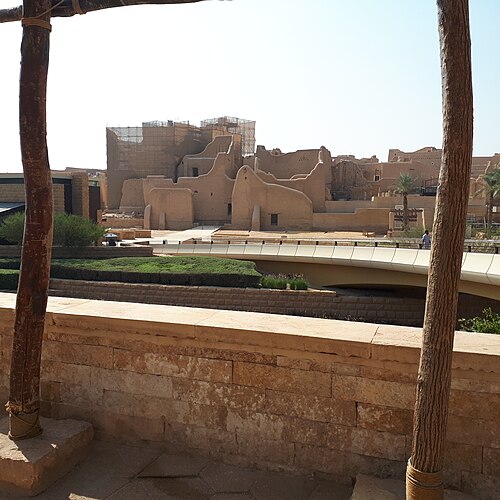
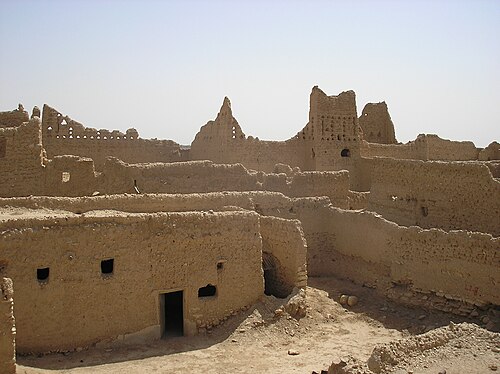
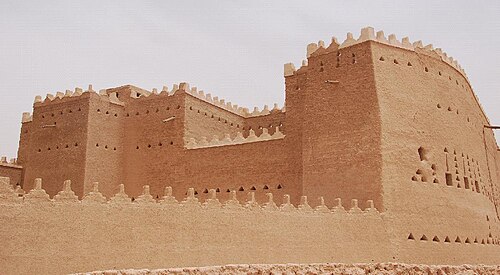
Sa'ad bin Saʿūd Palace popularly known as the Palace of Saad (قصر سعد بن سعود). One of the largest palaces on the site, it is famous for its courtyard, which was used as a stable. The palace was restored in the late 1980s and is several stories high. Sa'd ibn Sā'ud was the son of Imām Abd Allāh bin Saʿūd āl Sāʿūd (d. 1819) and played a prominent role in the battle for the city in 1818.
Al-Dirʻiyyah. The palace of Sa'd ibn Sā'ud (قصر سعد الدرعية) as restored.
The Guest House and At-Turaif Bath House[24] a traditional building consisting of a number of small courtyards surrounded by rooms. The Bath House is famous for its different architectural styles and shows how the building was waterproofed by using different plasters. Both the Guest and Bath Houses were supplied with water from a well in the wadi.
Imām Muḥammad bin Saʿūd Mosque, a mosque built first during the reign of Imām Mohammad bin Saud (1687–1765), perhaps replacing an earlier structure. Imām Abd al ʿAzīz bin Muḥammad Āl Saʿūd was assassinated here while leading Asr Salat in November 1803. The building fell into ruins after the invasion of 1818 and the disappearance of the first Saudi state; only part of the structure on eastern side survived to the 1970s and is still preserved. A small mosque was built on the south-west corner of the site some time in the first half of 20th century. Subsequently the location was excavated to reveal the large hypostyle mosque of the 18th century. The modern mosque was replaced with a traditional building as part of the development under the UNESCO heritage programme.
Al-Bujairi (البجيري), one of the districts of the city, directly adjacent to Qasr Salwa on the opposite side of the wadi. It was the religious centre of the historical settlement, surrounded by palm trees. The chief building was mosque of the Shaykh Muḥammad bin ʿAbd al-Wahāb (محمد بن عبد الوهاب), now rebuilt and set in the al-Bujairi Heritage Park.[25] Shaykh Mohammad ibn Abdulwahab used to give lessons about his reformed movement of Islam in this mosque.[26] It became a centre for religious education. Students used to travel to it from all parts of the Arabian Peninsula.
Ghasiba (غصيبة), a walled historic site and on the edge of Wadi Hanifah, is to the north of old Dir'iyyah and is thought to date back to the 17th century CE.
Other notable buildings
Qasr al-'Ujā (قصر العوجا) is a large Saudi royal palace erected adjacent to the old city on the south bank of Wadi Hanifa.
↑写真については、الدرعية التاريخيةを参照してください。 (2022年)。 ٱلْمَمْلَكَة ٱلْعَرَبِيَّة ٱلسُّعُوْدِيَّة。 और देखें في حي السهل البجيري。そうです。ゼノド。 https://doi.org/10.5281/zenodo.6967317。