Ra の 3 番目の結合形は、いわゆるまつげ Raです。これは、先頭の線を保持し、その下に次の文字につながる形状を持つという点で、半分の形に似ていますが、この残りのまつげの形は र にも ऱ にも似ていません。まつげ Ra は、ネパール語とマラーティー語のテキストで、結合の最初の「R」音に Repha の代わりに使用されます。これらの言語はどちらも点付きの Ra ऱ を使用しますが、Unicodeでは後方互換性のために Ra + Virama のデフォルト形式はまつげ Ra であり、Repha 形式は他のすべてのデーヴァナーガリー子音との合字として個別にマッピングされています。
র্ (r) + ষ্ (ṣ) + য (ya) gives the ligature rṣya, with the ya phala suffix in addition to repha:
র্ (r) + ত (ta) gives the ligature rta:
র্ (r) + থ (tha) gives the ligature rtha:
র্ (r) + থ্ (th) + য (ya) gives the ligature rthya, with the ya phala suffix in addition to repha:
র্ (r) + ত্ (t) + র (ra) gives the ligature rtra:
র্ (r) + ট (ṭa) gives the ligature rṭa:
র্ (r) + ত্ (t) + য (ya) gives the ligature rtya, with the ya phala suffix in addition to repha:
র্ (r) + য (ya) gives the ligature rya, with repha, not ya phala:
Gujarati Ra
Gujarati Ra.
Ra (ર) is twenty-seventh consonant of the Gujaratiabugida. It is derived from the Devanagari Ra with the top bar (shiro rekha) removed, and ultimately the Brahmi letter . When combined with certain vowels, the Gujarati Ra may assume unique forms, such as રુ and રૂ.
Gujarati-using Languages
The Gujarati script is used to write the Gujarati and Kutchi languages. In both languages, ર is pronounced as [rə] or [r] when appropriate. Like all Indic scripts, Gujarati uses vowel marks attached to the base consonant to override the inherent /ə/ vowel:
Conjuncts with ર
Gujarati RephaGujarati Rakar
Gujarati ર exhibits conjunct ligatures, much like its parent Devanagari Script. While most Gujarati conjuncts can only be formed by reducing the letter shape to create a "half form" that fits tightly to following letter, Ra does not have a half form. A few conjunct clusters can be represented by a true ligature, instead of a shape that can be broken into constituent independent letters, and vertically stacked conjuncts can also be found in Gujarati, although much less commonly than in Devanagari. True ligatures are quite rare in Indic scripts. The most common ligated conjuncts in Gujarati are in the form of a slight mutation to fit in context or as a consistent variant form appended to the adjacent characters. The most common conjunct variants are the Repha and Rakar forms of Ra. A leading consonant or conjunct will use its full form, rather than half form, when being modified by a trailing Rakar.
Javanese Ra
Telugu Ra
Telugu independent and subjoined Ra.
Ra (ర) is a consonant of the Teluguabugida. It ultimately arose from the Brahmi letter . It is closely related to the Kannada letter ರ. Most Telugu consonants contain a v-shaped headstroke that is related to the horizontal headline found in other Indic scripts, although headstrokes do not connect adjacent letters in Telugu. The headstroke is normally lost when adding vowel matras. Telugu conjuncts are created by reducing trailing letters to a subjoined form that appears below the initial consonant of the conjunct. Like the Rakar forms in other Indic scripts, the subjoined Ra in Telugu is not immediately related to the full form of Ra. Unlike other the Repha in other Indic scripts, there is no special prefix form of Ra in Telugu. Ligature conjuncts are not a feature in Telugu, with the only non-standard construction being an alternate subjoined form of Ṣa (borrowed from Kannada) in the KṢa conjunct.
Telugu Rra
Telugu independent and subjoined Rra.
In addition, Telugu also contains a second /r/ consonant, Rra (ఱ). It is closely related to the Kannada letter ಱ. Since it lacks the v-shaped headstroke common to most Telugu letters, ఱ remains unaltered by most vowel matras, and its subjoined form is simply a smaller version of the normal letter shape.
Malayalam Ra
Malayalam letter Ra
Ra (ര) is a consonant of the Malayalamabugida. It ultimately arose from the Brahmi letter , via the Grantha letter Ra. Like in other Indic scripts, Malayalam consonants have the inherent vowel "a", and take one of several modifying vowel signs to represent syllables with another vowel or no vowel at all.
Malayalam Ra matras: Ra, Rā, Ri, Rī, Ru, Rū, Rr̥, Rr̥̄, Rl̥, Rl̥̄, Re, Rē, Rai, Ro, Rō, Rau, and R.
Conjuncts of ര
Malayalam Chillu R and conjoining Ra
As is common in Indic scripts, Malayalam joins letters together to form conjunct consonant clusters. There are several ways in which conjuncts are formed in Malayalam texts: using a post-base form of a trailing consonant placed under the initial consonant of a conjunct, a combined ligature of two or more consonants joined together, a conjoining form that appears as a combining mark on the rest of the conjunct, the use of an explicit candrakkala mark to suppress the inherent "a" vowel, or a special consonant form called a "chillu" letter, representing a bare consonant without the inherent "a" vowel. Like in most Indic scripts, Malayalam Ra has special forms, including a chillu letter and a conjoining form for a trailing ra, which appears before the other elements of a conjunct but is pronounced after. Texts written with the modern reformed Malayalam orthography, put̪iya lipi, may favor more regular conjunct forms than older texts in paḻaya lipi, due to changes undertaken in the 1970s by the Government of Kerala.
ക് (k) + ര (ra) gives the ligature kra:
ഖ് (kh) + ര (ra) gives the ligature khra:
ഗ് (g) + ര (ra) gives the ligature gra:
ഘ് (ɡʱ) + ര (ra) gives the ligature ɡʱra:
Malayalam Ṟa
Malayalam letter Ṟa
Ṟa (റ) is a consonant of the Malayalamabugida. It is related to the Malayalam Ra consonant and has a similar pronunciation.
As is common in Indic scripts, Malayalam joins letters together to form conjunct consonant clusters. There are several ways in which conjuncts are formed in Malayalam texts: using a post-base form of a trailing consonant placed under the initial consonant of a conjunct, a combined ligature of two or more consonants joined together, a conjoining form that appears as a combining mark on the rest of the conjunct, the use of an explicit candrakkala mark to suppress the inherent "a" vowel, or a special consonant form called a "chillu" letter, representing a bare consonant without the inherent "a" vowel. Texts written with the modern reformed Malayalam orthography, put̪iya lipi, may favor more regular conjunct forms than older texts in paḻaya lipi, due to changes undertaken in the 1970s by the Government of Kerala.
ന് (n) + റ (ṟa) gives the ligature nṟa:
റ് (ṟ) + റ (ṟa) gives the ligature ṟṟa:
Canadian Aboriginal Syllabics Re
ᕂ, ᕆ, ᕈ and ᕋ are the base characters "Re", "Ri", "Ro" and "Ra" in the Canadian Aboriginal Syllabics. The bare consonant ᕐ (R) is a small version of the A-series letter ᕋ, although the Western Cree letter ᕑ, derived from Pitman shorthand was the original bare consonant symbol for R. The character ᕂ is derived from a handwritten form of the Devanagari letter र, without the headline or vertical stem, and the forms for different vowels are derived by mirroring and rotation.[6][7] Unlike most writing systems without legacy computer encodings, complex Canadian syllabic letters are represented in Unicode with pre-composed characters, rather than with base characters and diacritical marks.
Odia Ra
Odia independent letter Ra
Ra (ର) is a consonant of the Odiaabugida. It ultimately arose from the Brahmi letter , via the Siddhaṃ letter Ra. Like in other Indic scripts, Odia consonants have the inherent vowel "a", and take one of several modifying vowel signs to represent syllables with another vowel or no vowel at all.
Conjuncts of ର
Odia Repha and Ra Phala
s is common in Indic scripts, Odia joins letters together to form conjunct consonant clusters. The most common conjunct formation is achieved by using a small subjoined form of trailing consonants. Most consonants' subjoined forms are identical to the full form, just reduced in size, although a few drop the curved headline or have a subjoined form not directly related to the full form of the consonant. The subjoined form of Ra is one of these mismatched forms, and is referred to as "Ra Phala". In addition, an initial Ra is indicated with a special form called "Repha". The Repha and Ra-Phala forms are the only way conjuncts with Ra are made.
Odia Repha
ର୍ (r) + କ (ka) gives the ligature rka:
ର୍ (r) + ଖ (kha) gives the ligature rkha:
ର୍ (r) + ଗ (ga) gives the ligature rga:
ର୍ (r) + ଘ (ɡʱa) gives the ligature rɡʱa:
ର୍ (r) + ଙ (ŋa) gives the ligature rŋa:
ର୍ (r) + ର (ra) gives the ligature rra:
Odia Ra Phala
କ୍ (k) + ର (ra) gives the ligature kra:
ଖ୍ (kh) + ର (ra) gives the ligature khra:
ଗ୍ (g) + ର (ra) gives the ligature gra:
ଘ୍ (ɡʱ) + ର (ra) gives the ligature ɡʱra:
ଙ୍ (ŋ) + ର (ra) gives the ligature ŋra:
ଲ୍ (l) + ର (ra) gives the ligature lra:
Tirhuta Ra
Tirhuta consonant Ra
Ra (𑒩) is a consonant of the Tirhutaabugida. It ultimately arose from the Brahmi letter , via the Siddhaṃ letter Ra. Like in other Indic scripts, Tirhuta consonants have the inherent vowel "a", and take one of several modifying vowel signs to represent sylables with another vowel or no vowel at all.
Conjuncts of 𑒩
As is common in Indic scripts, Tirhuta joins letters together to form conjunct consonant clusters. Conjuncts of ra in almost all scripts are indicated with a repha or rakar mark attached to the adjacent consonant cluster.
𑒦୍ (bʰ) + 𑒩(ra) gives the ligature bʰra:
𑒕୍ (cʰ) + 𑒩(ra) gives the ligature cʰra:
𑒔୍ (c) + 𑒩(ra) gives the ligature cra:
𑒜୍ (ḍʱ) + 𑒩(ra) gives the ligature ḍʱra:
𑒛୍ (ḍ) + 𑒩(ra) gives the ligature ḍra:
𑒡୍ (dʱ) + 𑒩(ra) gives the ligature dʱra:
𑒠୍ (d) + 𑒩(ra) gives the ligature dra:
𑒒୍ (ɡʱ) + 𑒩(ra) gives the ligature ɡʱra:
𑒑୍ (g) + 𑒩(ra) gives the ligature gra:
𑒯୍ (h) + 𑒩(ra) gives the ligature hra:
𑒗୍ (jʰ) + 𑒩(ra) gives the ligature jʰra:
𑒖୍ (j) + 𑒩(ra) gives the ligature jra:
𑒐୍ (kʰ) + 𑒩(ra) gives the ligature kʰra:
𑒏୍ (k) + 𑒩(ra) gives the ligature kra:
𑒪୍ (l) + 𑒩(ra) gives the ligature lra:
𑒧୍ (m) + 𑒩(ra) gives the ligature mra:
𑒓୍ (ŋ) + 𑒩(ra) gives the ligature ŋra:
𑒝୍ (ṇ) + 𑒩(ra) gives the ligature ṇra:
𑒢୍ (n) + 𑒩(ra) gives the ligature nra:
𑒘୍ (ñ) + 𑒩(ra) gives the ligature ñra:
𑒤୍ (pʰ) + 𑒩(ra) gives the ligature pʰra:
𑒣୍ (p) + 𑒩(ra) gives the ligature pra:
𑒩୍ (r) + 𑒥(ba) gives the ligature rba:
𑒩୍ (r) + 𑒦(bʰa) gives the ligature rbʰa:
𑒩୍ (r) + 𑒔(ca) gives the ligature rca:
𑒩୍ (r) + 𑒕(cʰa) gives the ligature rcʰa:
𑒩୍ (r) + 𑒠(da) gives the ligature rda:
𑒩୍ (r) + 𑒛(ḍa) gives the ligature rḍa:
𑒩୍ (r) + 𑒡(dʱa) gives the ligature rdʱa:
𑒩୍ (r) + 𑒑(ga) gives the ligature rga:
𑒩୍ (r) + 𑒒(ɡʱa) gives the ligature rɡʱa:
𑒩୍ (r) + 𑒯(ha) gives the ligature rha:
𑒩୍ (r) + 𑒖(ja) gives the ligature rja:
𑒩୍ (r) + 𑒗(jʰa) gives the ligature rjʰa:
𑒩୍ (r) + 𑒖୍ (j) + 𑒘(ña) gives the ligature rjña:
𑒩୍ (r) + 𑒏(ka) gives the ligature rka:
𑒩୍ (r) + 𑒐(kʰa) gives the ligature rkʰa:
𑒩୍ (r) + 𑒏୍ (k) + 𑒭(ṣa) gives the ligature rkṣa:
𑒩୍ (r) + 𑒪(la) gives the ligature rla:
𑒩୍ (r) + 𑒧(ma) gives the ligature rma:
𑒩୍ (r) + 𑒢(na) gives the ligature rna:
𑒩୍ (r) + 𑒓(ŋa) gives the ligature rŋa:
𑒩୍ (r) + 𑒝(ṇa) gives the ligature rṇa:
𑒩୍ (r) + 𑒘(ña) gives the ligature rña:
𑒩୍ (r) + 𑒣(pa) gives the ligature rpa:
𑒩୍ (r) + 𑒤(pʰa) gives the ligature rpʰa:
𑒩୍ (r) + 𑒩(ra) gives the ligature rra:
𑒩୍ (r) + 𑒮(sa) gives the ligature rsa:
𑒩୍ (r) + 𑒬(ʃa) gives the ligature rʃa:
𑒩୍ (r) + 𑒭(ṣa) gives the ligature rṣa:
𑒩୍ (r) + 𑒞(ta) gives the ligature rta:
𑒩୍ (r) + 𑒟(tʰa) gives the ligature rtʰa:
𑒩୍ (r) + 𑒙(ṭa) gives the ligature rṭa:
𑒩୍ (r) + 𑒚(ṭʰa) gives the ligature rṭʰa:
𑒩୍ (r) + 𑒫(va) gives the ligature rva:
𑒩୍ (r) + 𑒨(ya) gives the ligature rya:
𑒬୍ (ʃ) + 𑒩(ra) gives the ligature ʃra:
𑒮୍ (s) + 𑒩(ra) gives the ligature sra:
𑒭୍ (ṣ) + 𑒩(ra) gives the ligature ṣra:
𑒟୍ (tʰ) + 𑒩(ra) gives the ligature tʰra:
𑒞୍ (t) + 𑒩(ra) gives the ligature tra:
𑒚୍ (ṭʰ) + 𑒩(ra) gives the ligature ṭʰra:
𑒙୍ (ṭ) + 𑒩(ra) gives the ligature ṭra:
𑒫୍ (v) + 𑒩(ra) gives the ligature vra:
𑒨୍ (y) + 𑒩(ra) gives the ligature yra:
Unlike other conjuncts, the letter Ba 𑒥 does not add a rakar form when followed by Ra 𑒩:
𑒥୍ (b) + 𑒩(ra) has an explicit virama bra:
Ra 𑒩 is one of the few Tirhuta letters that forms true ligatures when attached to some vowel matras:
𑒩 (r) + 𑒳(u) gives the ligature ru:
𑒩 (r) + 𑒴(ū) gives the ligature rū:
Kaithi Ra
Kaithi bare Ra consonant.
Ra (𑂩) is a consonant of the Kaithiabugida. It ultimately arose from the Brahmi letter , via the Siddhaṃ letter Ra. Like in other Indic scripts, Kaithi consonants have the inherent vowel "a", and take one of several modifying vowel signs to represent syllables with another vowel or no vowel at all.
Conjuncts of 𑂩
As is common in Indic scripts, Kaithi joins letters together to form conjunct consonant clusters. As is common in most Indic scripts, conjuncts of ra are indicated with a repha or rakar mark attached to the rest of the consonant cluster.
Kaithi Repha and Rakar.
Repha
Kaithi repha takes the form of a crescent attached to the top of a following consonant or consonant cluster.
𑂩୍ (r) + 𑂍 (ka) gives the ligature rka:
Rakar
Kaithi rakar take the form of a diagonal stroke attached near the bottom of the vertical stem of the preceding consonant or consonant cluster.
𑂍୍ (k) + 𑂩 (ra) gives the ligature kra:
Comparison of Ra
The various Indic scripts are generally related to each other through adaptation and borrowing, and as such the glyphs for cognate letters, including Ra, are related as well.
Character encodings of Ra
Most Indic scripts are encoded in the Unicode Standard, and as such the letter Ra in those scripts can be represented in plain text with unique codepoint. Ra from several modern-use scripts can also be found in legacy encodings, such as ISCII.
See further below for Tai Tham codepoints.
The full range of RE Canadian syllabic characters can be found at the codepoint ranges 1542-1550, 1622-1627, 18CE-18D3, 18B0-18B3, 18DC-18DD.
References
↑Ifrah, Georges (2000). The Universal History of Numbers. From Prehistory to the Invention of the Computer. New York: John Wiley & Sons. pp.447–450. ISBN0-471-39340-1.
12Bühler, Georg (1898). "On the Origin of the Indian Brahmi Alphabet". archive.org. Karl J. Trübner. Retrieved 10 June 2020.
↑Evolutionary chart, Journal of the Asiatic Society of Bengal Vol 7, 1838
↑Pall, Peeter. "Microsoft Word - kblhi2"(PDF). Eesti Keele Instituudi kohanimeandmed. Eesti Keele Instituudi kohanimeandmed. Retrieved 19 June 2020.



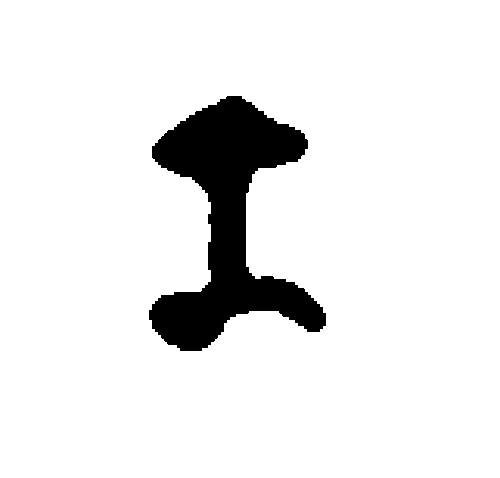 別のFremdzeichen形がありました
 。カローシュティー文字の ra の 3 番目の形は
 、ブラーフミー文字とは別にアラム語から派生したと考えられます。
 に由来し、現代ラテン語のRやギリシャ語のRhoと関連している。[ 2 ]ブラーフミー文字Raの書き方にはいくつかの識別可能なスタイルがあり、そのほとんどは、ある遺物からの特定の碑文や、ある歴史的時代のさまざまな記録に関連付けられている。[ 3 ]ブラーフミー文字の中で最も初期かつ最も幾何学的なスタイルであるアショーカ王の勅令やその頃の他の記録に見られる文字は、通常ブラーフミー文字の基準形であり、母音記号は、幾何学的な書き方に合わせて逆成された後のブラーフミーの形式まで確認されていない。


























































































































 から派生しており、デーヴァナーガリー文字の र と似た水平のヘッドラインが付いていますが、幾何学的な形状ではありません。ベンガル語の子音文字の固有の母音は /ɔ/ なので、文字 র は「ra」ではなく「ro」と音訳されることがあります。母音記号「o」の okar を追加すると、/ro/ と読めます。アッサム語の子音文字の固有の母音は異なります (/ɑ/) が、文字 ৰ も「ro」または「ra」と音訳されます。すべてのインド語の子音と同様に、র/ৰ は、固有の「a」以外の母音 (または母音なし) を示すために記号で変更されることがあります。































































































 with the top bar (shiro rekha) removed, and ultimately the Brahmi letter





 Ra. Like in other Indic scripts, Malayalam consonants have the inherent vowel "a", and take one of several modifying vowel signs to represent syllables with another vowel or no vowel at all.