According to Wurl et al., the SML can never be devoid of organics due to the abundance of surface-active substances (e.g., surfactants) in the upper ocean[5] and the phenomenon of surface tension at air-liquid interfaces.[16] The SML is analogous to the thermal boundary layer, and remote sensing of the sea surface temperature shows ubiquitous anomalies between the sea surface skin and bulk temperature.[17] Even so, the differences in both are driven by different processes. Enrichment, defined as concentration ratios of an analyte in the SML to the underlying bulk water, has been used for decades as evidence for the existence of the SML. Consequently, depletions of organics in the SML are debatable; however, the question of enrichment or depletion is likely to be a function of the thickness of the SML (which varies with sea state;[18] including losses via sea spray, the concentrations of organics in the bulk water,[5] and the limitations of sampling techniques to collect thin layers .[19] Enrichment of surfactants, and changes in the sea surface temperature and salinity, serve as universal indicators for the presence of the SML. Organisms are perhaps less suitable as indicators of the SML because they can actively avoid the SML and/or the harsh conditions in the SML may reduce their populations. However, the thickness of the SML remains "operational" in field experiments because the thickness of the collected layer is governed by the sampling method. Advances in SML sampling technology are needed to improve our understanding of how the SML influences air-sea interactions.[1]
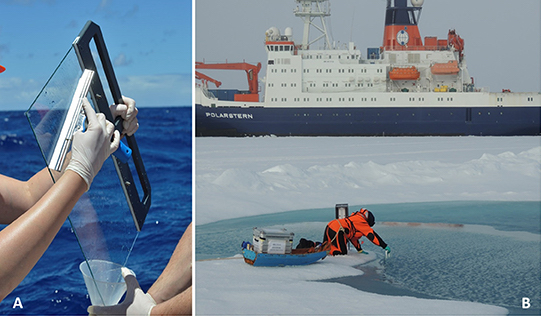
Marine surface habitats sit at the interface between the atmosphere and the ocean. The biofilm-like habitat at the surface of the ocean harbours surface-dwelling microorganisms, commonly referred to as neuston.[20] The sea surface microlayer (SML) constitutes the uppermost layer of the ocean, only 1–1000 μm thick, with unique chemical and biological properties that distinguish it from the underlying water (ULW).[21][2] Due to the location at the air-sea interface, the SML can influence exchange processes across this boundary layer, such as air-sea gas exchange and the formation of sea spray aerosols.[2][22][23][4][24]
where V is the sample volume in cm3, A is the total immersed plate area of both sides in cm2, and N is the number of times the sample was dipped.[110]
Remote sensing
Bacteria, sea slicks and satellite remote sensing. Surfactants are capable of dampening the short capillary ocean surface waves and smoothing the sea surface. Synthetic aperture radar (SAR) satellite remote sensing can detect areas with concentrated surfactants or sea slicks, which appear as dark areas on the SAR images.[111]
Ocean surface habitats sit at the interface between the ocean and the atmosphere. The biofilm-like habitat at the surface of the ocean harbours surface-dwelling microorganisms, commonly referred to as neuston. This vast air–water interface sits at the intersection of major air–water exchange processes spanning more than 70% of the global surface area . Bacteria in the surface microlayer of the ocean, called bacterioneuston, are of interest due to practical applications such as air-sea gas exchange of greenhouse gases, production of climate-active marine aerosols, and remote sensing of the ocean.[111] Of specific interest is the production and degradation of surfactants (surface active materials) via microbial biochemical processes. Major sources of surfactants in the open ocean include phytoplankton,[112] terrestrial runoff, and deposition from the atmosphere.[111]
Unlike coloured algal blooms, surfactant-associated bacteria may not be visible in ocean colour imagery. Having the ability to detect these "invisible" surfactant-associated bacteria using synthetic aperture radar has immense benefits in all-weather conditions, regardless of cloud, fog, or daylight.[111] This is particularly important in very high winds, because these are the conditions when the most intense air-sea gas exchanges and marine aerosol production take place. Therefore, in addition to colour satellite imagery, SAR satellite imagery may provide additional insights into a global picture of biophysical processes at the boundary between the ocean and atmosphere, air-sea greenhouse gas exchanges and production of climate-active marine aerosols.[111]
1 2 3 4 5 6 7 Wurl, Oliver; Ekau, Werner; Landing, William M.; Zappa, Christopher J. (2017 年 1 月 1 日). Deming, Jody W.; Bowman, Jeff (編). "変化する海洋における海面マイクロレイヤー ― 展望". Elementa: Science of the Anthropocene . 5 31. University of California Press. Bibcode : 2017EleSA...5...31W . doi : 10.1525/elementa.228 . ISSN 2325-1026 .この資料は、クリエイティブ・コモンズ表示4.0国際ライセンスの下で利用可能なこの情報源からコピーされました。
1 2 Sieburth, John McN. (1983). "表層および混合層における微生物学的および有機化学的プロセス". Air-Sea Exchange of Gases and Particles . pp. 121–172 . doi : 10.1007/978-94-009-7169-1_3 . ISBN978-94-009-7171-4。
↑ Ellison, G. Barney; Tuck, Adrian F.; Vaida, Veronica (1999). "有機エアロゾルの大気処理" . Journal of Geophysical Research: Atmospheres . 104 (D9): 11633– 11641. Bibcode : 1999JGR...10411633E . doi : 10.1029/1999JD900073 .
1 2 3 Carlson, David J. (1993). "有機物の初期続成作用:大気-海洋界面での反応". Organic Geochemistry . Topics in Geobiology. Vol. 11. pp. 255–268 . doi : 10.1007/978-1-4615-2890-6_12 . ISBN978-1-4613-6252-4。
↑ Zafiriou, Oliver C. (1986). "光化学と海面マイクロレイヤー:自然過程と技術としての可能性". Dynamic Processes in the Chemistry of the Upper Ocean . pp. 129–135 . doi : 10.1007/978-1-4684-5215-0_11 . ISBN978-1-4684-5217-4。
↑ Hunter, KA (1977)海面マイクロレイヤーの化学 イースト・アングリア大学 環境科学部。
↑ Zhang, Zhengbin (2003). 「pHマイクロ電極を用いた海面マイクロレイヤーの厚さの直接測定(原位置)」. Science in China Series B: Chemistry . 46 (4): 339. doi : 10.1360/02yb0192 (2025年10月5日非アクティブ)。{{cite journal}}: CS1メンテナンス: DOIは2025年10月現在非アクティブです(リンク)
↑ Levich VG (1962) Physicochemical hydrodynamics、Prentice Hall International。
↑ Schluessel, Peter; Emery, William J.; Grassl, Hartmut; Mammen, Theodor (1990). "On the bulk-skin temperature difference and its impact on satellite remote sensing of sea surface temperature". Journal of Geophysical Research . 95 (C8) 13341. Bibcode : 1990JGR....9513341S . doi : 10.1029/JC095iC08p13341 . hdl : 21.11116/0000-0004-BC37-B .
↑ Carlson, David J. (1982). "プレートおよびスクリーンマイクロレイヤーサンプリング技術の現場評価". Marine Chemistry . 11 (3): 189– 208. Bibcode : 1982MarCh..11..189C . doi : 10.1016/0304-4203(82)90015-9 .
↑ Aller, Josephine Y.; Radway, Joann C.; Kilthau, Wendy P.; Bothe, Dylan W.; Wilson, Theodore W.; Vaillancourt, Robert D.; Quinn, Patricia K.; Coffman, Derek J.; Murray, Benjamin J.; Knopf, Daniel A. (2017). "海塩エアロゾルの多糖類およびタンパク質成分のサイズ分解特性評価" . Atmospheric Environment . 154 : 331– 347. Bibcode : 2017AtmEn.154..331A . doi : 10.1016/j.atmosenv.2017.01.053 .
1 2 3 4 5 Zäncker, Birthe; Cunliffe, Michael; Engel, Anja (2018年11月15日). "ペルー沿岸沖の海面マイクロレイヤーにおける細菌群集構成" . Frontiers in Microbiology . 9 2699. Frontiers Media SA. doi : 10.3389/fmicb.2018.02699 . ISSN 1664-302X . PMC 6249803 . PMID 30498480 .この資料は、クリエイティブ・コモンズ表示4.0国際ライセンスの下で利用可能なこの情報源からコピーされました。
1 2 Hardy, JT (1982). "海面マイクロレイヤー:生物学、化学、および人為的富栄養化". Progress in Oceanography . 11 (4): 307–328 . Bibcode : 1982PrOce..11..307H . doi : 10.1016/0079-6611(82)90001-5 .
1 2 3 Sieburth, John McN.; Willis, Paula-Jean; Johnson, Kenneth M.; Burney, Curtis M.; Lavoie, Dennis M.; Hinga, Kenneth R.; Caron, David A.; French, Frederick W.; Johnson, Paul W.; Davis, Paul G. (1976). "北大西洋の表層マイクロレイヤーにおける溶存有機物と従属栄養性ミクロネウストン". Science . 194 (4272): 1415– 1418. Bibcode : 1976Sci...194.1415M . doi : 10.1126/science.194.4272.1415 . PMID 17819279 . S2CID 24058391 .
↑ Wurl, Oliver; Miller, Lisa; Röttgers, Rüdiger; Vagle, Svein (2009). "The distribution and fate of surface-active substances in the sea-surface microlayer and water column". Marine Chemistry . 115 ( 1– 2): 1– 9. Bibcode : 2009MarCh.115....1W . doi : 10.1016/j.marchem.2009.04.007 .
1 2 3 4 5 Franklin, Mark P.; McDonald, Ian R.; Bourne, David G.; Owens, Nicholas JP; Upstill-Goddard, Robert C.; Murrell, J. Colin (2005). "Bacterial diversity in the bacterioneuston (Sea surface microlayer): The bacterioneuston through the looking glass". Environmental Microbiology . 7 (5): 723– 736. Bibcode : 2005EnvMi...7..723F . doi : 10.1111/j.1462-2920.2004.00736.x . PMID 15819854 .
↑ Reinthaler, Thomas; Sintes, Eva; Herndl, Gerhard J. (2008). "Dissolved organic matter and bacterial production and respiration in the sea-surface microlayer of the open Atlantic and the western Mediterranean Sea" . Limnology and Oceanography . 53 (1): 122– 136. Bibcode : 2008LimOc..53..122R . doi : 10.4319/lo.2008.53.1.0122 . S2CID 17499707 .
↑ Rahlff, Janina; Stolle, Christian; Wurl, Oliver (2017). "SISI: A New Device for in Situ Incubations at the Ocean Surface" . Journal of Marine Science and Engineering . 5 (4): 46. Bibcode : 2017JMSE....5...46R . doi : 10.3390/jmse5040046 .
1 2 Hardy, John T.; Coley, James A.; Antrim, Liam D.; Kiesser, Steven L. (1988). "水生表面マイクロレイヤーを採取するための疎水性大容量サンプラー:特性評価とガラス板法との比較". Canadian Journal of Fisheries and Aquatic Sciences . 45 (5): 822– 826. Bibcode : 1988CJFAS..45..822H . doi : 10.1139/f88-099 .
↑ Mari, Xavier; Kerros, Marie-Emmanuelle; Weinbauer, Markus G. (2007). "ニューカレドニア南西部ラグーンの栄養勾配に沿った透明な外ポリマー粒子へのウイルス付着" . Applied and Environmental Microbiology . 73 (16): 5245– 5252. Bibcode : 2007ApEnM..73.5245M . doi : 10.1128/AEM.00762-07 . PMC 1950989 . PMID 17586679 .
↑ Wilson, Theodore W.; Ladino, Luis A.; Alpert, Peter A.; Breckels, Mark N.; Brooks, Ian M.; Browse, Jo; Burrows, Susannah M. ; Carslaw, Kenneth S.; Huffman, J. Alex; Judd, Christopher; Kilthau, Wendy P.; Mason, Ryan H.; McFiggans, Gordon; Miller, Lisa A.; Nájera, Juan J.; Polishchuk, Elena; Rae, Stuart; Schiller, Corinne L.; Si, Meng; Temprado, Jesús Vergara; Whale, Thomas F.; Wong, Jenny PS; Wurl, Oliver; Yakobi-Hancock, Jacqueline D.; Abbatt, Jonathan PD; Aller, Josephine Y.; Bertram, Allan K.; Knopf, Daniel A.; Murray, Benjamin J. (2015). "大気中の氷核生成粒子の海洋生物起源" (PDF) . Nature . 525 (7568): 234– 238. Bibcode : 2015Natur.525..234W . doi : 10.1038/nature14986 . PMID 26354482 . S2CID 4405246 .
↑ Wilhelm, Steven W.; Suttle, Curtis A. (1999年10月). "海のウイルスと栄養循環" . BioScience . 49 (10): 781– 788. doi : 10.2307/1313569 . JSTOR 1313569 .
↑ Wells, Mark L.; Goldberg, Edward D. (1992). "海洋サブミクロン粒子". Marine Chemistry . 40 ( 1– 2): 5– 18. Bibcode : 1992MarCh..40....5W . doi : 10.1016/0304-4203(92)90045-C .
↑ハーベイ、ジョージ・W. (1966). 海面からのマイクロレイヤー採取:新しい方法と初期結果。Limnology and Oceanography、11.4. 608-613
↑ Anderson, Zachary T.; Cundy, Andrew B.; Croudace, Ian W.; Warwick, Phillip E.; Celis-Hernandez, Omar; Stead, Jessica L. (2018年6月21日). "河口系における海面マイクロレイヤー(SML)へのマイクロプラスチック蓄積を評価するための迅速な方法" . Scientific Reports . 8 (1). Springer Science and Business Media LLC: 9428. Bibcode : 2018NatSR...8.9428A . doi : 10.1038/s41598-018-27612-w . ISSN 2045-2322 . PMC 6013445 . PMID 29930338 .この資料は、クリエイティブ・コモンズ表示4.0国際ライセンスの下で利用可能なこの情報源からコピーされました。
1 2 HARVEY, GEORGE W.; BURZELL, LINDEN A. (1972). "A Simple Microlayer Method for Small Samples1" . Limnology and Oceanography . 17 (1). Wiley: 156– 157. Bibcode : 1972LimOc..17..156H . doi : 10.4319/lo.1972.17.1.0156 . ISSN 0024-3590 .
1 2 Cunliffe, M. および Wurl, O. (2014)海洋表面を研究するためのベストプラクティスガイド。英国海洋生物学会の臨時出版物。doi : 10.25607/OBP-1512
1 2 3 4 5 Kurata, N., Vella, K., Hamilton, B., Shivji, M., Soloviev, A., Matt, S., Tartar, A. and Perrie, W. (2016) "海洋表層付近の界面活性剤関連細菌". Scientific Reports , 6 (1): 1–8. doi : 10.1038/srep19123 .この資料は、 Creative Commons Attribution 4.0 International Licenseの下で利用可能なこのソースからコピーされました。
↑ Ẑutić, V., Ćosović, B., Marčenko, E., Bihari, N. and Kršinić, F. (1981) "海洋植物プランクトンによる界面活性剤の生成". Marine Chemistry , 10 (6): 505–520. doi : 10.1016/0304-4203(81)90004-9 .
↑ Chow, JC、Watson, JG、Green, MC、Lowenthal, DH、Bates, B.、Oslund, W.、Torre, G. (2000)。メキシコ・メキシカリとカリフォルニア州インペリアル・バレーにおける浮遊粒子の国境を越えた輸送と空間的変動。大気環境、34、1833–1843。
1 2 Marks, R., Kruczalak, K., Jankowska, K., & Michalska, M. (2001). グダニスク湾とバルト海上空の空気中の細菌と真菌。Journal of Aerosol Science, 32, 237–250.
↑ Cincinelli A.; Stortini AM; Perugini M.; Checchini L.; Lepri L., 2001. Organic Pollutants in sea-surface microlayer and aerosol in the coastal environment Of Leghorn- (Tyrrhenian Sea). Marine Chemistry, Volume 76, Number 1, pp. 77-98(22)
↑ Murray, James W.「海洋」Jacobson, MC Charlson, RJ; Rodhe, H.; Orians, GH Earth System Science: From Biogeochemical Cycles to Global Changes, Oxford, UK: Elsevier (2000): 230-278.
↑ Crump, Byron C.、Jeremy M. Testa、Kenneth H. Dunton 編著。『河口生態学』John Wiley & Sons、2022年、42-43頁。





 この資料は、クリエイティブ・コモンズ表示4.0国際ライセンスの下で利用可能なこの情報源からコピーされました。