
Loading article…
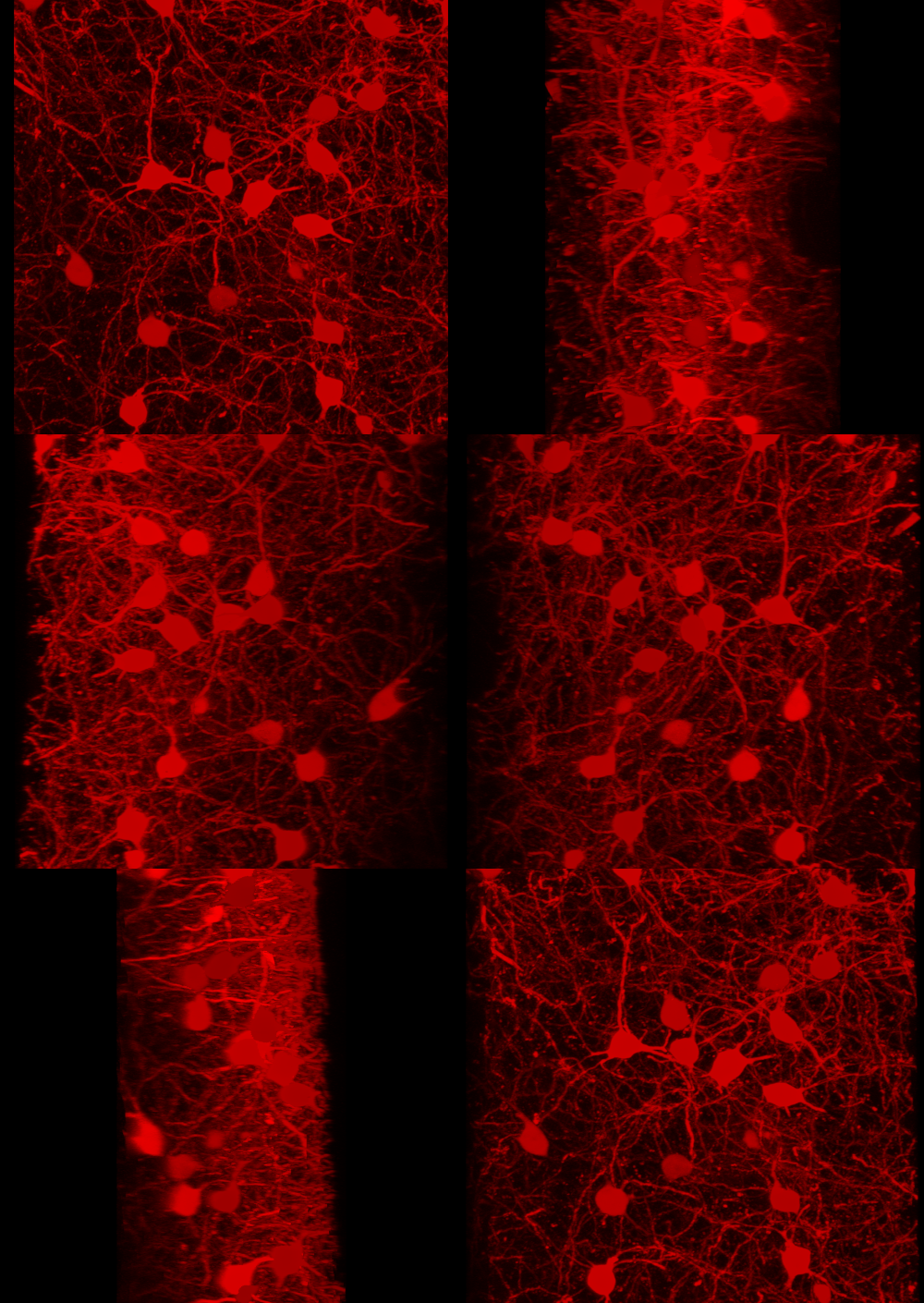
ニューラルネットワーク(神経ネットワークとも呼ばれる)は、通常複数の神経回路を含む、相互接続されたニューロンの集団である。[ 1 ] [ 2 ]生物学的ニューラルネットワークは、神経系の組織と機能を理解するために研究されている。
機械学習モデルの一種である人工ニューラルネットワークは、生物学的ニューラルネットワークから着想を得ています。これらは、神経回路のメカニズムを模倣するように設計された数学的関数によって生成される人工ニューロンで構成されています。
生物学的神経ネットワークは、化学的に結合した、または機能的に関連付けられたニューロンのグループで構成されています。[ 3 ] 1 つのニューロンは他の多くのニューロンと接続されている場合があり、ネットワーク内のニューロンと接続の総数は膨大になる可能性があります。シナプスと呼ばれる接続は、通常、軸索から樹状突起に形成されますが、樹状突起間シナプス[ 4 ]やその他の接続も可能です。電気信号以外にも、神経伝達物質の拡散から生じる他の形態の信号があります。
神経ネットワークの起源は、単純なニューロンから始まります。神経細胞、すなわちニューロンは、電気信号を化学信号に変換し、そのメカニズムを通して体内の経路を繋ぎ合わせる能力を持つという点で独特です。独自の役割を持つため、ニューロンは独自の形態も備えています。
A single neuron consists of three main parts, the cell body, the dendrites, and the axon. The cell body acts as a control center of the neuron, and contains the cell's nucleus and other organelles. Dendrites are branch-like extensions that come off of the cell body on one end, and their main purpose is to receive signals from other neurons. These signals are known as afferent signals, meaning they move toward the central nervous system. The axon is a long, tail-like structure that exits out of the cell body on the other end, and it is responsible for carrying action potentials away from the dendrites and cell body to other neurons (efferent signals). The axon terminal is the end of the axon where the action potential (electrical signaling) triggers the release of neurotransmitters, neuromodulators, or neurohormones (chemical signal), which creates the synapse that communicates with neighboring neurons.[5] When this synaptic connection occurs between a large number of neurons, a neural network is formed. In the process of creating a synaptic connection, there is a synaptic transmission from the presynaptic neuron to the postsynaptic neuron.
While it is true that the transmission of a signal within a neuron is carried out through chemicals, the transmission of a signal within a neuron, from the dendrites to the axon terminal, occurs through changes in membrane potential. This action potential occurs because each neuron has a charged cellular membrane (meaning that there is an imbalance of voltage between the outside and the inside of the cell), which is created through the presence of voltage-gated ion channels. The charge of neurons are influenced by neurotransmitters and other external stimuli, which allows the process of transmitting the chemical signal into an electrical signal to occur again. In essence, a membrane has a resting potential when the neuron is not transmitting a signal, and this resting membrane potential is maintained by sodium potassium pumps and potassium leak channels. An action potential then occurs, and these are regulated by voltage-gated sodium and potassium channels and sodium potassium pumps. When the action potential passes through the neuron, it will release neurotransmitters or other chemical messengers through the axon hillock and terminal, which will send a message to the adjacent neuron in the neural network, thus making another action potential more or less likely to occur to either continue or stop the message being transmitted.[6] This is the "language" that neural networks use to communicate, and is the basis of the entire nervous system's function.
Artificial neural networks are popular tools in computational studies, biological studies, and artificial intelligence. Artificial neural networks are modeled after biological neural networks, and can provide significant contributions to the study of biological neural networks.
A biological neural networks is not a simple system. The human brain forms millions of neural networks through 10¹¹ neurons that have about 10¹⁵ synaptic connections between them. All of these neural networks are specialized to work towards a specific function, such as basic survival, intense thought processing, or memory formation.[7]
生物学的ニューラルネットワークは、まずニューロンの機能を数学的に考察することで、数学的にモデル化できます。ニューラルネットワーク内のノードとして知られる単一のニューロンの数学的解釈は、ニューロンが周囲のニューロンから受け取る入力信号に基づいており、総活性化はすべての入力の合計となり、それが周囲の他のニューロン接続とのシナプス結合に統計的に結び付けられます。[ 7 ]ニューロンの出力信号は、その活性化の関数となり、これらの関数がより複雑な方法で重ね合わされると、人工ニューラルネットワークが作成されます。
人工知能、認知モデリング、人工ニューラルネットワークは、生物学的神経系がデータを処理する方法に触発された情報処理パラダイムです。人工知能と認知モデリングは、生物学的ニューラルネットワークのいくつかの特性をシミュレートしようとします。人工ニューラルネットワークは、人工知能が複雑なデータをゆっくりと適応して処理できるようにする機械学習のサブセットとして機能するためです。[ 8 ]人工知能の分野では、人工ニューラルネットワークは、ソフトウェアエージェント(コンピュータゲームやビデオゲーム)や自律型ロボットを構築するために、音声認識、画像解析、適応制御にうまく適用されています。
ニューラルネットワーク理論は、脳と神経系の生物学(生物学的ニューラルネットワーク)に触発された計算モデル(人工ニューラルネットワーク)の研究であり、脳内のニューロンがどのように機能するかをよりよく特定し、非線形変換と最適化に基づく人工知能やより複雑なシステムを作成する取り組みの基礎を提供してきました。[ 9 ]
現代のニューラルネットワークの基礎となる理論的基盤は、アレクサンダー・ベイン[ 10 ](1873年)とウィリアム・ジェームズ[ 11 ](1890年)によってそれぞれ独立に提唱された。彼らの研究では、思考と身体活動の両方が脳内のニューロン間の相互作用から生じるとされた。

For Bain,[10] every activity led to the firing of a certain set of neurons. When activities were repeated, the connections between those neurons strengthened. According to his theory, this repetition was what led to the formation of memory. The general scientific community at the time was skeptical of Bain's[10] theory because it required what appeared to be an inordinate number of neural connections within the brain. It is now apparent that the brain is exceedingly complex and that the same brain "wiring" can handle multiple problems and inputs.[13]
James'[11] theory was similar to Bain's;[10] however, he suggested that memories and actions resulted from electrical currents flowing among the neurons in the brain. His model, by focusing on the flow of electrical currents, did not require individual neural connections for each memory or action.[14]
C. S. Sherrington[15] (1898) conducted experiments to test James' theory. He ran electrical currents down the spinal cords of rats. However, instead of demonstrating an increase in electrical current as projected by James, Sherrington found that the electrical current strength decreased as the testing continued over time. Importantly, this work led to the discovery of the concept of habituation.
McCulloch and Pitts[16] (1943) also created a computational model for neural networks based on mathematics and algorithms. They called this model threshold logic. These early models paved the way for neural network research to split into two distinct approaches. One approach focused on biological processes in the brain and the other focused on the application of neural networks to artificial intelligence.
In 1956, Svaetichin discovered some of the neural processes underlaying neural networks in vivo. He had studied the functioning of second order retinal cells (Horizontal Cells), and discovered that in this first processing layer they operated by an opponency mechanism. This helped explain the first layer of processing of the visual system.
The parallel distributed processing of the mid-1980s became popular under the name connectionism. The text by Rumelhart and McClelland[17] (1986) provided a full exposition on the use of connectionism in computers to simulate neural processes.
人工知能で使用される人工ニューラルネットワークは、従来、脳内の神経処理の単純化されたモデルとして見なされてきたが、このモデルと脳の生物学的構造との関係については議論があり、人工ニューラルネットワークが脳の機能をどの程度反映しているかは明らかではない。[ 18 ]
人工ニューラルネットワークは、ニューラルネットワーク理論や機械学習、人工知能、現代のデジタルサービスに関するその他の進歩において大きな役割を果たしていますが、生物学研究や神経科学の発展にも活用できます。理論神経科学および計算神経科学は、生物学的神経系の分析と計算モデル化を扱う分野です。神経系は認知プロセスや行動と密接に関連しているため、この分野は認知および行動モデル化と密接に関連しています。
この分野の目的は、生物システムの仕組みを理解するために、生物学的神経系のモデルを作成することです。この理解を得るために、神経科学者は、観察された生物学的プロセス(データ)、神経処理と学習に関する生物学的に妥当なメカニズム(ニューラルネットワークモデル)、そして理論(統計的学習理論と情報理論)を結びつけようと努めています。
様々なモデルが用いられており、それぞれ異なる抽象度で定義され、神経系の様々な側面をモデル化している。これらのモデルは、個々のニューロンの短期的な挙動をモデル化したものから、個々のニューロン間の相互作用から生じる神経回路の動態をモデル化したもの、そして完全なサブシステムを表す抽象的な神経モジュールから生じる挙動をモデル化したものまで多岐にわたる。これらには、個々のニューロンからシステムレベルに至るまで、神経系の長期的および短期的な可塑性、そして学習と記憶との関係をモデル化したものも含まれる。
In August 2020 scientists reported that bi-directional connections, or added appropriate feedback connections, can accelerate and improve communication between and in modular neural networks of the brain's cerebral cortex and lower the threshold for their successful communication. They showed that adding feedback connections between a resonance pair can support successful propagation of a single pulse packet throughout the entire network.[19][20] The connectivity of a neural network stems from its biological structures and is usually challenging to map out experimentally. Scientists used a variety of statistical tools to infer the connectivity of a network based on the observed neuronal activities, i.e., spike trains. Recent research has shown that statistically inferred neuronal connections in subsampled neural networks strongly correlate with spike train covariances, providing deeper insights into the structure of neural circuits and their computational properties.[21]
Using different models and artificial intelligence tools creates opportunities for a new way of understanding neural function. In doing so, these technologies have the potential to offer treatments and advanced technology to help with neuroscience-related pathologies such as Alzheimer's and post-traumatic stress disorder.[22] As mentioned above, artificial neural networks already have given neuroscience the foundation for studying "complex behaviors, heterogenous neural activity, and circuit connectivity" in ways that could not be studied before.[23] Artificial neural networks provide scientists with data analysis tools, help with modeling complex behaviors and complex activity, and provide an optimization perspective.[23] A recent study involving brain-computer interfaces (BCIs) show how this technology has worked to rework the nervous system programming of patients with paralysis. By inputing an individual's motor intention through intracortical neural recording to control commands, patients are able to interact with external devices or regain sensory and motor function.[24] Future applications of artificial neural networks will continue to build on the abilities that have already been gaining interest in the field of neuroscience, such as analyzing large-scale data, building predictive visual cortex models, accelerating the discovery of drugs and therapies, and stimulating neural development and plasticity.[25][26][27][28]
近年の生物学的神経科学の発見に関して言えば、初期の研究は主にニューロンの電気的特性に関心が向けられていましたが、近年では、ドーパミン、アセチルコリン、セロトニンなどの神経調節物質が行動や学習に果たす役割の探求が特に重要な研究分野となっています。[ 29 ] [ 30 ]
BCM理論などの生物物理モデルは、シナプス可塑性のメカニズムを理解する上で重要であり、コンピュータ科学と神経科学の両方で応用されてきた。[ 31 ]
 テキストと画像は、クリエイティブ・コモンズ表示4.0国際ライセンスの下で利用可能です。