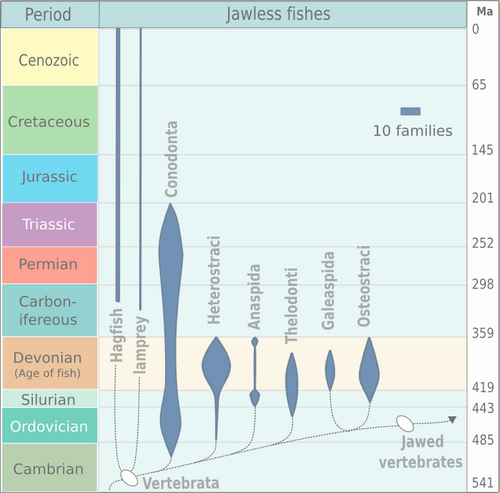
The oldest fossil agnathans appeared in the Cambrian. Living jawless fish comprise about 120species in total. Hagfish are considered members of the subphylumVertebrata, because they secondarily lost vertebrae; before this event was inferred from molecular[6][7][11] and developmental[12] data, the Craniata hypothesis was accepted (and is still sometimes used as a strictly morphological descriptor) to reference hagfish plus vertebrates.
Metabolism
Agnathans are ectothermic, meaning they do not regulate their own body temperature. Agnathan metabolism is slow in cold water, and therefore they do not have to eat very much. They have no distinct stomach, but rather a long gut, more or less homogeneous throughout its length. Lampreys feed on carrion, as well as other fish and marine mammals, although some species are non-carnivorous.[13]Anticoagulant fluids preventing blood clotting are injected into the host, causing the host to yield more blood. Hagfish are scavengers, eating mostly dead animals, although they have also been observed hunting.[14] They use a row of sharp teeth to break down the animal. Because agnathan teeth are unable to move up and down, their possible food types are limited.
Morphology
In addition to the absence of jaws, modern agnathans are characterised by absence of paired fins; the presence of a notochord both in larvae and adults; and seven or more paired gill pouches. Lampreys have a light-sensitive pineal eye (homologous to the pineal gland in mammals). All living and most extinct Agnatha do not have an identifiable stomach or paired appendages. Fertilization and development are both external. There is no parental care in the Agnatha class. The Agnatha are ectothermic or cold-blooded, with a cartilaginousskeleton, and the heart contains 2 chambers.
↑ Ruggiero, Michael; Gordon, Dennis P.; Orrell, Thomas M.; Bailly, Nicolas (2015年4月). "すべての生物のより高次の分類" . PLOS One . 10 (4) e0119248. Bibcode : 2015PLoSO..1019248R . doi : 10.1371/journal.pone.0119248 . PMC 4418965 . PMID 25923521 .
↑ Heimberg, Alysha M.; Cowper-Sal·lari, Richard; Sémon, Marie; Donoghue, Philip CJ; Peterson, Kevin J. (2010-11-09). "microRNAs reveal the interrelationships of hagfish, lampreys, and gnathostomes and the nature of the ancestral vertebrate" . Proceedings of the National Academy of Sciences . 107 (45): 19379– 19383. doi : 10.1073/pnas.1010350107 . PMC 2984222 . PMID 20959416 .
↑スタンレー、スティーブン M.、ルツァイ、ジョン A. (2015).地球システム史(第 4版).マクミラン教育. p. 311.コノドントはカンブリア紀前期の後期に出現し、オルドビス紀に多様化した。... カンブリア紀初期の動物相に見られる同様の小さな歯は、コノドントの祖先を表している可能性がある。
↑ Ginot, Samuel; Goudemand, Nicolas (2020年12月) 「地球規模の気候変動はコノドントの多様性の主な傾向を説明するが、最終的な絶滅の原因ではない」(PDF) . Global and Planetary Change . 195 103325. Bibcode : 2020GPC...19503325G . doi : 10.1016/j.gloplacha.2020.103325 . S2CID 225005180 .
↑ Du, Yixing; Onoue, Tetsuji; Tomimatsu, Yuki; Wu, Qiangwang; Rigo, Manuel (2023). "Lower Jurassic conodonts from the Inuyama area of Japan: implications for conodont extinction" . Frontiers in Ecology and Evolution . 11. doi : 10.3389 /fevo.2023.1135789 . hdl : 11577/3479836 . ISSN 2296-701X .
↑ Sarjeant, WA; Halstead, LB (1995). Vertebrate fossils and the evolution of scientific concepts: Writings in tribute to Beverly Halstead . Gordon and Breach. ISBN978-2-88124-996-9。
↑ Donoghue, Philip CJ; Forey, Peter L.; Aldridge, Richard J. (2000 年 5 月). 「コノドントの類縁性と脊索動物の系統発生」. Biological Reviews of the Cambridge Philosophical Society . 75 (2): 191– 251. doi : 10.1111/j.1469-185X.1999.tb00045.x . PMID 10881388 . S2CID 22803015 .
↑ Turner, S. (1999). "初期シルル紀から初期デボン紀のテロドント群集とその生態学的意義の可能性". AJ Boucot; J. Lawson (編)『古生物群集 - プロジェクト生態層序、最終報告書(報告書)』国際地質相関プログラム、第53巻、ケンブリッジ大学出版局、 42-78頁。
↑Ferrón, H.G.; Botella, H. (2017). "Squamation and ecology of thelodonts". PLOS ONE. 12 (2) e0172781. Bibcode:2017PLoSO..1272781F. doi:10.1371/journal.pone.0172781. PMC5328365. PMID28241029.
↑Ahlberg PE (2001). Major events in early vertebrate evolution: Palaeontology, phylogeny, genetics, and development. Washington, DC: Taylor & Francis. p.188. ISBN978-0-415-23370-5.
↑Patterson, Colin (1987). Molecules and Morphology in Evolution: Conflict or compromise?. Cambridge, UK: Cambridge University Press. p.142. ISBN978-0-521-32271-3.
↑Hall, Brian Keith; Hanken, James (1993). The Skull. Chicago, IL: University of Chicago Press. p.131. ISBN978-0-226-31568-3.
↑Colbert, Michael; Morales, Edwin H. (1991). Evolution of the Vertebrates: A history of the backboned animals through time (4thed.). New York, NY: Wiley-Liss. ISBN978-0-471-85074-8.
↑Haaramo, Mikko (2007). "Chordata – lancets, tunicates, and vertebrates". Mikko's Phylogeny Archive. Retrieved 30 December 2016.
12Delsuc, Frédéric; Philippe, Hervé; Tsagkogeorga, Georgia; etal. (April 2018). "A phylogenomic framework and timescale for comparative studies of tunicates". BMC Biology. 16 (1): 39. doi:10.1186/s12915-018-0499-2. PMC5899321. PMID29653534.
↑Miyashita, Tetsuto; Coates, Michael I.; Farrar, Robert; Larson, Peter; Manning, Phillip L.; Wogelius, Roy A.; etal. (2019). "Hagfish from the Cretaceous Tethys Sea and a reconciliation of the morphological–molecular conflict in early vertebrate phylogeny". Proceedings of the National Academy of Sciences of the United States of America. 116 (6): 2146–2151. Bibcode:2019PNAS..116.2146M. doi:10.1073/pnas.1814794116. PMC6369785. PMID30670644.