
Loading article…
隋から唐への移行(613~628年)、または単に隋唐移行[ 1 ]は、隋王朝の終焉から唐王朝の始まりまでの中国史の期間である。隋王朝の領土は、官僚、将軍、農民反乱指導者によって、短命な少数の国家に分割された。その後、淘汰と併合の過程が続き、最終的には元隋の将軍である李淵による唐王朝の統合で頂点に達した。隋王朝の末期近く、李淵は傀儡の幼帝楊有を擁立した。李淵は後に楊有を処刑し、自らを新しい唐王朝の皇帝高祖と宣言した。
この変革は、隋の煬帝が高句麗に対する3度の遠征のうち最初の遠征を開始した613年頃に始まり、軍隊からの脱走者の増加や隋に対する農民反乱の勃発につながった。変革は628年に高祖の子である李世民が農民反乱軍の指導者である梁世渡の国を併合し、中国の大部分を再び単一の勢力の下に統一したことで終結した。
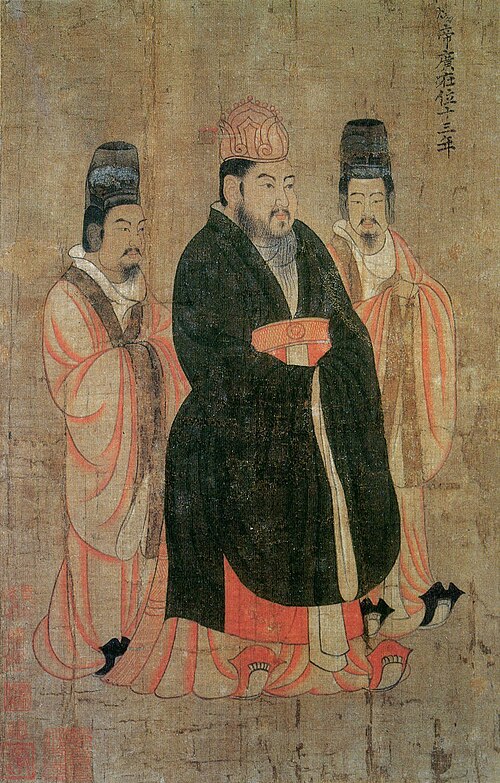
611年現在、隋王朝は589年に中国の大部分を統一し、陳王朝を滅ぼした後、20年以上にわたる平和と繁栄を享受していた。モンゴル高原を拠点とする東突厥は、その後、斉民ハーン・アシナ・ランガンの支配下で隋の属国となり、朝鮮半島を拠点とする高句麗も同様であった。604年に皇帝となった隋の煬帝と、戦争を経験したことのない弟の漢王楊良の間には、短期間の内紛があった。 610年に高句麗の王・盈陽が煬帝への臣従を拒否したため、煬帝は高句麗を征服するための遠征を計画し、煬帝自身も民衆も征服は容易であると信じていた。
However, staging the attack on Goguryeo took much human and other tolls. The building of a fleet and the shipping of food and other supplies to the base of operations, Zhuo Commandery (涿郡, roughly modern Beijing) caused major disruptions in the farming cycle and massive deaths among those conscripted to ship the supplies to Zhuo Commandery. In response, in 611, in northern China, those who refused to be conscripted began to revolt as agrarian rebels, led by leaders such as Wang Bo (王薄) and Liu Badao (劉霸道). While Emperor Yang initially did not consider these rebels serious threats, the local governmental militias were unable to quell them.

Despite this, Emperor Yang launched his first campaign against Goguryeo in 612, crossing the Liao River into Goguryeo territory in spring 612. Emperor Yang personally led part of the army to put the important city Liaodong (遼東, in modern Liaoyang, Liaoning) under siege, while he sent the Xianbei generals Yuwen Shu and Yu Zhongwen (于仲文) to lead the rest of the army deep into Goguryeo territory, heading toward the Goguryeo capital Pyongyang, joined by the fleet commanded by the southern Chinese general Lai Hu'er. Emperor Yang, however, was never able to capture Liaodong, while Yuwen and Yu, advancing nearly to Pyongyang, were defeated by the Goguryeo general Ŭlchi Mundŏk and forced to withdraw with heavy losses. By fall 612, Emperor Yang was forced to terminate the campaign and withdraw as well, with only minor territorial gains. About 300,000 men had been lost in the campaign.
Undeterred, Emperor Yang launched a second campaign against Goguryeo in 613, even though the agrarian rebellions were becoming more numerous and serious. He again headed for Liaodong himself and put it under siege, while sending Yuwen Shu with another general Yang Yichen toward Pyongyang. While he was sieging Liaodong, the northern Chinese general Yang Xuangan, in charge of logistics near the Sui eastern capital Luoyang, rebelled and attacked Luoyang. When Emperor Yang heard the news, he withdrew his forces and sent Yuwen and Qutu Tong back to Luoyang ahead of himself, and Yuwen and Qutu joined with Fan Zigai (樊子蓋) and Wei Wensheng (衛文昇), the commanders of forces that Emperor Yang had left at Luoyang and Chang'an respectively, to defeat Yang Xuangan. Emperor Yang carried out heavy-handed reprisals against actual or perceived adherents of Yang Xuangan, but such actions did not deter further rebellions.
Despite this, Emperor Yang launched a third campaign against Goguryeo in 614. As Lai Hu'er reached the Yalu River, however, Goguryeo submitted, sending Yang Xuangan's Turkic confederate Husi Zheng (斛斯政), who had fled to Goguryeo, back to Sui as a sign of submission. Emperor Yang terminated the campaign, but when he again summoned Yeongyang to pay homage to him, Yeongyang ignored his summons. Emperor Yang began to plan a fourth campaign, which, however, he was never able to launch.
Meanwhile, in the fall of 615, while Emperor Yang and Empress Xiao were conducting a tour of the northern frontier, Qimin Khan's son and successor Shibi Khan launched a surprise attack against Yanmen Commandery as a reprisal for the emperor's proposal to give a princess to his brother and for the treacherous murder of one of his close advisors. The khan's wife Princess Yicheng, a relative of the emperor who had been personally honored by the empress during an earlier visit, sent them a secret warning about the Turkic attack. The imperial entourage fled to the fortified commandery seat at present-day Daixian, Shanxi,[2] where Shibi Khan's forces besieged them on September 11.[3][4]Yu Shiji advised the emperor to raise morale among the soldiers by promising promotion and rewards, as well as promising to abandon the unpopular campaigns against Goguryeo; this had the desired effect and Sui forces loyally rushed to the area to lift the siege. Meanwhile, however, the empress's brother Xiao Yu had gotten the emperor to seek further assistance from Princess Yicheng, who was administering military affairs at home in her husband's absence. She sent a false report to the khan that a northern attack had been launched against the khaganate; between this report and others announcing the Chinese reinforcements, Shibi Khan lifted the siege and returned north. With credit for his salvation muddled, Emperor Yang followed the advice of Su Wei and Yuwen Shu and reneged on most of his promises, causing great resentment among the military.[2]

Despite (or perhaps because of) increasing agrarian rebel activities in northern China, Emperor Yang did not return to Chang'an or stay at Luoyang, but went to Jiangdu (江都, in modern Yangzhou, Jiangsu) in fall 616. With his departure from Luoyang, the rebels near Luoyang coalesced under the leadership of Yang Xuan'gan's former strategist Li Mi, who was proclaimed the Duke of Wei and considered the presumptive eventual emperor by most rebel leaders throughout northern China. Li, however, was not able to capture Luoyang and never claimed the imperial title.
Meanwhile, Yuchi Yichen made an attempt to destroy the rebels north of the Yellow River, but while he enjoyed some successes, Emperor Yang and his prime minister Yu Shiji, fearing Yuchi Yichen's military strengths, recalled him under guise of a promotion, allowing the rebel activities north of the Yellow River to reinvigorate themselves and become difficult to control, under the leadership of Dou Jiande.
By 617, a number of other major rebel leaders also began to control significant portions of territory. These include:
Several of these rebel leaders—including Li Yuan, Liu Wuzhou, Liang Shidu, Dou Jiande, and Gao Kaidao—formally submitted to Ashina Duojishi and received Eastern Göktürk military aid, with Ashina Duojishi's strategy apparently to keep China divided. In winter 617, Li Yuan captured Chang'an, declaring Yang You emperor (as Emperor Gong), while honoring Emperor Yang as Taishang Huang (retired emperor); these declarations were not recognized by most of Sui territory, which still recognized Emperor Yang as emperor. Li himself became regent with the title of Prince of Tang.


Meanwhile, Emperor Yang, while realizing that the empire was in turmoil, felt secure under the protection of the elite Xiaoguo Army (驍果) at Jiangdu. While he sent his general Wang Shichong to Luoyang to try to defend Luoyang against Li Mi's attacks, he did little quell the rebellions otherwise. Not wanting to return to north China, he considered officially moving the capital to Danyang (丹楊, in modern Nanjing, Jiangsu, south of the Yangtze River). Meanwhile, the Xiaoguo Army soldiers, who were predominantly northerners and missed their homes, began to desert, and this met with heavy-handed punishment from Emperor Yang. In fear, the remaining Xiaoguo Army officers formed a plot, supporting the general Yuwen Huaji the Duke of Xu (Yuwen Shu's son) as their leader. In spring 618, they carried out a coup and killed Emperor Yang. Yuwen declared Emperor Yang's nephew Yang Hao, the Prince of Qin, the new emperor, but retained power himself as regent. He abandoned Jiangdu and headed back north, commanding the Xiaoguo Army.
Soon, news of Emperor Yang's death spread throughout the empire. At Chang'an, Li Yuan executed Yang You, establishing the Tang dynasty as Emperor Gaozu. At Luoyang, seven of the leading officials declared another grandson of Emperor Yang, Yang Tong the Prince of Yue, emperor, and Yang Tong was recognized as Sui's emperor by most of the commanderies that still recognized Sui sovereignty. With both the Sui administration at Luoyang and Li Mi fearing Yuwen's northward advancement, they formed a temporary alliance in which Li Mi recognized Yang Tong as his sovereign. After Li Mi repelled Yuwen Huaji, however, Wang Shichong, who opposed the alliance, seized power from the other officials and became regent, and the alliance with Li Mi was broken. Later that year, in a surprise attack, Wang defeated Li Mi, forcing Li Mi to flee to Tang. Li Mi was later killed by Tang forces when he tried to reestablish his own independence.
Meanwhile, after Xue Ju died in early 618 and was succeeded by his son Xue Rengao, the Tang general Li Shimin the Prince of Qin (Emperor Gaozu's son) defeated and killed Xue Rengao, annexing his Qin state into Tang. At the same time, Dou Jiande further consolidated his holdings north of the Yellow River and killed Yuwen Huaji (who had poisoned Yang Hao and declared himself Emperor of Xu), but was unable to get Luo Yi to submit to him, and Luo subsequently submitted to Tang. Around the same time, Zhu Can, facing heavy resistance from the populace against his cruelty, vacillated between submitting to Yang Tong's Sui regime and Tang, eventually surrendering to Sui.
In summer 619, Wang Shichong had Yang Tong yield the throne to him, ending Sui and establishing a new state of Zheng as its emperor.

ほぼ同時期に、李桂の官僚である安興貴がクーデターを起こして李桂を捕らえ、唐に降伏させた。しかし、唐は別の方面でも脅威に直面していた。劉武洲が南方に大攻勢をかけ、唐が支配していた現在の山西省の大部分を占領し、唐の首都長安へのさらなる攻撃を企てているように見えたからである。ほぼ同時期に、煬帝の死後混乱状態にあった長江下流域では、3人の異なる対立する人物を中心に勢力が結集しつつあった。隋の元官僚である沈発興は梁王を名乗り、長江以南の領土の大部分を支配した。反乱指導者の李子同は江都とその周辺地域を支配し、呉の皇帝を名乗った。杜福維は唐に服従し、呉王に叙せられた。
619年末、李世民率いる唐軍は劉武州に対する反撃を開始した。620年の夏までに、李世民は劉武州を破り、劉武州は領土を放棄して東突厥へ逃亡した。彼の定陽国は唐に併合された。
定陽を破った李世民は、今度は鄭に狙いを定めた。彼は鄭の都洛陽に進軍し、これを包囲した。多くの鄭の都市が唐に降伏し、王世充は竇建徳の夏国に援軍を求めた。竇は、もし唐が鄭を滅ぼせば、自分の夏国が窮地に陥ると考え、援軍要請に応じ、包囲を解くために洛陽へ南下した。ほぼ同時期に、杜福維(高祖から李という皇姓を授けられ、李福維という名を名乗っていた)は李子同を破り、李子同は今度は沈を破り、沈を自殺に追い込んだ。こうして、沈の旧領土は李子同の旧領土となり、李子同の旧領土は唐の名の下に李福維によって保持されることになった。
621年の春、竇が迫る中、李世民は東へ進軍して重要な虎牢関に陣取った。竇が李世民と交戦すると、李世民は竇を破り捕らえた。恐れをなした王は降伏した。高祖は竇を処刑し、王を追放した(ただし、王は後に唐の将軍である独孤修徳によって殺害された。独孤修徳の父は王によって処刑されていた)。王の鄭国と竇の夏国は唐に併合されたが、旧夏領はすぐに竇の将軍である劉黒塔の指導の下、邯東王を名乗って勢力を拡大し、農業指導者の徐元朗が支配していたが、その後鄭国、そして唐国へと次々と服従してきた現在の山東も、徐元朗の指導の下、魯王を名乗って勢力を拡大した。
同じく621年、高祖の甥である趙郡の李孝公は、中国南部の梁国を蕭賢の国に攻撃し、梁の都江陵を包囲した。蕭賢は援軍が近づいていることに気づかず降伏し、梁国の大部分は唐に併合された。また、蕭賢の軍の一部は林世洪に服従した。ほぼ同時期に、李福威は李子同を破り、李子同を降伏させ、李子同の呉国も唐に併合された。
622年春、李世民は劉黒塔を破り、劉は東突厥へ逃亡したが、同年後半に東突厥の援軍を得て帰還し、かつての夏領を奪還した。622年冬、李世民の兄である皇太子李建成は再び劉を破り、623年春、逃亡中の劉は官僚の諸葛徳威に裏切られ、李建成によって処刑された。それ以前に林世洪が死去し、楚国は衰退し、都市は次第に唐に服従していった。劉の死後まもなく、唐軍に度々敗れていた徐も逃亡中に殺害された。この時点で、極北の梁世渡と高開道を除いて、中国は名目上は多少不完全ながらも、ほぼ唐の支配下で統一されていた。
しかし、623年秋、李福維が長安にいた時、李福維の部下である傅公師が丹陽で反乱を起こし、自らを宋の皇帝と宣言して、かつて李福維の支配下にあった領土を掌握した。624年までに、李孝公は傅公師を破って殺害し、宋の領土を唐に再編入した。一方、高は部下の張金樹によるクーデターに直面して自殺し、彼の燕国も唐に編入された。
一方、梁世渡は東突厥の支援を受けて唐の攻撃に耐え、唐自身も東突厥の襲撃に絶えず悩まされていた。しかし、626年に李世民が李建成ともう一人の兄弟である斉王李元基を待ち伏せして殺害し、高祖を事実上太宗として帝位を譲らせた後、唐は状況を好転させ始めた。 628年までに、東突厥は嘉理ハーンの阿史那什鉢苾(阿史那什鉢苾、阿史那什鉢苾の息子)との意見の相違により内乱状態に陥り、梁世渡を守ることができなくなった。唐の包囲下で、梁世渡の従兄弟である梁洛仁が梁世渡を殺害し、降伏した。こうして中国は太宗の支配下に入った。