
Loading article…
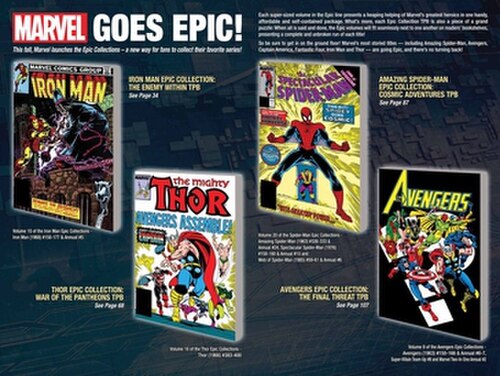
マーベル・エピック・コレクションは、マーベル・コミックを統一された装丁で再出版するカラーのトレードペーパーバックの継続的なシリーズです。2013年4月に発表されたこのシリーズは、廃止された白黒のエッセンシャル・マーベルと同様に、「可能な限り最高の価格で、キャラクターやタイトルの全シリーズを分厚いコレクションとして収集する」ことを目的としていました。[ 1 ] [ 2 ]
このシリーズは順番通りには出版されていませんが、完全版を目指しています。マーベルの販売担当上級副社長であるデビッド・ガブリエルは、「最終的に、エピックシリーズは読者の本棚に違和感なく並べられ、各タイトルの完全で途切れのない連載となるでしょう」と述べています。[ 3 ]
当初の発表では、6つのタイトルが月1巻のペースで刊行される予定で、ガブリエル氏はさらに「アメイジング・スパイダーマン、アベンジャーズ、キャプテン・アメリカ、ファンタスティック・フォー、アイアンマン、ソーなど、マーベルで最も歴史のあるタイトルがエピック版になる」と付け加えた。
最初の本である『The Enemy Within』は、アイアンマンの10番目のナンバリングされた巻で、2013年9月に発売されました。 [ 4 ]発売初月には推定864部が売れ、グラフィックノベルのトップ300チャートで129位に達しました。[ 5 ]
初期の売上は安定しており、10月に発売されたソーの第16巻「パンテオンの戦い」はチャート127位にランクインし、発売月に986部を売り上げた。11月のアメイジング・スパイダーマン第20巻「宇宙の冒険」は103位にランクインし、1,010部を売り上げた。12月のアベンジャーズ・エピック第9巻「最後の脅威」は943部を売り上げ、チャート順位は135位だった。[ 6 ] [ 7 ] [ 8 ]
トップ100入りを果たした最初のエピックコレクションは、全体で10番目のリリースでした。2014年5月に発売された『アメイジング・スパイダーマンVol.15:ゴースト・オブ・ザ・パスト』は1,152部を売り上げ、81位(ドルランキングでは51位)に達しました。[ 9 ] [ 10 ]
このシリーズは現在、ライセンス書籍を含む50以上のラインナップを誇り、例えば『エイリアン』、『スター・ウォーズ』、『ミクロノーツ』、『ROM – スペースナイト』などがある。
創刊以来、出版ペースは大幅に加速しており、印刷初年度である2014年には19のエピック・コレクションがリリースされました。2019年には45、2024年には再版を含めて89がリリースされています。このペースの加速に伴い、2023年と2025年にはそれぞれ2つのサブ・インプリントが立ち上げられました。モダン・エラ・エピック・コレクションはより最近のコミックシリーズを、アルティメット・エピック・コレクションは2000年代のアルティメット・ユニバースを対象としています。
DCコミックスは2024年に同様のシリーズであるDC Finestを立ち上げ、これを「手頃な価格の大型ペーパーバックコレクション」と説明し、「DCの歴史全体から最も需要の高い時代、ジャンル、キャラクターの包括的なコレクションの新しいシリーズ」を提供している。[ 11 ]
エピック・コレクションの中核となる書籍は、マーベルのコミックブックのシルバーエイジとブロンズエイジをほぼ網羅している。いくつかの例外を除けば、これはおおよそ1961年のファンタスティック・フォー第1号の発売[ 12 ]から1998年頃のマーベル・ナイツの創刊[ 13 ]までの期間をカバーしている。
2020年7月、マーベル・コミックスは、フォックスがディズニーに売却されたことを受けて、エイリアンとプレデターの出版権を獲得した。[ 14 ] 2023年以降、同社はエピック・コレクションの一部として、ダークホース・コミックスが元々制作したコミックを再出版している。
ピーター・パーカー版スパイダーマンは、1962年の『アメイジング・ファンタジー』第15号で初登場し、その後、1963年3月号で連載シリーズ『アメイジング・スパイダーマン』がスタートした。
注目すべきストーリーラインには、第7巻「ゴブリンの最後の抵抗」のグウェン・ステイシーの死、第17巻のクレイヴンの最後の狩り、第3巻のスパイダーマンの終焉、第18巻のヴェノムなどがある。 [ 15 ]
ハンク・ピムというキャラクターは、 1962年の『テイルズ・トゥ・アストニッシュ』第27号で初登場しました。最初の『エピック・コレクション』では、アントマン(『テイルズ・トゥ・アストニッシュ』第35号)とジャイアントマン(『テイルズ・トゥ・アストニッシュ』第49号)としての彼のデビューに加え、ジャネット・ヴァン・ダイン/ワスプ(『テイルズ・トゥ・アストニッシュ』第44号)の登場も取り上げられています。
最初のアベンジャーズのメンバーは、アイアンマン、アントマン、ワスプ、ハルク、ソーでした。その後、シルバーエイジのキャプテン・アメリカが第4号で加わり、その号は『地球最強のヒーロー』第1巻に収録されています。
登場人物が入れ替わり立ち替わり登場する主なストーリーラインには、クリー・スクラル戦争(第5巻:この橋頭堡の地球)、包囲下(第16巻)、コルヴァック・サーガ(第10巻:昨日の探求)[ 16 ]などがある。
エピック・コレクションズのタイトルは「アベンジャーズ・ウエストコースト」となっているが、コミック自体は第46号までは「ウエストコースト・アベンジャーズ」というタイトルで出版されていた。
第7巻:ウルトロン・アンバウンドには、ジェームズ・ローズがウォーマシンとして初登場するほか、ジュリア・カーペンター版スパイダーウーマンのオリジンストーリーが収録されている。
一方、スカーレット・ウィッチは第56号で狂気に陥り始めた最初の兆候を見せ、その様子は第5巻「ダーク・ザン・スカーレット」に再現されている。これが最終的に「ハウス・オブ・M」の出来事や「ミュータントがいなくなる」マーベル時代へと繋がった。[ 17 ]
ブラックパンサーエピック コレクション第 1 巻には、ファンタスティック フォー第 52-53 号でのキャラクターの初登場が収録されています。この号と同巻の残りの部分の間に、彼は第52 号でアベンジャーズに加わります。この第 52 号は、アベンジャーズエピック コレクション第 3 巻:マスターズ オブ イービルに収録されています。[ 18 ]
彼のオリジンストーリーは『アベンジャーズ』第87号(『アベンジャーズエピック コレクションVol.5: This Beachhead Earth 』)に掲載されており、第126号( 『アベンジャーズエピック コレクションVol.7: The Avengers/Defenders War 』)以降、チームを離れる。
その後、彼の物語は『パンサーズ・レイジ』の残りの部分で続いていく。
ナターシャ・ロマノフがブラック・ウィドウとして初登場するのは、 『テイルズ・オブ・サスペンス』第52号でアイアンマンのヴィランとして登場した時である。彼女はその後、第1巻の残りの部分ではアベンジャーズの脇役として登場し、1999年まで自身の単独シリーズはなかった。このシリーズは『モダン・エラ・エピック・コレクション第1巻:ちっちゃなクモ』としてまとめられている。
ブレイドは1973年に始まった『ドラキュラの墓』シリーズに脇役として初登場した。1976年から1992年の間はマーベル・コミックスからほぼ姿を消していたが、その後『ゴーストライダー』で再登場した。
キャプテン・アメリカが初めてコミックに登場したのは、1940年にタイムリー社から出版された『キャプテン・アメリカ・コミックス』第1号である。この時代の作品は『エピック・コレクション』には収録されておらず、同コレクションは1963年の『ストレンジ・テイルズ』第114号におけるシルバーエイジでのキャプテン・アメリカの復活から始まる。
注目すべきストーリーラインとしては、マーク・グルーンワルドの「キャプテン・アメリカ・ノー・モア」 (第14巻「キャプテン」まで続く)、JM・デマティスの「レッドスカルの死」(第11巻「シュトゥルム・ウント・ドラング」)、マーク・ウェイドの「オペレーション:リバース」(第22巻「マン・ウィズアウト・ア・カントリー」)、ジム・ステランコの「キャプテン・アメリカの奇妙な死」(第2巻「ザ・カミング・オブ…ザ・ファルコン」 )などがある。[ 19 ]
悪役カーネイジには、これまで連載シリーズはなく、エピック・コレクションのリリースはすべてミニシリーズや様々なスパイダーマンコミックへの登場シーンをまとめたものです。カーネイジ第1巻「ボーン・イン・ブラッド」の大部分は、アメイジング・スパイダーマン第25巻「マキシマム・カーネイジ」にも再録されています。
2022年から、マーベルは新しいコナンコミックを出版するライセンスを失いました。「コナンという名前とロバート・E・ハワードの他の主要キャラクターの名前の商標は、コナン・プロパティーズ・インターナショナルが保持し、キャビネット・エンターテイメントにライセンス供与されています。この会社、または新しい所有者は、コナンコミックを自社で出版することを望んでいます。そのため、マーベル・コミックスのライセンスは更新されません。」[ 20 ]
これにより、キング・コナン・エピック・コレクション第2弾は中止となった。ライセンスは最終的にタイタン・パブリッシングに渡った。[ 21 ]
注目すべきストーリーラインとしては、フランク・ミラーによる第8巻と第9巻までの連載、第15巻「最後の儀式」でのキングピンの没落、第13巻「チフスの接触」でのチフス・メアリーの登場などが挙げられる。[ 22 ]
デッドプールの初登場は、 『ニューミュータンツエピックコレクションVol.8:始まりの終わり』にも収録されている。デッドプール自身のエピックコレクションVol.1には、様々なカメオ出演やミニシリーズが収録されており、その後、キャラクター初の連載シリーズが Vol.2:ミッション・インプロバブルに収録されている。
ドクター・ストレンジが率いた初期のディフェンダーズは、ハルクとネイモアもメンバーに含まれていた。ファンタスティック・フォーやアベンジャーズといった他のマーベルチームとは異なり、ディフェンダーズは神秘的な敵に焦点を当てる傾向があった。
チームの起源については、『ドクター・ストレンジエピック・コレクションVol.3:別の現実』、『インクレディブル・ハルクエピック・コレクションVol.4:ヒドラの手の中で』 、そして『ネイモア・ザ・サブマリナーエピック・コレクションVol.3:アトランティスを狙うのは誰だ?』でも取り上げられています。
スティーブ・ディッコによって創造されたドクター・ストレンジは、『ストレンジ・テイルズ』第110号で初登場した。このキャラクターは非常に人気が高く、第169号から同誌は『ドクター・ストレンジ』と改題された。
このキャラクターの主な物語としては、『勝利と苦悩』(第8巻)と『別次元の現実』(第3巻)が挙げられる。[ 23 ]
『エクスカリバー』の基本的なコンセプトは、イギリスを舞台にしたX-メンである。16年間『アンキャニーX-メン』を手がけたライターのクリス・クレアモントはロンドン生まれで、1987年にこのシリーズを立ち上げた。初期のラインナップには、元X-メンのシャドウキャット、フェニックス、ナイトクローラーに加え、同じくクレアモントが生み出したキャプテン・ブリテンも含まれていた。
ファンタスティック・フォーはスタン・リーとジャック・カービーによって創造され、カービーが最初の102号を作画した。ストーリーのハイライトとしては、ギャラクタスの初登場と、第3巻「ギャラクタスの到来」に収録されている「この男、この怪物!」が挙げられる。 [ 24 ]
ジェネレーションXは、バンシーとエマ・フロストの指導を受けた若いミュータントたちのチームで、1994年のX-メンのイベント「ファランクス・コヴェナント」の出来事の後に結成された。このイベントは、現在も続くジェネレーションXシリーズが始まる前に、第1巻「バック・トゥ・スクール」の冒頭に再録されている。
1990年代の他のX-MENシリーズと比べて、ジェネレーションXは異なる売り込み方をしていた。「これは90年代によく見られたギミックをすべて取り除いた作品だった。(ライターのスコット・ロブデルは)X-MENは基本的にコミック版のソープオペラであり、真の焦点は常にチームメンバー間の相互作用にあるべきだと理解していた。」[ 25 ]
『マーベル・スポットライト』誌で7号にわたって連載された後、ジョニー・ブレイズ版ゴーストライダーは自身の連載シリーズを獲得した。このシリーズは1973年から1983年までの11年間、全81号にわたって刊行された。
『ゴーストライダー:ダニー・ケッチエピックコレクションVol. 1:ヴェンジェンス・リボーン』は、当初『ゴーストライダー エピックコレクション Vol. 6 ヴェンジェンス・リボーン』として告知されていた。 [ 26 ] シリーズを分割するという決定は、販売元のペンギン・ランダムハウスが変更を反映して印刷する直前に行われた。 [ 27 ]
1960年代のガーディアンズ・オブ・ザ・ギャラクシーは、マーベルの他の連続性とはほぼ別物である。[ 28 ]第2巻には、1990年にデビューしたキャラクターの最初の連載シリーズの最初の6号が収録されている。
オリジナルのホークアイ・エピック・コレクションでは、クリント・バートンがスーパーヒーローの弓使いとして登場します。第1巻「復讐の弓使い」には、マーク・グルーンワルドのミニシリーズが収録されており、「ホークアイとモッキンバードの長年にわたる関係の始まりであり、キャラクターの聴覚障害と彼がそれにどう対処するかを初期段階で探求した作品として特に注目に値する」とされています。[ 29 ]
ハルクは1962年に自身のコミックで初登場した。注目すべきストーリーラインには、第20巻のFuture Imperfect 、第15巻のWolverine Versus Gray Hulk、第19巻のHulk Versus Juggernautなどがある。 [ 30 ] [ 31 ]
『アイアンフィスト』初のエピック・コレクションには、シリーズが打ち切りになる前の1970年代のアイアンフィストの最初の連載が収録されている。その後、アイアンフィストはルーク・ケイジと共に『パワーマン&アイアンフィスト』シリーズに登場した。
アイアンマンは1963年に『テイルズ・オブ・サスペンス』誌に初登場し、5年後に自身のシリーズが始まった。また、同キャラクターは1963年に結成されたアベンジャーズの創設メンバーでもある。
彼の最も有名なストーリーラインである『瓶の中の悪魔』は、2026年9月に発売される予定です。
その他の注目すべき物語としては、第10巻「内なる敵」と第11巻「鉄の決闘」に収録されている「無敵のアイアンマン」 、および第13巻「スターク・ウォーズ」に収録されている「アーマー・ウォーズ」などがある。[ 32 ] [ 33 ]
ジョナサン・レイヴン(キルレイヴン)は、1976年にシリーズが打ち切りになるまで、アメイジング・アドベンチャーズに22号登場した自由の戦士である。キルレイヴンの唯一のエピック・コレクションに収録されている第31号は、「異人種間のキスを描いた最初の主流コミックとして注目に値する」[ 34 ] 。
1972年、ルーク・ケイジは、自身のコミックブックシリーズで主役を務める最初の黒人アメリカ人スーパーヒーローとなった。[ 35 ]この本は、第17号から『ルーク・ケイジ、パワーマン』、そして単に『パワーマン』と改題された。
ケージの2つのエピックコレクションには、1970年代のキャラクターの全連載が収録されている。1977年にシリーズが完全に打ち切りになるのを避けるため、ケージはダニー・ランドと組んで共同作品『パワーマン&アイアンフィスト』に登場した。
『マーベル・ツー・イン・ワン』は、ファンタスティック・フォーのメンバーであるザ・シングが、毎号異なるマーベルのスーパーヒーローとチームを組むという内容です。ただし、第21号は、マーベル・コミックスが所有していないライセンスキャラクターであるドック・サベージが登場するため、対象外となります
『マスター・オブ・カンフーエピック・コレクション』では、 1970年代の武道コンテンツブームから生まれたキャラクター、シャン・チーがフィーチャーされている。「マーベル・コミックスはテレビシリーズ『カンフー』をコミックブックとして翻案したかったが、著作権所有者であるワーナーメディアがマーベルのライバルであるDCコミックスも所有していたため、それは決して実現しなかった。」[ 36 ]
マーベル自身のシリーズは人気が高く、1983年の第125号まで続いた。
一方、エピック・コレクション第3巻:王冠への反逆者たちは権利問題のため中止となった。[ 37 ]
メゴ社の玩具シリーズを基にしたミクロノーツのコミックは、1979年から1986年にかけてマーベル社によって制作されました。マーベル社は2023年に出版権を再取得しました。 [ 38 ]シリーズは全5巻で完結しています。
ムーンナイトというキャラクターは、 1975年の『Werewolf By Night』で悪役として初登場したが、 『Peter Parker, the Spectacular Spider-Man』第22号に登場した頃には、より英雄的な存在として見られるようになっていた。
注目すべきストーリーラインとしては、ライターのダグ・モエンチによる第2巻「シャドウズ・オブ・ザ・ムーン」の連載や、最初のエピック・コレクションでのミッドナイト・マンの登場などが挙げられる。[ 39 ]
モービウス・ザ・リビング・ヴァンパイアは、1971年の『アメイジング・スパイダーマン』第101号で初登場し、この号は『アメイジング・スパイダーマン・エピック・コレクション』第6号「キャプテン・ステイシーの死」にも収録されている。
キャロル・ダンバース版のミズ・マーベルは、 1977年に自身の名を冠したシリーズ第1号で初登場しました。彼女の登場シーンの多くは『アベンジャーズエピック コレクション』で再録されていますが、妊娠とアルコール依存症を扱った最も有名なストーリーラインは、 『アベンジャーズ』第200号から『第2巻:地球に落ちてきた女』に収録されています。
キャラクターとしてのネイモアは、「マーベル・コミックスが存在する以前に確立されたキャラクター」である。1939年の彼の最初のコミック登場は、「後にマーベル・コミックスへと発展するタイムリー・コミックスの最初の出版物であるマーベル・コミックス第1号に収録された」。[ 40 ]
ゴールデンエイジにおけるネイモアの登場は、エピック・コレクションには収録されておらず、第1巻にはシルバーエイジにおける他の作品へのカメオ出演や、『テイルズ・トゥ・アストニッシュ』での共演シリーズが収録されている。彼自身のシリーズである『サブマリナー』は1968年に開始された。
第2巻:デーモンベア・サーガには、ビル・シンキェヴィッチのアートが収録されている。「彼は『ニューミュータンツ』を80年代で最も視覚的に大胆なシリーズの一つにした」。シンキェヴィッチは「スーパーヒーローコミックという媒体で許容される範囲を押し広げることを好んだ」。[ 41 ]
その他の注目すべきストーリーラインとしては、Vol. 4: Fallen Angelsに収録されている第 45 号の「We Were Only Foolin」や、Vol. 3: Asgardian Warsの第 35 号でマグニートーが校長に昇格する話などがある。[ 42 ]
デッドプールの初登場は第98号で、第100号以降はどちらも第8巻「始まりの終わり」に再録され、物語はX-Force Epic Collectionへと続きます。
2020年にフォックスがディズニーに売却された後、マーベル・コミックスはエイリアン、プレデター、猿の惑星を含む一連の出版権を再取得した。[ 14 ]
マーベルのエピック・コレクションは、猿の惑星の新作をリリースするだけでなく、 1975年に最初に制作されたフルカラーのコミックを再出版している。 [ 43 ]最初の猿の惑星の本は、これまでのところエピック・コレクションの中で最も小さく、わずか224ページである。 1968年の映画のストーリーラインと1970年の続編を再構成している。
アイアンフィストとルーク・ケイジの別々のコミックが打ち切りになるのを避けるため、マーベルは1977年にパワーマン&アイアンフィストを創刊した。エピック・コレクションには、1986年の打ち切りまでのほぼ全巻が収録されている。欠落していた第73号は、Rom: Spaceknight volume 2 : The Original Marvel Yearsに収録されている。
パニッシャーは、1974年の『アメイジング・スパイダーマン』第129号で初めて敵役として登場した。1986年にはミニシリーズが刊行され、その1年後には本格的な連載が開始された。
エピック・コレクションとして収録されている注目すべきストーリーラインには、ミニシリーズ「サークル・オブ・ブラッド」と、 「パニッシャー」第10号と「デアデビル」第257号にまたがるクロスオーバーが含まれており、どちらも第2巻「サークル・オブ・ブラッド」に収録されています。
マーベルのオリジナルコミック『ロム:スペースナイト』は1979年に7年間連載され、玩具シリーズに基づいていた。IDW Publishingは2016年からロムのコミックを制作し、その後マーベルは2023年にライセンスを再取得した。[ 44 ]このシリーズにはライセンスキャラクターが登場するが、物語はマーベルのメインユニバースであるアース616を舞台としている。最初の2つのエピックコレクションには、X-メン、パワーマン、アイアンフィスト、そしてミュータント兄弟団が登場する。
ニック・フューリーと彼の初期の戦争コミック作品は、『サージェント・フューリー』としてまとめられています。
シーハルクは「スタン・リーがマーベルのために共同で創造した最後の主要キャラクター」であり、ジェニファー・ウォルターズがブルース・バナーの疎遠になった従姉妹を演じた。[ 45 ]このシリーズは、第四の壁を常に破るという点で革新的だった。[ 46 ]
シルバーサーファーは『ファンタスティック・フォー』第48号で初登場し、地球を救った結果、追放された。
注目すべきストーリーラインとしては、Vol. 5: The Return of Thanosと Vol. 6: Thanos Questに分かれているRebirth of Thanos、 Vol. 3 のFreedom、Vol. 4 のParableなどがある。 [ 47 ]
マーベルが1977年に初めて刊行したコミックは、オリジナル映画を原作とした全6話構成のコミックだった。このシリーズは1986年まで107話と3冊のアニュアル版が刊行され、オリジナル三部作の間の物語や、『帝国の逆襲』と『ジェダイの帰還』のコミック化作品が掲載された。権利は一時的にブラックソーン・パブリッシングに渡った後、ダークホース・コミックスに買収された。同社は2014年まで100タイトル以上のスター・ウォーズ関連作品を制作した。
2012年10月にディズニーがルーカスフィルムを買収したことを受け、スター・ウォーズのコミックのライセンスが2015年にマーベル・コミックスに戻ることが発表された。
2014年4月、ルーカスフィルムはスター・ウォーズ拡張ユニバースの大部分をレジェンズと改名し、劇場版スカイウォーカー・サーガと2008年のクローン・ウォーズの映画およびテレビシリーズのみを正史として残しました。つまり、スター・ウォーズ現代エピック・コレクションのみが公式の伝承に適切に含まれるということです。[ 48 ]
マーベルの販売・マーケティング担当上級副社長であるデビッド・ガブリエル氏は、スター・ウォーズのリリースは「エピック・コレクションごとにスター・ウォーズの歴史のさまざまな時代を行き来し、過去35年間の最高のスター・ウォーズ・コミックの完全な連続シリーズを集めた巨大なタペストリーを構築する」と述べた。[ 49 ]
オリジナルのマーベル時代の書籍以外にも、スター・ウォーズ エピック コレクションには、ダークホース コミックスが元々出版したコンテンツが多数含まれています。とはいえ、完成していると言えるものの、カタログにはいくつかの欠落があります。例えば、ヘンリー・ギルロイやデイブ・フィローニなど、シリーズに関わった様々なクリエイターが執筆・作画した同名のクローン・ウォーズのタイイン コミック シリーズ、StarWars.com で独占公開された同名の週刊ウェブ コミック、そして同名の季刊グラフィック ノベルなどです。[ 50 ] [ 51 ]
ソーというキャラクターは『ジャーニー・イントゥ・ミステリー』第83号で初登場し、あまりの人気ぶりに、第126号からタイトルが『ソー』に変更された。
このキャラクターの最も注目すべきストーリーラインのいくつか(スルトゥル・サーガやベータ・レイ・ビルのバラードなど)はまだエピック・コレクションに再録されていませんが、その他には第4巻のマンゴグの目覚めや第10巻のエターナルズ・サーガなどがあります。 [ 52 ]
Created by Kurt Busiek and Mark Bagley, the Thunderbolts team first appeared in The Incredible Hulk #449, from January 1997.
That issue has yet to be reprinted in the Hulk series of Epic Collections.
Venom did not get his own ongoing Marvel Comics series until 2003. Marvel's legacy numbering for the title started with 1993's, Lethal Protector, with various miniseries making up 60 issues before crossing into the Modern Era.[53]
Wolverine's first appearance is collected in Incredible Hulk Epic Collection Vol. 7: And Now... The Wolverine. The character has many more appearances, beginning in X-Men Epic Collection Vol. 5: Second Genesis, before his first miniseries is reproduced in X-Men Epic Collection Vol. 10: God Loves, Man Kills.
Notable storylines in Wolverine's own Epic Collection line include the character fighting sentient cocaine, and Jungle Adventure, both in Vol. 2: Back to Basics; the Bone Claw Era (Vol. 8: The Dying Game); and the Origin miniseries (Vol. 13: Blood Debt).[54][55]
Launched in 1986, X-Factor featured Angel, Beast, Cyclops, Marvel Girl and Iceman, the original line-up of X-Men from 1963.
The team debuted in Fantastic Four #286, with notable storylines including the introduction of villain Apocalypse in Volume 1: Genesis & Apocalypse, the conclusion of the Inferno event in Volume 4: Judgment War, plus the introduction of a new roster, led by Havok, in Volume 7: All-New, All-Different X-Factor.[56][57]
The first appearance of X-Force is in New Mutants Epic Collection Volume 8: The End of the Beginning. That book leads directly into X-Force Epic Collection Volume 1: Under the Gun.
A notable storyline includes Destination Unknown from Vol. 7: Zero Tolerance.[58]
The X-MenEpic Collection has three distinct periods. Volumes 1 to 4 reprint Classic X-Men books, written by Stan Lee and Roy Thomas, chronicling the period up to the comic's cancellation in 1970, and various guest appearances in other Marvel titles between 1970 and 1975.[59]
Volume 5: Second Genesis starts with the reinvention of the team, in Giant-Sized X-Men from 1975. It then reproduces Chris Claremont's iconic 16-year run on Uncanny X-Men, concluding with volume 19: Mutant Genesis.
Volume 20: Bishop's Crossing starts the collection of material published after Claremont's exit in 1991.
Marvel's "Modern Era" has never been specifically defined, however, when Marvel Knights launched in 1998, it was described as "the first wave of Marvel's renaissance".[60] The imprint was launched partly as a way to redefine the company, following Marvel's bankruptcy - and was "a major factor behind the revival of Marvel Comics".[61]
The first Modern Era Epic Collection was solicited by Marvel in December 2022. Spider-Gwen: Ghost Spider - Edge of Spider-Verse was released in May 2023 to coincide with the release of the Spider-Man: Across the Spider-Verse movie.[62]
Laura Kinney - or X-23 - was originally introduced in the television series, X-Men Evolution. Her first comics appearance was in the 2003 NYX series as a clone of Wolverine.[63][64] Tom Taylor's new take on the character launched at the end of 2015, exploring Kinney's relationship with her cloned sisters.
The character's modern era begins with J. Michael Straczynski, who wrote The Amazing Spider-Man for six years from 2001. His first arc, Coming Home, introduced the villain Morlun, and saw Peter Parker's Aunt May discover his alter-ego.
Later, the writer attempted to reinvent parts of Spider-Man's origin, with storylines such as Spider-Totem and The Other. He caused controversy with the Sins Past storyline, which involved Gwen Stacy – then navigated the Civil War event, before finishing with One More Day, which saw Peter's marriage to Mary-Jane removed from history.[65][66]
Every volume so far is a direct port of a previous Complete Collection into the Modern Epic line.
Annihilation is the first Marvel Event to be published as an Epic Collection. The contents of the first volume are identical to 2018's Complete Collection. The event leads into the beginning of 2008's Guardians of the Galaxy reboot.
The first two Astonishing X-Men volumes contains the entire 25-issue run from Joss Whedon and John Cassaday. For the most part, the series continued Grant Morrison's New X-Men series, while ignoring much of Marvel's ongoing continuity.[67]
The modern era of Captain America starts with writer Ed Brubaker's eight-year run. The first two volumes include the return of Bucky Barnes as The Winter Soldier, and the death of Captain America following Civil War.
The storyline was not only "one of the best-selling comics of the decade" but also "perhaps one of the best moves that Marvel could have made ... (as it) provided the perfect opportunity for the gravity of the Civil War's outcome to be felt".[68][69]
In 1998, Daredevil was cancelled and relaunched, with a new #1 - plus filmmaker Kevin Smith as writer and Joe Quesada as artist. This relaunch "set the tone for the entire Marvel Knights line, directly inspired subsequent depictions of the character in film and television and set the template for how to relaunch a Marvel character."[70]
The rest of the volume was dominated by Brian Michael Bendis' 55 issues, then 33 from Ed Brubaker. Bendis' run starts with Volume 2: Underboss; Brubaker's with Volume 6: The Devil in Cell-Block D
Dark Avengers was a 2009 spin-off from Brian Michael Bendis' main New Avengers book, following the events of the Secret Invasion event. It saw Norman Osborn take charge of a revamped Avengers team, crossing over with the Utopia event, before concluding with Siege.
Even though the individual comic issues are named Cable & Deadpool, the collected Modern Era Epic line is called Deadpool & Cable. Marvel's legacy numbering for Deadpool continues from the original Epic Collection, through the Deadpool & Cable books, then onto Deadpool's Modern Era Epics.[71]
The legacy numbering of the Deadpool books means these Modern Era Epics take place directly after the Deadpool And Cable line.[71]
Despite the same name, the Modern Era Guardians of the Galaxy are largely separate from the 1960s version.[28] Regardless of this, Marvel considers both versions part of the same legacy numbering.[53] The 2008 team line-up - Star-Lord, Rocket Raccoon, Groot, Phyla-Vell, Gamora, Drax the Destroyer, and Adam Warlock - first came together during the Annihilation: Conquest event.
The modern era of Hawkeye releases begin later than almost any other character. Spider-Girl's first volume starts with an issue from 1997, while Hawkeye doesn't kick off until 2009.
The Clint Barton version of the character was killed during 2004's Avengers Disassembled event, though returned to the team as Ronin in New Avengers. His separate Modern Era series begins after the events of Secret Invasion, in which his wife, Mockingbird, returns.
The first twelve issues of Hulk volume 2 are part of The Incredible Hulk legacy numbering. Issues #13-57 feature Red Hulk and are not part of the Incredible Hulk legacy numbering. The series was renamed Red She-Hulk with #58 and lasted with that name until its cancellation. Marvel published Incredible Hulk #600 after Hulk volume 2 #12; however, they miscalculated the numbering and issue #600 should have been #599. They corrected this several years later when they restored the majority of their titles to their original legacy numbering in October of 2017.[53]
Launching at the same time as Marvel's first Iron Man movie, volumes three to six of the character's modern era covers the Matt Fraction-Salvador Larroca run on the title. Readers "were treated to a version of Tony [Stark] that embraced his mistakes and flaws", plus arcs which were "filled with stories that pushed the Armored Avenger to his limit, and revealed new layers to the tortured genius underneath the suit".[72][73] The Iron Man legacy numbering was incorrectly calculated when issue #500 was released in March of 2011 and was later corrected in October of 2017.[53]
The first two Modern Era Loki volumes were released at the same time as the Disney+ series of the same name.
Miles Morales was created by Brian Michael Bendis and debuted in Ultimate Fallout #4 from 2011.
The first three Modern Era Epic Collections, have the same content and page count as 2015's Ultimate Collection line. All three volumes take place in Marvel's Ultimate Universe, labelled Earth-1610, before the character moved to the company's main Earth-616 multiverse.[74]
The first four New Avengers volumes have been solicited with the same contents, and page count, as the previously released New Avengers by Brian Michael Bendis Complete Collections from 2017.
Bendis relaunched The Avengers with the 2004 event Avengers Disassembled, which is included in the first Modern Era Epic. He wrote New Avengers for seven-and-a-half-years, alongside sister series Mighty Avengers, (2007–2010), and Dark Avengers (2009–2013).
The run is entwined with a series of Marvel events, including House of M (2005, written by Bendis), Civil War (2006–07, Mark Millar), Secret Invasion (2008, Bendis), Siege (2010, Bendis), and culminates with Avengers vs. X-Men (2012, co-written by Bendis).
New X-Men ran for 44 issues from 2001 to 2004. It was written by Grant Morrison, with the majority of the art from Frank Quitely. The series numbering continued from the previous X-Men (vol. 2), despite the change in title.
Mayday Parker debuted in What If... (vol. 2) #105, released on 17 December 1997.[75] This makes it the earliest issue covered by the Modern Era Epic Collection line so far. The first full issue of the Spider-Girl series was released on 12 August 1998, with a cover date of 1 October.[76]
The series takes place outside of the main Marvel continuity, on Earth-982.[74]
Spider-Gwen initially appeared in Edge Of Spider-Verse #2, from 2014. The story explores a world in which Gwen Stacy was bitten by a radioactive spider, instead of Peter Parker. The character's first ongoing series was Spider-Gwen a year later, with the core stories taking place outside of main Marvel continuity, in the Earth-65 universe.[74]
Edge of Spider-Verse, was the first release of Marvel's Modern Era line.
Joe Kelly was Deadpool writer in 1997 when the character first got his own series. The writer introduced the concept of Deadpool breaking the fourth wall, although he left the book after 33 issues. After 19 years, Kelly returned to the character with Spider-Man/Deadpool, which ran for exactly 50 issues.[77]
The return of Star Wars comics rights to Marvel saw the continuity of previous releases reset to "Legends", with "any material published since April 2014 now considered canon."[78] That means only the Modern Era releases are in the same world as the Star Wars films and television series.
The first issue of the 2015 Star Wars relaunch "exceeded one million copies sold on the direct market ... the top-selling single issue of the past 20 years."[79] That version of the comic ran for 75 issues, exploring the time between Episode IV: A New Hope and Episode V: The Empire Strikes Back.
Charles Soule's 2020 relaunch ran for 50 issues, bridging the gap from Episode V until Episode VI: Return of the Jedi.[80]
Kieron Gillen's 2015 Darth Vader series lasted 25 issues, filling the gap between Episode IV: A New Hope and Episode V: The Empire Strikes Back.[81] Gillen wrote: "This was my story... Vader must fall from power in some way after A New Hope and then climb to whole new heights. My go-to reference was House of Cards - where a powerful man feels slighted and turns to methods that he would have previously avoided to reach whole new levels of power."[82]
The series was relaunched in 2017 by writer Charles Soule, for a separate 25-issue run that immediately follows the events of Episode III: Revenge of the Sith.[83]
It was relaunched a third time in 2020, for a 50-issue arc, with writer Greg Pak bridging Episode V: The Empire Strikes Back and Episode VI: Return of the Jedi.[84]
Star Wars: Kanan is a standalone 12-issue series, following the character Kanan Jarrus, from the Star Wars Rebels animated series.[85]
After 2004's Avengers Disassembled event, the Thor comic was cancelled. J. Michael Straczynski and Olivier Coipel relaunched the series three years later by bringing the kingdom of Asgard to the skies above Oklahoma. The first issue of the new series debuted at #1.[86]
Nineteen years after Venom's debut in Amazing Spider-Man, the character received an own ongoing series, written by Daniel Way. The full 18-issue run is collected in the first volume, Shiver. By volume four, Agent Venom, Flash Thompson had replaced Eddie Brock as the main protagonist.
The first Modern Era volume of Young Avengers contains the complete 2005 series, written by Allan Heinberg, with art from Jim Cheung. There was a run of limited series before volume two relaunched in 2013.
On 10 October 2024, Marvel announced - via the Epic Marvel Podcast - that the Ultimate Epic Collection would be separate from the main Epic Collection, with its own trade dress.[87]
While most Epic Collection releases take place in Marvel's main Earth-616 universe, the Ultimate series is designated as Earth-1610, with its own continuity.[74]
The first book released was Ultimate Spider-Man Vol. 1: Learning Curve in March 2025, with a different Ultimate book released in April, May and June. The launch marked 25 years since the inception of Ultimate Marvel.
As well as the four lines below, the first three volumes of Miles Morales: Spider-Man also takes place in the Earth-1610 continuity.
After Ultimate Spider-Man, X-Men, and Ultimates, Ultimate Fantastic Four was the final core book to launch in Marvel's new universe. Writers Mark Millar and Brian Michael Bendis worked together with artist Adam Kubert for the first six-issue arc, before Warren Ellis took on the series.
Compared to the main universe counterparts, the new series saw: "The more "superheroic" elements of the series done away with, as the Ultimate Fantastic Four book focused more on science fiction and exploration. Doctor Doom was given a less cartoony characterization than his more well-known mainstream counterpart. Other villains such as Mole Man, Annihilus and even Galactus also received massive makeovers."[88]
The series ran for 60 issues.
The first book in Marvel's Ultimate Universe was Ultimate Spider-Man. The title ran from 2000 until 2012, with a younger version of Peter Parker as the main protagonist. The new iteration was a response to "so much backstory that the stories (in the main books) were almost incomprehensible."[89]
Bill Jemas, President of Marvel Enterprises from 2000 to 2004, wrote: "Joe Quesada and I started the Ultimate books because we wanted Marvel to get back in touch with kids. We wanted Marvel's great teen heroes - Spidey and the X-Men - to star in comics for 2001 kids."[90]
Creator Brian Michael Bendis said: "When I got hired, I literally thought I was going to be writing one of the last — if not the last — Marvel comics."
The title went on to run for more than 150 issues and launched the character of Miles Morales.
Launched by writer Mark Millar, Ultimate X-Men saw "the superheroic side of the franchise pushed a bit to the sidelines. Instead, the prejudice mutants faced on a daily basis took center stage."
Millar was followed by superstar writers Brian Michael Bendis, Brian K Vaughan, and Robert Kirkman, and "the Ultimate X-Men comics quickly became the most popular titles at Marvel Comics, even outselling X-Men books in the mainstream continuity."[91]
The series ran for 100 issues.
The Ultimates portrayed a version of The Avengers, outside of the main Marvel continuity that "looked and sounded like a movie in a way that no Marvel story ever had."
Written by Mark Millar, and drawn by Bryan Hitch, the comic blurred the lines of right and wrong, where the heroes "have no idea they are supervillains. They think they're merely doing what superheroes are supposed to do: defend truth, justice, and the American Way — with an emphasis on the latter."[92] Millar conceded that point, describing the series as a "pro-status quo book" and "kind of a right-wing book, like Rush Limbaugh doing super comics".[93]
Director of Marvel Studio's 2012 The Avengers movie, Joss Whedon, said: "It's my feeling that Ultimates brought Marvel into the modern age in a way no other book did."[89]
Statistics for debut chart position and first-month sales come from ICv2. Estimates are for North American stores only, with UK purchases adding between three and 20 per cent to sales numbers.[94]
Statistics are correct up to and including the scheduled release of Captain America Epic #24: American Nightmare on 30 December 2025.
{{cite web}}: CS1 maint: deprecated archival service (link){{cite web}}: CS1 maint: deprecated archival service (link){{cite web}}: CS1 maint: deprecated archival service (link){{cite web}}: CS1 maint: deprecated archival service (link){{cite web}}: CS1 maint: deprecated archival service (link){{cite web}}: CS1 maint: deprecated archival service (link){{cite web}}: CS1 maint: deprecated archival service (link){{cite web}}: CS1 maint: deprecated archival service (link){{cite web}}: CS1 maint: deprecated archival service (link){{cite web}}: CS1 maint: deprecated archival service (link){{cite magazine}}: CS1 maint: deprecated archival service (link){{cite web}}: CS1 maint: deprecated archival service (link)He was the first black superhero to get his own comic book. Now, Luke Cage is the first black superhero with his own TV show.
{{cite web}}: CS1 maint: deprecated archival service (link){{cite web}}: CS1 maint: deprecated archival service (link){{cite web}}: CS1 maint: deprecated archival service (link){{cite web}}: CS1 maint: deprecated archival service (link){{cite web}}: CS1 maint: deprecated archival service (link){{cite magazine}}: CS1 maint: deprecated archival service (link){{cite web}}: CS1 maint: deprecated archival service (link){{cite web}}: CS1 maint: deprecated archival service (link){{cite web}}: CS1 maint: deprecated archival service (link)