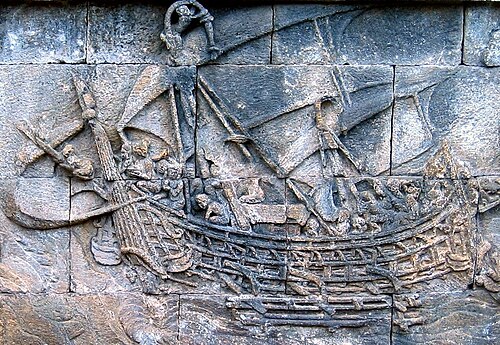
The second opinion states that this ship may be a ship from Srivijaya or Malay. There is absolutely no evidence to support this statement. Epigraphical records of Srivijaya rarely recorded the types of watercraft, the type of Malay boat recorded is the samvau (modern Malay: Sampan) on the Kedukan Bukit inscription (683 AD) in Sumatra. Another recorded watercraft is the lancang, from 2 inscriptions on the northern coast of Bali written in the Old Balinese language dated 896 and 923 AD.[10]:149–150 Meanwhile, the Borobudur ship is only found in the Borobudur temple, which is a Javanese heritage, not Sumatran or Malay.[11]:109–110[12] Lastly, and most commonly believed, is the assumption that the Borobudur ship was a Majapahit ship. In fact, historical accounts of the main ships of Majapahit mention the jong, malangbang, and kelulus,[13]:290–291 all of which do not have outriggers.[14][13]:266–267
Plate renderings
Renderings of the five ships with outriggers in the Borobudur bas-reliefs (out of seven ships depicted in total) in Conradus Leemans's Boro-Boedoer (1873). Note that the ships are of different types.[15]
Replica
A replica of Borobudur ship during 2018 Asian Games opening ceremony
The earliest replica of this ship was made in the Philippines in 1985, based on the Pontian boat structure. It is called Sarimanok (lucky little bird), used to sail to Java and Madagascar.[16]
The least known replica was named Damar Sagara, completed in 1992.[17]:286–287,317