
Loading article…
1,1,1-Trichloroethane, also known as methyl chloroform and chlorothene, is a chloroalkane with the chemical formula CH3CCl3. It is an isomer of 1,1,2-trichloroethane. A colourless and sweet-smelling liquid, it was once produced industrially in large quantities for use as a solvent.[7] It is regulated by the Montreal Protocol as an ozone-depleting substance, and as such, use has declined since 1996. Trichloroethane should not be confused with the similar-sounding trichloroethene which is also commonly used as a solvent.
1,1,1-Trichloroethane was first reported by Henri Victor Regnault in 1840. Industrially, it is usually produced in a two-step process from vinyl chloride. In the first step, vinyl chloride reacts with hydrogen chloride at 20–50 °C (68–122 °F) to produce 1,1-dichloroethane:
This reaction is catalyzed by a variety of Lewis acids, mainly aluminium chloride, iron(III) chloride, or zinc chloride. The 1,1-dichloroethane is then converted to 1,1,1-trichloroethane by reaction with chlorine under ultraviolet irradiation:
This reaction proceeds at 80%–90% yield, and the hydrogen chloride byproduct can be recycled to the first step in the process. The major side-product is the related compound 1,1,2-trichloroethane, from which the 1,1,1-trichloroethane can be separated by distillation.
A somewhat smaller amount is produced from the reaction of 1,1-dichloroethene and hydrogen chloride in the presence of an iron(III) chloride catalyst:
It is sold with stabilizers because it is unstable with respect to dehydrochlorination and attacks some metals. Stabilizers comprise up to 8% of the formulation, including acid scavengers (epoxides, amines) and complexants. One discontinued product contained only 1,4-dioxane (2% ± 1% )、一方、別の化学品供給業者は安定剤として 2.5% 1,4-ジオキサン、0.47% 1,2-ブチレンオキシド、および 0.35%ニトロメタンを含めた。[ 5 ] [ 3 ]
1,1,1-トリクロロエタンは、多くの有機化合物の優れた溶媒であり、塩素化炭化水素の中でも毒性が最も低いものの1つです。一般的には非極性と考えられていますが、塩素原子の分極率が高いため、ヘキサンなどの炭化水素に溶けにくい有機化合物の優れた溶媒となります。モントリオール議定書以前は、金属部品や回路基板の洗浄、電子産業におけるフォトレジスト溶剤、エアゾール噴射剤、切削油添加剤、インク、塗料、接着剤、その他のコーティング剤の溶剤として広く使用されていました。
革やスエードのドライクリーニングに使われていた。ドライクリーニングでの使用は1980年代まで続いた。殺虫燻蒸剤としても使われていた。[ 8 ]
また、写真フィルムの標準的な洗浄剤としても使われていました。他の一般的な溶剤は乳剤やベースを損傷する(アセトンはほとんどのフィルムのトリアセテートベースを溶解する)ため、この用途には適していません。標準的な代替品であるフォラン141は効果がはるかに低く、残留物が残りやすい傾向があります。フォラン141は、修正液(リキッドペーパーなど)の希釈剤としても使用されていました。
以前は多くの用途で四塩化炭素が使用されていましたが(1970年に米国消費者製品での使用が禁止されました)、その結果、1,1,1-トリクロロエタン自体も現在では実験室で他の溶剤に置き換えられつつあります。[ 9 ]オゾン層破壊による1,1,1-トリクロロエタンの段階的廃止により、金属脱脂におけるトリクロロエチレンの使用が復活しました。[ 8 ]
メチルクロロホルムは獣医用駆虫薬としても使用されていた。
1,1,1-トリクロロエタンは、麻酔薬としてクロロホルムの代替品として試された揮発性有機塩素化合物の1つです。[ 10 ] 1880年代には、クロロホルムの安全で強力な代替品であることがわかりましたが、その製造は当時の基準では高価で困難でした。[ 11 ] [ 12 ]
1880年、1,1,1-トリクロロエタンが麻酔薬として提案された。同年、初めてメチルクロロホルムと呼ばれた。当時、抱水クロラールの麻酔作用は、「アルカリ性血液」におけるクロロホルムへの仮説的な代謝経路によるものと考えられていた。トリクロロエタンは、抱水クロラールとの構造的類似性および潜在的な麻酔作用について研究された。しかし、トリクロロエタンは実験室実験でクロロホルムへの変換を示さなかった。トリクロロメチル基を持たない1,1,2-トリクロロエタン(ビニルトリクロリド)異性体は、1,1,1異性体よりもさらに強い麻酔作用を示した。[ 13 ]
1,1,1-トリクロロエタンは、多くの類似化合物ほど毒性は強くないものの、吸入または摂取すると中枢神経抑制剤として作用し、低濃度では反応時間や器用さの低下、平衡感覚の障害、脳波異常、喉の炎症を引き起こし、高濃度では死に至る可能性がある。[ 14 ]
国際がん研究機関は、 1,1,1-トリクロロエタンをグループ2Aに分類し、発がん性のおそれがあるとしている。[ 15 ]
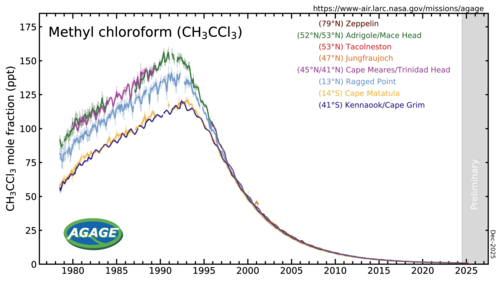
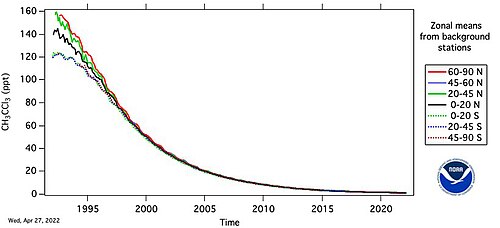
1,1,1-トリクロロエタンは、二酸化炭素に対する100年間の地球温暖化係数が169である、かなり強力な温室効果ガスである。[ 17 ]しかし、大気中での寿命が約5年と比較的短いため、溶媒として取って代わった四塩化炭素の10分の1以下である。[ 18 ]
モントリオール議定書は、1,1,1-トリクロロエタンをオゾン層破壊の原因物質として特定し、1996年からその使用を禁止した。それ以来、世界のほとんどの地域でその製造と使用は段階的に廃止され、大気中の濃度は大幅に減少した。[ 18 ]