
Loading article…
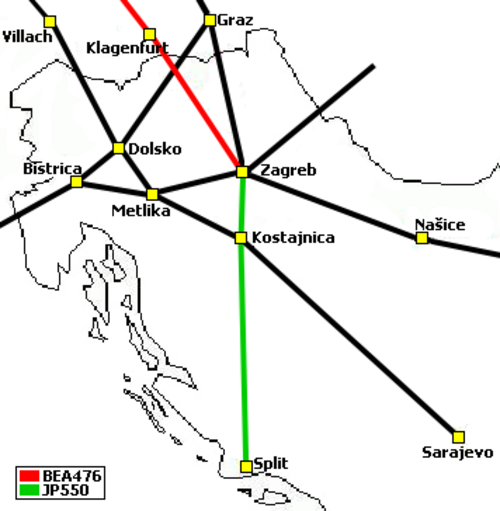
1976年のザグレブ空中衝突は、1976年9月10日に発生した空中衝突事故である。ロンドン発イスタンブール行きのブリティッシュ・エアウェイズ476便が、ユーゴスラビア社会主義連邦共和国のスプリト発西ドイツのケルン行きのイネックス・アドリア・アビオプロメット550便と、現在のクロアチアのザグレブ近郊で空中衝突した。この衝突は、ザグレブの航空管制官の手続き上のミスが原因だった。
2機の航空機に搭乗していた176人全員が死亡し、[ 2 ] : 8 [ 3 ] : 5–6 [ 4 ] [ 5 ]当時、世界で最も死者数の多い空中衝突事故となった。[ 6 ]これは、ユーゴスラビアとクロアチアの歴史上、最も死者数の多い航空事故である。[ 7 ] [ 8 ] また、これは子会社や旧社名を除くブリティッシュ・エアウェイズの事故で、死者が出た唯一の事故でもある。
ブリティッシュ・エアウェイズ476便は、乗客54名と乗員9名を乗せ、協定世界時8時32分にロンドン・ヒースロー空港からイスタンブール・アタチュルク空港に向けてBA476便として出発した。 [ 3 ]: 1ホーカー・シドレー・トライデントの乗員は、機長デニス・タン(44)、副操縦士ブライアン・ヘルム、航空機関士マーティン・フリントで構成されていた。[ 3 ]: 6-8タン機長は、事故当時までに10,781時間の飛行時間を記録しており、非常に経験豊富だった。
Inex-Adria 550 便は、 JP550 便としてスプリト空港をUTC 09:48 (現地時間 10:48) に出発し、ケルン・ボン空港に向かいました。乗客 108 人(ほとんどがダルマチア海岸での休暇を終えて帰国するドイツ人旅行者)と乗務員 5 名が搭乗していました。[ 3 ] : 2乗務員は、飛行時間 10,157 時間のベテランパイロットである機長の Jože Krumpak (51) と副操縦士の Dušan Ivanuš で構成されていました。[ 7 ] [ 3 ] : 10–11 Inex-Adria は、ユーゴスラビア社会主義連邦共和国を構成する共和国の中で最も北に位置するスロベニアに拠点を置くチャーター航空会社でした。
両便とも、ザグレブVORに接近するまでは順調に飛行を続けた。
1970年代半ば、ザグレブ航空管制区域は深刻な人員不足と設備不足にもかかわらず、ヨーロッパで最も混雑する区域の一つであった。[ 9 ]: 26ザグレブVORは、北ヨーロッパと南東ヨーロッパ、中東、そしてそれ以遠を結ぶ多くの混雑した航空路の報告地点であった。[ 10 ]空域は高度によって3つのセクターに分けられていた。25,000フィート(7,600m )以下の低高度セクター、25,000~31,000フィート(7,600~9,400m )の中高度セクター、そして31,000フィート(9,400m )以上の高高度セクターである。[ 3 ]: 27~29
オーストリアからユーゴスラビア領空に入ったBA476便は、協定世界時10時04分12秒(現地時間11時04分12秒)にザグレブ航空管制センター(ACC)の高高度管制官グラディミル・タシッチと無線連絡を取り、高度330(33,000フィート、10,050メートル)を飛行中で、10時14分にザグレブVORに到達する予定であることを伝えた。管制官はこれに対し、トランスポンダーコード2312を選択し、VORに到達したら再度連絡するよう指示した。[ 3 ]: 1
これは事故前のトライデント機との最後の通信だった。[ 3 ]: 1

ほぼ同時刻に、JP550は中高度管制官のボヤン・エルヤベックに連絡を取り、より高い飛行高度を要請した。同機は飛行高度260(約26,000フィート(7,900メートル))を飛行していた。FL280(28,000フィート(8,500メートル))とFL310(31,000フィート(9,400メートル))は利用できなかったため、エルヤベックはJP550に状況を伝え、飛行高度350(約35,000フィート(11,000メートル))を提案し、パイロットはこれを受け入れた。より高い高度への許可を得るには、上層管制官の許可を得る必要があった。エルヤベツはタシッチの注意を引こうと手を振ったが、タシッチ(同僚のムラデン・ホッホベルガーが遅れている交代要員のネナド・テペシュを探しに行っていたため、上層セクターを一人で担当していた)は忙しすぎて邪魔される暇がなかった。そこで、中層セクター管制官のグラディミル・ペリンに、DC-9の離陸をタシッチと調整するよう指示が出された。
ペリンによると、彼はJP550の飛行進捗状況を示すストリップが置かれた上部セクターのコンソールまで歩いて行った。彼はタシッチに、DC-9がFL350まで上昇できるかと尋ねた。タシッチはペリンからストリップを受け取り、それを見てから、航空機が現在どこにいるのかを尋ねた。するとペリンは、ボスニア・ヘルツェゴビナのコスタイニツァに近づいている画面上の点を指さした。タシッチの返答は「はい、上昇できます」だった。ペリンは次に、画面上でメトリカの方向から来る航空機に気づき、タシッチにそれについて尋ねたところ、タシッチは「通過するまで待て」と言った。ペリンは、上部セクターの画面でDC-9を確実に識別したことを確認するために、中部セクターの画面を参照した。それから彼はタシッチのところに戻り、二人は目標がすれ違うのを見守り、その時点でタシッチはJP550に上昇を許可した。それからペリンはエルヤベツに「はい、上昇してください」と呼びかけた。エルヤベックはペリンから許可を得ると、DC-9に高度35,000フィートまで上昇するよう指示した。時刻は10時07分40秒だった。
At 10:12:03, JP550 called the Zagreb middle-sector controller to inform them that the aircraft was out of flight level 310. The last instructions given by Erjavec to JP550 were to call the upper-sector controller on 134.45 MHz and to stop squawking the assigned squawk code. By instructing JP550 to squawk Standby, Erjavec simply released a code allocated for the middle sector. The data tag for the DC-9 would now disappear from his screen and the aircraft would become merely a point among many others. If everything about this handover had been normal, the DC-9 would have been given a new code on initial contact with the upper sector controller and would have been positively identified on the upper sector screen with its flight number and altitude readout. But this had not been a normal handover because of the ill-handled co-ordination for the climb. Also, Tasić was busy with other traffic and JP550 did not immediately contact the upper-sector controller. This could have been because the frequency was busy, but the pilots might also have delayed the call for some unknown reason.
By the time JP550 contacted the upper-sector controller at 10:14:04 it had reached the Zagreb VOR and was already climbing through flight level 325 (approximately 32,500 feet (9,900 m)). The controller immediately asked for confirmation of the aircraft's level:[3]:4
Realising the imminent danger of collision, Tasić instructed the JP550 to stop climbing. In doing so, he reverted to his native Serbo-Croatian language, contrary to the regulations.[3]:30 This meant that the British Airways plane, even if they overheard this conversation, would have very little chance of understanding their own imminent danger. The controller's last-ditch attempt to avert catastrophe turned what would have been a near miss into the collision he was trying to prevent. For, by the time JP550 had levelled off it was at flight level 330 (approximately 33,000 feet (10,000 m)), exactly the same level as BA476:[3]:4
空中衝突は10時14分41秒に発生した。[ 3 ]: 1 30秒後、タシッチはBA476に電話をかけ、次のウェイポイントであるナシツェを通過したことを報告するように指示しようとしたが、別の飛行機が応答した。
タシッチはBA476便とJP550便に呼びかけ続け、他の航空機からの呼びかけは無視したが、効果はなかった。
一方、ルフトハンザ航空のボーイング737型機は、トライデント機のわずか15マイル(13海里、24km)後方で、 UB5を東に向かって高度290(約29,000フィート(8,800m ) )でザグレブ方面へ飛行していた。副操縦士は、衝突を稲妻の閃光として目撃し、その後、煙の塊の中から2機の航空機が地面に向かって落下するのを見た。ルフトハンザ航空の機長、ヨゼフ・クローゼは、目撃情報を中間セクター管制官のエルヤベックに報告した。[ 11 ]
エルヤベックは、あまりにも興奮した声で話したため、何を言っているのか理解できなかった。[ 3 ]: 5(後にこの通話の録音を聞いたクローゼ機長は、自分の言葉を理解するのに苦労した。)ルフトハンザの機長は、メッセージを何度も繰り返さなければならなかった。[ 3 ]: 5
エルヤベツは、話の内容の意味を理解した途端、上層管制官のほうに目を向けた。管制席には、ショックで顔面蒼白になったタシッチが呆然と座っていた。彼はゆっくりとヘッドセットを耳から外し、目の前のコンソールに置いた。
The two aircraft had collided over the town of Vrbovec, northeast of Zagreb. The last five metres of the DC-9's left wing had cut through the Trident's cockpit section and forward passenger compartment.[3]:2,34
The pilots of the Trident were killed at the moment of collision. The explosive decompression caused the forward part of the Trident's fuselage to disintegrate; the Trident fell, landing on its tail and sliding a short distance before its remains came to rest near the village of Gaj.[3]:5
The DC-9, now without over one-third of its left wing, went into an immediate nose-dive and slammed into the ground right-wing first, near the village of Dvorišće near Rakovec, 25 seconds after the collision.[3]:5 The CVR had reactivated at the moment of collision, having stopped recording 20 minutes earlier.[3]:22
Everyone aboard both aircraft were killed.[12]
A police officer who was one of the first to arrive at the scene reported that a baby on the ground was "still giving feeble signs of life near the [British] plane, but even if the ambulances had arrived before me, it would have been too late to save it."[6] Locals reported finding a boy, who was lying on a road near a field, and who displayed signs of life up to 15 minutes after the collision, but he eventually died.[12]

By noon that day, all controllers were in custody for interrogation. Later, all were released except Tasić, who remained in custody until the trial.
The trial opened on 11 April 1977 in Zagreb District Court. All the controllers were indicted under the Penal Code of Yugoslavia, Articles 271–72 as "persons who by endangering railway, sea or air traffic, threaten the lives of persons or property."
Tasić was the only one to be found guilty; he was sentenced to seven years imprisonment.[10] After a petition by air traffic controllers, it was determined that Tasić had been used as a scapegoat, and he was released on 29 November 1978, having served nearly two years and three months in prison.
A dramatised reconstruction of the events leading up to the accident, starring Antony Sher and entitled Collision Course, was made by Granada Television in 1979.[13]
The events of the accident are also documented in a season 1 episode of Aircrash Confidential titled "Collisions", which was first aired on the Discovery Channel in 2011.
引用文献