
Loading article…

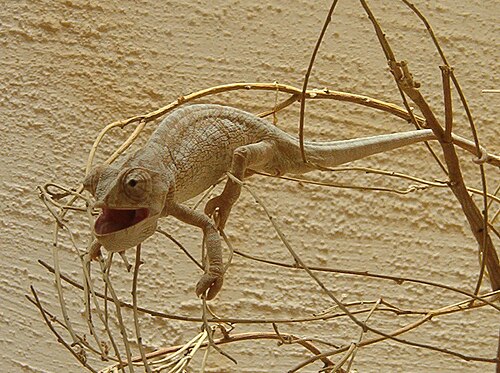
An animal's tail is said to be prehensile if it can grasp or hold objects.[1] Fully prehensile tails can be used to hold and manipulate objects, and in particular to aid arboreal creatures in finding and eating food in the trees. If the tail cannot be used for this it is considered only partially prehensile; such tails are often used to anchor an animal's body to dangle from a branch, or as an aid for climbing. The term prehensile means "able to grasp" (from the Latin prehendere, to take hold of, to grasp).[2]
One point of interest is the distribution of animals with prehensile tails. The prehensile tail is predominantly a New World adaptation, especially among mammals.[1] Many more animals in South America have prehensile tails than in Africa and Southeast Asia. It has been argued that animals with prehensile tails are more common in South America because the forest there is denser than in Africa or Southeast Asia.[3] In contrast, less dense forests such as in Southeast Asia have been observed to have more abundant gliding animals such as colugos or flying snakes; few gliding vertebrates are found in South America. South American rainforests also differ by having more lianas, as there are fewer large animals to eat them than in Africa and Asia; the presence of lianas may aid climbers but obstruct gliders.[4]Australia-New Guinea contains many mammals with prehensile tails and also many mammals which can glide; in fact, all Australian mammalian gliders have tails that are prehensile to an extent.
Tails are mostly a feature of vertebrates; however, some invertebrates such as scorpions also have appendages that can be considered tails. However, only vertebrates are known to have developed prehensile tails. Many mammals with prehensile tails will have a bare patch to aid gripping. This bare patch is known as a "friction pad".

{{cite book}}: CS1メンテナンス: パブリッシャーの場所 (リンク){{cite book}}: CS1メンテナンス: パブリッシャーの場所 (リンク){{cite book}}: CS1 maint: 複数の名前: 著者リスト (リンク)