
Loading article…

| |

| |

| |
| Names | |
|---|---|
| IUPAC name
poly(ethylene terephthalate)
| |
| Systematic IUPAC name
poly(oxyethyleneoxyterephthaloyl) | |
| Other names
Terylene (trademark);
Dacron (trademark).
| |
| Identifiers | |
| |
| Abbreviations | PET, PETE |
| ChEBI |
|
| ChemSpider |
|
| ECHA InfoCard | 100.121.858 |
| UNII |
|
CompTox Dashboard (EPA)
|
|
| Properties | |
| (C10H8O4)n[1] | |
| Molar mass | 10–50 kg/mol, varies |
| Density |
|
| Melting point | > 250 °C (482 °F; 523 K)[2] 260 °C[1] |
| Boiling point | > 350 °C (662 °F; 623 K) (decomposes) |
| Practically insoluble[2] | |
| log P | 0.94540[3] |
| Thermal conductivity | 0.15[4] to 0.24 W/(m·K)[1] |
Refractive index (nD)
|
1.57–1.58,[4] 1.5750[1] |
| Thermochemistry | |
Heat capacity (C)
|
1.0 kJ/(kg·K)[1] |
| Related compounds | |
Related Monomers
|
Terephthalic acid Ethylene glycol |
Except where otherwise noted, data are given for materials in their standard state (at 25 °C [77 °F], 100 kPa).
 verify (what is verify (what is  ?) ?)
Infobox references
| |
Polyethylene terephthalate (or poly(ethylene terephthalate), PET, PETE, or the obsolete PETP or PET-P), is the most common thermoplastic polymer resin of the polyester family and is used in fibres for clothing, containers for liquids and foods, and thermoforming for manufacturing, and in combination with glass fibre for engineering resins.[5]
In 2016, annual production of PET was 56 million tons.[6] The biggest application is in fibres (in excess of 60%), with bottle production accounting for about 30% of global demand.[7] In the context of textile applications, PET is referred to by its common name, polyester, whereas the acronym PET is generally used in relation to packaging.[citation needed] Polyester makes up about 18% of world polymer production and is the fourth-most-produced polymer after polyethylene (PE), polypropylene (PP) and polyvinyl chloride (PVC).[citation needed]
PET consists of repeating (C10H8O4) units. PET is commonly recycled, and has the digit 1 (♳) as its resin identification code (RIC). The National Association for PET Container Resources (NAPCOR) defines PET as: "Polyethylene terephthalate items referenced are derived from terephthalic acid (or dimethyl terephthalate) and mono ethylene glycol, wherein the sum of terephthalic acid (or dimethyl terephthalate) and mono ethylene glycol reacted constitutes at least 90 percent of the mass of monomer reacted to form the polymer, and must exhibit a melting peak temperature between 225 °C and 255 °C, as identified during the second thermal scan in procedure 10.1 in ASTM D3418, when heating the sample at a rate of 10 °C/minute."[8]
Depending on its processing and thermal history, polyethylene terephthalate may exist both as an amorphous (transparent) and as a semi-crystalline polymer. The semicrystalline material might appear transparent (particle size less than 500 nm) or opaque and white (particle size up to a few micrometers) depending on its crystal structure and particle size.
One process for making PET uses bis(2-hydroxyethyl) terephthalate,[citation needed] which can be synthesized by the esterification reaction between terephthalic acid and ethylene glycol with water as a byproduct (this is also known as a condensation reaction), or by transesterification reaction between ethylene glycol and dimethyl terephthalate (DMT) with methanol as a byproduct. Polymerization is through a polycondensation reaction of the monomers (done immediately after esterification/transesterification) with water as the byproduct.[5]
Uses
Textiles
Polyester fibres are widely used in the textile industry. The invention of the polyester fibre is attributed to J. R. Whinfield.[9] It was first commercialized in the 1940s by ICI, under the brand 'Terylene'.[10] Subsequently E. I. DuPont launched the brand 'Dacron'. As of 2022, there are many brands around the world, mostly Asian.
Polyester fibres are used in fashion apparel often blended with cotton, as heat insulation layers in thermal wear, sportswear and workwear and automotive upholstery.
Rigid packaging
Plastic bottles made from PET are widely used for soft drinks, both still and sparkling. For beverages that are degraded by oxygen, such as beer, a multilayer structure is used. PET sandwiches an additional polyvinyl alcohol (PVOH) or polyamide (PA) layer to further reduce its oxygen permeability.
Non-oriented PET sheet can be thermoformed to make packaging trays and blister packs.[11] Crystallizable PET withstands freezing and oven baking temperatures.[12]: 1378 Both amorphous PET and BoPET are transparent to the naked eye. Color-conferring dyes can easily be formulated into PET sheet.
PET is permeable to oxygen and carbon dioxide and this imposes shelf life limitations of contents packaged in PET.[13]: 104
In the early 2000s, the global PET packaging market grew at a compound annual growth rate of 9% to €17 billion in 2006.[14]
Flexible packaging
Biaxially oriented PET (BOPET) film (often known by one of its trade names, "Mylar") can be aluminized by evaporating a thin film of metal onto it to reduce its permeability, and to make it reflective and opaque (MPET). These properties are useful in many applications, including flexible food packaging and thermal insulation (such as space blankets).
Photovoltaic modules
BOPET is used in the backsheet of photovoltaic modules. Most backsheets consist of a layer of BOPET laminated to a fluoropolymer or a layer of UV stabilized BOPET.[15]
PET is also used as a substrate in thin film solar cells.
Thermoplastic resins
PET can be compounded with glass fibre and crystallization accelerators, to make thermoplastic resins. These can be injection moulded into parts such as housings, covers, electrical appliance components and elements of the ignition system.[16]
Nanodiamonds
PET is stoichiometrically a mixture of carbon and H2O, and therefore has been used in an experiment involving laser-driven shock compression which created nanodiamonds and superionic water. This could be a possible way of producing nanodiamonds commercially.[17][18]
Other applications
- A waterproofing barrier in undersea cables.
- As a film base.
- As a fibre, spliced into bell rope tops to help prevent wear on the ropes as they pass through the ceiling.
- Since late 2014 as liner material in type IV composite high pressure gas cylinders. PET works as a much better barrier to oxygen than earlier used (LD)PE.[19]
- As a 3D printing filament, as well as in the 3D printing plastic PETG (polyethylene terephthalate glycol). In 3D printing PETG has become a popular material[20] - used for high-end applications like surgical fracture tables[21] to automotive and aeronautical sectors, among other industrial applications.[22] The surface properties can be modified to make PETG self-cleaning for applications like the fabrication of traffic signs for the manufacture of light-emitting diode LED spotlights.[23]
- As one of three layers for the creation of glitter; acting as a plastic core coated with aluminum and topped with plastic to create a light reflecting surface,[24] although as of 2021 many glitter manufacturing companies have begun to phase out the use of PET after calls from organizers of festivals to create bio-friendly glitter alternatives.[24][25]
- Film for tape applications, such as the carrier for magnetic tape or backing for pressure-sensitive adhesive tapes. Digitalization has caused the virtual disappeance of the magnetic audio and videotape application.
- Water-resistant paper.[26]
-
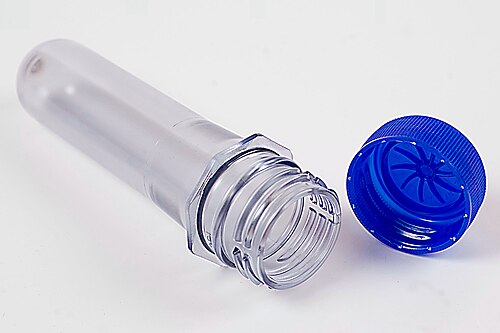 PET preform for injection stretch blow moulding of a bottle
 -
 A finished PET bottle
 -
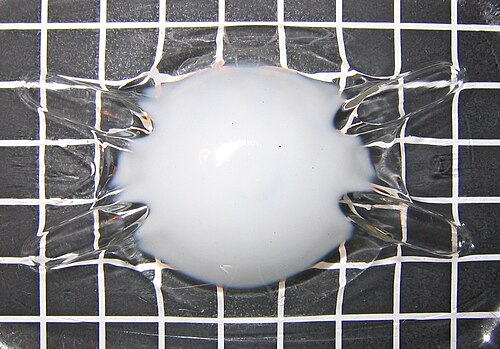 A PET bottle which has been heated by a candle and has recrystallized, making it opaque.
 -
 PET clamshell packaging, used to sell fruit, hardware, etc.
 -
 Polyester yarn
 -
 Microfiber towels and cleaning cloths
 -
 Aluminized Mylar balloons filled with helium
.jpg/500px-Clean_the_Bay_2012_(7324648864).jpg)
History
PET was patented in 1941 by John Rex Whinfield, James Tennant Dickson and their employer the Calico Printers' Association of Manchester, England.