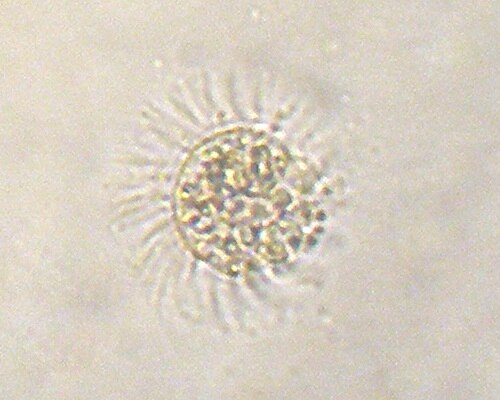
The stability of transient plastids varies considerably across plastid-retaining species. In the dinoflagellatesGymnodinium spp. and Pfiesteria piscicida, kleptoplastids are photosynthetically active for only a few days, while kleptoplastids in Dinophysis spp., taken from cryptophytes,[5] can be stable for 2 months.[1] In other dinoflagellates, kleptoplasty has been hypothesized to represent either a mechanism permitting functional flexibility, or perhaps an early evolutionary stage in the permanent acquisition of chloroplasts.[6]
Karyoklepty is a related process in which the nucleus of the prey cell is kept by the host as well. This was first described in 2007 in M. rubrum.[9]
Euglenozoa
The first and only case of kleptoplasty within Euglenozoa belongs to the species Rapaza viridis, the earliest diverging lineage of Euglenophyceae. This microorganism requires a constant supply of a strain of Tetraselmis microalgae, which it ingests to extract chloroplasts. The kleptoplasts are then progressively transformed into ones that resemble the permanent chloroplasts of the remaining Euglenophyceae. Cells of Rapaza viridis can survive for up to 35 days with these kleptoplasts.[10]
Kleptoplasty is considered the mode of nutrition of the euglenophycean common ancestor. It is hypothesized that kleptoplasty allowed for various events of horizontal gene transfer that eventually allowed the establishment of permanent chloroplasts in the remaining Euglenophyceae.[10]
Animals
Rhabdocoel flatworms
Two species of rhabdocoel marine flatworms, Baicalellia solaris and Pogaina paranygulgus, make use of kleptoplasty. The group was previously classified as having algal endosymbionts, though it was already discovered that the endosymbionts did not contain nuclei.[11]
↑ Bernhard, Joan M.; Bowser, Samuel S. (1999). "低酸素堆積物の底生有孔虫:葉緑体隔離と機能形態". Earth-Science Reviews . 46 ( 1– 4): 149– 165. Bibcode : 1999ESRv...46..149B . doi : 10.1016/s0012-8252(99)00017-3 .
↑Keeling PJ (October 2004). "Diversity and evolutionary history of plastids and their hosts". American Journal of Botany. 91 (10): 1481–93. Bibcode:2004AmJB...91.1481K. doi:10.3732/ajb.91.10.1481. PMID21652304. S2CID17522125.
↑Gast RJ, Moran DM, Dennett MR, Caron DA (January 2007). "Kleptoplasty in an Antarctic dinoflagellate: caught in evolutionary transition?". Environ. Microbiol. 9 (1): 39–45. Bibcode:2007EnvMi...9...39G. CiteSeerX10.1.1.490.54. doi:10.1111/j.1462-2920.2006.01109.x. PMID17227410.
↑Johnson, Matthew D.; Oldach, David; Charles, F. Delwiche; Stoecker, Diane K. (Jan 2007). "Retention of transcriptionally active cryptophyte nuclei by the ciliate Myrionecta rubra". Nature. 445 (7126): 426–8. Bibcode:2007Natur.445..426J. doi:10.1038/nature05496. PMID17251979. S2CID4410812.
↑Nishitani, G.; Nagai, S.; Baba, K.; Kiyokawa, S.; Kosaka, Y.; Miyamura, K.; Nishikawa, T.; Sakurada, K.; Shinada, A.; Kamiyama, T. (2010). "High-level congruence of Myrionecta rubra prey and Dinophysis species plastid identities as revealed by genetic analyses of isolates from Japanese coastal waters". Applied and Environmental Microbiology. 76 (9): 2791–2798. Bibcode:2010ApEnM..76.2791N. doi:10.1128/AEM.02566-09. PMC2863437. PMID20305031.