左側のボトルには、生産者(Dr. Loosen)、ヴィンテージ、村(Bernkastel)、畑(Lay)、品種(Riesling)、プレディカーツ(Eiswein)、小さな文字で記載された必須情報、アルコール度数、地域(Mosel-Saar-Ruwer)、容量が表示されています。右側のボトルは、地域(Rheingau)、品種(Riesling)、ヴィンテージ、村(Kiedrich)、畑(Gräfenberg)、プレディカーツ(Auslese)、生産者(Weingut Robert Weil)、容量、アルコール度数が少し異なる順序で表示されています。
2007年8月までは「Qualitätswein mit Prädikat (QmP)」(特定の特性を持つ高品質ワイン)として知られていたこのワインは、ドイツワインの最高峰に位置づけられています。ラベルには「Prädikat」(熟度レベル)が明記されており、補糖は認められていません。Prädikatsweinは辛口から極甘口まで幅広い味わいがありますが、辛口またはやや辛口と明記されていない限り、必ずかなりの量の残糖が含まれています。Prädikatsweinは、13のワイン生産地域のうち、39のサブリージョン(Bereich)のいずれかで認められた品種から生産されなければなりませんが、ラベルに表示が義務付けられているのはサブリージョンではなく地域名です。(ラインガウなどの小規模な地域は、サブリージョンが1つしかない場合もあります。)
A Riesling from the Bernkastel region, on the Moselle River
The geographic classification is different for Landwein, Deutscher Wein, Qualitätswein and Prädikatswein.
Geographic classification for Deutscher Wein (formerly Tafelwein) and Landwein
There are seven Deutscher Wein regions: Rhein-Mosel, Bayern, Neckar, Oberrhein, Albrechtsburg, Stargarder Land and Niederlausitz. These are divided into a number of subregions, which in turn are divided into 19 Landwein regions (and must be trocken or halbtrocken in style). (There is no Landwein region for Franken.) Names of individual vineyards are not used for Deutscher Wein or Landwein. Deutscher Wein must be 100% German in origin, or specifically state on the label where grapes were sourced from within the European Union. Sparkling wine produced at the Deutscher Wein level is often labeled as Deutscher Sekt and is made from 100% German grapes/wine.
Geographic classification for Qualitätswein and Prädikatswein
There are four levels of geographic classification, and any level of classification can be used on the label of Qualitätswein and Prädikatswein:
Anbaugebiet, wine growing regions, of which there are 13. Anbaugebiet is always indicated on the label of Qualitätswein and Prädikatswein.
Bereich, district, of which there are 39. Each Anbaugebiet is divided into one or more Bereiche.
Großlage, collective site, which is a collective name for a number of single vineyards, and which number about 170.
Einzellage, single vineyard, of which there are about 2,600.
The names of Großlagen and Einzellagen are always used together with the name of a wine village, because some Einzellage names, such as Schlossberg (castle hill) are used in several villages. Unfortunately, it is not possible to tell a Großlage from an Einzellage just by looking at the wine label. A few examples of how the names appear on labels:
The vineyard Sonnenuhr (meaning "sun dial") in the village Wehlen along the Mosel is designated as Wehlener Sonnenuhr.
The neighbouring village Zeltingen also has a vineyard called Sonnenuhr, and will appear on the label as Zeltinger Sonnenuhr.
Both these vineyards belong to Großlage Münzlay, which is assigned to the village Wehlen. A wine from any of these vineyards, or a blend from both of them, can be sold under the name Wehlener Münzlay.
These vineyards lie within Bereich Bernkastel, which provides an additional choice for labelling.
It is also possible to simply label the wine as a wine from Anbaugebiet Mosel.
ブドウ園名とともに村名を明記しなければならないという規則には、いくつかの例外があります。それは、ワイン法上の村名(Ortsteil im sinne des Weingesetzes )として知られる、歴史あるブドウ園です。例としては、ラインガウ地方のシュロス・ヨハニスベルクや、ザール川沿いのシャルツホーフベルクなどが挙げられます。これらは典型的なアインツェラーゲ(Einzellage)と同じ規模で、村名の表示が免除されるほど有名だったアインツェラーゲ(Einzellagen)と考えることができます。
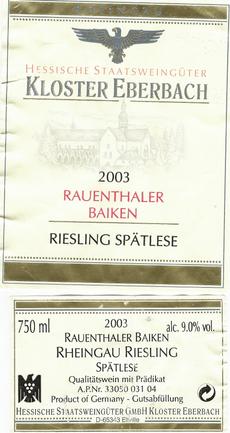
ドイツ高級ワイン生産者協会(Verband Deutscher Prädikatsweingüter、略称VDP)のロゴは、会員投票で選ばれた上位200の生産者に授与されます。ロゴは、中央にブドウの房を配した黒い鷲です。画像例のワイナリーはVDPのロゴを使用しています。VDPのロゴは品質を保証するものではありませんが、ワインの品質を知る上で参考になります。