Loading article…
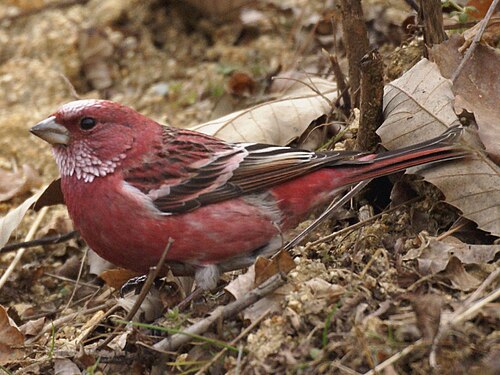
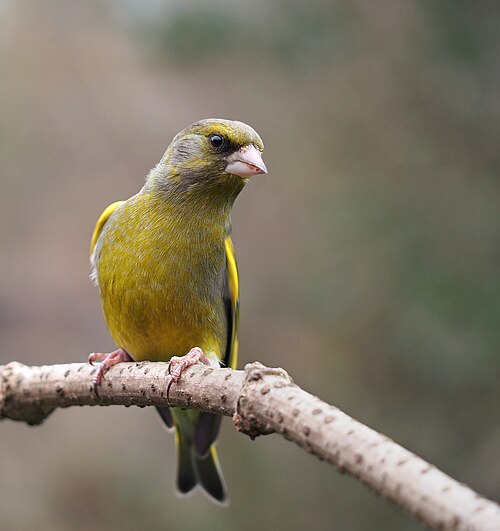
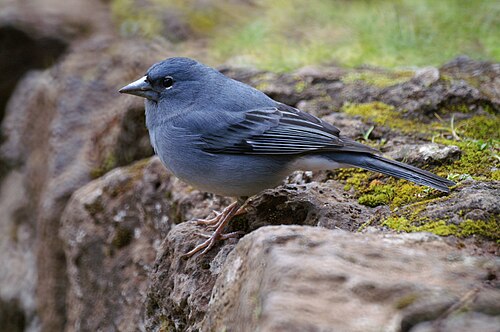
The true finches are small to medium-sized passerinebirds in the familyFringillidae. Finches generally have stout conical bills adapted for eating seeds and nuts and often have colourful plumage. They occupy a great range of habitats where they are usually resident and do not migrate. They have a worldwide native distribution except for Australia and the polar regions. The family Fringillidae contains more than two hundred species divided into fifty genera. It includes the canaries, siskins, redpolls, serins, grosbeaks and euphonias, as well as the morphologically divergent Hawaiian honeycreepers.
Many birds in other families are also commonly called "finches". These groups include the estrildid finches (Estrildidae) of the Old World tropics and Australia; some members of the Old World bunting family (Emberizidae) and the New World sparrow family (Passerellidae); and the Darwin's finches of the Galapagos islands, now considered members of the tanager family (Thraupidae).[1]
Finches and canaries were used in the UK, US and Canada in the coal mining industry to detect carbon monoxide from the eighteenth to twentieth century. This practice ceased in the UK in 1986.[2]
The name Fringillidae for the finch family was introduced in 1819 by the English zoologistWilliam Elford Leach in a guide to the contents of the British Museum.[3][4] The taxonomy of the family, in particular the cardueline finches, has a long and complicated history. The study of the relationship between the taxa has been confounded by the recurrence of similar morphologies due to the convergence of species occupying similar niches.[5] In 1968 the American ornithologist Raymond Andrew Paynter, Jr. wrote:
Limits of the genera and relationships among the species are less understood – and subject to more controversy – in the carduelines than in any other species of passerines, with the possible exception of the estrildines [waxbills].[6]
Beginning around 1990 a series of phylogenetic studies based on mitochondrial and nuclear DNA sequences resulted in substantial revisions in the taxonomy. Several groups of birds that had previously been assigned to other families were found to be related to the finches. The NeotropicalEuphonia and the Chlorophonia were formerly placed in the tanager family Thraupidae due to their similar appearance but analysis of mitochondrial DNA sequences revealed that both genera were more closely related to the finches. They are now placed in a separate subfamily Euphoniinae within the Fringillidae.[7][8] The Hawaiian honeycreepers were at one time placed in their own family, Drepanididae but were found to be closely related to the Carpodacus rosefinches and are now placed within the Carduelinae subfamily.[5] The three largest genera, Carpodacus, Carduelis and Serinus were found to be polyphyletic.[5][9][10] Each was split into monophyletic genera. The American rosefinches were moved from Carpodacus to Haemorhous. Carduelis was split by moving the greenfinches to Chloris and a large clade into Spinus leaving just three species in the original genus. Thirty seven species were moved from Serinus to Crithagra leaving eight species in the original genus.[8] Today the family Fringillidae is divided into three subfamilies, the Fringillinae containing a single genus with the chaffinches, the Carduelinae containing 183 species divided into 49 genera, and the Euphoniinae containing the Euphonia and the Chlorophonia.[5]

Although Przewalski's "rosefinch" (Urocynchramus pylzowi) has ten primary flight feathers rather than the nine primaries of other finches, it was sometimes classified in the Carduelinae. It is now assigned to a distinct family, Urocynchramidae, monotypic as to genus and species, and with no particularly close relatives among the Passeroidea.[8][11]
真のフィンチの化石はまれで、知られているもののほとんどは少なくとも現存属に分類できます。他のスズメ上科の科と同様に、真のフィンチはおよそ中期中新世、約2000万年前から1000万年前(Ma)に起源を持つようです。ハンガリーのポルガルディでは、後期中新世亜期のメッシニアン期、約1200万年前から730万年前(Ma)の正体不明のフィンチの化石が発見されています。[ 15 ] [ 16 ] [ 17 ]
最も小さい「古典的な」真のフィンチは、体長わずか9.5cmのアンデスヒワ(Spinus spinescens)と、体重わずか8gのコキンカチョウ(Spinus psaltria)です。最も大きい種はおそらく体長最大24cm 、体重83gのエリマキヒワ(Mycerobas affinis )ですが、平均的にはやや小さい種でも、体長最大25.5cmのマツヒワ(Pinicola enucleator )や体重最大86.1gのイブニングヒワ( Hesperiphona vespertina )が記録されています。[ 18 ] [ 19 ]一般的に、彼らは丈夫でずんぐりとした嘴を持ち、種によってはかなり大きくなることもあります。しかし、ハワイミツドリは適応放散によってもたらされた嘴の形と大きさの多様性で有名です。すべての真のフィンチは、9 枚の初列風切羽と 12 枚の尾羽を持っています。基本的な羽毛の色は茶色がかった色で、時には緑がかった色です。多くの種はかなりの量の黒色を持ち、白い羽毛は翼帯やその他の信号マークを除いて一般的にありません。この科では明るい黄色と赤色のカロテノイド色素が一般的であるため、青色の構造色はかなりまれです。黄色色素が青色を緑色に変えてしまうからです。多くの真のフィンチは強い性的二型性を持ちますが、決してすべてではありません。雌は通常、雄の明るいカロテノイドの模様がありません。[ 1 ]

フィンチ類はほぼ世界中に分布しており、南北アメリカ大陸、ユーラシア大陸、アフリカ大陸、そしてハワイ諸島などの島嶼部にも生息している。オーストラリア、ニュージーランド、南極大陸、南太平洋、インド洋の島々には生息していないが、ヨーロッパ原産の種がオーストラリアやニュージーランドに広く移入されている。
フィンチ類は一般的に森林地帯に生息するが、山岳地帯や砂漠地帯でも見られることがある。
The finches are primarily granivorous, but euphoniines include considerable amounts of arthropods and berries in their diet, and Hawaiian honeycreepers evolved to utilize a wide range of food sources, including nectar. The diet of Fringillidae nestlings includes a varying amount of small arthropods. True finches have a bouncing flight like most small passerines, alternating bouts of flapping with gliding on closed wings. Most sing well and several are commonly seen cagebirds; foremost among these is the domesticatedcanary (Serinus canaria domestica). The nests are basket-shaped and usually built in trees, more rarely in bushes, between rocks or on similar substrate.[1]
The family Fringillidae contains 235 species divided into 50 genera and three subfamilies. The subfamily Carduelinae includes 18 extinct Hawaiian honeycreepers and the extinct Bonin grosbeak.[8] See List of Fringillidae species for further details.
Subfamily Fringillinae
Subfamily Carduelinae
ユウフォニイナ亜科