
Loading article…

ファルコン9第一段ブースターは、 SpaceX社が製造するファルコン9およびファルコンヘビー軌道打ち上げロケットで使用される再利用可能なロケットブースターである。第一段ブースターの製造は、使用済みのファルコン9 1機の打ち上げ価格の約60%を占め[1](3機の場合は使用済みのファルコンヘビー1機の打ち上げ価格の80%以上)であるため、SpaceX社は打ち上げコストを大幅に削減するために、これらのブースターの回収と再利用に特化したプログラムを開発しました。 [要出典] 2010年という早い時期から、第二段から分離した後の第一段の再突入を制御する複数回の試みの後、2015年12月22日のフルスラストバージョンの初飛行で、第一段の制御された着陸に初めて成功しました。それ以来、ファルコン9の第1段ブースターは、365回の試みのうち353回着陸・回収されており、これにはファルコン・ヘビー飛行のほとんどのサイドブースターの同期回収も含まれています。
回収されたブースターは合計43基が改修され、その後少なくとも2回目の飛行が行われ、1基のブースターで23回のミッションと着陸を記録した。SpaceXはブロック3とブロック4のブースターの飛行をそれぞれ2回のミッションのみに制限していたが[2] [3]、同社は2018年にブロック5バージョンが軽微な改修のみで10回の飛行を達成すると予想していることを示した。このマイルストーンは、2021年のスターリンク27ミッションでブースターB1051によって初めて達成された。[4]この制限は数回延長されており、個々のブースターは23回もの飛行を行ったことがある。
ブロック 4 以前のブースターはすべて退役、消費、または紛失しています。ブロック 4 ブースターの最後の飛行は 2018 年 6 月でした。それ以降、アクティブな艦隊のブースターはすべてブロック 5 です。
ブースターの名前は、B の後に 4 桁の数字が続きます。最初の Falcon 9 バージョン v1.0 には、ブースター B0001 から B0007 がありました。それ以降のブースターはすべて、B1001 から順に番号が付けられ、数字の 1 は第 1 段ブースターを表します。
ブースターのリスト
v1.0 および v1.1
SpaceX は、1 回目と 2 回目の飛行で Falcon 9 v1.0 の第一段のパラシュート降下を試みたが、両方の試みでブースターは再突入時に分解し、計画は放棄されて推進着陸が選択された。ブースター B0002 ( Grasshopper ) と B1002 ( F9R Dev1 ) は、着陸技術を実証するためにテストサイトで短い推進ホップを行うように改造されたが、軌道ミッションには使用されなかった。3 つのブースターは軌道飛行で海へのソフト タッチダウンに成功したが、回収されなかった。
ブロック4までフルスラスト
ファルコン 9 フル スラスト (バージョン 1.2 / ブロック 3) は、着陸に成功した最初のファルコン 9 バージョンです。変更点には、パフォーマンスを向上させるために、燃料タンクの大型化、エンジンのアップグレード、過冷却推進剤と酸化剤が含まれています。このリストにはブロック 3 とブロック 4 が含まれていますが、アクティブなブロック 5 は別々にリストされています。ブロック 4 は、チタン グリッド フィンなどの新しいハードウェアを含むテスト バージョンで、後に現在のブロック 5 に引き継がれました。ブロック 4 までのすべてのファルコン 9 ロケットの飛行は 2 回のみに制限されており、これらのバリエーションの合計 14 回の 2 回目の飛行がありました。ブースターは、2 回目の打ち上げ後に退役するか、消費されました。
ブースター B1023 と B1025 は、もともとファルコン 9 ブースターでしたが、ファルコン ヘビーのテスト飛行のためにファルコン ヘビー サイド ブースターに改造されました。
ブロック5
ブースターには、ファルコン9(F9)、ファルコンヘビーコア(FHコア)ブースター、ファルコンヘビーサイド(FHサイド)ブースターの3種類がある。ファルコン9とファルコンヘビーサイドブースターは相互に再構成可能である。ファルコンヘビーコアブースターは、サイドブースターの構造サポート付きで製造されており、ファルコン9ブースターやファルコンヘビーサイドブースターに変換することはできない。[要出典]インターステージマウントハードウェアは、B1056以降に変更された。新しいインターステージ設計では、インターステージを固定するピンが少なくなり、ファルコン9ブースターをファルコンヘビーサイドブースターに変換するために必要な作業量が削減されている。[82]
ブロック 5 は、ファルコン 9 およびファルコン ヘビー ブースターの最新版です。変更点には、より強力なヒート シールド、アップグレードされたエンジン、新しい炭素複合材セクション (着陸脚、エンジン セクション、レースウェイ、RCS スラスタ、中間段)、格納式着陸脚、チタン グリッド フィン、および改修を簡素化して再利用を容易にするその他の追加機能が含まれます。
ブロック5のブースターは当初10回の打ち上げが認定されていたが[83] 、これは15回に増加された。ファルコン9 B1058とB1060は15回目の飛行後に「徹底的な」検査が行われ、 [84] SpaceXはファルコン9ブースターを20回のミッションに認定した。SpaceXは、一部のブースターが20回の飛行に達したため、ファルコンの再飛行認定をブースター1基あたり40回の飛行にさらに増加した。[85] [86]
2020年5月30日(クルードラゴンデモ2 )に初めて打ち上げられたB1058は、NASAのロゴが入った唯一のブースターでした。2022年9月11日、スターリンクミッション中に、14回の打ち上げと着陸を完了した最初のブースターとなり、フリートリーダーになりました。さらに5回のスターリンクミッションで、B1058は15、16、17、18、19回の打ち上げと着陸を達成し、これを初めて達成しました。B1062は現在フリートリーダーであり、ブースターの最初の20、21、22、23回目の飛行を達成し、B1061とほぼ匹敵しています。[87] B5ブースターの中で、B1058は最も多くの宇宙船(869機)を軌道に打ち上げた記録を保持しており、単一のブースターで軌道に打ち上げられた宇宙船の質量の記録はB1062(313,000 kg(690,000ポンド))が保持しています。B1061は現在、ファルコン9艦隊で最も古い現存するブースターです。
2024年9月6日現在[update]、スペースXは合計42基の新しいB5ブースターを運用しており、そのうち23基が破壊されている(15基は使用済み、6基は着陸失敗により失われ、2基は回収中に失われた)。[45]
破壊された
活動中と推定される
統計
ファルコン9シリーズのロケットは14年間で389回打ち上げられ、そのうち386回は完全成功(99.23%)、2回は飛行中の失敗(SpaceX CRS-7とStarlink Group 9-3)、1回は部分的成功(国際宇宙ステーション(ISS)に貨物を届けたが、二次ペイロードが計画より低い軌道に取り残されたSpaceX CRS-1 )となっている。さらに、1機のロケットとそのペイロード( AMOS-6)は、発射台での静的燃焼試験に備えて打ち上げ前に破壊された。このロケットの現役バージョンであるファルコン9ブロック5は、321回の飛行に成功している。
2022年、ファルコン9は、暦年内に同じロケットタイプで60回の打ち上げに成功するという新記録を樹立した。これは、 1979年にソユーズUが保持していた47回の打ち上げ(うち成功45回)という以前の記録を上回った。 [232] 2023年には、ファルコンファミリーのロケット(ファルコンヘビーを含む)は96回の打ち上げに成功し、1980年のR-7ロケットファミリーの63回の打ち上げ(うち成功61回)を上回った。 [a] [233]
ファルコン9はいくつかのバージョンを経て進化してきました。バージョン1.0は2010年から2013年にかけて5回打ち上げられ、バージョン1.1は2013年から2016年にかけて15回打ち上げられ、フルスラストは2015年から2015年にかけて36回打ち上げられました。最新バージョンのブロック5は2018年5月に導入されました。[234]それぞれのイテレーションで、ファルコン9はより強力になり、垂直着陸が可能になりました。垂直着陸がより一般的になるにつれて、スペースXはブースターの改修プロセスを合理化し、より迅速かつコスト効率の高いものにすることに重点を置きました。[4]
ファルコンヘビー派生型は、ファルコン9第一段ブースター3基で構成された大型ロケットである。中央コアは強化されており、サイドブースターは通常の段間ブースターではなく空力ノーズコーンを備えている。[235]
ファルコン 9 の第 1 段ブースターは、365 回の試行のうち 353 回 (96.7%) で着陸に成功し、ファルコン 9 ブロック 5 バージョンでは 333 回のうち 328 回 ( 98.5%) で着陸に成功しました。合計 324 回の第 1 段ブースターの再飛行ではすべてペイロードの打ち上げに成功しました。
ロケットの構成
- ファルコン 9 v1.0
- ファルコン 9 v1.1
- ファルコン9 フルスラスト
- ファルコン 9 FT (再利用)
- ファルコン9ブロック5
- ファルコン 9 ブロック 5 (再利用)
- ファルコンヘビー
発射場
打ち上げ結果
25
50
75
100
125
150
'10
'11
'12
'13
'14
'15
'16
'17
'18
'19
'20
'21
'22
'23
'24
- 発売前の損失
- 飛行中の紛失
- 部分的な失敗
- 成功(商業および政府)
- 成功(スターリンク)
- 計画中(商業および政府)
- 計画中(スターリンク)
ブースター着陸
25
50
75
100
125
150
'10
'11
'12
'13
'14
'15
'16
'17
'18
'19
'20
'21
'22
'23
'24
- グラウンドパッドの故障
- ドローン船の失敗
- 海洋実験の失敗[b]
- パラシュートテスト失敗[c]
- グラウンドパッドの成功
- ドローン船の成功
- 海洋試験成功[d]
- 試みなし
ブースターターンアラウンドタイム
このグラフは、各ブースターの2回の飛行間のターンアラウンドタイム(月単位)を示しています。2024年9月現在、最短のターンアラウンドタイムは、B1062の6回目の飛行で21日でした。まだ再利用される可能性のあるブースター(アクティブなフリート)は太字で強調表示されています。
10
20
30
40
50
60
- ファルコン 9 FT v1.2
- FT–ヘビーサイド[e]
- ブロック4
- FHフライト2
- ブロック5フライト2
- ブロック5フライト3
- ブロック5フライト4
- ブロック5フライト5
- ブロック 5 フライト 6
- ブロック 5 フライト 7
- FHフライト3
- FHフライト4
- FHフライト5
- ブロック 5 フライト 8
- ブロック 5 フライト 9
- ブロック5フライト10
- ブロック 5 フライト 11
- ブロック 5 フライト 12
- ブロック 5 フライト 13
- ブロック 5 フライト 14
- ブロック 5 フライト 15
- ブロック 5 フライト 16
- ブロック 5 フライト 17
- ブロック5フライト18
- ブロック5フライト19
- ブロック5フライト20
- ブロック5フライト21
- ブロック5フライト22
- ブロック5フライト23
- 予定発売
- ^ 発射台上での爆発もあったが、これを打ち上げとしてカウントすることもあり、その結果、打ち上げ回数は64回となった。
- ^ 制御降下、海上着陸制御失敗、回復なし
- ^ パラシュート展開前に受動的再突入に失敗
- ^ 制御降下、軟らかく垂直な海面着陸、回復なし
- ^ フルスラストブースターB1023とB1025は、 2018年2月のファルコン・ヘビーの試験飛行のためにサイドブースターに改造されました。将来のファルコン・ヘビーのミッションでは、ブロック5モジュールの改造版がサイドブースターとして使用されるため、この構成が再び飛行することはありません。
フルスラストブースター飛行回数
この表はブースターの飛行頻度を示しています。以前のバージョンは無傷で回収されたことがなかったため、フルスラストバージョンに限定されています。ブロック5の項目には、将来的に追加の飛行を行う可能性のあるアクティブなブースターが含まれています。ブロック1~3は18個のブースターで27回の飛行(ブースターあたり1.5回の飛行)を行い、ブロック4は7個のブースターで12回の飛行(ブースターあたり1.7回の飛行)を行いました。2024年9月28日現在、ブロック5はファルコン9で28個のブースターで323回の飛行(ブースターあたり11.5回の飛行)を行っています。
3
6
9
12
15
18
21
24
27
30
1
2
3
4
5
6
7
8
9
10
便
便
11
12
13
14
15
16
17
18
19
20
21
22
23
ブロック5ブースターの飛行状況
このチャートには、N 回の飛行を行ったブースターの数と、それらのステータス(まだアクティブか、使用済み(つまり、回復の試みは行われなかった)か、破壊された(つまり、ブースターの回復に失敗した)か)が表示されます。
1
2
3
4
5
6
7
8
9
10
11
12
13
14
15
1
2
3
4
5
6
7
8
9
10
便
便
11
12
13
14
15
16
17
18
19
20
21
22
23
- 消費されたFHコア
- 支出、その他
- 破壊された
- ファルコン9が稼働中
- ファルコンヘビーサイドアクティブ
- 改造されたファルコン9/ファルコンヘビーサイドアクティブ
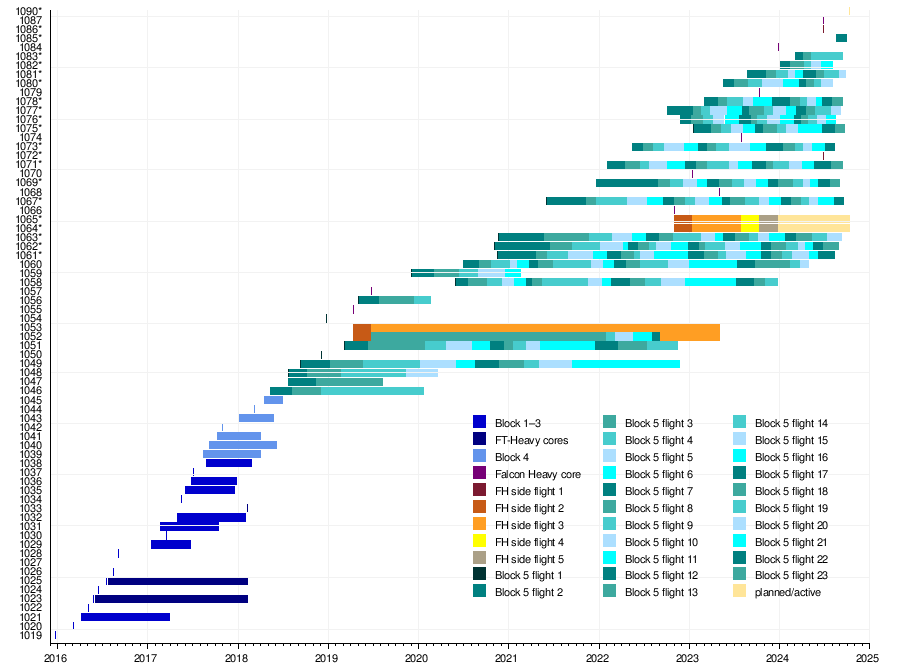
ファルコン9 FTブースターのタイムライン
このタイムラインには、フル スラストの最初の打ち上げから始まる、ファルコン 9 ブースターのすべての打ち上げが表示されます。将来的に追加の飛行が予定されているアクティブなブースターには、アスタリスクが付いています。単一の飛行は、縦線で示されています。短い白いギャップは、ファルコン 9 とファルコン ヘビーのサイド フォーマット間の変換を示しています。ブースターが複数回の打ち上げを行った場合、色付きのバーによって各飛行のターンアラウンド時間が表示されます。
サイドブースターの同期回復
ファルコン・ヘビーの飛行のほとんどには、2 つのサイドブースターが同時に陸上に着陸することが含まれます。
注目すべき後援者
バッタ

Grasshopper consisted of "a Falcon 9 first-stage tank, a single Merlin-1D engine" with a height of 32 m (105 ft).[236] The booster used for Grasshopper had the serial number 0002.
Grasshopper began flight testing in September 2012 with a brief, three-second hop, followed by a second hop in November 2012 with an 8-second flight that took the testbed approximately 5.4 m (18 ft) off the ground, and a third flight in December 2012 of 29 seconds duration, with extended hover under rocket engine power, in which it ascended to an altitude of 40 m (130 ft) before descending under rocket power to come to a successful vertical landing.[237] Grasshopper made its eighth, and final, test flight on 7 October 2013, flying to an altitude of 744 m (2,441 ft) before making its eighth successful vertical landing.[238] Grasshopper is retired.[11]
Booster 1019
.jpg/500px-ORBCOMM-2_First-Stage_Landing_(23271687254).jpg)
Falcon 9 B1019 was the first Full Thrust booster, and was first launched on 22 December 2015 for Falcon 9 flight 20 and landed on the Landing Zone 1 (LZ‑1) at Cape Canaveral. It became the first orbital-class rocket booster to perform a successful return to launch site and vertical landing.[239][240][241]
SpaceX decided not to fly the booster again.[242] Rather, the rocket was moved a few miles north, refurbished by SpaceX at the adjacent Kennedy Space Center, to conduct a static fire test. This test aimed to assess the health of the recovered booster and the capability of this rocket design to fly repeatedly in the future.[243][239] The historic booster is on display outside SpaceX headquarters in Hawthorne, California.
Booster 1021
.jpg/500px-CRS-8_(26239020092).jpg)
Falcon 9 B1021 was the first booster to be re-flown and the first to land on a droneship. It was first launched on 8 April 2016 carrying a Dragon spacecraft and Bigelow Expandable Activity Module (BEAM) on the SpaceX CRS-8 mission and landed on an autonomous spaceport drone ship (ASDS). After recovery, inspections and refurbishing, it was launched again on 30 March 2017 for the SES-10 mission and recovered successfully a second time. This event marks a milestone in SpaceX's drive to develop reusable rockets and reduce launch costs.[28][244][245][246][247] Following the second flight, SpaceX stated that they plan to retire this booster and donate it to Cape Canaveral for public display.[248][249] It was later put on public display outside Dish Network's headquarters in Littleton, Colorado in October 2023.[30]
Boosters 1023 and 1025
.jpg/500px-Falcon_Heavy_Side_Boosters_landing_on_LZ1_and_LZ2_-_2018_(25254688767).jpg)
B1023 became the third orbital-class rocket to land on a droneship after launching Thaicom 8 into a geostationary transfer orbit on 27 May 2016. It was an unusually hard landing that crushed the energy absorbers on at least one of the landing legs, causing the booster to "walk" across the droneship and lean over,[250][251] but the rocket arrived safely at Port Canaveral.[252] B1025[253] successfully launched the CRS-9 resupply mission on its maiden flight on 18 July 2016 and landed on LZ-1, being the first after B1019 to do so.[254] The mission carried a new docking adapter specifically designed for autonomous spacecraft to the ISS in preparation for Dragon 2 resupply and Commercial Crew missions.[255]
B1023 and B1025 were assigned the role of side boosters for the Falcon Heavy test flight in 2017, after which they underwent separate static fire tests. The boosters were mated to a newly built Falcon Heavy core, B1033, for the flight.[256] The maiden flight of Falcon Heavy on 6 February 2018 launched SpaceX CEO Elon Musk's Tesla Roadster and a dummy astronaut into a Mars-crossing heliocentric orbit. The boosters successfully separated from the core and performed synchronized landings on LZ-1 and LZ-2.[257]
B1023 is on display at the Kennedy Space Center Visitor Complex in its Falcon Heavy side booster configuration.[37]
Booster 1046
.jpg/500px-Spaceflight_SSO-A_Mission_(44460659210).jpg)
B1046 was the first Block 5, the final version of the SpaceX Falcon 9. It was first launched on 11 May 2018, carrying Bangabandhu-1, Bangladesh's first geostationary communications satellite. This marked the 54th flight of the Falcon 9 and the first flight of the Falcon 9 Block 5.[258] After completing a successful ascent, B1046 landed on the drone ship Of Course I Still Love You. After inspection and refurbishment, B1046 was launched a second time on 7 August 2018, carrying the Telkom-4 (Merah Putih) satellite. The Telkom-4 mission marked the first time an orbital-class rocket booster launched two GTO missions. This was also the first re-flight of a Block 5 booster.[259] Four months after the Telkom-4 mission, B1046 arrived at Vandenberg Air Force Base to support the SSO-A mission. Following delays for additional satellite checks,[260] liftoff occurred from SLC-4E on 3 December 2018. This marked the first time that the same orbital-class booster flew three times.[261] Its fourth and last mission launched a Crew Dragon capsule up to the point of maximum dynamic pressure, where it separated from the rocket to test its abort system in flight to validate the system's safety for crews. After separation of Falcon and Dragon, B1046 was compromised by aerodynamic forces.
Booster 1048
B1048 was the third Falcon 9 Block 5 to fly and the second Block 5 booster to re-fly, and the first booster ever to be launched four, then five times. During the last launch, an engine shut down seconds before the planned shutdown, becoming only the second time a Merlin engine failed since the failure during the SpaceX CRS-1 in October 2012. The primary mission was unaffected and the Starlink payload deployed successfully,[262] further confirming the reliability of the rocket due to redundancy of the engines. With reduced thrust, B1048 was unable to sufficiently slow down its descent, and thus was unable to land.[263]
Booster 1049
B1049 was the oldest Falcon 9 booster on active duty until its last flight on Nov 22, 2022, after which this title went to B1052. It was the first to successfully launch and land six, then seven times, and the second to launch and land eight, nine, and then ten times respectively. It launched two commercial payloads, Telstar 18V and the eighth Iridium NEXT batch, and eight internal Starlink batches.[264] B1049 was seen with its landing legs and grid fins removed indicating that it would be expended on its next flight. The final flight of B1049 was originally thought to be O3b mPower 4-6 but a regrouping of the launches meant that an expendable booster was no longer required. It was then planned that B1049's last flight would be the launch of Nilesat-301 however, those plans changed and the mission was flown with a recoverable booster (B1062.7). B1049 flew the Eutelsat-10B communications satellite on November 22, 2022. This mission was its last flight.
Booster 1050
B1050 launched for the first time on 5 December 2018.[265][266] A grid fin malfunction occurred shortly after the entry burn, resulting in the booster performing a controlled landing in the ocean instead of the planned ground pad landing.[267]
No future flights for B1050 were planned, and it was scrapped due to its damage.[268]
Booster 1051
B1051 was the sixth Falcon 9 Block 5 booster built. On its maiden flight on 2 March 2019, it carried a Crew Dragon into orbit on the Demo-1 mission. It then flew its second mission out of Vandenberg AFB launching the Radarsat constellation. It then flew 4 Starlink missions and launched SXM-7, totaling 5 flights in 2020 alone, and becoming the first Falcon 9 to launch a commercial payload on its seventh flight. On 18 December 2021, it flew for a record 11th time.[269] It was the first booster to be used eight, nine, ten, eleven, and twelve times respectively. It flew for the final time on 12 November 2022 for the Intelsat G-31/G-32 mission, and was expended.
Booster 1056
B1056 first launched on 4 May 2019, carrying a Cargo Dragon to the ISS. Because of the failure of the static test fire of Crew Dragon C204's Super-Draco abort engines on LZ-1, it landed on a drone ship instead.[270] It flew three more times. On 17 February 2020, B1056 was planned to perform the 50th orbital-class rocket landing, just 27 days after its previous launch.[271] The booster soft-landed in the Atlantic Ocean and was severely damaged after launching Starlink satellites into orbit, becoming the first flight-proven Block 5 booster to fail landing.[137]
Booster 1058
.jpg/500px-DM-2_Falcon_Rollout_(cropped).jpg)
Falcon 9 B1058 was first launched on 30 May 2020, from Kennedy Space Center Launch Complex 39A (Apollo 11 launch site). It carried NASA astronauts Doug Hurley and Bob Behnken to the International Space Station. It was the first crewed orbital spaceflight launched from the United States since the final Space Shuttle mission, and the first crewed flight test of Dragon 2. It was the first crewed orbital spaceflight by a private company. The booster was the first and only Falcon 9 booster to feature NASA's worm logo and meatball insignia, which was reintroduced after last being used in 1992.[272]
On 11 September 2022, it flew for the 14th time and became the first booster to be recovered 14 times.[273] On 17 December 2022, it was also the first booster to fly and land for the 15th time.[274] On 10 July 2023, it broke the reusability record of flying and landing an orbital-class rocket booster for the 16th time and later went on to be the first to complete 17, 18, and 19 launches in the same year.[275]
Despite the successful landing in its nineteenth flight, the booster tipped over during transit due to rough seas and high winds. SpaceX has already equipped newer Falcon boosters with upgraded landing legs that have the capability to self-level and mitigate this type of issue.[276]
Booster 1060
B1060 first flew on 30 June 2020, a month after Demo-2. Further missions it supported include launches of Starlink v1, v1.5 and v2 Mini, two Transporter ridesharing missions, and three large commercial satellites. After becoming the senior active rocket for SpaceX on 25 December 2023, it was assigned to what would become the first successful commercial Lunar landing: the booster launched IM-1 on 15 February 2024. This was its eighteenth mission.[277]
Booster 1061
Falcon 9 B1061 first launched Crew-1 to the ISS in November 2020, the first operational flight of Crew Dragon, and landed on a drone ship.[278] It became the first booster to fly crew twice as well as the first reused booster to fly crew as a part of the Crew-2 mission.[279] This first stage went on to complete additional missions.[180] B1061 is the only booster to land on all of SpaceX's different landing zones and drone ships (not including LZ-2).
Booster 1062
Falcon 9 B1062 launched Inspiration4 in 2021, operated by SpaceX on behalf of Shift4 Payments CEO Jared Isaacman.[280] The mission launched the Crew Dragon Resilience on 16 September 2021 at 00:02:56 UTC[a] from the Florida Kennedy Space Center's Launch Complex 39A atop a Falcon 9 launch vehicle, placed the Dragon capsule into low Earth orbit,[258] and ended successfully on 18 September 2021 at 23:06:49 UTC,[281] when the Resilience splashed down in the Atlantic Ocean. B1062 holds the record for the fastest booster turnaround time at 21 days and 4 hours between 8 April 2022 (Axiom-1) and 29 April 2022 (Starlink Group 4–16) beating the previous record of 27 days and 6 hours held by B1060. This was the first time a booster had flown twice in the same calendar month. According to the SpaceX webcast of the Starlink Group 4-16 mission, the booster spent just nine days in refurbishment. This booster was the first booster to achieve 20 launches and landings. This booster completed 22 successful launch and landings, before tipping over on its 23rd landing on the droneship A Shortfall of Gravitas during the Starlink 8-6 mission.[282]
Booster 1069
Falcon 9 B1069 launched SpaceX CRS-24 to ISS in December 2021 for NASA. SpaceX achieved the feat of 100 successful orbital rocket booster landings in this mission, coinciding with the sixth anniversary of its first booster landing. The rough seas led to the Octagrabber robot not being able to secure the booster to the deck, leading to both the booster, droneship and the Octagrabber robot being heavily damaged in transit.[283] It took months for SpaceX to refurbish B1069, returning into service only on Group 4-23 mission in August 2022.
On its next flight for Eutelsat Hotbird 13F, B1069 included a hosted promotional payload by FIFA, that was a box powered by Starlink containing two Adidas Al Rihla (the Journey) balls, that were to be used in 2022 FIFA World Cup in Qatar.[284] These match balls were launched and brought back by landing on the drone-ship surviving the stresses of re-entry. Later, they were taken out and shipped back to Qatar for the world cup. This was the first payload on a Falcon 9 booster itself and demonstrated the reusability.[285] The balls' flight by SpaceX was, in part, a promotion for the company's Starlink satellite internet service. An associated website invited World Cup attendees to visit the Starlink office in Doha.[286]
Reuse and recovery records
- B1012 featured the first recovery attempt on a drone-ship on 10 January 2015. The attempt was unsuccessful.
- B1019 became the first orbital booster ever to be recovered after a launch. After it landed at LZ-1 on 22 December 2015, it was retired and put on display at SpaceX Headquarters in Hawthorne, California.
- B1021 became the first booster ever to land on a drone-ship. On 8 April 2016, B1021 touched down on the drone ship Of Course I Still Love You, marking SpaceX's second successful landing.
- B1021 became the first booster to fly a second time, on F9 Flight 32 when it launched the SES-10 satellite on 30 March 2017. After its second successful landing, it was retired and put on display at Cape Canaveral Air Force Station.[249]
- B1023 and B1025 achieved the first synchronized landings when they touched down together at LZ-1 and LZ-2 respectively after the Falcon Heavy Test Flight on 6 February 2018.
- B1046 (the first Block 5 booster) became the first to launch three times, carrying Spaceflight SSO-A on 3 December 2018.
- B1048 was the first booster to be recovered four times on 11 November 2019, and the first to perform a fifth flight on 18 March 2020, but the booster was lost during re-entry.
- B1049 was the first booster to be recovered five times on 4 June 2020, six times on 18 August 2020, and seven times on 25 November 2020.
- B1051 became the first booster to be recovered eight times on 20 January 2021, nine times on 14 March 2021, and ten times on 9 May 2021, achieving one of SpaceX's milestone goals for reuse. It then became the first booster to be recovered eleven times on 18 December 2021 and twelve times on 19 March 2022.[287][288][289][290]
- B1060 became the first booster to fly thirteen times on 17 June 2022.
- B1062 booster holds the record for fastest turnaround at 21 days. It launched on 8 April and again on 29 April 2022.[291]
- B1023 holds the record for the farthest downrange drone-ship landing from Falcon 9 at 681 km on 27 May 2016 and B1055 holds the record of 1236 km downrange from Falcon Heavy.[292]
- B1058 became the first booster to fly fourteen times on 11 September 2022, fifteen times on 17 December 2022, sixteen times on 10 July 2023, seventeen times on 20 September 2023, eighteen times on 4 November 2023 and nineteen times on 23 December 2023.
- B1069 launched and returned a hosted box containing two FIFA 2022 World Cup Adidas Al Rihla on 15 October 2022 for a sub-orbital flight, the first payload on a Falcon 9 booster.[293]
- B1061 became the only booster on 30 December 2022 to launch from all SpaceX's different launch sites and on all of SpaceX's different landing zones and drone ships (except rarely used LZ-2 that is located nearby LZ-1).
- B1080 became the first booster to land onshore after launching a crewed mission (Ax-2) on 21 May 2023. Before, all boosters of Dragon 2 missions, crew and cargo, landed on ships. As of May 2024, since Ax-2 all boosters of Dragon 2 missions landed onshore.
- The fastest return of a droneship from the landing site to Port Canaveral is 50 hours achieved by A Shortfall of Gravitas, on the Starlink Group 6-46 mission.[citation needed]
- B1062 became the first booster to fly twenty times on 13 April 2024, twenty-one times on 18 May 2024, twenty-two times on 27 June 2024, and twenty-three times on 28 August 2024.
- The fastest landing-to-landing turnaround of a droneship is 84 hours achieved by A Shortfall of Gravitas, between the Starlink Group 6-60 and Group 6-64 missions.[294]
See also


- List of Falcon 9 and Falcon Heavy launches
- Lists of spacecraft
- Category:Individual Falcon 9 boosters
Notes
- ^ 15 September 2021, 20:02:56 Eastern Daylight Time (EDT)
References
- ^ Sheetz, Michael (11 May 2018). "Here's everything Elon Musk told reporters about the reusable rocket that will fly twice within 24 hours". CNBC. Retrieved 22 April 2024.
- ^ Baylor, Michael (19 July 2018). "SpaceX to attempt five recoveries in less than two weeks as fleet activity ramps up". NASASpaceFlight.com. Retrieved 2 August 2018.
- ^ a b c d Ralph, Eric (5 June 2018). "SpaceX will transition all launches to Falcon 9 Block 5 rockets after next mission". Teslarati. Retrieved 5 June 2018.
- ^ a b Baylor, Michael (17 May 2018). "With Block 5, SpaceX to increase launch cadence and lower prices". NASASpaceFlight.com. Archived from the original on 18 May 2018. Retrieved 5 July 2018.
- ^ Meyer, Jake W. "Cores" (JSON). api.spacexdata.com. Retrieved 16 August 2018 – via SpaceX Data API.
- ^ a b c d "SpaceX Falcon 9 v1.2 Data Sheet / Falcon 9 v1.1 and v1.2 Flight History". 25 July 2018. Archived from the original on 20 September 2016. Retrieved 28 July 2018.
{{cite web}}: CS1 maint: unfit URL (link) - ^ "SpaceX Completes Primary Structure of the Falcon 9 First Stage Tank". 13 April 2007.[permanent dead link]
- ^ Clark, Stephen (24 September 2012). "SpaceX's reusable rocket testbed takes first hop". Spaceflight Now. Retrieved 13 March 2018.
- ^ Clark, Stephen (9 July 2012). "Reusable rocket prototype almost ready for first liftoff". Spaceflight Now. Retrieved 13 March 2018.
- ^ a b Krebs, Gunter. "Grasshopper/Falcon-9R-Dev". Gunter's Space Page. Retrieved 15 December 2018.
- ^ a b Klotz, Irene (17 October 2013). "SpaceX Retires Grasshopper, New Test Rig To Fly in December". Space News. Archived from the original on 21 October 2013. Retrieved 13 March 2018.
- ^ Boyle, Alan (4 June 2010). "Shuttle successor succeeds in first test flight". MSNBC. Archived from the original on 21 December 2019. Retrieved 5 June 2010.
- ^ Cowing, Keith (4 June 2010). "Falcon 9 Nails Orbit – First Stage Slams Hard into Atlantic". nasawatch.com. NASA Watch. Retrieved 31 May 2018.
- ^ Clark, Stephen (9 December 2010). "Musk 'optimistic' next Dragon flight will visit space station". Spaceflight Now. Retrieved 30 October 2023.
- ^ Editorial (30 October 2012). "First Outing for SpaceX". The New York Times. Retrieved 17 January 2016.
- ^ "SpaceX Falcon 9 v1.1 Data Sheet". Archived from the original on 12 September 2013. Retrieved 30 August 2021.
{{cite web}}: CS1 maint: unfit URL (link) - ^ Bergin, Chris (22 April 2014). "Rockets that return home – SpaceX pushing the boundaries". NASASpaceFlight.com. Retrieved 13 March 2018.
- ^ "Commercial Space Data - Launches". FAA. Retrieved 13 March 2018.
Dates of Grasshopper launches
 This article incorporates text from this source, which is in the public domain.
- ^ Foust, Jeff (23 August 2014). "Falcon 9 test vehicle destroyed in accident". New Space Journal. Retrieved 13 March 2018.
- ^ a b c d e Krebs, Gunter. "Falcon-9 v1.1(ex)". Gunter's Space Page. Retrieved 22 May 2019.
- ^ Evans, Ben (3 August 2014). "SpaceX Prepares to Score Two 'Personal Bests' With AsiaSat-8 Launch". AmericaSpace. Retrieved 13 July 2016.
- ^ "SpaceX - F9R Development Updates". Spaceflight101. 22 August 2014. Archived from the original on 1 June 2016. Retrieved 20 March 2020.
- ^ Klotz, Irene (19 February 2015). "SpaceX bypassing replacement for lost Falcon 9R landing test vehicle". Portal to the Universe. Archived from the original on 14 March 2018. Retrieved 13 March 2018 – via SEN.
- ^ Jeff Foust (21 December 2015). "Falcon 9 Launches Orbcomm Satellites, Lands First Stage". SpaceNews. Retrieved 22 December 2015.
the first time SpaceX had successfully landed the rocket's first stage.
- ^ Clark, Stephen (21 December 2015). "SpaceX puts historic flown rocket on permanent display". Spaceflight Insider. Retrieved 4 November 2017.
- ^ Masunaga, Samantha (22 August 2016). "You can visit the first SpaceX rocket booster that blasted off and came back". Los Angeles Times.
- ^ "Banged-Up Drone Ship pulls into Port after latest Falcon 9 Landing Attempt". Spaceflight 101. 9 March 2016. Retrieved 19 November 2017.
- ^ a b c "First Falcon 9 Re-Flight Achieves Successful Launch, Landing and Payload Fairing Recovery". Spaceflight 101. 31 March 2017. Retrieved 5 November 2017.
- ^ Kelly, Emre (4 November 2017). "Historic SpaceX Falcon 9 rocket returns home to Port Canaveral". Florida Today. Retrieved 23 April 2017.
- ^ a b Lynn, Nate (28 October 2023). "SpaceX rocket escorted through Colorado". KUSA-TV. Retrieved 30 October 2023.
- ^ Edwards, Jon [@edwards345] (30 October 2023). "1021" (Tweet). Retrieved 30 October 2023 – via Twitter.
- ^ Masunaga, Samantha (30 August 2016). "SpaceX signs first customer for launch of a reused rocket". Los Angeles Times. Archived from the original on 10 April 2024. Retrieved 30 August 2016.
- ^ Grush, Loren (30 March 2017). "SpaceX makes aerospace history with successful launch and landing of used rocket". The Verge. Archived from the original on 10 April 2024. Retrieved 31 March 2017.
- ^ Gebhardt, Chris (12 April 2017). "Falcon Heavy build up begins; SLC-40 pad rebuild progressing well". NASASpaceFlight.com. Archived from the original on 4 April 2023. Retrieved 5 November 2017.
- ^ Wall, Mike (28 May 2016). "Three in a Row! SpaceX Lands Rocket on Ship at Sea Yet Again". Space.com. Archived from the original on 29 November 2023. Retrieved 27 May 2016.
- ^ a b c d e f O'Kane, Sean (7 February 2018). "Here's what's next for SpaceX after Falcon Heavy's first flight". The Verge. Archived from the original on 5 April 2023. Retrieved 7 February 2018.
- ^ a b Kelly, Emre (17 September 2021). "The Space Coast is finally getting its own SpaceX Falcon 9 booster". Florida Today. Archived from the original on 17 September 2021.
- ^ Kurkowski, Seth (25 June 2022). "Inside Gateway: Kennedy Space Center Visitor Complex's newest attraction". Space Explored. Retrieved 13 October 2022.
- ^ Clark, Stephen (15 June 2017). "SpaceX successfully fires satellites into orbit, but loses booster on landing". Spaceflight Now. Retrieved 19 November 2017.
- ^ Gebhardt, Chris (11 November 2017). "SpaceX static fires Zuma Falcon 9; engine test anomaly no issue for manifest". NASASpaceFlight.com. Retrieved 18 November 2017.
- ^ "Falcon 9 Rocket lifts Japanese Communications Satellite, aces high-energy Ocean Landing". SpaceFlight101.com. 15 August 2016.
- ^ "SpaceX Falcon Heavy (updates and maiden flight) - Page 3 - Science Discussion and News - Neowin". 27 January 2015. Retrieved 30 August 2021.
- ^ "Why did Falcon 9 boosters numbers skip B1027?". 15 May 2017. Retrieved 30 August 2021.
- ^ Godwin, Curt (1 September 2016). "SpaceX set to launch heaviest payload to date as Tropical Storm Hermine looms". SpaceFlight Insider. Archived from the original on 3 December 2020. Retrieved 31 March 2017.
- ^ a b "SpaceX Falcon 9 v1.2 Data Sheet/ List by stage 1 serial number". 25 July 2018. Archived from the original on 28 July 2018. Retrieved 28 July 2018.
{{cite web}}: CS1 maint: unfit URL (link) - ^ a b Malik, Tariq (1 September 2016). "Launchpad Explosion Destroys SpaceX Falcon 9 Rocket, Satellite in Florida". Space.com. Retrieved 18 November 2017.
- ^ Chris Bergin (17 January 2017). "Landed Falcon 9 booster sails into Los Angeles". NASASpaceFlight.com.
- ^ Clark, Stephen (5 May 2017). "Bulgaria's first communications satellite to ride SpaceX's second reused rocket". Spaceflight Now. Retrieved 5 May 2017.
- ^ Graham, William (23 June 2017). "SpaceX Falcon 9 success with second flight involving BulgariaSat-1 mission". NASASpaceFlight.com. Retrieved 27 November 2017.
- ^ EchoStar XXIII Launch. 16 March 2017. Retrieved 18 November 2017. The number 30 is visible just above the engines.
- ^ a b c d e f Krebs, Gunter. "Falcon-9 Full Thrust(ex) (Falcon(ex))". Gunter's Space Page. Retrieved 16 April 2017.
- ^ Siceloff, Steven (19 February 2017). "NASA Cargo Headed to Space Station Includes Important Experiments, Equipment". blogs.nasa.gov. Retrieved 19 February 2017. This article incorporates text from this source, which is in the public domain.
- ^ a b Graham, William (11 October 2017). "Falcon 9 conducts second launch this week with SES-11 mission". NASASpaceFlight.com. Retrieved 18 November 2017.
- ^ Bergin, Chris (25 April 2017). "SpaceX Static Fire spy sat rocket and prepare to test Falcon Heavy core". NASASpaceFlight.com. Retrieved 3 May 2017.
- ^ @ChrisG_NSF (8 February 2018). "So the #Falcon9 1st stage for #GovSat1 that soft landed in the ocean and survived... @NASASpaceflight has confirmed that the Air Force conducted a scuttling operation to destroy it as there was no safe way to get it back to Port" (Tweet) – via Twitter.
- ^ Clark, Stephen (11 January 2018). "After Zuma, SpaceX keeps pace in preps for next Falcon 9 launch". Spaceflight Now. Retrieved 11 January 2018.
SES officials confirmed this week that satellite and rocket preps are on track for January 30. A recycled Falcon 9 booster stage that first flew 1 May with the U.S. government's classified NROL-76 payload will hoist the GovSat 1 spacecraft toward orbit, and a factory-fresh second stage will finish the job.
- ^ "Elon Musk Explains Why SpaceX's Falcon Heavy Core Booster Crashed". Space.com. 14 February 2018.
- ^ Bergin, Chris (3 May 2017). "SpaceX improving launch cadence, testing new goals". NASASpaceFlight.com. Retrieved 5 May 2017.
- ^ Gebhardt, Chris (28 May 2017). "SpaceX static fires CRS-11 Falcon 9 Sunday ahead of ISS mission". NASASpaceflight.com. Retrieved 30 May 2017.
- ^ Berger, Eric (10 May 2019). "Old Falcon 9 rockets done firing their engines will now inflame imaginations". Ars Technica. Archived from the original on 18 April 2023.
- ^ "SpaceX delivers Falcon 9 rocket for Space Center Houston display". collectspace.com. 4 March 2020. Retrieved 4 March 2020.
- ^ Graham, William (14 December 2017). "Flight proven Falcon 9 launches previously flown Dragon to ISS". NASASpaceFlight.com. Retrieved 15 December 2017.
- ^ "SpaceX launches and lands its first used rocket for NASA". The Verge. 15 December 2017. Retrieved 15 December 2017.
- ^ Graham, William (24 June 2017). "SpaceX Doubleheader Part 2 – Falcon 9 conducts Iridium NEXT-2 launch". NASASpaceFlight.com. Retrieved 3 July 2017.
- ^ Gebhardt, Chris (19 October 2017). "Iridium-4 switches to flight-proven Falcon 9, RTLS at Vandenberg delayed". NASASpaceFlight.com. Retrieved 19 October 2017.
- ^ Bergin, Chris (29 June 2017). "SpaceX returns two boosters, fires up a third for Static Fire test". NASASpaceFlight.com. Retrieved 2 July 2017.
- ^ "Formosat 5 program description". National Space Organization. Retrieved 10 May 2014.
- ^ Graham, William (14 August 2017). "SpaceX Falcon 9 launches CRS-12 Dragon mission to the ISS". NASASpaceFlight.com. Retrieved 14 August 2017.
- ^ a b c Krebs, Gunter. "Falcon-9 v1.2 (Falcon-9FT)". Gunter's Space Page. Retrieved 19 November 2018.
- ^ Graham, William (2 April 2018). "CRS-14: SpaceX Falcon 9 conducts second flight with previously flown Dragon". NASASpaceFlight.com. Retrieved 4 April 2018.
- ^ Graham, William (6 September 2017). "SpaceX launches first X-37B launch with a Falcon 9". NASASpaceFlight.com. Retrieved 27 November 2017.
- ^ Graham, William (3 June 2018). "Falcon 9 conducts SES-12 night launch from Cape Canaveral". NASASpaceFlight.com. Retrieved 5 June 2018.
- ^ Dean, James (4 June 2018). "SpaceX Falcon 9 delivers massive commercial satellite to orbit from Cape Canaveral". Florida Today. Retrieved 4 June 2018.
- ^ Bergin, Chris (25 September 2017). "SpaceX realign near-term manifest ahead of double launch salvo". NASASpaceFlight.com. Retrieved 3 October 2017.
- ^ "SpaceX launch adds another 10 satellites to Iridium Next fleet". 9 October 2017. Retrieved 1 April 2018.
- ^ a b Atkinson, Ian (24 March 2018). "Falcon 9 conducts static fire test ahead of the fifth Iridium NEXT mission". NASASpaceFlight.com. Retrieved 27 March 2018.
- ^ "Live coverage: Falcon 9 rocket lifts off with fifth set of Iridium Next satellites". 30 March 2017. Retrieved 1 April 2018.
- ^ Graham, William (30 October 2017). "SpaceX Falcon 9 successfully launches Koreasat 5A". NASASpaceFlight.com. Retrieved 30 October 2017.
- ^ Gebhardt, Chris (16 October 2017). "SpaceX adds mystery "Zuma" mission, Iridium-4 aims for Vandenberg landing". NASASpaceFlight.com. Retrieved 17 October 2017.
- ^ Shotwell, Gwynne (9 January 2018). "Statement From Gwynne Shotwell, President and COO of SpaceX on Zuma Launch". SpaceRef. Archived from the original on 20 October 2021. Retrieved 12 January 2018.
- ^ Clark, Stephen (29 June 2018). "SpaceX launches AI-enabled robot companion, vegetation monitor to space station". Spaceflight Now. Retrieved 4 July 2018.
- ^ a b c "Eutelsat 10B | Falcon 9 Block 5". 23 November 2022.
- ^ @jeff_foust (15 March 2023). "Ochinero: F9 booster is capable of "way more" than 10 flights each; up to 15 now, but will see based on market conditions if we want to take effort to increase certification to 20 flights" (Tweet) – via Twitter.
- ^ Axiom Mission 2 Flight Readiness Review. 15 May 2023.
- ^ "In 2023, SpaceX completed 96 successful missions, safely flew 12 more astronauts to orbit, launched two flight tests of Starship, and more than doubled the number of people around the world connected by @Starlink. Watch @elonmusk deliver a company update". X (formerly Twitter).
- ^ Clark, Stephen (15 January 2024). ""Elon Musk's recent all-hands meeting at SpaceX was full of interesting news"". Ars Technica. Retrieved 15 April 2024.
- ^ "Most missions flown by a rocket first stage (not updated since then but B1058 is leader with 19 flights)". 3 January 2023.
- ^ a b c Krebs, Gunter. "Falcon-9 v1.2 (Block 5) (Falcon-9FT (Block 5))". Gunter's Space Page. Retrieved 9 November 2018.
- ^ Ralph, Eric (27 July 2018). "SpaceX's first Falcon 9 Block 5 reuse will also be its quickest drone ship turnaround". Teslarati. Retrieved 27 July 2018.
- ^ Foust, Jeff (8 October 2018). "Debating reusability". The Space Review. Retrieved 9 October 2018.
- ^ @NASA (6 January 2020). ".@SpaceX is targeting no earlier than Saturday, January 18, for an In-Flight Abort Test of the #CrewDragon spacecraft. This is one of the final major tests before @Commercial_Crew astronauts will fly to the @Space_Station aboard the spacecraft: https://go.nasa.gov/2R4HhUL" (Tweet). Retrieved 7 January 2020 – via Twitter. This article incorporates text from this source, which is in the public domain.
- ^
- @SpaceXUpdates (21 February 2019). "Fourth flight of B1048 is scheduled for April 2019. CRS-17? or another mission?" (Tweet). Retrieved 22 February 2019 – via Twitter.
- @elonmusk (21 February 2019). "Crew Dragon high altitude abort test" (Tweet). Retrieved 22 February 2019 – via Twitter.
- ^ a b Ralph, Eric (13 June 2018). "SpaceX's third Block 5 rocket heads to Texas test site as launch marathon nears". Teslarati. Retrieved 13 June 2018.
- ^ @SpaceXUpdates (28 July 2019). "AMOS-17 is a big one. At 6,500kg, we're not gonna be seeing a booster recovery" (Tweet) – via Twitter.
- ^ Graham, William (15 November 2018). "SpaceX Falcon 9 launches Es'Hail-2 from 39A". NASASpaceFlight.com. Retrieved 1 March 2019.
- ^ Bergin, Chris (2 August 2019). "SpaceX present to future: From retesting boosters to planning a Starship pad". NASASpaceFlight.com. Retrieved 2 August 2019.
- ^ "Falcon 9 Block 5 | AMOS-17". nextspaceflight.com. Retrieved 22 July 2019.
- ^ Baylor, Michael (1 August 2018). "SAOCOM 1A ships to Vandenberg as Falcon 9 prepares for the first west coast RTLS". NASASpaceFlight.com. Retrieved 2 August 2018.
- ^ "Nusantara Satu Mission Press Kit" (PDF). Archived from the original (PDF) on 21 February 2019. Retrieved 20 February 2019.
- ^ Horack, John (1 February 2019). "Israel's Beresheet is first private spacecraft to shoot for the Moon". The Times of Israel. Retrieved 10 February 2019.
- ^ "Falcon 9 Block 5 | Starlink V1 L5". nextspaceflight.com. Retrieved 9 March 2020.
- ^ a b "SpaceX launches Danuri, South Korea's first mission to the Moon". NASASpaceFlight.com. 4 August 2022. Retrieved 11 August 2022.
- ^ @Alexphysics13 (20 March 2022). "@chiragp87233561 The only thing I know that is correct there is that B1049 donated its interstage to B1052" (Tweet) – via Twitter.
- ^ Krebs, Gunter. "Falcon-9". Gunter's Space Page. Retrieved 5 August 2018.
- ^ Desch, Matt [@IridiumBoss] (18 October 2018). "I understand it's 1049-2" (Tweet). Retrieved 18 October 2018 – via Twitter.
- ^ Baylor, Michael [@nextspaceflight] (14 May 2019). "The Falcon 9 static fire for #Starlink could be coming up at the top of the hour. 10 PM Eastern was the last T-0 target that I had heard, but I am not sure if that is still the case. The first stage booster is B1049-3" (Tweet). Retrieved 14 May 2019 – via Twitter.
- ^ "SpaceX set for record-breaking 2020 manifest". 27 December 2019.
- ^ "Starlink V1 L7". Retrieved 30 August 2021.
- ^ a b "Falcon-9 v1.2 (Block 5) (Falcon-9FT (Block 5))". GuntersSpacePage. Retrieved 24 June 2020.
- ^ "Starlink V1 L15". Next Spaceflight.
- ^ "Falcon 9 Block 5 | Starlink V1 L17". nextspaceflight.com. Retrieved 15 May 2021.
- ^ "Falcon 9 Block 5 | Starlink Group 2-1". nextspaceflight.com. Retrieved 14 October 2021.
- ^ "SpaceX crew capsule returns to Earth, paving the way for human launches". 8 March 2019.
- ^ a b c d e Baylor, Michael (6 March 2019). "Falcon Heavy and Starlink headline SpaceX's upcoming manifest". NASASpaceFlight. Retrieved 7 March 2019.
- ^ "Starlink V1 L6". Retrieved 30 August 2021.
- ^ "SXM-7 Falcon 9 Block 5". 11 December 2020. Retrieved 30 August 2021.
- ^ "Falcon 9 Block 5 | Starlink V1 L16". nextspaceflight.com. Retrieved 15 January 2021.
- ^ "SpaceX - Launches". spacex.com. Retrieved 12 March 2021.
- ^ "Falcon 9 Block 5 | Starlink V1 L27". nextspaceflight.com. Retrieved 4 May 2021.
- ^ a b Baylor, Michael. "Upcoming Launches: SpaceX". NextSpaceflight. Retrieved 9 November 2021.
- ^ Clark, Stephen (1 November 2021). "Launch schedule". SpaceFlight Now. Retrieved 4 November 2021.
- ^ "SpaceX's next West Coast Starlink launch is heading to an unexpected orbit". 15 December 2021.
- ^ "B1051-14 is a Falcon 9 booster set to fly the Galaxy 31&32 mission". 10 October 2022. Retrieved 10 October 2022.
- ^ a b c d @Alexphysics13 (16 January 2023). "On Arabsat 6A B1052 landed on LZ-1 while B1053 landed on LZ-2. It's funny because on STP-2 it was the other way around heh" (Tweet) – via Twitter.
- ^ @Alexphysics13 (20 March 2022). "@chiragp87233561 The only thing I know that is correct there is that B1049 donated its interstage to B1052" (Tweet) – via Twitter.
- ^ "CSG-2 Falcon 9 Block 5". 25 January 2022. Retrieved 26 January 2022.
- ^ "Starlink Group 4-10 Falcon 9 Block 5". 3 March 2022. Retrieved 3 March 2022.
- ^ "Falcon 9 Block 5 | Starlink Group 4-18". nextspaceflight.com. Retrieved 13 May 2022.
- ^ "Falcon 9 Block 5 | KPLO". everydayastronaut.com. Retrieved 31 July 2022.
- ^ "Falcon 9 Block 5 | Starlink Group 4-20 and Varuna-TDM". nextspaceflight.com. Retrieved 8 January 2023.
- ^ a b c d e f "Falcon Heavy | ViaSat-3 Americas & Arcturus". nextspaceflight.com. Retrieved 7 September 2022.
- ^ a b c "ViaSat-3 Americas & Arcturus". Retrieved 3 March 2023.
- ^ a b "SpaceX to set new booster reuse record on Starlink mission". www.nasaspaceflight.com. 18 March 2022. Retrieved 19 March 2021.
- ^ Baylor, Michael (22 October 2018). "SpaceX lines up five launches to close out 2018". NASASpaceFlight.com. Retrieved 25 October 2018.
- ^ Krebs, Gunter. "Falcon-9 v1.2 (Block 5)(ex) (Falcon-9FT (Block 5)(ex))". Gunter's Space Page. Retrieved 27 January 2019.
- ^ Grush, Loren (15 April 2019). "SpaceX loses the center core of its Falcon Heavy rocket due to choppy seas". The Verge. Retrieved 16 April 2019.
- ^ a b "A farewell to hackadays favorite falcon 9 booster". 25 February 2020.
it has the dubious honor of being the first reused Block 5 booster to be unintentionally destroyed.
- ^ Chris G - NSF [@ChrisG_NSF] (4 May 2019). "#NASA says this Falcon 9 might be the first one NASA uses three times (with 2 reflights). Confirms it's the booster for CRS-18 and might be used again for CRS-19. #SpaceX #Falcon9 #Dragon #CRS17" (Tweet). Retrieved 4 May 2018 – via Twitter.
- ^ a b Baylor, Michael [@nextspaceflight] (26 November 2019). "The CRS-19 mission will use a new first stage, B1059-1. B1056-3, originally penciled in for CRS-19, is now expected to be used for JCSAT, but core assignments are always subject to change. #SpaceX" (Tweet) – via Twitter.
- ^ "Falcon 9 Block 5 | Starlink V1 L4". nextspaceflight.com. Retrieved 6 February 2020.
- ^ "United States Commercial Launch Manifest". 20 April 2020.
- ^ Wall, Mike (29 October 2019). "Elon Musk: SpaceX to Launch Vital Crew Dragon Escape System Test Soon". Space.com. Retrieved 6 November 2019.
- ^ "During transport back to Port early this morning, the booster tipped over on the droneship due to high winds and waves. Newer Falcon boosters have upgraded landing legs with the capability to self-level and mitigate this type of issue". Twitter. 26 December 2023.
- ^ "Falcon 9 Block 5 | Starlink V1 L12". Archived from the original on 25 October 2020. Retrieved 2 October 2020.
- ^ a b c Cooper, Ben (24 October 2020). "Rocket Launch Viewing Guide for Cape Canaveral". launchphotography.com. Retrieved 24 October 2020.
- ^ "Falcon 9 Block 5 | Transporter 1". nextspaceflight.com. Retrieved 19 January 2021.
- ^ "Starlink V1 L20". Retrieved 30 August 2021.
- ^ @SpaceX (12 November 2021). "Standing down from today's launch due to weather. Forecast improves to 80% favorable for tomorrow's launch opportunity at 7:19 a.m. EST" (Tweet) – via Twitter.
- ^ @TSKelso (9 November 2021). "CelesTrak has pre-launch SupTLEs for the #Starlink Group 4-1 launch set for Nov 12 at 1240 UTC of 53 satellites from Cape Canaveral. Deployment is set for 12:55:56.740 UTC, just over 15 minutes after launch" (Tweet) – via Twitter.
- ^ Neal, Mihir (12 November 2021). "SpaceX poised for Starlink launch from Cape Canaveral". NASASpaceFlight.com. Retrieved 12 November 2021.
- ^ "Falcon 9 Block 5 | Transporter 3". nextspaceflight.com. Retrieved 12 January 2022.
- ^ "Falcon 9 Block 5 | Starlink Group 4-21". nextspaceflight.com. Retrieved 26 May 2022.
- ^ "Falcon 9 Block 5 | Starlink Group 4-2". 8 September 2022.
- ^ "United States Commercial Launch Manifest". Retrieved 15 December 2022.
- ^ Joachim Wilhelm Josef Becker (9 March 2020). "ISS Expedition 62". SpaceFacts.
- ^ "NROL 108". Retrieved 26 October 2020.
- ^ "Starlink V1 L19". Retrieved 30 August 2021.
- ^ "Spaceflight Now: Launch schedule". Retrieved 6 June 2020.
- ^ Gray, Tyler (3 September 2020). "SpaceX launches latest Starlink mission". NASASpaceFlight.com. Retrieved 15 May 2021.
- ^ Krebs, Gunter. "Türksat 5A". Gunter's Space Page. Retrieved 9 November 2017.
- ^ "Starlink V1 L18". Retrieved 30 August 2021.
- ^ "Next Space Flight- Launches". nextspaceflight.com.
- ^ "Next Space Flight- Launches". nextspaceflight.com.
- ^ "Next Space Flight- Launches". nextspaceflight.com.
- ^ "Falcon 9 Block 5 | Starlink Group 4-19". nextspaceflight.com. Retrieved 26 May 2022.
- ^ "Falcon 9 Block 5 | Galaxy 33 & 34". nextspaceflight.com. Retrieved 30 September 2022.
- ^ "Falcon 9 Block 5 – Galileo FOC FM25-FM27". Next Spaceflight. Retrieved 15 April 2024.
- ^ Clark, Stephen (17 April 2020). "Launch Schedule". Spaceflight Now.
- ^ @124970MeV (31 July 2021). "inspiration 4 will use B1062-3" (Tweet) – via Twitter.
- ^ "Starlink Group 4-5 | Falcon 9 Block 5". Everyday Astronaut. 4 January 2022. Retrieved 6 January 2022.
- ^ "Falcon 9 Block 5 | Nilesat-301". nextspaceflight.com. Retrieved 26 May 2022.
- ^ "Falcon 9 Block 5 | Starlink Group 4-27". nextspaceflight.com. Retrieved 3 August 2022.
- ^ "Falcon 9 Block 5 | Starlink Group 4-36". nextspaceflight.com. Retrieved 21 September 2022.
- ^ "Falcon 9 Block 5 | Starlink Group 5-1". nextspaceflight.com. Retrieved 19 December 2022.
- ^ "Falcon 9 Block 5 | Starlink Group 5-4". nextspaceflight.com. Retrieved 26 January 2023.
- ^ "Falcon 9 Block 5 | OneWeb #17". Retrieved 3 March 2023.
- ^ "Falcon 9 Block 5 | Starlink Group 6-7". nextspaceflight.com. Retrieved 26 July 2023.
- ^ "Falcon Heavy | USSF-67". nextspaceflight.com. Retrieved 5 January 2023.
- ^ a b c "Falcon 9 Block 5 | Psyche". nextspaceflight.com. Retrieved 20 March 2023.
- ^ a b Sesnic, Trevor; Kanayama, Lee (5 June 2021). "SpaceX launches 2nd mission in three days with SiriusXM-8". NASASpaceFlight.com. Retrieved 6 June 2021.
- ^ "SpaceX F9 : Starlink Group 4-7 : KSC LC-39A : 3 February 2022 (18:13 UTC)". forum.nasaspaceflight.com.
- ^ "Falcon 9 Block 5 | Transporter 5". nextspaceflight.com. Retrieved 9 May 2022.
- ^ "Falcon 9 Block 5 | Globalstar-2 M087 & Unknown Payloads". nextspaceflight.com. Retrieved 15 June 2022.
- ^ "Falcon 9 Block 5 | Starlink 3-3". nextspaceflight.com. Retrieved 3 August 2022.
- ^ "Falcon 9 Block 5 | EROS-C3". nextspaceflight.com. Retrieved 14 December 2022.
- ^ "Starlink Group 2-7 | Falcon 9 Block 5". nextspaceflight.com. Retrieved 25 February 2023.
- ^ "Starlink v1.0 L28 mission completes first "shell" of satellites for worldwide coverage". 26 May 2021.
- ^ "DART in transit to Vandenberg Space Force Base ahead of November 2021 launch". 7 October 2021.
- ^ "Falcon 9 Block 5 | Starlink Group 4-13". nextspaceflight.com. Retrieved 10 May 2022.
- ^ "Falcon 9 Block 5 | Starlink Group 3-4". nextspaceflight.com. Retrieved 3 August 2022.
- ^ "Falcon 9 Block 5 | Starlink Group 4-31". nextspaceflight.com. Retrieved 21 October 2022.
- ^ "Iridium Oneweb". nextspaceflight.com. Retrieved 12 May 2023.
- ^ a b @Alexphysics13 (1 November 2022). "A bit of analysis here of which booster landed where... Looks like B1065, PY booster, landed on LZ-2 and B1064, MY booster, landed on LZ-1. That's of course unless they swapped feeds between booster sep and landing" (Tweet) – via Twitter.
- ^ a b "Falcon Heavy | USSF-67". nextspaceflight.com. Retrieved 18 December 2022.
- ^ a b Clark, Stephen. "Falcon Heavy rocket on the launch pad for one of SpaceX's most complex missions – Spaceflight Now". Retrieved 1 November 2022.
The next military mission to fly on a Falcon Heavy rocket, named USSF-67, will launch the LDPE 3 spacecraft and a Space Force communications satellite in tandem. That launch is scheduled for January, and will use the same Falcon Heavy side boosters flown on the USSF-44 mission, assuming a successful recovery on the landing zones at Cape Canaveral Space Force Station, the Space Force said.
- ^ a b @Alexphysics13 (16 January 2023). "Oops I looked wrong at my notes yesterday and actually on the USSF-44 mission the boosters landed in the opposite pads they landed on USSF-67" (Tweet) – via Twitter.
- ^ a b Krebs, Gunter (6 May 2022). "Jupiter 3 / EchoStar 24". Gunter's Space Page. Retrieved 7 May 2022.
- ^ a b "Falcon Heavy | USSF-52". nextspaceflight.com. Retrieved 7 September 2022.
- ^ a b c "Everything is coming together for launch of NASA's mission to a metal asteroid". arstechnica.com. 11 August 2023. Retrieved 29 August 2023.
- ^ "CRS-22". Retrieved 17 April 2021.
- ^ "CRS-22 Mission Overview" (PDF). Archived from the original (PDF) on 30 October 2021. Retrieved 27 May 2021.
This booster will be used on the Crew-3 mission
- ^ "SpaceX debuts new Dragon capsule in launch to the International Space Station". spaceflightnow.com. 11 November 2021.
- ^ Clark, Stephen [@StephenClark1] (19 January 2022). "NASA's Steve Stich: Crew-4 mission in April will be the first NASA astronaut launch with a fourth-flight Falcon 9 booster. B1067 flew on CRS-22, Crew-3, and Turksat 5B. Future crew missions could use a fifth flight booster. Crew-4 will use a brand new Crew Dragon spacecraft" (Tweet). Retrieved 19 January 2022 – via Twitter.
- ^ "SpaceX CRS-25 patch: ISS resupply flight". 6 January 2022.
- ^ "Falcon 9 Block 5 | Starlink Group 4-34". nextspaceflight.com. Retrieved 11 September 2022.
- ^ "Falcon 9 Block 5 | Hotbird 13G". nextspaceflight.com. Retrieved 31 October 2022.
- ^ "Falcon 9 Block 5 | O3b mPOWER 1 & 2". nextspaceflight.com. Retrieved 16 December 2022.
- ^ "Falcon 9 Block 5 | Starlink Group 5-9". forum.nextspaceflight.com. Retrieved 12 May 2023.
- ^ "Falcon 9 Block 5 | Satria". forum.nextspaceflight.com. Retrieved 16 June 2023.
- ^ "Falcon 9 Block 5 – Galileo FOC FM26-FM32". Next Spaceflight. Retrieved 15 September 2024.
- ^ "Falcon 9 Block 5 | Starlink Group 4-23". nextspaceflight.com. Retrieved 25 August 2022.
- ^ "Falcon 9 Block 5 | Hotbird 13F". nextspaceflight.com. Retrieved 21 September 2022.
- ^ "Falcon 9 Block 5 | OneWeb #15". Retrieved 2 December 2022.
- ^ "Starlink Group 5-3". Retrieved 26 January 2023.
- ^ "Falcon 9 Block 5 | Starlink Group 5-6". forum.nasaspaceflight.com. Retrieved 28 April 2023.
- ^ "Falcon 9 Block 5 | Starlink Group 4-29". nextspaceflight.com. Retrieved 21 September 2022.
- ^ "Falcon 9 Block 5 | SWOT". nextspaceflight.com. Retrieved 14 December 2022.
- ^ "Starfield". Retrieved 14 April 2023.
- ^ Berger, Eric (18 April 2024). "SpaceX and Northrop are working on a constellation of spy satellites". Ars Technica. Retrieved 2 June 2024.
- ^ a b "Falcon 9 Block 5 | Starlink Group 4-15". nextspaceflight.com. Retrieved 9 May 2022.
- ^ "Falcon 9 Block 5 | SES-22". nextspaceflight.com. Retrieved 15 June 2022.
- ^ "Falcon 9 Block 5 | Starlink Group 4-26". nextspaceflight.com. Retrieved 3 August 2022.
- ^ "Falcon 9 Block 5 | Starlink Group 4-35". nextspaceflight.com. Retrieved 21 September 2022.
- ^ @Alexphysics13 (31 October 2022). "B1073 and B1049 get ready for their next flights during November" (Tweet). Retrieved 12 November 2022 – via Twitter.
- ^ "Falcon 9 Block 5 | Starlink Group 6-1". nextspaceflight.com. Retrieved 26 January 2023.
- ^ "Falcon 9 Block 5 | GPS III-6". Retrieved 29 November 2022.
- ^ "Falcon 9 Block 5 | Inmarsat I6-F2". nextspaceflight.com. Retrieved 26 January 2023.
- ^ "Falcon 9 Block 5 | Galaxy 37".
- ^ "CRS NG-20". nextspaceflight.com. Retrieved 20 March 2023.
- ^ "- SpaceX - Launches".
- ^ "- SpaceX - Launches".
- ^ Musk, Elon [@elonmusk] (20 October 2022). "Congrats to @SpaceX team on 48th launch this year! Falcon 9 now holds record for most launches of a single vehicle type in a year" (Tweet). Archived from the original on 13 December 2022. Retrieved 21 December 2022 – via Twitter.
- ^ Will Robinson-Smith (13 January 2024). "SpaceX launches Falcon 9 launch following Saturday night scrub". Spaceflight Now. Archived from the original on 15 January 2024. Retrieved 15 January 2024.
- ^ "SpaceX debuts new model of the Falcon 9 rocket designed for astronauts". Spaceflightnow.com. 11 May 2018. Archived from the original on 1 April 2021. Retrieved 25 May 2022.
- ^ Foust, Jeff (29 September 2017). "Musk unveils revised version of giant interplanetary launch system". SpaceNews. Retrieved 1 September 2024.
- ^ Mohney, Doug (26 September 2011). "SpaceX Plans to Test Reusable Suborbital VTVL Rocket in Texas". Satellite Spotlight. Archived from the original on 4 August 2016. Retrieved 30 December 2012.
- ^ Boyle, Alan (24 December 2012). "SpaceX launches its Grasshopper rocket on 12-story-high hop in Texas". NBC News. Archived from the original on 3 March 2016. Retrieved 30 December 2012.
- ^ "Grasshopper flies to its highest height to date". SpaceX. 12 October 2013. Archived from the original on 17 January 2016. Retrieved 14 October 2013.
WATCH: Grasshopper flies to its highest height to date - 744 m (2441 ft) into the Texas sky. http://youtu.be/9ZDkItO-0a4 This was the last scheduled test for the Grasshopper rig; next up will be low altitude tests of the Falcon 9 Reusable (F9R) development vehicle in Texas followed by high altitude testing in New Mexico.
- ^ a b Gebhardt, Chris (31 December 2015). "Year In Review, Part 4: SpaceX and Orbital ATK recover and succeed in 2015". NASASpaceFlight.com. Retrieved 1 January 2016.
- ^ "SpaceX Shooting for a December 19 Falcon Return-to-flight Launch". SpaceNews. 10 December 2015. Retrieved 10 December 2015.
- ^ "SpaceX Makes History: Falcon 9 Launches, Lands Vertically". 22 December 2015. Retrieved 28 December 2015.
- ^ O'Kane, Sean (21 December 2015). "SpaceX's "reusable" Falcon 9 rocket won't fly again, Elon Musk says". The Verge. Retrieved 23 December 2015.
- ^ "Returned falcon 9 booster fires up for static fire test". Spaceflight 101. 15 January 2016. Retrieved 18 January 2016.
- ^ Chris Gebhardt (25 March 2017). "SES-10 F9 static fire – SpaceX for history books and first core stage re-flight". NASA Spaceflight.
- ^ James Dean (31 March 2017). "Reusable Falcon 9 rocket a triumph for SpaceX, Elon Musk". USA Today.
- ^ James Dean (24 March 2017). ""Flight proven" SpaceX Falcon 9 rocket poised for second launch". Florida Today.
- ^ Andy Pasztor (28 March 2017). "SpaceX Aims for Historic Rocket Launch With Reused Booster". Wall Street Journal.
- ^ Dunn, Marcia (5 April 2017). "Reused rocket back in port after satellite launch by SpaceX". Associated Press. Retrieved 9 July 2017.
- ^ a b Bart Leahy (4 April 2017). "Twice-launched Falcon 9 first stage returned to Port Canaveral". SpaceFlight Insider. Archived from the original on 17 May 2017. Retrieved 18 August 2020.
- ^ Selding, Peter B. de (27 May 2016). "SpaceX launches Thaicom-8, returns Falcon 9 first stage to offshore drone ship". SpaceNews. Retrieved 12 February 2023.
- ^ How Not to Land an Orbital Rocket Booster, 14 September 2017, retrieved 8 June 2023
- ^ Wall, Mike (7 June 2016). "SpaceX's Leaning Rocket Tower Comes Ashore (Photos)". Space.com. Retrieved 12 February 2023.
- ^ Gebhardt, Chris (11 November 2017). "SpaceX static fires Zuma Falcon 9; engine test anomaly no issue for manifest". NASASpaceFlight.com. Retrieved 12 February 2023.
- ^ Bergin, Chris (17 July 2016). "SpaceX Falcon 9 lofts CRS-9 Dragon launch and achieves LZ-1 landing". NASASpaceFlight.com. Retrieved 12 February 2023.
- ^ Siceloff, Steven (13 July 2016). "SpaceX CRS-9 Carrying Crucial Port to Station". NASA. Archived from the original on 16 July 2016. Retrieved 8 June 2023.
- ^ Gebhardt, Chris (1 November 2017). "SpaceX aims for late-December launch of Falcon Heavy". NASASpaceFlight.com. Retrieved 12 February 2023.
- ^ Gebhardt, Chris (5 February 2018). "SpaceX successfully debuts Falcon Heavy in demonstration launch from KSC". NASASpaceFlight.com. Retrieved 12 February 2023.
- ^ a b "Bangabandhu-1 sucessfully [sic] launched by first Block 5 Falcon 9 – SpaceX's goal of affordable access to space". nasaspaceflight.com. 11 May 2018. Retrieved 14 November 2018.
- ^ "Falcon 9 launch timeline with Merah Putih". spaceflightnow.com. Retrieved 14 November 2018.
- ^ "SpaceX Delays Historic Third Launch of Used Rocket (and Its Flock of Satellites)". Space.com. Retrieved 3 December 2018.
- ^ "SpaceX official says company about to launch a Falcon 9 for the third time". Ars Technica. Retrieved 14 November 2018.
- ^ Atkinson, Ian (18 March 2020). "SpaceX successfully launches sixth Starlink launch despite engine issue". NASASpaceflight. Retrieved 20 March 2020.
- ^ Musk, Elon [@elonmusk] (18 March 2020). "Yeah. There was also an early engine shutdown on ascent, but it didn't affect orbit insertion. Shows value of having 9 engines! Thorough investigation needed before next mission" (Tweet) – via Twitter.
- ^ "B1049's Flight History". Archived from the original on 5 July 2020. Retrieved 8 September 2020.
- ^ "SpaceX landing mishap won't affect upcoming launches". SpaceNews. 5 December 2018. Retrieved 7 June 2021.
- ^ "Falcon 9 successfully lofts CRS-16 Dragon enroute to ISS - Booster spins out but soft lands in water". NASASpaceFlight.com. 5 December 2018. Retrieved 7 June 2021.
- ^ Grush, Loren (5 December 2018). "For the first time ever, a SpaceX Falcon 9 rocket fails to stick a ground landing". The Verge. Retrieved 7 June 2021.
- ^ "A SpaceX Booster Went for a Swim and Came Back as Scrap Metal". Wired. 20 December 2018. ISSN 1059-1028. Retrieved 22 June 2021.
- ^ Thompson, Amy (18 December 2021). "SpaceX launches Falcon 9 rocket on record 11th flight carrying 52 Starlink satellites". Space.com. Retrieved 18 December 2021.
- ^ Clark, Stephen. "SpaceX likely to move next rocket landing to drone ship – Spaceflight Now". Retrieved 12 February 2023.
- ^ "Elon Musk's SpaceX is about to land its 50th Falcon 9 booster". Washington Post. ISSN 0190-8286. Retrieved 12 March 2023.
- ^ Chang, Kenneth (8 April 2020). "NASA's "Worm" logo Will Return to Space – The new old logo, dropped in the 1990s in favor of a more vintage brand, will adorn a SpaceX rocket that is to carry astronauts to the space station in May". The New York Times. Retrieved 8 April 2020.
- ^ Wall, Mike (10 September 2022). "Watch SpaceX launch the huge BlueWalker 3 satellite, Starlink fleet on rocket's record-setting 14th flight tonight". Space.com.
- ^ Wall, Mike (17 December 2022). "SpaceX rocket launches on record-setting 15th mission, lands on ship at sea (video)". Space.com.
- ^ Wall, Mike (10 July 2023). "SpaceX Falcon 9 rocket launches for record-breaking 16th time, lands on ship at sea". Space.com.
- ^ @SpaceX (26 December 2023). "During transport back to Port early this morning, the booster tipped over on the droneship due to high winds and waves. Newer Falcon boosters have upgraded landing legs with the capability to self-level and mitigate this type of issue" (Tweet) – via Twitter.
- ^ Sharp, John (13 February 2024). "SpaceX launches Intuitive Machines IM-1 mission from Florida". NASASpaceFlight.com. Retrieved 27 February 2024.
- ^ Corbett, Tobias; Barker, Nathan (15 November 2020). "With Resilience, NASA and SpaceX begin operational Commercial Crew flights". NASASpaceflight.com.
- ^ Kanayama, Lee (April 2021). "NASA Spaceflight". NASASpaceflight.com. Retrieved 3 December 2021.
- ^ Overbye, Dennis (21 September 2021). "What a Fungus Reveals About the Space Program - One thing's for sure: Escaping the dung heap doesn't come cheap". The New York Times. Retrieved 24 September 2021.
- ^ Gorman, Steve (13 September 2021). "SpaceX prepares to send first all-civilian crew into orbit". Reuters. Archived from the original on 22 September 2021. Retrieved 17 September 2021.
- ^ https://x.com/SpaceX/status/1828705304177234126.
{{cite web}}: Missing or empty|title=(help) - ^ Wise, Derek (29 December 2021). "SpaceX Falcon 9 booster & octograbber damaged during recovery". SpaceExplored.
- ^ @Gewoonlukas_ (12 December 2022). "Based on the video of the booster landing on the droneship, I was able to match this with the landing of B1069 during the Eutelsat Hotbird 13F mission" (Tweet). Retrieved 13 December 2022 – via Twitter.
- ^ "From Orbit To Kick-off | Starlink × FIFA". worldcup.starlink.com. Archived from the original on 13 December 2022. Retrieved 13 December 2022.
- ^ "SpaceX launched Qatar World Cup match balls on Falcon 9 first stage".
- ^ "SpaceX's Falcon 9 booster flies for 9th time as Starlink constellation grows". NASASpaceFlight.com. 14 March 2021. Retrieved 15 March 2021.
- ^ Tayeb, Zahra. "SpaceX launches Falcon 9 rocket booster for a record-breaking 9th time". Business Insider. Retrieved 15 March 2021.
- ^ Sesnic, Trevor; Fletcher, Colin; Kanayama, Lee (8 May 2021). "SpaceX flies historic 10th mission of a Falcon 9 as Starlink constellation expands". NASASpaceFlight.com. Archived from the original on 30 September 2023. Retrieved 9 May 2021.
- ^ Alcantarilla, Alejandro (18 March 2022). "SpaceX sets new booster reuse record on Starlink mission". NASASpaceFlight.com. Archived from the original on 4 April 2023. Retrieved 18 March 2022.
- ^ Alcantarilla, Alejandro (29 April 2022). "Starlink Group 4-16 launches, breaks SpaceX turnaround records". NASASpaceflight.com. Archived from the original on 18 November 2023.
- ^ "Raul General SpaceX Map". Retrieved 3 October 2022.
- ^ Pearlman, Robert Z. (13 December 2022). "SpaceX launched Qatar World Cup match balls on Falcon 9 first stage". Space.com. Archived from the original on 11 December 2023.
- ^ Dontchev, Kiko [@TurkeyBeaver] (31 May 2024). "... the recovery team just chattered our fastest ever landing to landing turn. Roughly 84 hours between two booster touchdowns on ASOG ..." (Tweet) – via Twitter.
External links
- Lists of SpaceX booster cores in Reddit and NASASpaceFlight forums
- Cape Canaveral Air Force Station on 25 Nov 2020 SpaceX successfully launches a Falcon 9 booster for a record seventh time